Dinner seatings in a half-board hotel: how many tables, how many turns and what to tell guests
Determine if your restaurant can serve every half-board guest in one seating. Learn to calculate capacity, set fair seating times, and communicate rules clearly.
AI draft · awaiting editorial review
Contents
Key takeaways
- Count usable seats rather than tables: a four-seat table used by a couple costs the hotel two seats of its evening.
- A dinner occupies a table until it is cleared and reset, so the reset crew is part of the capacity, not part of the cleanup.
- Usable seats multiplied by turns per seat is the evening's capacity; if that number is below the peak covers, the plan needs two seatings, a longer window or fewer promises.
- The kitchen sets the turn time, not the dining room: seating twice as many guests at once doubles the wait rather than the speed.
- A seating rule that is not in the booking confirmation is not a rule, it is a surprise at the door.
A dinner seating is a fixed arrival window for the evening meal, with a table held for each party. A half-board restaurant can serve seats × turns covers in an evening. If that number is below the guests you expect at peak, run two seatings, publish the times and write the rule into the booking confirmation.
It is 19:40, the dining room is full, and a family holding a half-board voucher is standing at the door being told to come back in an hour. Nobody wrote that rule anywhere, and the guest read nothing about it at booking. This article shows how to work out whether your restaurant can serve every half-board guest in one seating, how to set the times if it cannot, and exactly what to tell guests, and where.
How many seats does a half-board restaurant really need?
Count usable seats, not tables, and count them against the party sizes your rooms actually produce. A four-seat table used by a couple consumes four seats of your evening.
Half board ties dinner demand to rooms sold, not to restaurant bookings. Every occupied room is entitled to a dinner, so tonight's room list is the demand forecast. Party size comes from the room mix: a double room usually arrives as two guests, a family room as three or four, a single as one. The average party is a result of that mix, not a fixed number.
A seat is only usable if a party can sit at it. Chairs at a six-top cannot absorb couples without wasting seats, and a room laid out for groups can run short on a couples' night. Floor space caps the count before the furniture does: gangways, buffet islands, service stations and pram space all remove seats from the plan. If you are unsure what half board should include in the first place, start with what half board includes.
Write the assumption down: the seat count, the party mix it assumes and the date it was measured. A seat count without its assumptions is a guess with a number on it. Across a group of properties, the comparable figure is seats per 100 rooms, measured the same way in every hotel.
Seats, tables and the real size of the party
| Table | Chairs | Party of 2 uses | Party of 4 uses | Where it works |
|---|---|---|---|---|
| Square 2-top | 2 | 2 | only by joining two tables | couples |
| Square 4-top | 4 | 4 | 4 | mixed parties, but a couple costs two seats |
| Round 6-top | 6 | 6 | 6 | families and small groups |
| Long table | 10 | 10 | 10 | tour groups and large families |
| Banquette with movable tables | varies | 2 | 4 | flexible rooms, where the seat count changes nightly |
How long does dinner actually take, and what changes it?
A dinner occupies a table from the moment the party is seated to the moment the table is cleared, reset and ready for the next party, which is longer than the time they spend eating.
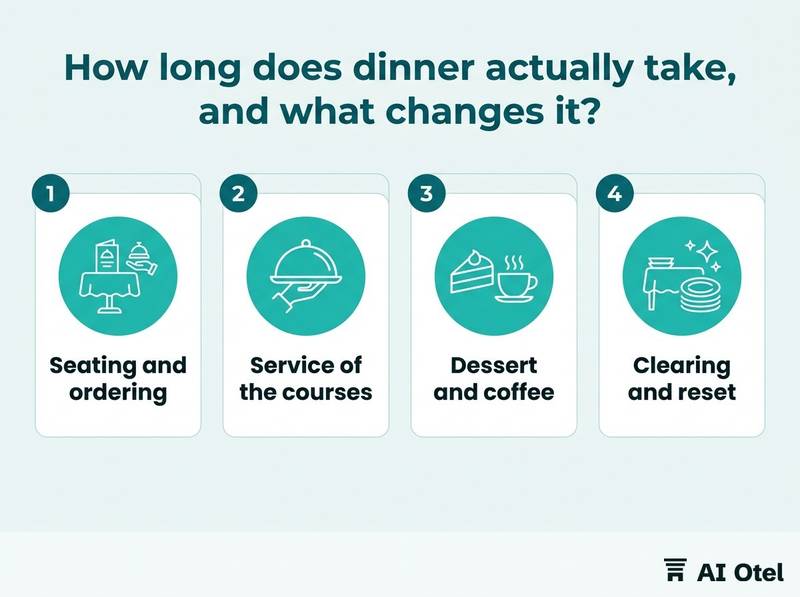
Split the time into four parts and give each an owner: seating and ordering, service of the courses, dessert and coffee, clearing and reset. What lengthens the stay: a set menu served course by course, live cooking queues, wine service, a large party, children who must be fed before the adults. What shortens it: a buffet taken in one pass, tables pre-set before service, a clearing team that works the room continuously instead of waiting for departures.
The kitchen runs on a separate clock. A table can sit for ninety minutes while the pass can only send a limited number of main courses in the first half hour; the queue then forms at the pass, not at the door.
Watch outThe kitchen sets the turn
Seating twice as many guests at once does not make the pass twice as fast; it doubles the wait at the table and moves the queue from the door to the plate.
Measure rather than assume. Record the seated time and the cleared time for a sample of tables across three different nights, including a busy one. The reset is part of the turn: a table that is cleared but not re-laid is not available, and the gap you published is already gone.
Can one seating serve every half-board guest?
Only when usable seats multiplied by turns per seat is at least the covers (guests to be fed) you expect in your busiest window. When the product is smaller, you need two seatings, a longer window or fewer covers promised at the peak.
The formula: capacity per evening = usable seats × turns per seat. Turns per seat is the length of the service window divided by the time one table occupies a seat, reset included. Compare against the peak, not the average: guests arrive in a curve, and the question is the busiest hour, not the whole evening. Do the sum for each night of the week. A Saturday and a Tuesday rarely produce the same answer, and a plan built on the average fails on the one night that matters.
Turns are not free. The second turn exists only if the first party leaves on time, the reset crew is on the floor and the kitchen can cook a second full wave. When the arithmetic fails, the options are two seatings, a longer window, a second outlet taking part of the demand, or a stated time limit on the half-board entitlement.
A worked example, for example: 120 rooms, 85 sold, about 1.7 guests per occupied room, so roughly 145 half-board guests. With 110 usable seats and a 90-minute turn in a three-hour window, the room can serve about 220 covers, which fits with margin. Sell 110 rooms at 1.9 guests instead and the same room sits at its limit, where one slow reset starts a queue.
Key pointThe one line to keep
Usable seats × turns per seat ≥ covers expected in the peak window. Everything else in the seating plan is a way of protecting that number.
How do you set the seating times and the gap between them?
Set the first seating early enough that the second wave is seated before the kitchen's late rush, and make the gap equal to the reset time you measured plus a margin.
Publish an arrival window rather than a table time: "between 18:30 and 19:15" is easier to hold than "19:00", and it spreads the queue. The gap has to cover clearing, re-laying the table and seating the next party, so it comes from your own measurement, not from the times a similar hotel uses. The second seating needs a real kitchen behind it: the pass must be ready to cook a second full wave, not finish what the first wave left.
Decide what happens to a guest who arrives after the last seating, and write it down before the season, not at the door at 21:15. Two waves mean two peaks for the kitchen, the dishwash and the clearing team; the rota has to show both. A buffet with one continuous window and a stated last-entry time is a legitimate alternative to two seatings, and it is simpler to staff; the same logic applies to buffet set-up and refills that hold at peak.
ChecklistBefore you publish the times
- The kitchen has confirmed it can send a second full wave
- Dishwash and clearing cover two peaks
- The reset crew works during service, not after it
- A written rule exists for late arrivals
- The times are in the booking confirmation and on the room card
- The host stand list matches the reservation system before service
- The à la carte outlet is either open as an alternative or clearly closed
Fixed tables, nightly reservations or open seating: which one?
Fixed tables suit a single seating and stable party sizes, nightly reservations suit two seatings, and open seating suits a buffet with a long window. The choice is a trade-off, not a matter of taste.
| Model | Works best when | The guest experiences | What it costs the hotel |
|---|---|---|---|
| Fixed table for the stay | one seating, stable party sizes | the same table every night, no decisions | breaks when a party changes size or the room is re-laid |
| Reservation per night | two seatings, mixed party sizes | a time they chose and a short wait | front-desk minutes and a no-show list to manage |
| Open seating with a host | buffet, long window | freedom to arrive when they like | a queue at peak and a host with authority to hold it |
Families need one written rule on children, such as an earlier window or a children's buffet at a set hour. Count high chairs as seats and prams as floor space, because both remove capacity from the plan.
Groups and tour series are a wave of their own. A party of forty needs a slot or a separate room, a time agreed with the group leader before arrival, and those covers taken out of the seats offered to other guests. A group of forty arriving unannounced at peak will break a plan that was correct on paper. Whichever model you choose, keep one table of record: the host stand list and the reservation system must agree before service starts. For the à la carte side of the house, the same fairness questions are covered in booking rules guests find fair.
What do you tell guests, and where?
Tell them three things before they book: whether dinner has set times, how to reserve one, and what happens if they arrive late. Then repeat the same three things in the confirmation, in the room and at the door.
The rate plan description comes first. If dinner runs in two waves, the board basis description says so, because that is the text the guest reads before paying. The booking confirmation carries one short paragraph: the window, the way to reserve, the late-arrival rule. A pre-arrival message a day before, with a link or a single instruction to reply, moves the queue from the door to the inbox.
In the room, a card with the times; at the door, a host with the list and the authority to solve a problem rather than only to refuse. Wording rules: state the window instead of a table time, say what the guest should do rather than what the hotel forbids, and always give one exception path, such as calling the front desk. Keep the same words everywhere. A guest who reads one rule at booking and hears another at the door will not believe either.
TipSample wording
For example: "Dinner is served in the main restaurant between 18:30 and 21:30. To keep a table free for every guest, we seat in two waves, 18:30 to 19:15 and 20:00 to 20:45. Tell us your preferred wave when you book, or at the front desk on arrival. If you arrive after 21:00, call the front desk and we will arrange something for you."
The evening itself starts earlier than the door: the ten-minute pre-service briefing before dinner is where the host stand list, the kitchen's wave plan and the late-arrival rule are confirmed as one version.
What do you check after the first week?
Check the arrival curve against the plan, the parties that missed their wave, and the time each table actually took, then change one thing at a time.
Look at covers per quarter hour against the plan, for each night, not for the week as a whole. Record parties moved, turned away or seated late, with the reason in a word or two. Count tables that were not reset inside the planned gap, counted by the host rather than estimated by the manager. Track late arrivals after the last seating, and what the team actually did at the door.
Ask the host and the kitchen separately; they see different failures, and the kitchen usually sees the queue first. Change one variable per week, the gap or the window or the rule, and write the version and the date on the plan so the team knows which one is current.
ChecklistWeekly review
- Covers per quarter hour against the plan
- Parties moved or turned away, and why
- Tables not reset within the gap
- Arrivals after the last seating
- Complaints at the door versus complaints at the desk
- The single change made this week, and its date
What to do next
Before the next rate plan goes out, count the usable seats in the main restaurant, measure how long a table really takes from seated to reset, and multiply. If the product is smaller than the covers you expect on your busiest night, choose the model, write the rule and put it in the confirmation. The seat count, the turn time and the wording are one decision seen from three sides: get the arithmetic right and the wording becomes easy, because you are describing something that actually works.
If you are planning this work at the level of the whole property, a hotel operating system that keeps restaurant sales, reservations and guest communication in one place makes the room list, the covers and the seating rule visible to the same team, and the platform overview shows how the pieces connect.
And if you are a traveler reading this rather than a hotelier, you can find a hotel in Türkiye (opens in a new tab) for your next trip.
Frequently asked questions
How many dinner sittings should a half-board hotel run?
There is no standard number. Work out usable seats multiplied by turns per seat and compare it with the covers you expect in the busiest hour; one seating is enough when the product is larger than the peak, and two are needed when it is not. A buffet with one long window and a stated last-entry time is a third option that avoids waves entirely.
Do half-board guests have to book dinner in advance?
That is the hotel's own rule, and either answer works if it is written down and told to the guest before arrival. Requiring a booking gives you the arrival curve and costs front-desk minutes; not requiring one means the host manages a queue. Whichever you choose, the rule belongs in the booking confirmation.
What should a hotel do when a guest misses their dinner seating?
Have a written answer before the season starts: hold a cold plate, keep the buffet open to a stated time, or seat the guest in the second wave if there is room. The guest should hear the same answer at booking, at the door and at the desk. The rule is the hotel's to set; what matters is that it exists and is published.
How should a tour group be handled in a half-board restaurant?
Treat the group as its own wave: give it a fixed slot or a separate room, agree the time with the group leader before arrival, and remove those covers from the seats offered to other guests. A group of forty arriving unannounced at peak will break a plan that was correct on paper.
Should children eat at the same seating as adults?
The hotel sets the rule. An earlier window or a children's buffet at a set hour shortens the family's stay at the table and frees seats at peak. Count high chairs as seats and prams as floor space, because both take capacity out of the room.