The restaurant pre-service briefing: ten minutes before breakfast, lunch and dinner
A pre-service briefing aligns the team before each meal. This guide provides a minute-by-minute structure, rules for handling allergen notes, and a simple log line to track changes.
AI draft · awaiting editorial review
Contents
Key takeaways
- Ten minutes standing up beats thirty minutes sitting down: the briefing exists to align the room, not to deliver information that could have been written down.
- Read the numbers out loud, covers expected, groups in house and the guests whose requests are already on file, because those three change how the room is worked.
- Say every allergen and diet note aloud and write it where the kitchen and the floor can both see it, with one named person who confirms it with the chef.
- Give each briefing one standard to practice, so the ten minutes change behavior rather than only informing it.
- Close with a log line: who led, what changed, what is still open, so the next briefing starts from what happened rather than from memory.
A pre-service briefing is a ten-minute stand-up meeting held before each service, in which the team hears the covers expected, the groups and guests with special needs, what the kitchen is out of, allergen and diet notes, station changes and one standard to practice. It ends with questions and one written log line.
At 06:50 the breakfast room is about to fill and the team has not yet been told that two items are out, that a group of forty is due at 07:30, or that one guest's diet note is already on file. Ten minutes earlier, all three could have been said out loud. This article gives you a running order for those ten minutes: what to read, who owns each part, how to handle allergen notes, and how a buffet briefing differs from a dinner one.
What is a restaurant pre-service briefing?
It is a short stand-up meeting held before each service, in which the room is told what it needs for that service and nothing else.
A full-service hotel restaurant holds three a day, before breakfast, before lunch and before dinner, because each service carries different numbers, different dishes and different guests. The team stands and meets in the room itself, near the pass, so the stations, the table plan and the buffet are in front of them while they listen.
The restaurant manager or headwaiter leads, the chef or sous-chef attends for the menu and allergen part, and everyone working that shift is present, including the host and the bartender where the bar serves the room. One person leads every time where possible, and arrives with the notes already written, because a briefing that is assembled in front of the team runs long and drifts.
It is not a training session, not a rota meeting and not a place to raise a disciplinary matter; those need their own time and would push the ten minutes past the first guest. It has three outputs: the room knows the numbers, the room knows the exceptions, and every open item has a named owner.
Key pointThe ten-minute rule
If the briefing needs longer than ten minutes, the extra content belongs on paper or in a separate meeting. The ten minutes are for what changes today, not for what is true every day.
How should the ten minutes be structured?
Give every minute a fixed slot and a named owner, so the briefing ends on time even when one item runs long.
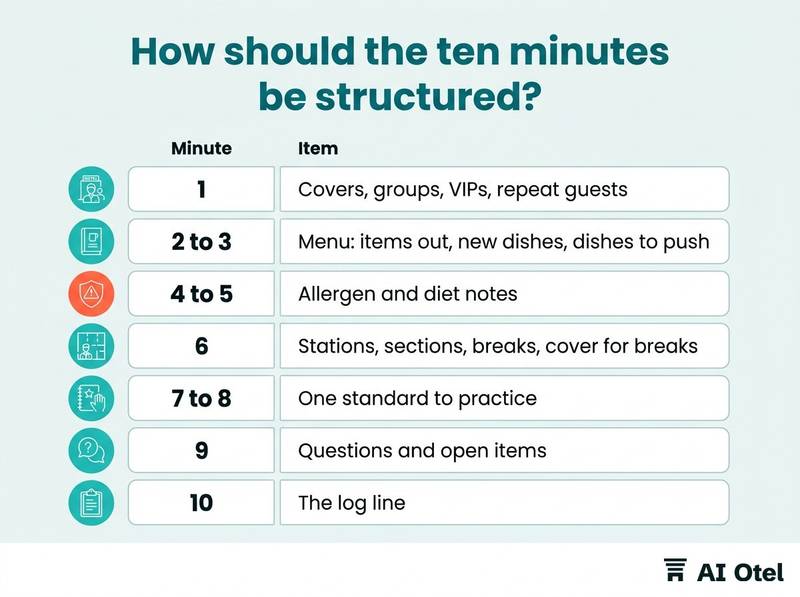
Numbers come first, because everything else is heard in the light of them: covers expected, groups, and the guests whose requests are already logged. The menu comes second: what is out, what is new, what the kitchen needs to sell, each with the exact words the guest will hear. Allergen and diet notes come third, read aloud with the guest's name and table or room, and confirmed by one named person before any order goes to the pass.
Stations, section assignments and breaks come fourth, so nobody leaves the briefing unsure where they stand or when they eat. One standard to practice comes fifth, demonstrated in a sentence or a single movement rather than described at length. Questions and the log line close it: two minutes for the team, then one written line before anyone walks away.
| Minute | Item | Owner | Output |
|---|---|---|---|
| 1 | Covers, groups, VIPs, repeat guests | Headwaiter | The room knows how the service is shaped |
| 2 to 3 | Menu: items out, new dishes, dishes to push, longer cooking times | Chef | The room knows what it can promise |
| 4 to 5 | Allergen and diet notes, read aloud with name and table | Chef with headwaiter | Each note has one named owner |
| 6 | Stations, sections, breaks, cover for breaks | Headwaiter | Everyone knows where they stand |
| 7 to 8 | One standard to practice | Headwaiter or chef | One behavior changes today |
| 9 | Questions and open items | Leader | Every open item has an owner |
| 10 | The log line | Leader | One written line before the doors open |
If a slot overruns, cut the next slot's detail, never its existence. A briefing that skips the allergen notes to save time has saved the wrong minute.
Which numbers should the team hear before service?
The numbers that change how the room works: covers expected, how they fall across the service, which groups are in house, and which guests already have something agreed.
Covers per sitting matter more than the day total. For example, a day of two hundred covers that arrives in forty minutes is a different day from the same two hundred spread over three hours. Groups need their size, arrival time, set menu or à la carte, one bill or many, and the name of the person who speaks for the group.
In-house guests on a package need what is included and what is chargeable, so nobody explains the bill twice at the table. VIPs and repeat guests need the name, the preference on file, and who greets them at the door. Special requests already logged, allergies, high chairs, a quiet table, a late arrival, a birthday the kitchen is expecting, all get read out. Walk-in expectation covers how many seats to hold back and who decides when to release them to the door.
The numbers come from the reservation system and the arrivals list, read the same morning, not remembered from yesterday. A hotel operating system that keeps reservations, groups and guest notes in one place is one way to have them ready to read; the briefing itself works whatever produces the list.
ChecklistRead out before every service
- Covers expected for this service and the next sitting
- Groups in house with arrival times
- Guests on a package and what it covers
- VIP and repeat guests with their preference on file
- Special requests already logged
- Seats held for walk-ins and who releases them
- Anything that changed since the previous service
How do you brief the menu, the items out and the dishes to push?
Say what is out first, then what is new, then what the kitchen needs to sell, because the first two change what the team is allowed to promise.
Items out need the reason in one line, the substitute the chef has approved, and who decided it. New dishes need the name, the main ingredients, how they are served, the price, and one sentence the guest will actually hear. Dishes to push need the item with stock or shelf life against it, with one honest reason the team can say aloud; a scripted sales line is heard as a sales line.
Pairings and extras need the exact wording for offering them, so the offer sounds the same from every station. Longer cooking times tonight need to be named, with how the team sets that expectation when the order is taken. Never say "we don't have" without an alternative, and never promise a dish the chef has not confirmed in the briefing.
The chef owns the menu content; the headwaiter owns the wording, because the wording is what reaches the table. The same discipline applies behind the bar, where measures and par stock are briefed rather than assumed: see beverage cost control in hotel bars.
How should allergen and diet notes be handled at the briefing?
Say them aloud, write them where the kitchen and the floor can both see them, and name one person who confirms each note with the chef before the order goes in.
Read the note as it was recorded, with the guest's name and table or room. "A gluten-free guest" is not information; "table 12, gluten-free, confirmed with the chef" is. Separate preference from medical need, because a guest who avoids meat by choice and a guest with a severe nut allergy are handled differently at the pass.
One owner per note: the headwaiter confirms with the chef, and the confirmation, not the assumption, is what the guest is told. On cross-contact, say honestly at the table what the kitchen can and cannot guarantee, rather than promising at the briefing what the line cannot deliver. Write the note where it is used, on the pass and on the table plan, not only in a folder in the office.
New team members learn here that the answer to a diet question is never a guess, and that "I will check with the chef" is a complete answer. Diet notes for children travel with the children's menu, so the same note reaches whoever takes that order: see the children's menu in a hotel restaurant. For menus and buffets that serve special diets without a separate kitchen, see gluten-free, vegan and diabetic guests.
Watch outNo note without an owner
Never end the briefing with an allergen or diet note that has no named owner. A note that was read aloud but not assigned is a note nobody owns by the time the order reaches the pass.
How does the briefing change for a breakfast buffet?
At a buffet the briefing moves from dishes to stations: what is filled when, who watches which counter, and where the queue will form.
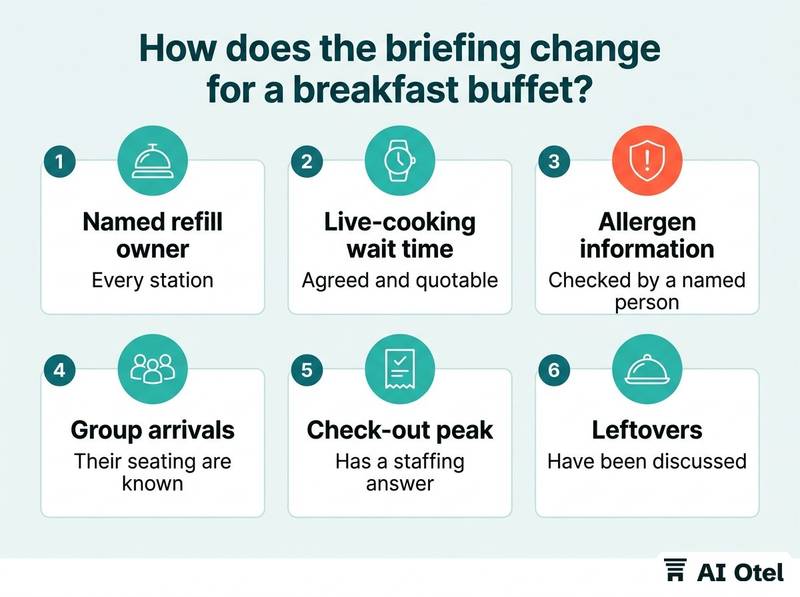
Covers are expected by half hour rather than by sitting, because a buffet is a flow and the room fills and empties in waves. Every station gets a named refill owner, and the trigger for calling a refill is an empty or low dish seen by that owner, not a clock. Live cooking needs what is cooked to order, the wait the team quotes at the counter, and who manages the queue when it builds.
Allergen information on the buffet itself is checked by a named person before the doors open, and must say the same thing as the note read out in the briefing. Seating and clearing need who seats, who clears, and how a group of forty is walked in without blocking the room for everyone behind them. The check-out peak, the half hour when the lobby and the buffet collide, needs a staffing answer: who is pulled from which station to cover it. What was left on the buffet at the end of the previous service changes today's quantities, and is discussed rather than rediscovered.
ChecklistBefore the doors open at a buffet
- Every station has a named refill owner
- Live-cooking wait time is agreed and quotable
- Allergen information on each dish has been checked by a named person
- The group arrivals and their seating are known
- The check-out peak has a staffing answer
- The previous service's leftovers have been discussed
- The queue plan for the live counter is clear
For the set-up itself, see hotel breakfast buffet: item list, set-up and refills that hold up at peak; for planning quantities from covers, see buffet food waste in all-inclusive hotels.
Who owns what, and how do you close the ten minutes?
Close by naming an owner for every open item and writing one log line, so the next briefing starts from what happened rather than from memory.
Stations and breaks need who covers which section, when each person breaks, and by name who covers that break. The one standard to practice is a single behavior for this service, such as how a plate is set down, how a dish is described, or how a complaint is passed up the line, practiced once rather than lectured. Questions come last, and they matter: a question asked at 07:20 costs less than the same question asked at 08:40 in front of a guest.
The log line is date, service, who led, what changed, what is still open, written before the room opens. Yesterday's open items open today's briefing, which is how a ten-minute meeting stays ten minutes while still carrying everything forward. Escalation, who the team tells when something goes wrong mid-service, is named at the briefing rather than discovered at the moment it is needed. What stays out: next week's rota, a disciplinary matter, and any training that needs more than a sentence.
What to do next
Pick one service tomorrow, write the running order on a card, and run the ten minutes standing in the room. Keep the log line for a week and read the previous one before each briefing. The briefing is not a meeting about service; it is the first minute of service, and the numbers, the menu exceptions, the allergen owners and the one standard all reach the guest through it.
Frequently asked questions
Should the briefing happen before or after the team meal?
Either works, provided it ends before the first guest arrives and never runs during the meal. Fix the same time and place for each service so the briefing becomes part of the shift rather than something that gets skipped when the room is busy. If the team eats together, brief first and eat second, so the notes are heard while people are still attentive.
Who leads the briefing when the restaurant manager is off?
A deputy named in advance, not chosen on the morning. The deputy uses the same running order and writes the same log line, so the content does not depend on who is standing at the front. The chef still owns the menu and allergen part whoever leads.
Do we need to write anything down for a ten-minute meeting?
One log line: date, service, who led, what changed, what is still open. It carries the briefing across shift changes and across days, and it shows what was said about an allergen or diet note and who owned it. Anything longer than a line belongs in a separate note, not in the briefing.
What should never be in a pre-service briefing?
Next week's rota, a disciplinary matter, long training, and any item that has no owner. Also anything that could have been written and read, because it uses the minutes the room needs for what changed today. Keep those for their own meeting and protect the ten minutes.