Live cooking stations at a hotel buffet: where they pay, what they need and how they are staffed
A live cooking station pays only when the dish is better fresh than held. This guide explains the space, power and staffing requirements, plus how to measure take-up and cost per portion.
AI draft · awaiting editorial review
Contents
Key takeaways
- A live station earns its place only when the dish is clearly better made to order than held on the buffet, so the decision is a trade between freshness and a cook's shift.
- One station means one cook for the whole service window and one named relief, because an unattended station is a closed station with a queue in front of it.
- Space, power, extraction and a hand-wash basin within the cook's reach decide whether a station can exist at all, before the menu does.
- Portion size set by the ladle, scoop or cup, not by the cook's judgment, is what keeps a queue moving and a plate costed.
- A station is retired on counts, not on opinion: take-up, queue length, cook-hours and cost per portion including labor.
A live cooking station is a buffet point where a cook finishes a dish to order. It pays where the dish is better fresh than held: eggs, gözleme, pide, grill or pasta. It needs its own space, power, extraction and hand-wash, one cook per station at peak, and a portion rule that keeps the queue short.
Picture an omelet station with a line at it, the cook stepped away to fetch bread, and the general manager at the door trying to work out whether the station is selling breakfast or costing it. This article gives you the decision tools that answer that question: which stations suit which service, what each one needs in space and services, how to staff and portion it, and how to run a trial week that tells you, in numbers, whether the station stays.
What does a live cooking station add to a buffet, and what does it take away?
It adds freshness, aroma and a short conversation with a cook, and it takes a trained cook's shift, floor space and a queue. Both sides are real, so the decision is a trade rather than an upgrade.
Define the thing precisely. A hotel live cooking station is a buffet point where the final step, frying, grilling, rolling or boiling, happens to order in front of the guest. The item is never held under a lamp. That single sentence separates a live station from a carving trolley or a heated buffet well, and everything else follows from it.
What it adds is concrete. The item arrives at its best temperature. The guest sees the craft and the hygiene. Allergen and dietary questions get answered by a person standing in front of the food, not by a card. And the portion is controlled at the moment of service. On the cost side, the item the station replaces is no longer batch-cooked and thrown away at the end of service, so waste on that one item usually falls.
What it takes is equally concrete: one trained cook for the full service window, floor area on the guest side for the queue and on the cook side for mise en place, power, extraction and a hand-wash basin, and a second pair of hands at peak. The station cook is not available for refills, clearing or prep, so the rest of the buffet needs its own staffing plan rather than borrowing the station cook.
The decision rule is simple. A station pays where the item degrades fast when held: eggs, gözleme, pide, grilled meat or fresh pasta. It does not pay where the item holds well: soups, stews, cold mezze or bread. And it does not rescue a buffet whose core items are poor. The station is a finishing point, not a substitute for a proper item list and refill rhythm, the kind covered in breakfast buffet set-up and refills that hold up at peak.
Which station should you open: eggs, gözleme, pide, grill or pasta?
Choose by throughput per cook and by what your kitchen already does well, not by what looks impressive in a video. The station that fits your prep capacity and your guest profile will always beat the one that photographs better.
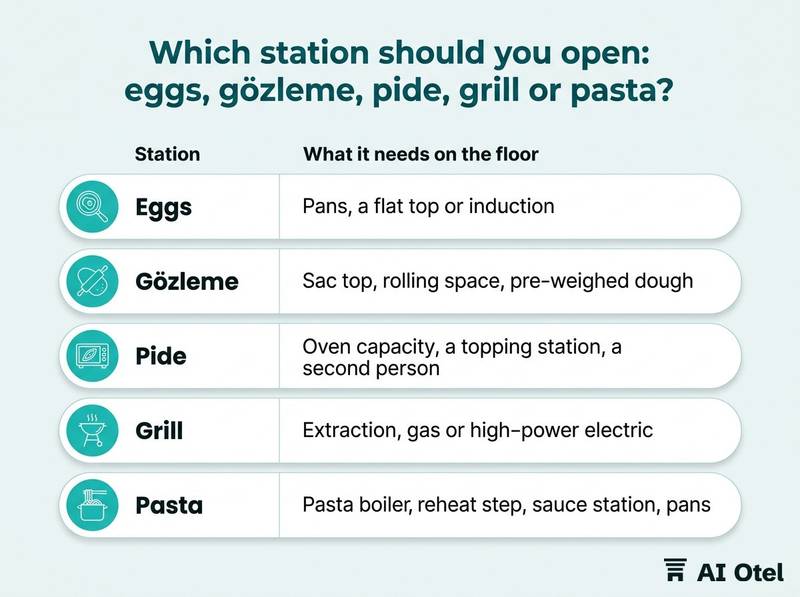
Eggs, whether fried, scrambled or as omelets, have the lowest equipment cost and the fastest portion per cook, with the widest appeal at breakfast. The limit is the number of pans and the cook's two hands, not the menu. Gözleme needs one sac top, one cook, a rolling pin and pre-weighed dough balls; the speed lives in the prep, so the station is only fast if the dough and the fillings are ready before service starts.
Pide is different: the oven sets the pace, not the cook, and a second person is needed for topping. Plan the queue around bake time rather than around how fast someone can shape dough. Grill makes the heaviest demand on extraction and ventilation, brings the strongest aroma and theater, and produces the slowest portion per cook; it suits dinner and pool-side service better than a short breakfast window. Pasta is fast if the pasta is par-cooked and finished in the pan with a sauce, and slow if it is cooked from dry to order. The boiling water and the reheat step decide which of the two you are running.
The rule that holds across all five: one station, one cook, one queue. Two half-stations run by one cook produce two queues and one unhappy cook. Treat the station's dishes as menu items with a cost and a take-up rather than as decoration, and review them the same way you review the rest of the buffet, using the approach in menu engineering for hotel restaurants.
| Station | What it needs on the floor | What it does well | Where it fails |
|---|---|---|---|
| Eggs | Pans, a flat top or induction, a cold well for eggs and fillings | Fastest portion, widest appeal | When one cook also refills the buffet |
| Gözleme | Sac top, rolling space, pre-weighed dough, cold filling trays | Strong aroma, local identity | When dough is rolled to order |
| Pide | Oven capacity, a topping station, a second person | High visual appeal at dinner | When the oven, not the cook, becomes the queue |
| Grill | Extraction, gas or high-power electric, a holding tray, a carving board | Theater and aroma | When extraction is undersized or the portion is large |
| Pasta | Pasta boiler, reheat step, sauce station, pans | Fast when par-cooked | When cooked from dry to order |
What does a live station need in space, power, extraction and hand-washing?
Each station needs a working island with a guest side and a cook side, its own power, extraction over any open flame or grill, and a hand-wash basin the cook can reach without leaving the station. These four decide whether a station can exist at all, before the menu does.
Design the island with two sides and one approach. Guests come from one side only, and the cook's side stays closed so the cook never turns their back on the food to serve. Mark a queue lane that does not cross the main buffet line, and draw it on the floor plan before the equipment is ordered. Moving a station after the power is in is a construction job.
Count the appliances first: induction, sac top, grill, pasta boiler, bain-marie, cold well. Give the list to your technical team and check the electrical and gas load before anything is ordered. Extraction and ventilation over grill and sac decide where the station can sit relative to the dining room; no menu decision survives a badly placed grill. This is one of the reasons to think about the station early in planning a hotel kitchen layout from delivery to the buffet.
Then the details that make the station workable day after day: a hand-wash basin within the cook's reach, a waste bin, a landing surface for the next guest's plate, and cold holding at the station for eggs, dough and meat, so the cook is not walking to the kitchen and back in the middle of a queue. The hotel's own food safety plan sets the cleaning schedule and the holding limits for raw and cooked items. Add lighting on the cooking surface and a readable sign naming the item and the expected wait, and place the station on the flow from kitchen to buffet rather than at the end of it, so supplies arrive without crossing the guest area.
ChecklistCheck these before the station opens
- Guest side and cook side separated
- Queue lane marked and clear of the buffet line
- Power and gas load checked with the technical team
- Extraction over every open flame and grill
- Hand-wash basin within the cook's reach
- Waste bin and plate landing space
- Cold holding at the station
- Lighting on the cooking surface
- Readable sign with item and wait
- Supply route from the kitchen that does not cross guests
How many cooks does a live station need, and who covers the break?
One cook per station for the whole service window, plus a named second person who can take over, because a station without a cook is a closed station with a queue in front of it.
The station cook is a position, not a task added to another position. If the same person also refills the buffet, both jobs fail at exactly the moment they matter. Name the relief cook on the schedule and train at least two people per station. Hand over mid-queue rather than at a gap, so the guest in front never notices.
Put prep behind the station. A prep cook or an early shift cracks eggs into cups, weighs dough, portions toppings and fills the cold wells, so the station cook only cooks. Staff to the arrival curve, not to the length of the service window: the second cook arrives before the rush, not during it. Set opening and closing times too, so the station opens when the first guest can be served and closes before the buffet closes, with the last order announced rather than discovered.
Brief five minutes before service on what is short, what is being promoted, and what the cook should say when an item runs out. And remember that the position has an hourly cost; the trial week is what turns that cost into a cost per portion you can compare.
Watch outThe station left unattended
A station whose cook steps away to fetch something is worse than no station at all: guests queue at food nobody is serving, and the food sits. Build the mise en place so the cook never has to leave the station during service, and write the relief into the schedule rather than into a promise.
How do you keep the queue short and the portion size right?
Cap the queue by capping the choice at the station, pre-portion everything the cook touches, and set portion size with a scoop or a ladle rather than with judgment.
Fewer choices means faster service. Two omelet fillings served quickly beat six served slowly, and the guest remembers the wait, not the list. Pre-portion the work: cracked eggs in cups, weighed dough balls, counted toppings, a fixed ladle for sauce. The cook assembles; the prep measures.
Write the portion rule on the station card and enforce it with the utensil. A bigger plate quietly becomes a bigger portion, so the plate size is part of the rule. Use a numbered ticket or a clear wait marker for pide and grill, so guests sit down instead of standing in a line that blocks the rest of the buffet. Add a second pair of hands at peak rather than a second station, because a second station splits the cook's attention and doubles the queue.
If the queue has nowhere to go, move the station. Speeding up the cook is the harder fix and usually the wrong one. And keep an eye on the refill side: the buffet items around the station still need their own refill rhythm, and a queue at the station hides an empty tray behind it.
TipSet the portion with the tool
Choose the ladle, scoop or cup that gives the portion you costed, and let the tool rather than the cook's mood decide. Then cost the plate from that same measure, so the recipe, the service and the food cost all describe the same portion.
How do you run a trial week and count whether the station earns its place?
Run the station for one full week at fixed hours, count five things every day, and compare that week with the week before on the same days.
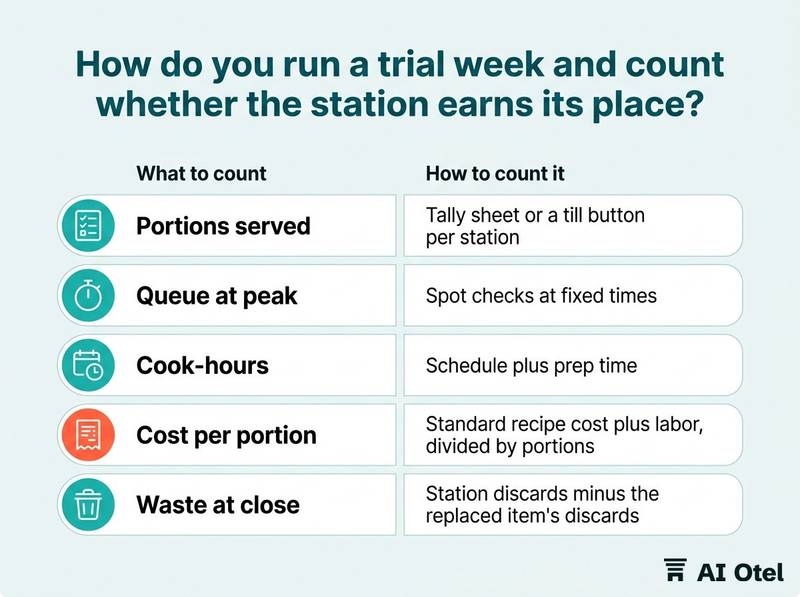
Count portions served with a tally sheet or a dedicated button on the restaurant till per station. That count is the take-up, and it is the first number anyone will ask for. Count the queue at fixed times, for example a spot check every fifteen minutes through the peak; three or four checks a day is enough to see the shape of the wait. Count cook-hours actually consumed, including prep, not just the service window. Prep is where live stations quietly become expensive.
Count cost per portion: the recipe cost from the standard recipe plus the labor hours divided by portions served, then compare it with the buffet item the station replaced. The method for the recipe side is the one in standard recipes and portion cost for hotel kitchens. Count waste at close too: what the station threw away, and what the replaced buffet item no longer throws away. The second number is the one that pays for the station.
Compare like with like: same days, same guest-count band, same menu. Note anything that changed, such as weather, a group in house or a themed night, so the comparison is honest. Then decide in a short meeting with the chef, the F&B manager and the cost controller, and write the decision and its date down so the next review has a baseline.
| What to count | How to count it | What it tells you |
|---|---|---|
| Portions served | Tally sheet or a till button per station | Take-up and the base for cost per portion |
| Queue at peak | Spot checks at fixed times | Whether the cook or the menu is the bottleneck |
| Cook-hours | Schedule plus prep time | The labor the station really consumes |
| Cost per portion | Standard recipe cost plus labor, divided by portions | Whether the station beats the item it replaced |
| Waste at close | Station discards minus the replaced item's discards | The saving that justifies the position |
If you run the counts in software, a hotel operating system, built and working ahead of launch, records restaurant sales, so the portions can be counted from the till rather than by hand, and the wider platform puts those numbers next to occupancy and guest counts on the same day. A tally sheet works too; what matters is that the count exists before opinions do.
When should you retire a live station?
Retire it when the counts show low take-up, a queue the cook cannot clear in the time guests will wait, or a cost per portion above the buffet item it replaced, and retire it on a date rather than by drift.
Signal one is take-up: the station sells less of its item than the buffet version did, week after week, on comparable days. Signal two is the queue: guests regularly wait longer than the cook can clear, which means the station is producing theater and frustration in the same motion. Signal three is cost per portion including labor: if the station loses to the alternative even after the waste saving is counted, it is a cost with a sign on it.
Retire in steps. Cut the hours first, then the days, then the station. A station that only earns its place at Sunday brunch should run at Sunday brunch. Keep the equipment and the trained cook, and move them to a themed night or a pool-side service rather than selling both and rebuilding later.
Tell guests what changed. A station that disappears without notice reads as a cut; a station that moves to weekends reads as a schedule. Review each season against the same counts, using the trial week's tally sheets as the baseline, so the decision stays a measurement rather than a memory.
Key pointThe retirement rule
A station stays only if it beats the buffet item it replaced on take-up and on cost per portion including labor, on comparable days, for a full season. If it fails one of the three signals for two reviews in a row, cut its hours, then its days, then the station itself, and record the date.
What to do next
Pick one station, write its portion rule and its relief cook into the schedule, and run the trial week with the five counts before you commit to a second station. The chain runs in one direction: choose the station by throughput, give it the space and services it needs, staff it as a position, control the queue with the portion, and let the counts decide whether it stays.
Frequently asked questions
Is a hotel live cooking station worth it in a city hotel with a short business breakfast?
It depends on how long guests actually sit and how concentrated arrivals are. A short, early business breakfast with a narrow peak favors one fast egg station or a pre-plated hot option, because the queue has no time to clear. A resort with a long, spread-out breakfast can carry slower stations such as pide or grill. Judge it on the arrival curve, not on the hotel's category.
Can one cook run two live stations at the same time?
Only if the two stations are physically adjacent and one of them is low-touch, such as a cold well or a self-service bread point. Two real cooking stations run by one cook produce two queues and one bottleneck, and the cook's attention, not the equipment, becomes the limit. Staff one cook per cooking station at peak.
Do live stations raise food cost?
They can raise the labor line and the per-portion cost while lowering waste on the item they replace. The honest comparison is cost per portion including labor against the buffet item the station replaced, with the waste saving counted in. Measure it over a full week on comparable days rather than on a single service.
What is the difference between show cooking and a live station?
The two terms are used loosely in the industry. In practice, show cooking describes the visible performance, and a live station describes the operating point where the final cooking step happens to order. A station can be one without the other: a quiet pasta point is a live station with no show, and a carving trolley is a show with no cooking to order.