Broken glasses and plates: a breakage log, a replacement rule and the restaurant order that follows
Stop emergency tableware orders by logging breaks at the station and counting stock monthly. This guide shows how to set par levels and reorder points to keep shelves full and costs clear.
AI draft · awaiting editorial review

Contents
Key takeaways
- A breakage log earns its keep only when it is filled at the moment of the break, at the station where the break happens, with a short closed list of causes.
- The monthly count, not the log, is the control: opening count plus deliveries minus closing count gives the items that actually left the shelf.
- Par stock is built from covers, pieces per cover, turns per service and the wash cycle; the reorder point is the usage during the supplier's lead time plus a buffer.
- Breakage shown as its own line in the outlet's cost report can be acted on; breakage buried in cost of sales cannot.
- Charging a staff member for what they break stops the reporting that makes the log worth keeping.
Breakage control is a written loop: every broken item is logged in one line at the stewarding station, the shelf is counted monthly, and the gap between counts and the log sets a par stock and a reorder point for each item. Orders follow that par, not the empty shelf. Hotel tableware breakage control is a procedure you can write on one page and run this week.
The shelf is empty on a Friday night, the banquet is at seven, and nobody can say where four dozen glasses went. The order goes out as an emergency at whatever price the supplier names, and the same thing happens next month. After reading this you will be able to put a working breakage log at the stewarding station, turn a monthly count into an order that restores par stock, and show breakage in the cost report as a line a manager can act on.
Why does breakage stay invisible until the shelf is empty?
Because nobody records it: a broken glass leaves the shelf, not the cost report, and the first signal is an empty shelf before service.
Breakage is neither a purchase nor a sale, so it has no natural place in the daily paperwork. At month end it is absorbed into the outlet's cost of sales, where it reads as a purchasing variance, and the purchasing manager spends a morning explaining a price difference that was never a price difference. The person who breaks the item, whether a steward, a waiter or a banquet porter, is not the person who buys it, and neither sees the other's numbers. No one owns the total.
Counting usually happens at the annual inventory. That delivers a year of breakage as one number with no cause, no outlet and no shift attached to it, which is a number you can neither explain nor fix. The emergency order that follows costs more per piece and often arrives in the wrong size or pattern, and that starts a second problem: mixed stock that stacks badly, sits badly in the rack and breaks faster than the stock it replaced.
There is also a control problem hiding inside the cost problem. Breakage, loss and theft look identical on a shelf, because all three are items that were there and are not now. Only a log separates them.
What a hotel can do before spending anything: put a sheet and a pen at the stewarding station today and start recording what leaves service. If the section itself is new to you, start with what stewarding is and why the section is rarely planned for.
What should a breakage log record?
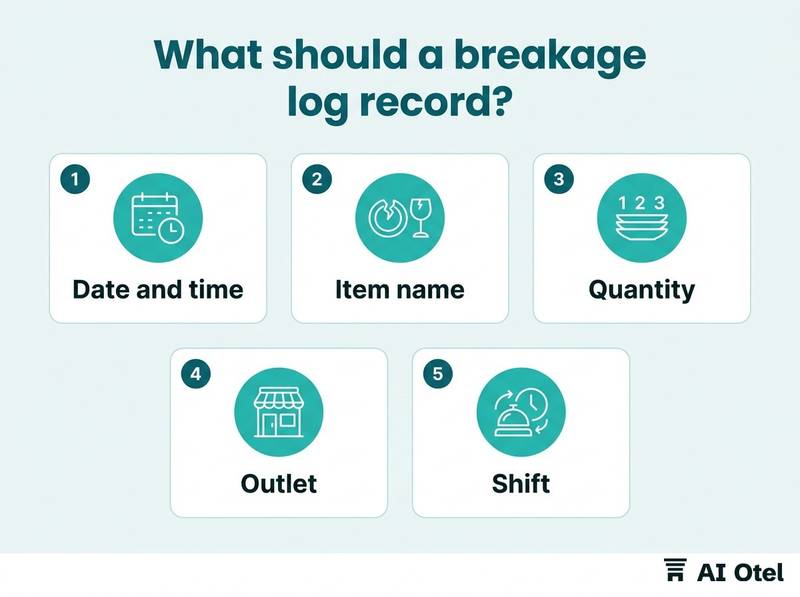
One line per break with five fields: item, quantity, outlet, shift and cause, plus the date and the initials of the person who logged it.
Keep the sheet at the stewarding station, on a clipboard or as a form in the hotel's system. A log kept in the office is filled from memory at the end of the shift, and the cause field becomes fiction. Item names must match the storeroom's names exactly, so the monthly total can be compared with deliveries without translation between two vocabularies. If the storeroom says "water glass 30 cl" and the sheet says "big glass", the two records cannot be reconciled.
The cause list stays short and closed: dropped in wash, chipped in rack, tray fall, banquet move, guest area, storage, unknown. Unknown is a valid entry and a useful one. Forcing a cause produces invented ones, and an invented cause is worse than no cause because it sends the fix in the wrong direction.
Log the event when it happens, one line per event, not a summary at the end of the shift. A summary loses the outlet and the shift, which are the two fields that point to a fix. The supervisor reads the sheet at the end of each shift and initials it, and does nothing else with it that day.
Ten seconds per line is the test. If a line takes longer to write, the sheet will be abandoned within a week. What the log cannot do is tell you what was stolen, and it should not be asked to.
ChecklistChecklist for the sheet at the stewarding station
- Date and time
- Item name, as the storeroom names it
- Quantity
- Outlet: restaurant, bar, banquet, pool, room service
- Shift
- Cause, from the closed list
- Initials of the person logging
Print the cause list at the top of the sheet: dropped in wash, chipped in rack, tray fall, banquet move, guest area, storage, unknown.
How do you turn a monthly count into a replacement order?
Count the shelf on a fixed day, add what arrived, subtract what is left, and compare the difference with the log; the order then restores par stock instead of replacing items one by one.
Count at the same time of day each month, before service and with the outlet closed. A count taken mid-service is a guess with a number written next to it. The arithmetic is simple: opening count plus deliveries minus closing count equals items gone. The log explains part of that number. The rest is unrecorded breakage, loss or a counting error, and it deserves a second count before anyone calls it theft.
The share of stock replaced is the hotel's own ratio: replacements in the month divided by the stock at the start. It is comparable month to month within one outlet and means nothing between hotels, so do not borrow a benchmark from anywhere.
Order to par, not to the break. If par is 240 and 190 are on the shelf, the order is 50, whatever the log says broke. Order the exact pattern, size and weight already in use; a different rim height or foot diameter breaks the racks, the stacking and the wash cycle the outlet was built around. File the count sheet with the month's log: the two together are the evidence behind the order and the only way to explain it later.
For example, one outlet's month might look like this. The numbers are illustrative, and the unexplained column is the gap the second count must resolve.
| Item | Par | Opening + deliveries | Closing | Logged | Unexplained | Order |
|---|---|---|---|---|---|---|
| Water glass 30 cl | 240 | 260 | 190 | 48 | 22 | 50 |
| Dinner plate 27 cm | 180 | 190 | 152 | 30 | 8 | 28 |
| Side plate 19 cm | 150 | 155 | 138 | 12 | 5 | 12 |
| Soup bowl | 120 | 125 | 108 | 14 | 3 | 12 |
| Tea glass | 300 | 315 | 260 | 46 | 9 | 40 |
The order column is par minus closing, not the log total. The log explains the gap; the par sets the order. If the ordering step itself is the weak point in your hotel, the wider procedure is covered in the purchasing and receiving process from order to storeroom.
Which causes repeat, and which fixes cost nothing?
Most breakage comes from a handful of habits: overloaded racks, nested glasses, overfilled trays and unsecured banquet moves. The fixes are written rules and a place to post them, not purchases.
Dishwasher racks fail in four ways: overloading, the wrong rack for the glass, glasses placed over the pegs instead of on them, and thermal shock from a cold glass going into a hot wash. Each has a one-line rule and a place on the wall above the machine. Stacking fails the same way everywhere: plates stacked higher than the rack allows, bowls stacked wet, glasses nested inside each other. The top item carries the load, the rim chips first, and the chip fails later, in the wash or in a guest's hand.
Trays fail through overloading, a missing non-slip mat and glasses carried by the rim. A tray limit written on the tray itself costs nothing. Banquet moves fail through trolleys loaded above the rail, plates carried stacked through a service door and no crates for glasses. The move is where a shift's breakage concentrates and the least supervised part of service, which is exactly why it needs a written rule rather than an assumption.
Guest areas produce their own breakage: glass by the pool, wind on the terrace, glasses left on the edge of a table. That rule belongs to the outlet, not to the steward who collects the pieces. In storage, the usual faults are heavy items on the top shelf, rims against a hard surface and no padding between stacks.
The log tells you which rule to write first: the cause with the most lines this month is the one to fix, and the next monthly count shows whether the rule held. Buffet formats raise the stakes further, as live cooking stations change plate and cover flow and put more pieces in motion per cover.
Watch outA chipped rim is the cheapest warning a hotel gets
Check rims at the pass and at the rack, and take a chipped item out of service immediately rather than sending it through the next wash. A chip that goes back into the wash becomes a break, and a chip that reaches a guest becomes an incident.
What is par stock for tableware, and where is the reorder point?
Par stock is the quantity an outlet needs to run a full service, cover the wash cycle and absorb a peak. The reorder point is the level at which an order must go out so it arrives before par is breached.
Build par from the outlet's own numbers: covers at a full service, times pieces per cover, times the number of times the item turns in one service, plus the wash cycle in progress, plus a buffer for the banquet peak. Pieces per cover is a decision, not a constant: a set menu uses fewer pieces than an à la carte service, and a buffet uses more plates than either.
The wash cycle is the number hotels forget. If a glass takes forty minutes from table back to shelf, the outlet needs a second set in circulation to keep the same covers served. The shelf is not the whole stock; the shelf plus the racks plus the tables is the whole stock.
The reorder point equals usage during the supplier's lead time plus a safety quantity for a late delivery or a banquet added at short notice. Count against par weekly for the twenty items that break most and monthly for the rest; the weekly count of the top items is what keeps the order from becoming an emergency. Par is set per outlet, not per hotel: the pool bar and the fine-dining room break different items and peak at different hours.
TipWrite the par and the reorder point on the item card
The order then comes from the card, not from a phone call at 18:00 before a banquet. Purchasing can act without calling the outlet, and the outlet does not learn about the order from the delivery.
If the request itself needs a form, what a purchase request form and a quote comparison sheet must hold is a separate decision, and it works best when par stock has already fixed the quantity.
How does breakage appear in the cost report?
By default it does not: breakage is absorbed into the outlet's cost of sales, where it reads as a purchasing variance and no manager can act on it.
A separate breakage line per outlet, fed by the monthly count, lets a manager see the cost, compare months and connect it to a cause. Timing has to be stated: the replacement order hits the month it arrives, not the month the item broke, so a count-based line and an invoice-based line will not match. Choose one basis and say which one the report uses.
Keep three categories apart: breakage, which is logged; unexplained, which is a count gap with no log line; and loss or theft, which is a control question, not a cost line. Merging them hides both the cost and the control failure. Breakage belongs to the department that uses the item, not to purchasing. Purchasing's number is price; the outlet's number is care.
The report should carry the share of stock replaced for the outlet, computed from the hotel's own counts, so the trend is visible without borrowing anyone else's benchmark. What the report should not do is rank staff by breakage. A ranking turns the log into a punishment and the cause field into "unknown", and the whole loop stops working. The wider context is covered in food and beverage cost control in hotels.
A hotel operating system built to hold the log, the counts and the outlet's cost lines in one place would let the monthly total reach the report without double entry. Where those pieces are designed to sit in one platform rather than in three binders, the count sheet and the log file themselves. The same design applies to a hotel operating system that keeps restaurant and bar sales in the same system as the rest of the business.
What to do next
Start with one sheet at the stewarding station this week, count the shelf on a fixed day next month, and set par and a reorder point for the ten items that break most. The log explains the break, the count proves it, and the par turns both into an ordinary order instead of a Friday-night emergency.
Frequently asked questions
Should the hotel charge a steward for the items he breaks?
No. Charging individuals stops the reporting the log depends on, and the cause field fills with "unknown". Handle repeated carelessness through training and supervision, and deliberate damage through the hotel's own disciplinary procedure with human resources and, where needed, legal advice.
How often should tableware be counted?
A full count per outlet once a month, at the same time of day and before service, plus a weekly spot count of the twenty items that break most. The weekly count is what keeps ordering ahead of the empty shelf; the monthly count is what feeds the cost report.
Is a paper sheet enough, or does the log have to be in the hotel system?
A paper sheet at the station is enough to start, and it is usually the version that survives a busy shift. What matters is that the monthly total reaches the cost report; a form inside the hotel's system removes the double entry and makes the total easier to keep.
How do you tell breakage from theft?
Not item by item. The unexplained gap, the difference between the count and the log, is the only signal, and it is a prompt for a second count and a control check rather than a conclusion. Locked storage, issue against signature and a count on return from a banquet are the controls that shrink the gap.
Does buying cheaper plates save money?
Only if they last as long in the same rack, the same wash and the same stacking. Compare cost per month in service or cost per cover served, not unit price, and keep the pattern, rim height and weight consistent so the racks and the wash cycle still fit.