Early-morning departures: the night before routine for a 4 a.m. airport transfer
A departure before breakfast is decided the evening before, not at 3 a.m. This guide sets out the night-before routine for settling bills, confirming transfers and preparing guests for a 4 a.m. airport transfer.
Contents
Key takeaways
- A departure before breakfast is decided the evening before, not at 3 a.m. at the desk.
- Settle the bill while the guest is awake and the minibar can still be checked; a closed account cannot collect a charge nobody verified.
- Every early transfer needs a named back-up car and a phone number, because a vehicle that does not arrive cannot be replaced in time.
- Two wake-up calls and a knock at the door are a routine; one call is a hope.
- A promise made at 18:00 is gone by 03:00 unless it is written in the night log.
The night-before routine is a fixed set of steps the evening team completes for every guest leaving before breakfast: settle the bill, confirm the transfer and a back-up car, set two wake-up calls, prepare a breakfast box, agree the key return and leave a written note for the night shift.
The car is at the door, the guest is in the lift, and the account is still open because nobody checked the minibar. None of that is a morning problem. It is an evening one. This article sets out a hotel early morning departure routine that starts at check-in and ends the moment the key comes back: what to ask, how to close the account, how to confirm the car, what to put in the box and what to leave on paper for the night team.
What should the front desk ask at check-in about an early flight?
Ask for the time the guest must leave the hotel, not the flight time, and write it into the reservation where the night shift will see it. The flight time is context; the pick-up time is the operational fact everything else hangs on.
Take the flight time, the airport and the terminal, then agree a pick-up time with the guest and read it back out loud. Ask who owns the transfer: a hotel arrangement and the guest's own arrangement carry different duties for the desk, and the difference should be clear before anyone sleeps. Ask how many people and how many bags, because a car that seats two passengers may not take four with luggage. If you are arranging airport transfers for hotel guests, the vehicle size follows from that answer.
Ask about the breakfast box and any dietary restriction at that moment, while the kitchen is open, not at 3 a.m. Record a mobile number for a fallback call, and the number of people in the room, so the night team knows who should be inside. Finally, ask whether the guest wants the account settled that evening, and say plainly what that involves.
ChecklistCheck-in questions for an early departure
- Flight time
- Airport and terminal
- Agreed pick-up time, read back
- Who owns the transfer
- Passengers and bags
- Breakfast box yes or no
- Dietary notes
- Mobile number
- Account settlement preference
- Number of people in the room
How do you settle a hotel bill the evening before an early departure?
Close the guest's account the evening before, with the guest present, and treat anything that arrives afterward as a separate, clearly explained addition. The guest is awake, the minibar can be checked and there is time to explain a line item without a car idling outside.
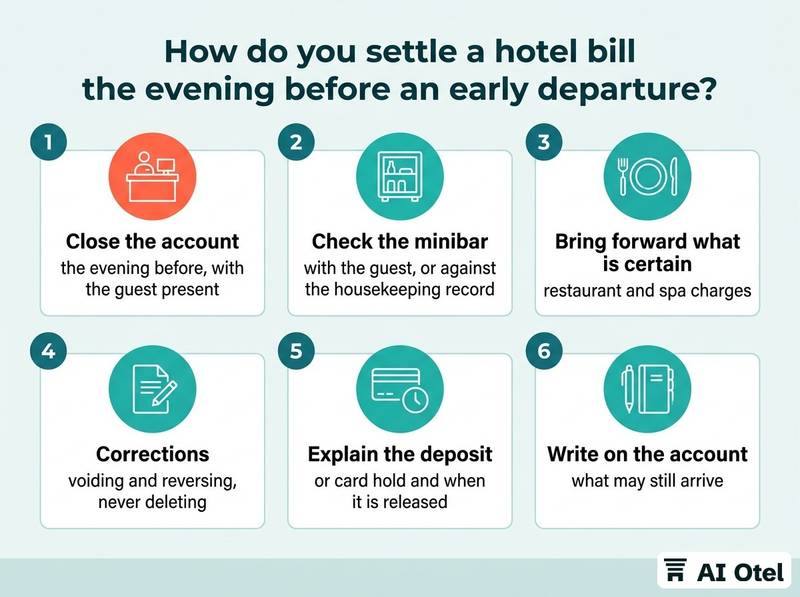
Check the minibar with the guest, or against the housekeeping record, before closing. A closed account cannot collect a charge nobody verified. Bring forward everything that is certain, such as restaurant and spa charges, and leave open only what genuinely cannot be known yet. Corrections are handled by voiding and reversing, never by deleting a line, so the guest sees a clean trail rather than a missing entry. For a fuller treatment of the bill under the door and the signed folio, see express checkout and the minibar check.
Explain the deposit or card hold and when it is released. The hotel's own written policy and the guest's bank decide the timing, so state the policy plainly instead of promising an hour. Hand over a copy, printed at the desk or sent by email, so the 4 a.m. desk is not re-explaining line items to a guest with a car waiting. A settled account can also be visible to the guest in a hotel's own guest app, which reduces the questions the night desk has to answer. Write on the account what may still arrive: a late minibar charge, a phone call, a transfer paid at the desk.
Watch outAn account closed in a hurry reopens in a worse hurry
An account closed at 22:00 without a minibar check reopens at 03:40, in a rush, with the car already outside. The minibar check is the one step that cannot be done after the guest leaves the room.
How do you confirm an airport transfer for a 4 a.m. pick-up?
Confirm it in writing the evening before, with a named driver, a named vehicle and a second car that can be called if the first does not arrive. A 4 a.m. failure has no recovery time; the back-up is the whole safety margin.
The pick-up time is the hotel's decision with the guest: drive time plus a buffer the hotel sets and describes as a buffer, never as an airport rule. Name the driver and the vehicle, and give the guest a number to call if the car is not there. Hold a back-up: a second provider, a partner's spare vehicle or the hotel's own car, recorded in the same place as the first. Decide who is paid and how before the morning: on the account, or to the driver, agreed and written the night before.
Write the late-guest rule: how long the car waits, who calls the room, and when it leaves without the guest. When the guest arranged the transfer themselves, the hotel's duty is the wake-up call and a lit lobby, not the car. Say so at check-in so nobody assumes otherwise.
| What is confirmed | What the record must show | Where the guest sees it |
|---|---|---|
| Pick-up time | Time, room, initials of who agreed it | Written confirmation or app screen |
| Driver and vehicle | Name, plate, phone | The confirmation message |
| Back-up car | Provider and phone, second line | Mentioned in the confirmation |
| Payment | On the account or to the driver, amount and method | Stated in the confirmation |
| Late-guest rule | Waiting time and who calls the room | Explained at check-in |
Wake-up call: how many, and what happens if nobody answers?
Two calls, the second a short interval after the first, and a person at the door if neither is answered. Log the times against the room in the system, not on a note at the desk that the next shift may never read.
The second call catches the guest who silenced the first and went back to sleep, which is the common failure. If neither call is answered, send a staff member to knock; the occupancy record tells them who should be inside. The call is made by a person or by a system the hotel has tested, and the guest's own phone alarm is a fallback, never the plan. Say what the call contains: the guest's name, the current time, the pick-up time, and a request to confirm. Agree at check-in that a guest who asks not to be disturbed still gets the second call when a car is booked. The wording and tone of the call itself follow the same standard as wake-up calls and messages at the front desk.
ChecklistWake-up escalation checklist
- Time logged against the room
- First call made and noted
- Second call made and noted
- Knock at the door
- Call to the mobile number
- Night manager informed
- Outcome written in the log
What goes in a breakfast box for an early departure?
Food that survives a car seat and can be eaten with one hand, packed sealed and labeled with the room number. The box is a service the kitchen can prepare the evening before; it is not a plate of breakfast carried to the lobby.
Leave out anything that needs a plate, a knife or heat: soup, eggs, an open pot of yogurt. Include a sealed drink, because a cup without a lid ends up on the car floor. Label the box with name, room and the dietary note already in the reservation. Pack it at a fixed hour the night shift can keep, and store it where it stays cold or stays dry, not on the lobby counter. Hand it over together with the key return, in a bag rather than on a tray. Decide whether it is included or charged, and say which at check-in, not at 4 a.m. For a longer treatment of contents, see what goes in a hotel breakfast or lunch box.
| In the box | Why it works on the road | Leave out |
|---|---|---|
| A sealed sandwich or wrap | Eaten with one hand, no cutlery | Anything that leaks |
| Whole fruit | Travels without a container | Cut fruit in an open tub |
| A sealed drink | No spill in a moving car | An open cup |
| Napkin and small cutlery set | For the guest who wants it later | A plate |
| A labeled bag | Identifies the room at handover | A tray |
What does the night shift need on paper?
One line per departing room, written by the evening team, carrying the time, the name, the transfer, the account status, the box and the key. A promise made at 18:00 is gone by 03:00 unless it is written in the night log the night team actually reads.
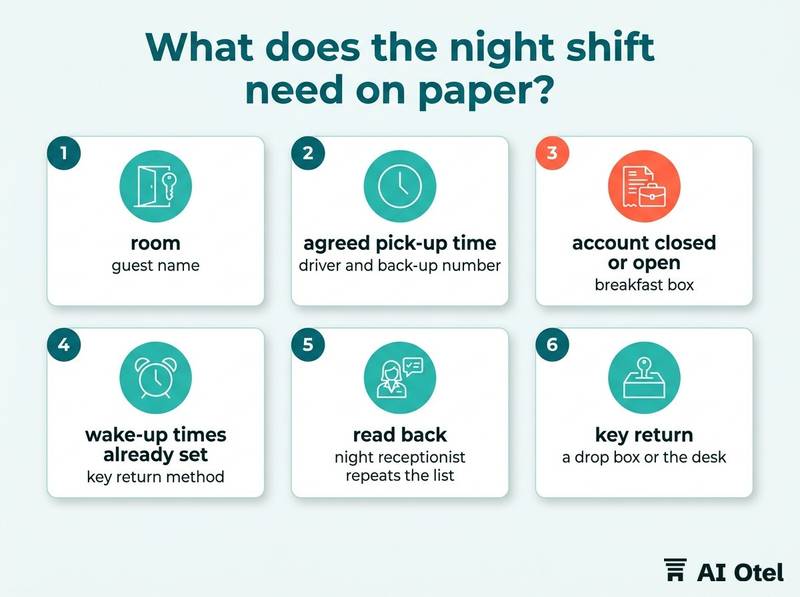
The line carries: room, guest name, agreed pick-up time, driver and back-up number, account closed or open, breakfast box, wake-up times already set, key return method. The handover is read back, not just passed over: the night receptionist repeats the list and asks about anything missing. This is one item in the wider discipline of the front desk shift handover checklist. Key return is a decision, not an accident: a drop box or the desk, and the deposit or hold closed at the same moment. Anything the evening team could not settle is named as open, with the name of the person who owns it.
Key pointOne line per room, never a paragraph
If a field is empty, it is a question for the evening team, not a gap for the night team to fill at 3 a.m.
After departure: how does the room get back to housekeeping?
Mark the room departed the moment the key is returned, so housekeeping can clean it before the morning rush rather than after it. Departure status is set at the desk when the key comes back, not when housekeeping next walks past the door.
Early rooms go to the top of the housekeeping list: they are the ones that can be prepared for an early arrival or sold again. Check for forgotten items before the room is stripped, while the guest may still be reachable. Close the account for good and send the final copy, so the file does not stay open on the next shift. Record the actual departure time against the planned one; the difference is the only honest measure of whether the routine worked. A hotel operating system that ties reservations, housekeeping and billing into one place, such as the one described on the AI Otel platform pages, is built so that these statuses move together instead of being typed into separate lists.
What to do next
Write the routine as one page tonight: the check-in questions, the evening account close, the transfer record with its back-up, the two calls and the knock, the box, and the night note. Then put that page in the night log and read it back at handover. Every step in it exists for the same reason: whatever can be decided while the guest is awake and the kitchen is open should never be left to 3 a.m.
If you are a traveler with an early flight rather than hotel staff, you can look for a hotel in Türkiye (opens in a new tab) and ask the desk these same questions when you book.
Frequently asked questions
Can a guest settle the bill at night and still keep the room until the morning?
Yes. Settling the account closes the bill, not the stay. The room stays occupied until the key is returned, so agree the actual leaving time, write it on the night note, and mark the room departed at the moment of key return.
Should the wake-up call be automatic or made by a person?
Either works if the time is logged against the room and the hotel has tested the method. What matters more is the second call and the knock at the door when nobody answers, and that the outcome is written down.
Who pays for the transfer if the flight is cancelled or the guest does not come down?
There is no single rule. The hotel's own written policy and its contract with the transfer provider decide, so the waiting time, the cancellation terms and who pays must be agreed at booking and repeated at check-in. Confirm the wording with the provider before it is promised to a guest.
Is the breakfast box included in the room rate?
The hotel decides and should say so at check-in. If it is charged, the charge belongs on the account closed the evening before, not on a bill opened again at 4 a.m.
What if a guest leaves without settling the account?
Follow the hotel's own written procedure: the card on file, the authorization the guest signed, and a record of what was explained at check-in. How the charge is then documented is a question for the hotel's accountant.