Electricity bill terms for hotel managers: kWh, kVA, demand, tariff band and sub-meter
Decode your hotel electricity bill by labeling each line as consumption, capacity, or tax. Learn how kWh, kVA, demand charges, and tariff bands affect costs.
AI draft · awaiting editorial review
Contents
Key takeaways
- kWh is energy, kW is the speed of the draw and kVA is the total the cables and the connection must carry, so a low-consumption month can still carry a high demand charge.
- A demand charge is set by the highest average draw in a fixed interval, so a few minutes of simultaneous equipment starts can cost more than hours of steady running.
- A tariff band is a priced period, not a discount: read the band prices printed on your own bill before moving laundry or pool filtration to the night.
- A sub-meter attributes consumption to a department but never reduces it; its value depends on the current transformer ratio and on readings taken on the same dates as the utility bill.
- Every line on the bill is consumption, capacity, or tax and finance; label it that way before anyone compares one month with another.
kWh measures energy used over time, kVA measures the apparent power the supply must carry, demand is the highest power drawn in a set interval, a tariff band is a priced period of the day, and a sub-meter splits the total between departments. Each term answers a different question about the same bill.
The bill arrives, the total is higher than last month, and the meeting spends forty minutes on that one number. The bill itself has twenty lines, and each line has a different owner. After reading these hotel electricity bill terms, you will be able to label every line, name the department that can change it, and turn the next meeting into three specific questions instead of one argument about the total.
What do kWh, kW and kVA actually measure?
kWh is energy consumed over a period, kW is the rate at which power is drawn at a moment, and kVA is the apparent power the supply has to carry, which is always at least the kW.
kWh is a quantity: a load of one kilowatt running for one hour. The meter accumulates it, and most consumption lines on the bill are priced on it. kW is a speed: the size of the draw at a given moment. A hotel's kW moves all day as chillers, dryers, lifts and kitchen equipment start and stop.
kVA is the total the cables, transformers and connection must be sized for. It contains the working power plus the reactive part that motors, transformers and ballasts need in order to operate. Power factor is the ratio between the two, working power divided by apparent power. A low ratio means the same useful work is pulling a larger apparent load through the supply.
Read them as three different questions: kWh answers how much did we use, kW answers how fast, and kVA answers how big does our connection have to be. If the kVA figure sits well above the kW figure on your bill, the reactive line deserves attention before anything else in this glossary.
| Term | What it measures | Unit shown on the bill | Who can change it |
|---|---|---|---|
| kWh | Energy over the reading period | Consumption lines | Department that runs the equipment |
| kW | Instantaneous draw | Demand register and demand line | Technical service, through scheduling |
| kVA | Apparent power, including the reactive part | Demand and reactive lines | Technical service and the electrical contractor |
| Power factor | Working power divided by apparent power | Reactive or power factor line | Technical service and the electrical contractor |
Why is there a demand charge when the kWh line is low?
Because demand is charged on the highest power drawn inside a fixed interval, not on the total energy, so one short peak can set the charge for the whole month.
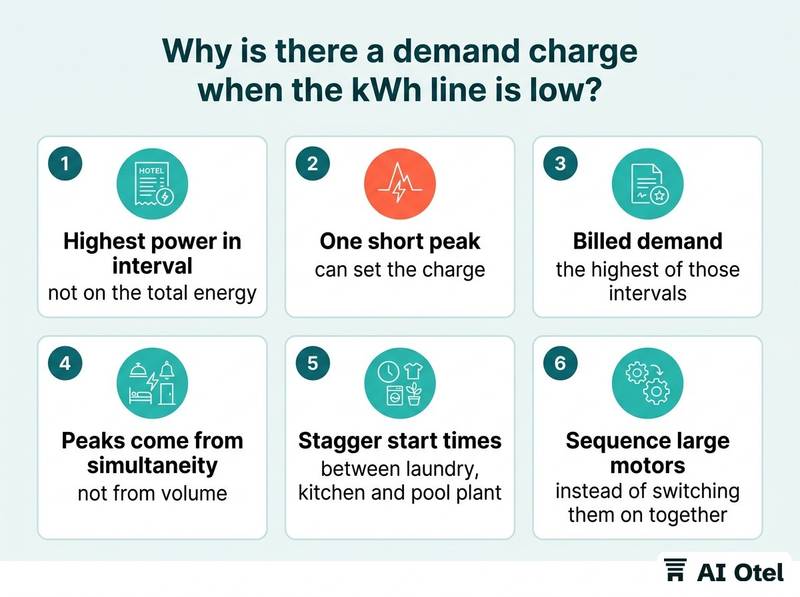
The meter records an average draw over a fixed interval, commonly something like fifteen or thirty minutes; your own bill or contract states the interval and the unit used. The billed demand is the highest of those intervals in the period. Some contracts also carry a peak forward into later months; check the wording of yours rather than assuming.
Peaks usually come from simultaneity, not from volume: laundry dryers, kitchen equipment, pool plant and chillers starting within the same window. To find the peak, read the demand line and the demand register on the meter, then match the date and time against the operations log for that morning.
You can lower it without capital. Stagger start times between laundry, kitchen and pool plant, sequence large motors instead of switching them on together, and fix thermostat setpoints so chillers do not all recover at once. Review the agreed contract power once a year against twelve months of demand readings. Cutting it below real peaks to save on the fixed line usually costs more than it saves, because the charge for exceeding the agreed level is higher.
Reactive power is a separate charge with its own mechanism and is covered in its own article on reactive power charges on a hotel electricity bill.
TipFinding the peak that set this month's demand charge
Note the demand figure and its unit on the bill. Read the maximum demand register on the meter. Then match the time against the shift log, the laundry schedule and the pool filtration timer.
What is a tariff band, and how does time of use change the bill?
A tariff band is a period of the day, and sometimes of the season or week, with its own price per kWh, so the same kilowatt-hour costs different amounts depending on when it is used.
Structures vary: a single rate, a day and night split, or three bands with a peak, a day and a night rate. The names and the hours are defined by your supplier, so read the definitions printed on your own bill. Each band appears as its own kWh line with its own price, and the split between bands tells you what share of consumption lands in the expensive one.
Flexible loads are the candidates for shifting: laundry, pool filtration, water heating, ice machines and equipment charging. Shift only what operations can genuinely absorb. Check the meter clock and calendar, too. A meter set to the wrong time or the wrong season bills consumption in the wrong band, and the error repeats every month until someone asks for a check.
Test the assumption that night is cheaper. Read the prices on the bill first; on some contracts the difference is small, and on others the night band carries its own conditions. A night shift costs supervision, staffing and sometimes comfort in the building. The saving has to cover that before it counts as a saving.
ChecklistBefore moving any load to another band
- Confirm the band hours and prices printed on your own bill
- Confirm the meter clock and season setting
- Confirm the load can run unattended or with existing staff
- Confirm the move does not create a new demand peak in the cheaper band
- Confirm the change is written into the department's schedule, not just agreed in the meeting
What can sub-meters tell a hotel that the main meter cannot?
A sub-meter splits the total into parts, so a department sees its own consumption and a change can be attributed to the equipment that caused it.
Useful points are the ones with their own owner and their own schedule: kitchen cold rooms and cooking, laundry, pool plant and water heating, chiller and boiler plant, guest room risers by floor or wing, outdoor lighting, spa. Check the installation before trusting the numbers: current transformer ratio, meter class, a labeled register and a reading date aligned with the utility bill. A mis-rated transformer produces confident, wrong figures.
Decide the allocation method in writing before the first internal invoice: which lines are split by sub-meter reading, which by occupied rooms, which stay in overhead. A sub-meter measures; it does not save. Its return comes from the decisions it makes possible, not from the device.
Keep the reading discipline simple: same day each month, photographed, entered in one sheet. Gaps destroy the comparison faster than any other mistake. Compare a department against its own baseline and against occupied rooms, never against another hotel, whose building, climate and equipment differ. Sub-meter data is also the input for a room-level review of controls and setpoints, which is a separate decision with its own cost, covered in energy management and room controls in hotels. The savings themselves come from what people do with the information, as in the hotel energy saving checklist by department.
NoteThe current transformer ratio
A sub-meter reads a scaled-down signal from a transformer clamped on the cable. The ratio of that transformer must match the meter's setting. A mismatch scales every reading by the same wrong factor, with no visible error on the display.
Which lines on the bill do managers skip?
The small, unfamiliar ones: standing or capacity charges, reactive power, taxes and funds, deposits and late-payment items, and the reading period itself.
The reading period comes first. Check the dates and whether the figure is an actual or an estimated reading; an estimate distorts every comparison made afterwards. The standing or capacity charge pays for the connection, not for consumption. It belongs in overhead and should be reviewed against real demand once a year.
The reactive or power factor line has its own cause and its own fix, and it is usually the least understood line on the page. Taxes, funds and surcharges follow the taxable base. Ask your accountant which lines they apply to and how they are calculated rather than guessing from the label.
Deposits, guarantees and late-payment items are cash-flow events, not consumption. Keep them out of any department comparison or they will explain a variance that never happened. Meter rent and connection fees are fixed; put them in overhead with the capacity charge so the departments are judged on what they control. The working rule: label every line as consumption, capacity, or tax and finance before anyone discusses savings.
Watch outDo not compare two months blindly
Confirm both reading dates and that neither figure is an estimated read first. A short or estimated period can make a flat month look like a spike and send a department chasing a problem it did not cause.
Which department owns which line on the bill?
Each line belongs to the department that can change it, and the purpose of the exercise is that the monthly meeting asks a named person a specific question.
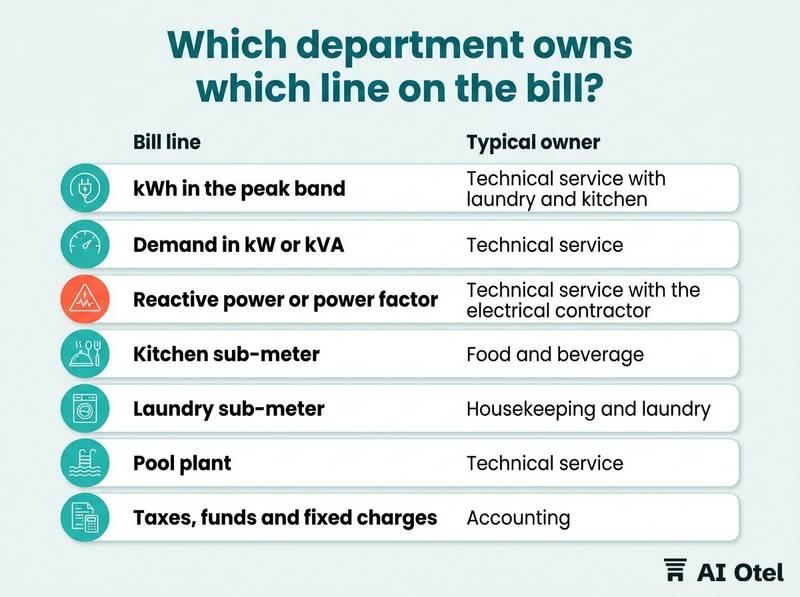
Assign one owner per line, not one owner for the bill. A single owner turns every discussion back into the total. Consumption lines go to the department that runs the equipment; capacity and reactive lines go to technical service with the electrical contractor; tax and finance lines go to accounting.
Write the question next to the owner, in the form the meeting can answer: what ran, what changed, what will we test next month. Where a line has no sub-meter, the owner is still named; the first question then becomes whether a sub-meter is worth installing there. Keep the assignment stable for a year, because reassigning owners every month produces no trend and no accountability.
| Bill line | Typical owner | Question to ask in the meeting |
|---|---|---|
| kWh in the peak band | Technical service with laundry and kitchen | What ran in the peak band that could move to another band? |
| Demand in kW or kVA | Technical service | What started at the same time and can be staggered? |
| Reactive power or power factor | Technical service with the electrical contractor | Which motors or ballasts are driving it? |
| Kitchen sub-meter | Food and beverage | What changed in cold room, cooking or dishwashing hours? |
| Laundry sub-meter | Housekeeping and laundry | How does the load track occupied rooms? |
| Pool plant | Technical service | Are filtration hours in the cheapest band? |
| Taxes, funds and fixed charges | Accounting | Is the base and the calculation correct? |
What does a monthly bill-reading routine look like?
A short routine on the same day each month, with the same steps in the same order, turns the bill from a payment into a management document.
Confirm the period and the reading type first, then check that sub-meter readings carry the same dates. Split the total into consumption, capacity, and tax and finance, and note the band split inside consumption. Compare with the previous month and the same month last year, adjusted for occupied rooms, and write the variance down before discussing causes.
Carry three questions to the operations meeting, each addressed to a named department, and record the answer next month. Keep one sheet per year so a trend is visible without reopening old bills, and photograph each meter reading as the evidence behind the sheet. Escalate any jump that has no operational explanation to the electrical contractor before the payment run, and treat it as a question rather than a conclusion.
ChecklistThe monthly routine, in order
- Reading dates and actual versus estimated confirmed
- Sub-meter readings taken on the same dates
- Total split into consumption, capacity, and tax and finance
- Band split noted
- Comparison with previous month and same month last year, adjusted for occupied rooms
- Three questions assigned to named departments
- Readings photographed and filed
- Unexplained jump escalated to the electrical contractor
What to do next
Take last month's bill, label every line as consumption, capacity, or tax and finance, and write the name of the department that can change each one beside it. That single page is what turns the next meeting from a discussion of one total into three specific questions with owners, and it is also the page that tells you whether a sub-meter, a schedule change or a contract review is the next thing worth doing.
Frequently asked questions
Why is the kVA figure on our bill higher than the kW figure?
Because kVA is apparent power and includes the reactive part that motors, transformers and ballasts need, while kW is only the working part. The gap is expressed as power factor, and a large gap means the reactive line is worth investigating with the electrical contractor.
Can a hotel install its own sub-meters?
Yes, as internal measurement behind the utility meter, installed and commissioned by a qualified electrician. The value depends on the current transformer ratio matching the meter setting, on a labeled register, and on readings taken on the same dates as the utility bill. A sub-meter measures consumption; it does not reduce it.
Does moving laundry to the night shift always reduce the bill?
No. It reduces the bill only if the night band is genuinely cheaper on your contract, if the move does not create a new demand peak inside the cheaper band, and if the extra supervision and staffing cost less than the difference. Read the band prices printed on your own bill before changing a schedule.
Who should attend the monthly bill meeting?
The general manager, the technical service head, the accounting lead, and the managers of the departments that own the largest consumption lines, usually kitchen, laundry and housekeeping. Each arrives with the question assigned to their line and the answer to last month's question.
What should a hotel check before signing a new electricity contract?
Twelve months of bills: the band split, the highest demand readings and their dates, the reactive line, and the agreed contract power against real peaks. The contract should be read for the demand interval, any carry-forward of peaks, and the charge for exceeding the agreed power, since these decide how much of the bill a manager can influence afterwards.