Guest messages on booking sites: who answers, how fast and what never to write
Assign a named owner per shift to answer booking site messages within your set target. Use templates for common questions and never share card numbers or identity documents in the thread.
AI draft · awaiting editorial review

Contents
Key takeaways
- A booking site message is answered by a named person on a named shift, not by whoever happens to notice it.
- The hotel sets its own reply-time target and measures the gap between the guest's message and the first human reply.
- A message thread is a record, not a booking: any change to dates, rooms or price must also be made in the reservation itself.
- Card numbers, identity documents and price promises never belong in a booking site message.
- A short weekly review of unanswered threads turns repeated questions into templates and roster changes.
Booking site guest messaging for hotels lands in each site's extranet, the private management area the site gives the hotel. One named person per shift answers against a target the hotel sets, using short templates for arrival time, parking, extra beds and payment, and never puts card numbers, identity documents or price promises in the thread.
For example, at 23:40 a guest writes through the booking site to ask whether the car park has a height limit. Nobody opens the extranet until the morning shift logs in, and by then the guest has parked elsewhere. The message was answered, just not in time. This article covers the whole loop: where messages arrive, who owns them shift by shift, how fast to reply, what a template should contain, what never to write, when to call instead, and how to review the inbox every week.
Where do guest messages on booking sites actually arrive?
They arrive in the extranet, the private management area each booking site gives the hotel, and that inbox is separate from the hotel's email, its phone and its property management system. The extranet is a login on the booking site where the hotel manages its listing, its rates, its availability and its messages with guests. By default it is not part of the hotel's own systems and does not feed the reservations mailbox, unless the hotel has connected a tool that pulls messages in.
Each booking site has its own inbox, so a hotel on three sites has three places to check, and none of them is the reservations mailbox. A guest who writes on two sites may get two different answers unless the team treats the inboxes as one queue. The same rules that work for a shared reservations mailbox, one owner and one record of what was said, apply here too.
Messages arrive at two different moments. Before a reservation, guests ask about location, parking and family rooms. After one, they ask about arrival time, late check-in, extra beds and invoices. The second group is more urgent, because the guest is already committed and often already traveling.
The thread is the record of what the hotel told the guest, which matters later in a dispute or a review. A phone call that leaves no note in the thread leaves no record. The inbox is not the reservation: a message that says "see you at 2 a.m." does not change the arrival time in the booking, and the front office will not see it there. Whoever answers a message must also change the reservation if the answer changes anything.
Decide who holds a login. Use named accounts where the site allows them, a shared one only where it does not, and keep a list of who has access somewhere the whole team can see.
Who should answer booking site messages, shift by shift?
One named person per shift owns the inbox, with a named backup, and whoever reads a message owns it until it is answered or handed over in writing. Name the owner by shift rather than by job title: morning, evening and night each need one person whose first task of the shift is to open the inboxes. Ownership by shift closes the gap that the hook described, the message that sat overnight because it belonged to nobody.
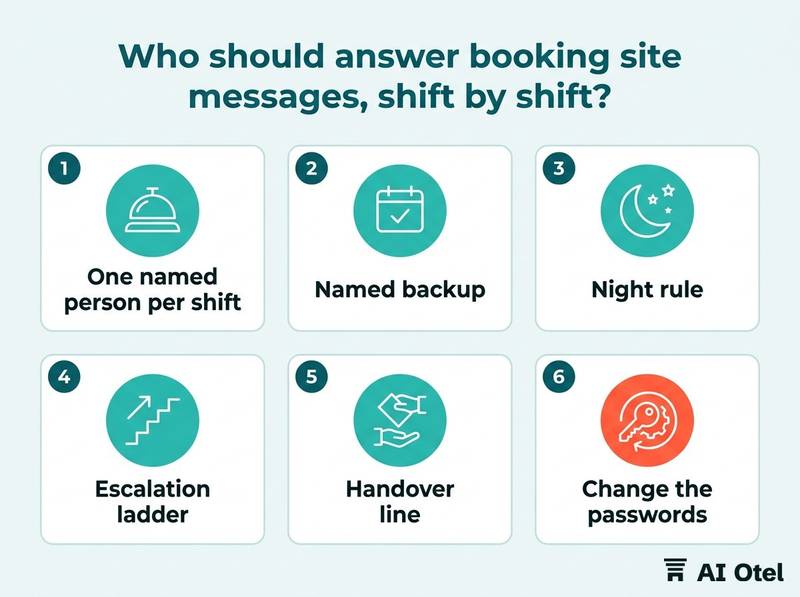
Give the night shift a written rule, because most arrival questions arrive after the reservations desk has gone home. The rule says what the night team may answer alone (parking, check-in time, address) and what waits for the morning (rates, complaints, anything involving money). Without a written rule, the night team either ignores the inbox or improvises promises.
Set an escalation ladder with three steps and no gaps: front office agent, then reservations supervisor, then duty manager. Each step has a trigger, such as a rate question, a complaint, a group request or anything involving money. Write a handover line at every shift change: how many threads are open, which ones are waiting on the guest, which ones are waiting on the hotel. Keep the reservation mailbox and the extranet inboxes under the same ownership, so a guest who writes to both does not get two different answers.
When someone leaves, change the passwords the same week and remove their access. A login that outlives the person is how messages go unanswered.
ChecklistOwnership checklist for the shift board
- The inbox owner for this shift is named
- The backup is named
- The night rule is posted
- Open threads counted at handover
- Threads waiting on the hotel listed
- Escalation contacts for rate, complaint and group requests written down
- Access list checked at the end of the month
How fast should a hotel reply to booking site messages?
The hotel sets its own target, writes it down and measures it, because whatever a booking site displays about reply speed is set by that site and can change without notice. Use two targets, not one: a first-reply target, where a human acknowledges the message, and a resolution target, where the question is actually answered. A fast acknowledgment of the wrong answer is not a resolution.
Set the first-reply target from the hotel's own pattern of questions. For example, within the hour during reception hours and by a stated time for anything that arrives overnight; that is an example each hotel adjusts to its own shifts and guest mix. The target comes from the inbox's history, not from a number a booking site publishes.
An auto-reply buys time only if it does three things: says when a person will answer, gives the one fact the guest most likely needs (check-in time, address, parking), and never pretends to be a person. The wording matters as much as the speed, and after-hours auto-replies that help instead of annoy are written, not bought. Measure the gap between the guest's message and the first human reply, not the gap to the auto-reply; the auto-reply is a holding message, not an answer.
Cover the languages the hotel actually receives. If the team cannot write in a guest's language, say which language the answer will come in and keep it short. Do not turn the target into a promise to the guest in writing; a target is an internal standard, and a missed promise is worse than a slow answer.
What should a booking site message template contain?
The answer, the next step and the hotel's name, in three or four lines, with the variable filled in by a person before sending. Build templates for the four questions that repeat most: arrival and check-in time, parking, extra bed or crib, and payment or invoice. These four are the ones worth writing first, because they repeat most often in a hotel's own inbox.
Every template keeps the booking reference, answers the question in the first line, and ends with one clear next step rather than an open invitation to write again. Templates are drafts, not automatic replies: a person reads the thread, checks the reservation and fills the variable before sending. Keep the template list where the whole shift can reach it, and date each entry so an outdated one can be spotted.
Write templates in the languages the hotel answers in, and keep the same facts in every language so two guests do not get two different answers. Review the list whenever the same new question appears three times in a week; that is the signal to add a template or a line on the hotel's own website.
Four templates worth writing first
| Guest question | The reply must contain | The reply must not contain |
|---|---|---|
| Arrival time | The actual check-in window, the late-arrival step, whether reception is staffed | A promise of early check-in housekeeping has not confirmed |
| Parking | The location, the height limit, the charge, whether it goes on the bill | A guaranteed space unless one is actually held |
| Extra bed or crib | Availability, the charge, that it is added to the guest bill | A room number or a free upgrade |
| Payment and invoice | Which card is taken, when, what document the guest receives | A request for card numbers, security codes or ID copies |
What should never go in a booking site message?
Card numbers, identity documents and any promise that changes the booking without changing the booking. Never ask for a full card number, a security code or a photograph of a card in a message thread; payment details belong in the booking site's own payment step or at the desk. Never send or request copies of passports or identity cards through the thread. In Türkiye, every stay involves a payment, a fiscal document, a guest identity notification (KBS) and personal data under KVKK, the personal data protection law, and a message inbox is the wrong place to move any of it. Confirm your own property's obligations with your accountant or legal adviser.
Never quote a room rate that differs from the confirmed reservation. If the hotel wants to offer something, it makes a new offer in the reservation, not a sentence in a chat. Never confirm a change of dates, room type or guest name in a message alone; the reservation must show it, or the front office will not know. Never promise a specific room number, a view or an upgrade that has not been blocked in the system.
Never write about another guest, and never forward an internal note into the thread by mistake; assume the guest will screenshot it. Never move the conversation to another channel purely to avoid the record. If the guest prefers a messaging app, as with WhatsApp messaging during the stay, keep the booking thread updated with what was agreed.
Watch outThe thread is a record
A message thread is a record the guest can keep and a booking site can read. Anything that changes money, dates or the room must be made in the reservation, and anything that identifies a person or a payment card must not be typed into the thread at all.
When should you call the guest instead of replying?
Call when the answer needs a decision, money or a safety judgment, and when the guest has already written twice without a resolution. Call when the request changes the booking: different dates, a different room type, a name change, a group block. These need the reservation changed anyway, and a call settles the details faster than three messages.
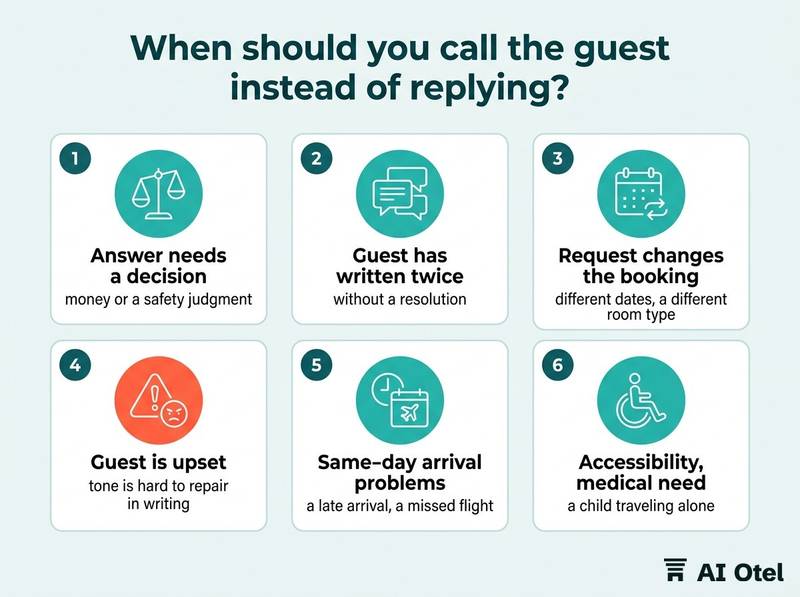
Call when the guest is upset, because tone is hard to repair in writing and a short call usually ends the thread. Call for same-day arrival problems: a late arrival, a missed flight, a request the hotel cannot meet tonight. Call when the message mentions accessibility, a medical need or a child traveling alone; these need a conversation and a written confirmation afterwards. Call when the guest's written language and the hotel's do not meet well enough to be sure of the answer, rather than sending a machine translation of a sensitive reply. The same judgment applies when turning phone, email and messaging inquiries into reservations: the channel follows the stakes, not the habit.
Whatever was agreed on the phone, write one line back into the thread the same shift, so the record exists and the next shift can see it.
How do you review unanswered messages every week?
Fifteen minutes a week, with the inbox owner and one manager, reading every thread that ended without a reply from the hotel and sorting them by how long they waited. Start from the oldest unanswered thread in each extranet, not from the newest; the newest messages are the ones everyone already looks at.
Count first replies that missed the target and note the hour they arrived; the pattern usually points at a shift, not at a person. Read the auto-reply as a guest would and check whether it still states the right check-in time and address. List questions that appeared three times or more and decide for each one: a template, a line on the hotel's own website, or a change at the desk.
Check threads that were answered but never closed, where the hotel asked for information and the guest replied and nobody followed up. Keep the review with the same owner as the inbox, and write the three actions for next week at the end of the meeting.
ChecklistWeekly review checklist
- Oldest unanswered thread in each extranet opened
- First replies over target counted
- The hours they arrived noted
- Auto-reply wording read and checked against current facts
- Questions repeated three or more times listed
- One action chosen for each repeated question
- Threads waiting on the guest listed
- Three actions for next week written down with an owner
What to do next
Write the rule down this week: name the inbox owner for each shift, set a first-reply target, and agree the four templates. Then run the first weekly review, because the review is what keeps the rule alive after the first quiet month. If the hotel's systems are part of the problem, a hotel operating system that keeps reservations, front desk and reporting in one place removes one source of mismatch between what the thread says and what the desk charges, and a distribution setup that feeds one room inventory to the hotel's own website, booking sites and travel agencies at once removes another. Both are worth understanding before the next high season.
Frequently asked questions
Should a hotel answer booking site messages in the guest's language?
Yes where someone on the shift can write it, and short is better than fluent. If nobody can, say in one line which language the answer will come in. Machine translation is fine for facts such as the address or the check-in time, and risky for complaints, money and anything a guest might quote back.
Can a hotel ask the guest to continue the conversation on WhatsApp?
It can be a convenience, especially after arrival, but the booking thread must keep the record of what was agreed. Ask the guest first, keep the consent, and never move a rate discussion off the booking site to avoid the record.
What should a hotel do when a guest asks for a discount in a booking site message?
The room rate lives in the reservation, so a discount is a new offer that has to be recorded as a new rate or a new booking. Never confirm a price in a message that the reservation does not show, because the front desk will charge what the system says.
Do auto-replies make the guest experience worse?
A good one buys time: it says when a person will answer and gives one useful fact. A bad one repeats the question back and promises a reply that does not come. Read the wording every week and change it when the check-in time or the address changes.
Who should hold the extranet login?
Named people, one per shift plus a backup, with a written list of who has access. Change passwords when someone leaves and review the list monthly. A login shared by everyone is a login nobody owns.