Guest safe deposit boxes at reception: key control, sealed envelopes and the claim form
Secure guest valuables with a two-person routine, sealed envelopes and a signed claim form. Learn how to log items, control keys and reconcile boxes monthly.
Contents
Key takeaways
- Two people, two keys: no box opens with one person present, and every opening is written into the key log at the moment it happens.
- The envelope is sealed in front of the guest and signed across the seal by both sides, and it is never opened afterward to check what is inside.
- The item log records the box number, the envelope number, the date and the staff member, and never a passport number, a card number or a priced inventory of jewelry.
- An item is released only to the guest who signed it in, after an identity check, with a second staff member present and both signatures on the release line.
- A monthly count of boxes against the log catches the two failures that matter: a box occupied with no entry, and a seal broken with no record.
A reception safe deposit box is a locked box at the front desk that holds a guest's valuables for a short period, opened under a two-person routine and recorded in a key log, an item log and a signed claim form. The hotel's written policy sets what it accepts and who may open the box.
A guest slides a passport, a watch and an envelope of cash across the desk and asks you to keep them until Friday. What happens in the next minute decides how the hotel is judged if anything goes missing. This article walks the whole routine: what the hotel controls, who holds the keys on each shift, how an item is sealed and logged, how it is released, and how to check the record against the cabinet once a month.
What is a reception safe deposit box, and what does the hotel actually control?
It is a numbered box behind the front desk, held under a written routine that covers acceptance, sealing, logging, release and unclaimed items. The hotel controls the routine and the record; the box is only the metal.
Separate it from the in-room safe. The in-room safe is used by the guest alone, while a reception box passes through staff hands, so every handover needs a record. If your property also manages room keys, the wider discipline is the same one described in key control in hotels: master keys, store keys and the key log.
The governing document is the hotel's own written policy. It should state what may be deposited (passports, cash, jewelry, documents), what is refused (perishables, unlawful items, anything too large for the box), the maximum holding period, and who is authorized to open a box. The policy should say in plain words what the hotel does and does not undertake, it should be visible to the guest at check-in or printed on the claim form, and its wording belongs with the hotel's insurer and legal adviser, especially on the question of whether a hotel is liable for guests' belongings.
Three records, not one: the key log (who holds which key, and when), the item log (what sits in which box), and the claim form (the guest's signature and the copy the guest takes away). Place the cabinet in a room with restricted access rather than in a drawer under the desk, anchor it, and keep box numbers out of sight from the lobby. Decide in advance what happens when a guest asks to deposit something the policy excludes, so the desk refuses politely instead of improvising.
Key pointThe principle
The box protects the item, the routine protects the hotel. Every deposit ends with three things in place: a sealed envelope, a log entry and a signed form.
Who holds the keys on each shift?
Two keys, two people: the hotel's key stays with the duty manager on shift, and the guest's key goes to the guest or stays sealed with the deposit, so no single person can open a box alone.
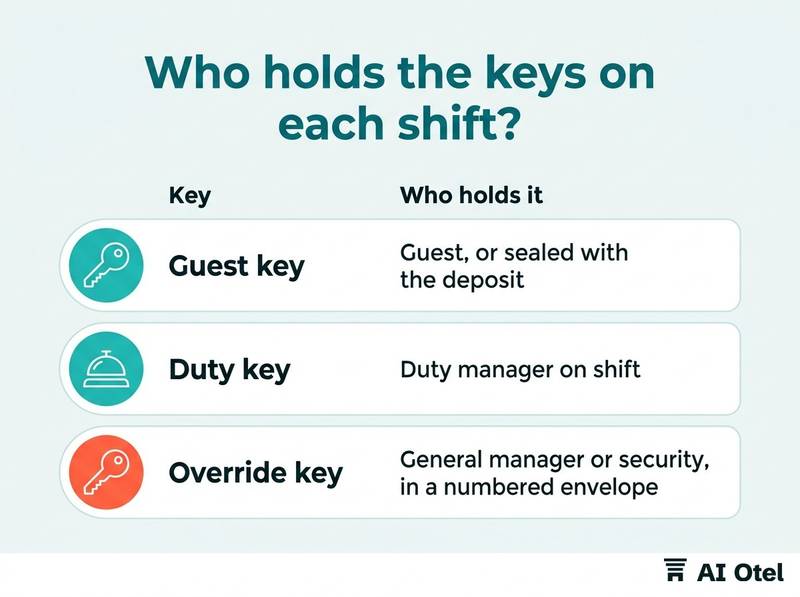
Where a box has two keys, one is handed to the guest and one is kept by the hotel. Where it has a single key, the hotel keeps it and the guest never holds it, and the box is opened only with staff present. The hotel key is signed out at the start of a shift and signed back at the end, with time and initials, so the log shows a continuous chain rather than a list of names.
The override or spare key is sealed in a numbered envelope signed across the seal and held by the general manager or security. A broken seal is an incident, recorded and reported the same day. At shift change the outgoing receptionist walks the incoming one through the boxes that are open, not just the log lines, and both initial the handover, the same discipline that keeps a front desk shift handover honest. When the key holder leaves the building, even for a break, the key returns to the log rather than to a pocket, a drawer or a colleague. When a staff member who held keys leaves the hotel, the affected boxes are re-keyed or replaced and the reason is written in the log.
| Key | Who holds it | Where it is signed | If it cannot be accounted for |
|---|---|---|---|
| Guest key | Guest, or sealed with the deposit | Claim form | Box opened only with staff present, event logged |
| Duty key | Duty manager on shift | Key log at shift start and end | Duty manager and security notified, box sealed until resolved |
| Override key | General manager or security, in a numbered sealed envelope | Key log plus the seal number | Seal replaced, incident written up the same day |
How do you receive an item: sealing, labeling and the guest's signature
In front of the guest: count it, describe it, seal it, sign across the seal, log it, and hand the guest a signed copy before they leave the desk.
Count cash in front of the guest and write the total on the form. The note numbers and the condition of the item are not the hotel's business to record. Describe the item in general terms, for example one passport, one ring and one envelope marked cash, rather than a valuation or a detailed inventory.
Seal everything in a numbered tamper-evident envelope, and have both the guest and the receptionist sign across the flap so that any later opening shows. Write the box number and the envelope number on the form and on the envelope, and make sure the same pair appears in the item log. The guest signs the claim form and takes a copy; the form states the holding period, how to collect, and what the guest must bring. If the guest wants to deposit something the policy excludes, offer the alternative the policy names and escalate to the duty manager rather than making an exception at the desk.
ChecklistDesk checklist, in order
- Count the cash and the items with the guest watching
- Describe each item in general terms on the form
- Seal in a numbered envelope
- Both sign across the seal
- Write box and envelope numbers on form, envelope and log
- Guest signs, guest takes a copy
- Place the envelope in the box with the guest present
What belongs in the log, and what never does?
The log records who, when, which box and which envelope. It never records anything that would let a reader identify the guest or put a price on the contents.
Write the date and time, the box number, the envelope number, the guest name and room number, a generic description, the receiving staff member, the guest's signature, and later the release entry. Keep the log as a bound book or a system record that cannot be edited silently. Corrections are struck through and initialled, never erased or rewritten.
The log holds personal data, so the policy sets who may read it, how long it is kept and how a guest can ask what is held about them. Treat the log and the claim form as two different documents: the log is the hotel's internal chain of custody, the form is the guest's receipt. Number the log pages and note the first and last entry of each month, so a missing page is visible rather than assumed.
| Write this | Never write this |
|---|---|
| Date and time, box and envelope numbers | Passport or identity number |
| Guest name and room, generic description | Card number |
| Receiving staff member, guest signature | Priced inventory of jewelry |
| Release time and second signature | Medical detail or a stated value |
How do you release an item, including when the key holder is away?
Only to the person who signed it in, after an identity check, with a second staff member present and both signatures on the release line.
Ask for the claim form copy, then check a photo identity document against the name on the form. A room key or a room number alone is not proof of anything, a point that also applies when checking who is asking before a key card or a safe is opened. Two people open the box: one opens, one witnesses, and both initial the release line with the time. The guest signs the release. If the guest cannot sign, the duty manager writes why on the form and signs it.
A colleague, a family member or a tour guide collecting on the guest's behalf needs a written authorization signed by the guest, confirmed with the guest on the number held in the reservation, and recorded on the form. If the key holder is away, two people open the sealed override envelope, write the seal number and the reason in the log, and re-seal and re-sign the envelope the same day. If the envelope number does not match or the guest says the box is not theirs, stop and call the duty manager. Do not open a second box to compare.
Watch outThe weakest point
A release with one signature and no identity check is the single weakest point in the whole routine, because it undoes a correct deposit in ten seconds.
What happens at checkout when the box is still full?
The night audit compares the open-box list with the departures list, and the desk contacts the guest before the room is closed.
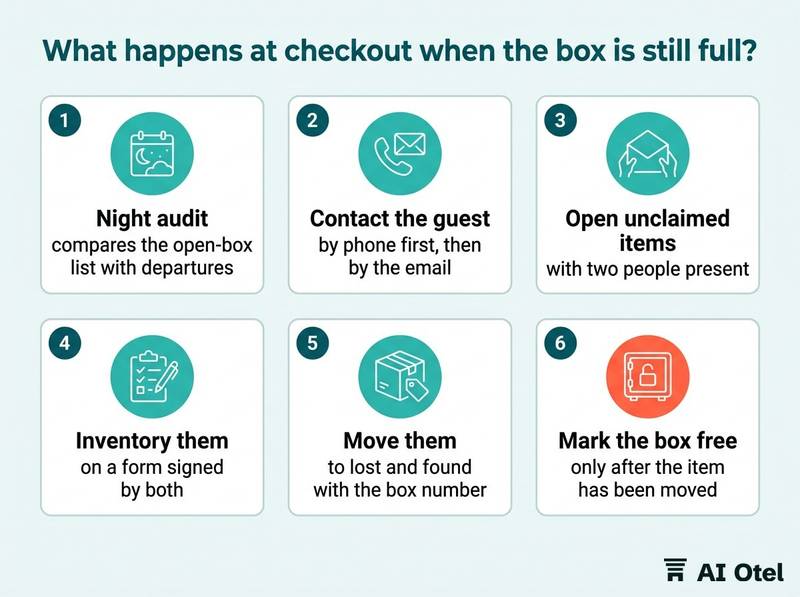
Build the check into the night audit: list every box with an open entry, cross-check it against departures, and flag any departure that still has a box. Contact the guest by phone first, then by the email or message held in the reservation, and write each attempt with its time and the person who made it.
If the guest has already left, the policy sets the holding period and the escalation path, from duty manager to the manager named for unclaimed items. Open unclaimed items with two people present, inventory them on a form signed by both, and move them to lost and found with the box number as a cross-reference, the same care that belongs in hotel luggage storage: tags, the log and bags left for weeks. Mark the box free in the log only after the item has been moved and the entry signed. A cleared box with no entry is the same failure as a full box with no entry. Never dispose of, sell or hand over an unclaimed item without a written decision from the manager the policy names.
How do you check the log against the boxes each month?
Open the cabinet, count the boxes, and match every occupied box to an open log entry. The mismatches are the whole point of the exercise.
Reconcile three numbers: boxes in the cabinet, boxes marked occupied, and open entries in the log. Investigate both directions, an occupied box with no entry and an entry with no item. Check the seals: guest envelopes intact, and the override envelope still carrying the seal number recorded in the log.
Read the claim forms for missing guest signatures, missing staff initials and missing release times, and correct the process rather than the paper. Read the key log for gaps: a shift with no sign-out, a key signed out and never signed back, an override seal replaced with no incident note. After any staff departure or lost key, confirm the affected boxes were re-keyed or replaced, and that the change is written down. Write the result on one page, signed and dated, and keep it. A check that leaves no record is a check nobody can rely on.
ChecklistMonthly reconciliation checklist
- Count boxes; count occupied boxes; count open log entries
- Match all three
- Inspect every seal; verify the override seal number
- Spot-check five claim forms for signatures and times
- Scan the key log for gaps
- Confirm re-keying after staff changes
- Sign and date the one-page result
What to do next
Write the one-page policy and the three records this week, then run the first monthly reconciliation before the next busy period, because the routine only holds if someone checks it. The pieces fit together in one order: the policy decides what is accepted, the two-key rule decides who can open a box, the seal and the log record what happened, and the monthly count proves the record still matches the cabinet. If you are rebuilding front desk routines from the ground up, a hotel operating system (built and working, ahead of launch) can hold the records and the audit trail in one place, and the wider platform covers the rest of the desk's daily flow. If you are reading this as a traveler rather than a hotelier, you can find a hotel in Türkiye (opens in a new tab) and ask at the desk how the safe deposit boxes are run.
Frequently asked questions
Should the guest keep one of the two safe deposit box keys?
It depends on the box type and on the hotel's own policy, and the answer must be the same for every guest. Where the guest holds a key, the hotel still keeps its own key and still opens the box only with staff present and a log entry. Where the box has a single key, the hotel keeps it and the guest receives a signed claim form instead.
Can a receptionist open a safe deposit box alone in an emergency?
The two-person rule exists precisely so that the answer is not decided at the moment of pressure. If the policy allows a single-person opening at all, it should name the circumstances, require the duty manager's written approval, and require the event to be logged and reviewed the next day. A box opened alone with no record is the case the hotel cannot defend.
Do we need a claim form when a guest leaves a passport for an hour?
Yes, and the shorter the hold the more useful the form is, because short holds are the ones done in a hurry. The form takes a minute, gives the guest a receipt, and records the envelope number that ties the item to a box. Without it, the desk has an item and no evidence of what was agreed.
What should the desk do if a guest says cash is missing from the box?
Stay calm, do not open anything else, and call the duty manager. The sealed envelope, the signatures across the seal and the log entry are the evidence, so they must be preserved exactly as they are and photographed before anything is opened. The guest's account is written down in their own words, and the next steps follow the hotel's policy and its insurer's instructions.
Is the hotel responsible if a safe deposit box is broken into?
That is a question of the hotel's own policy wording, its contract with the guest and the law that applies to it, so it belongs with the hotel's legal adviser and insurer rather than with the front desk. What the desk controls is the record: a sealed envelope, a signed form and a complete key log are what any later assessment will rest on.