How to read the AI Otel Core demo: a fictional hotel, what it shows and what it does not
The AI Otel Core demo runs on a fictional hotel, not a live customer system. Learn what an AI assistant can do inside it, what the software does not show, and which questions to ask before judging any hotel tech demo.
Contents
Key takeaways
- The demo runs on a fictional hotel: it shows the mechanism of a booking, not a customer's property and not a real room.
- An AI assistant can find, hold and book a room in the demo within limits the hotel sets, and every action sits in one of three safety tiers.
- The demo is built, not live: working software in a public environment, ahead of launch, not in customers' hands.
- What the demo cannot show is a trained model, a connected agency or your own hotel's results; the Hotel Brain is architected and entering training.
- Ask any demo two questions before you judge it: whose hotel is this, and which parts are live rather than built.
The AI Otel Core demo is a public environment built on a fictional hotel, where every hotel action is defined once and served to hotel teams, partner systems and the AI assistants people already use. An assistant can find, hold and book a room there within limits the hotel sets. It is built, not live.
A demo opens, an assistant finds a room, holds it, books it, and a confirmation appears on screen. The first question a hotelier usually asks is whose hotel this is. The answer tells you more about the software than anything that happened on screen. After reading this AI Otel Core demo explained article, you will know what the environment is, what an assistant can do inside it, and which questions to take into your next software demo, ours or anyone else's.
What is the AI Otel Core demo, and what is it not?
It is a public demo environment on a fictional property, where the shared core defines every hotel action once and serves it to three doors: the hotel team's screens, partner systems, and the AI assistants people already use. It is not a customer's hotel and not a live system.
In plain words, the shared core works like this. An action such as checking a rate, holding a room, confirming a booking or posting a charge is written once in the core. Each audience then reaches that same action through its own door, instead of through a separate integration built for each one. The hotel team gets screens, partners get a versioned booking interface, and assistants get the same definitions the hotel itself uses.
The demo exists so a hotelier or an institution can watch the whole path of a booking, from search to confirmation, without logging into a customer's system and without touching a real guest's record. That is its entire job. It is not a pilot, not a live hotel, not a sandbox where a demo booking becomes a real reservation, and not evidence of what the software does to occupancy or revenue.
The property is fictional for a simple reason: a real hotel's rates and guest records cannot be published. A made-up property lets the mechanism be shown while exposing nobody. The status is built, demo: working software in a public environment, ahead of launch, not in customers' hands.
Key pointWhat the demo is
The demo is a public environment on a fictional hotel where an assistant can find, hold and book a room within limits the hotel sets, and it is built, not live.
Draw the line where it matters. A demo can show that a hold expires and the room returns to inventory. It cannot show that your front desk will be faster next August.
The fictional hotel: whose data are you looking at?
You are looking at invented data on an invented property, running through real software. The property, its rooms and its rates are illustrative; the rules, the confirmation steps and the logging are the product.
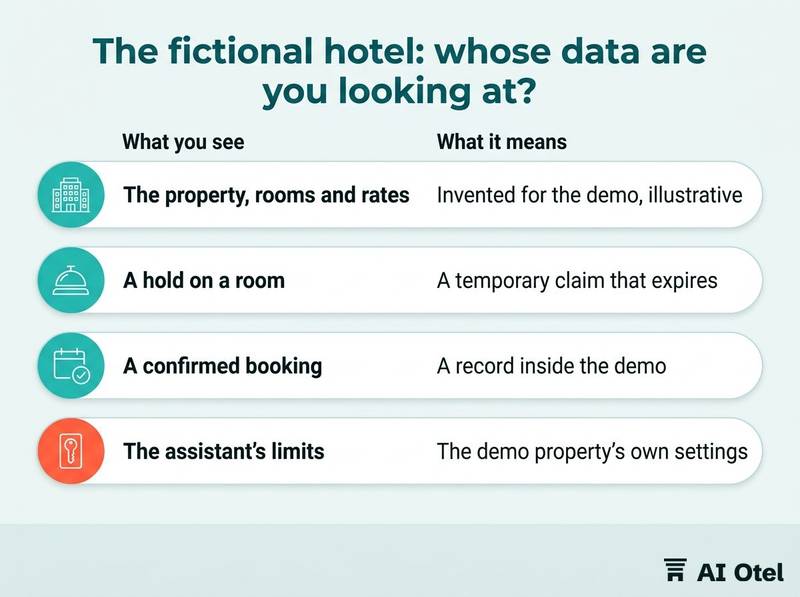
The distinction between configuration and code is the whole point of a demo. Which room types exist, what a hold costs and how long it lasts are settings a hotel chooses. Whether a change is logged, and whether a sensitive action needs a second person, are fixed in the software. When you watch a demo, you are watching both at once, and separating them is your job as the viewer.
The limits the assistant works within in the demo are the demo property's own settings: which room types, which dates, how many rooms, which price floor. These are the same kind of limits a real hotel would set for itself. The hotel keeps control of what may be sold and at what floor price.
A fictional property is also a forgiving one. It has no awkward group block, no overbooked Saturday and no guest who disputes a charge. Read the demo as a mechanism, not as a stress test. And a demo guest record is a placeholder: not a person, and not a copy of anyone's identity document or personal data.
Carry this question into any demo: which parts of what I just saw would I configure, and which parts would I have to accept as they are?
| What you see | What it means |
|---|---|
| The property, rooms and rates | Invented for the demo, illustrative; not a customer's hotel |
| A hold on a room | A temporary claim that expires and returns the room to inventory |
| A confirmed booking | A record inside the demo; no real room, payment or fiscal document behind it |
| The assistant's limits | The demo property's own settings, the same kind a hotel sets for itself |
What can an AI assistant do in the demo, and within which limits?
It can find what the property offers, prove who it is, hold a room, book it, and receive a signed message about what happened, all inside limits the hotel sets. It cannot step outside those limits or take a payment.
Each step has a mechanism worth watching:
- Find. The assistant reads what the property offers and at what rate, from the same definitions the hotel team uses, rather than from a document written for developers.
- Prove access. Partners and assistants connect through a versioned booking interface secured with OAuth. In plain words, OAuth is a standard way for a program to prove who it is without sharing a password.
- Hold. A hold is a temporary claim on a room with an expiry time. When it expires, the room returns to inventory. This is the mechanism that stops a hesitant assistant from blocking a sale.
- Book. A confirmed reservation inside the demo, inside the limits the hotel sets, so the hotel keeps control of what may be sold and at what floor price.
- Report. The partner receives signed booking events: a message it can check came from us and was not altered on the way.
- Confirm. Every action the assistant can take sits in one of three safety tiers. Some run directly, some need one person's confirmation, and the most sensitive need two.
- Log. Small changes apply automatically and are recorded; larger ones wait for a person; every change can be undone, except a message already sent to a guest. How those records work is covered in decision record and audit record: two records with two jobs.
ChecklistWhile the assistant books, watch for these five things
- Does the screen show the limits it is working inside?
- Does the hold visibly expire and the room come back?
- Is there a point where a person confirms?
- Is the action written into the record?
- Can the change be undone afterwards?
What does the demo not show?
It does not show a trained model, a connected agency, a live hotel, real money or your own results. Each of those is a separate status, and none of them is live.
No trained model. The Hotel Brain is architected and entering training, and we have no trained model yet. What runs today is the PMS assistant answering from a hotel's own data, and the decision engines around it.
No connected agency or travel partner. The distribution hub is built with seed data, and no agency is connected yet. The demo shows the mechanism of a quote, not a trading relationship.
No live hotel. The hotel operating system is built and working, ahead of launch. OtelCiro, the ecosystem's hotel growth and consultancy arm, works with paying hotel clients today, but the demo is not one of their systems.
No money and no fiscal document. Nothing is charged and no invoice is issued in the demo, so treat any amount on screen as an illustration. No hosting claim either: moving hosting and AI processing into Türkiye is on the roadmap, and until it is done we do not claim it. And no results: a demo cannot show what happened to a real hotel's occupancy, rate or front-desk workload, because it has not happened.
Watch outThree assumptions to leave at the door
The property is not a customer's hotel. A booking in the demo is not a real reservation. The assistant is not running on a trained model.
Built or live? Why the status word changes what you are watching
Built means working software ahead of launch; live means operating today in customers' hands. The demo is built, and within AI Otel's technology nothing is live.
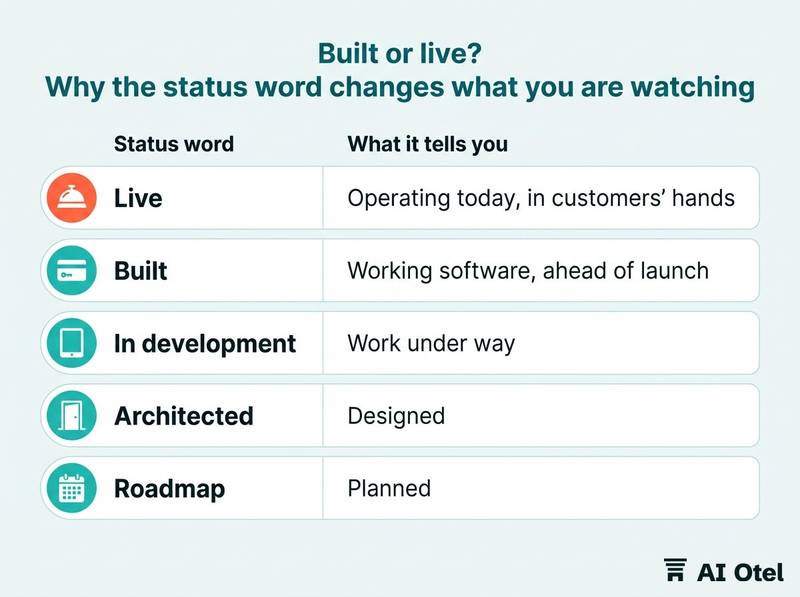
There are five status words, and a reader who does not hold them will read every demo as a launch. AI Otel Core builds every hotel action once; the hotel team, partners and the AI assistants people already use each get their own door, and it runs in a public demo environment on a fictional hotel. That is the built, demo status in one sentence.
| Status word | What it tells you | What it does not tell you |
|---|---|---|
| Live | Operating today, in customers' hands | Within AI Otel's technology, nothing carries it |
| Built | Working software, ahead of launch | Not that it has run a season |
| In development | Work under way | Not a date |
| Architected | Designed | Not code you can use |
| Roadmap | Planned | Not started |
Built does tell a buyer something real: the software exists, it runs, and the path you watched is the path that will run in a hotel. Built does not tell you that the software has survived a full season, a sold-out weekend, a system outage or a dispute over a bill.
Place OtelCiro correctly in this map. It is the ecosystem's hotel growth and consultancy arm, working with paying hotel clients today, and it is the only part of the ecosystem that carries the word live. The five words are defined in more depth in built or live? The five status words AI Otel uses.
Use this sentence in your next meeting: ask which parts of this are live and which are built, and ask for the answer in writing.
What should you ask when you watch any demo?
Ask whose hotel it is, what is configured and what is code, and what happens when the happy path fails. A demo that answers those three questions is worth an hour; one that avoids them is worth ten minutes.
Whose hotel is this, and is the data real, invented or a customer's with the names removed? Which parts of what I saw would I configure, and which would I have to accept as they are? What happens when the hold expires, when two assistants reach for the last room, and when a message has already gone to a guest? Which parts are live and which are built, asked separately for the booking path, the reporting and the compliance steps?
Bring your own scenarios rather than watching the vendor's, and score each one against a sheet you wrote before the call. A method for that is in how to run a hotel PMS demo with your own scenarios and a scoring sheet. Listen for relabeling too: a feature that existed under an old name and reappears as artificial intelligence without a mechanism behind it. How to spot that is covered in AI washing: telling a real feature from a new label.
Checklist
- Whose hotel is this?
- What is configured and what is code?
- What happens when the hold expires?
- What happens when two assistants want the last room?
- Which parts are live and which are built?
- What does this cost me if it is wrong?
What to do next
Watch the demo with three questions in hand: whose hotel it is, what is configured and what is code, and which parts are built rather than live. Then take the next step a demo cannot take for you: request a briefing, bring one real scenario from your own property, and ask us to walk through it on the demo hotel and say plainly where the software stops. Write to info@ai-otel.com, and if you want the wider picture the demo sits inside, read the Tourism Brain pages first.
Frequently asked questions
Is the hotel in the AI Otel Core demo a real hotel?
No. The property, its rooms and its rates are invented for the demo and are illustrative only. The software path you watch is the product; the hotel is not a customer's and the guest records are placeholders.
Can an AI assistant make a real booking in the demo?
It can find, hold and book a room on the demo property within limits the hotel sets, and the partner receives a signed message about what happened. The booking stays inside the demo environment: no real room, no payment taken, no fiscal document issued.
Does the demo prove the AI is trained?
No. The PMS assistant and the decision engines run today; the Hotel Brain is architected and entering training, and we have no trained model yet. A 30-case benchmark to choose models is built and not yet run, and results will be published when measured.
What does "built, demo" mean next to a feature?
It means working software, running in a public demo environment, ahead of launch and not in customers' hands. It is a different word from live, which means operating today in customers' hands; within AI Otel's technology nothing is live.
Can I see my own hotel's data in the demo?
The public demo runs on a fictional property, so it does not carry any hotel's real data. Bring one of your own scenarios to a briefing instead, and ask for it to be walked through on the demo property so you can judge how the software handles your case.