Instant confirmation or confirmation by hand: how AI Otel's distribution hub treats the two kinds of hotel
Instant confirmation and confirmation by hand are two settings on the same room inventory. This guide explains how AI Otel's distribution hub treats both modes, ensuring every quote shows its working and every request has a deadline.
AI draft · awaiting editorial review
Contents
Key takeaways
- Instant confirmation and confirmation by hand are two settings on the same room inventory, not two kinds of hotel.
- The hub is built so that one engine confirms instantly for connected hotels and routes requests to hotels that confirm by hand.
- A request that waits for a person needs a deadline, or the room sits unsold while the agency's client waits.
- Every quote shows its working whether the answer comes at once or after a person has looked: the hotel's net, each pricing rule that fired, the final price.
- The hub is built with seed data; no agency is connected yet.
Instant confirmation means the hotel lets the system confirm an agency booking within limits it sets. Confirmation by hand means each request waits for a person. AI Otel's distribution hub is built to serve both from one engine: instant for connected hotels, routed requests for hotels that confirm by hand. No agency is connected yet.
For example, an agency sends a request for two rooms next Friday. One hotel answers in seconds. Another answers the next morning, after the front desk has checked the group block. Both are normal. What matters is what the system does in between: whether the room is counted, whether a deadline exists, and whether anyone is accountable for the answer. This article explains instant or manual confirmation for hotel agency bookings in plain words, and what a hotel should decide before either mode goes live.
What is the difference between instant confirmation and confirmation by hand?
Instant confirmation means the hotel has given the system authority to accept an agency booking within limits it sets. Confirmation by hand means every request goes to a person at the hotel who accepts or declines it.
A request, often called "on request" in hotel sales, is a booking that is not yet confirmed: it depends on the hotel saying yes. You can read more about what on request means in hotels and how to answer in time. Instant confirmation is a yes given by the system inside rules the hotel wrote. The distinction is not about the hotel's size or its technology budget. It is about authority: who is allowed to say yes, and how fast.
In instant mode the hotel sets the limits. Which room types may be sold this way. Which date ranges. Which contracted rates each agency may see. How many rooms per booking. Minimum stay. Cut-off time, meaning how close to arrival the system may still confirm. Inside those limits, no person is involved. Outside them, nothing sells.
In manual mode the hotel keeps judgment on every booking. That suits groups, long stays, allotments, shoulder dates, and any rate the hotel does not want sold unattended. A group of thirty rooms at a negotiated rate in peak week is not the same decision as two rooms at a standard retail rate in November, and manual mode lets the hotel treat them differently.
Why a hotel would choose one over the other
The trade-off is speed against control. An agency selling to a traveler will usually take the faster answer, because its own client is waiting. If two hotels offer the same room at the same rate and one confirms in seconds, the agency has a reason to prefer it. Speed is a commercial feature.
Control is also a commercial feature. A wrong yes, an unattended sale of a room type the hotel wanted to hold for upgrades, or a negotiated rate sold on a blackout date, can cost more than a slow answer. Hotels that sell complex inventory, groups, allotments, event weeks, tend to keep more of their business manual.
Where the two modes meet on one property
Both modes can sit on the same property at the same time. A common split is instant confirmation for standard retail room types and confirmation by hand for everything else: suites, group blocks, long stays, negotiated corporate rates. The modes are settings on the same inventory, not a fork in the road.
Each mode has its own failure. Instant with limits set too wide sells rooms the hotel wanted to keep. Manual with no deadline loses the booking without anyone noticing, because the request sits open until the agency gives up and re-shops elsewhere.
Key pointIt is a commercial decision, not a technical one
The choice between instant and manual answers one question: what is this hotel willing to sell without a person looking at it? Everything else, limits, deadlines, who answers, follows from that answer.
What does the travel agency see in each case?
The agency sees a confirmed booking in one case and a request with a deadline in the other. What it must never see is silence.
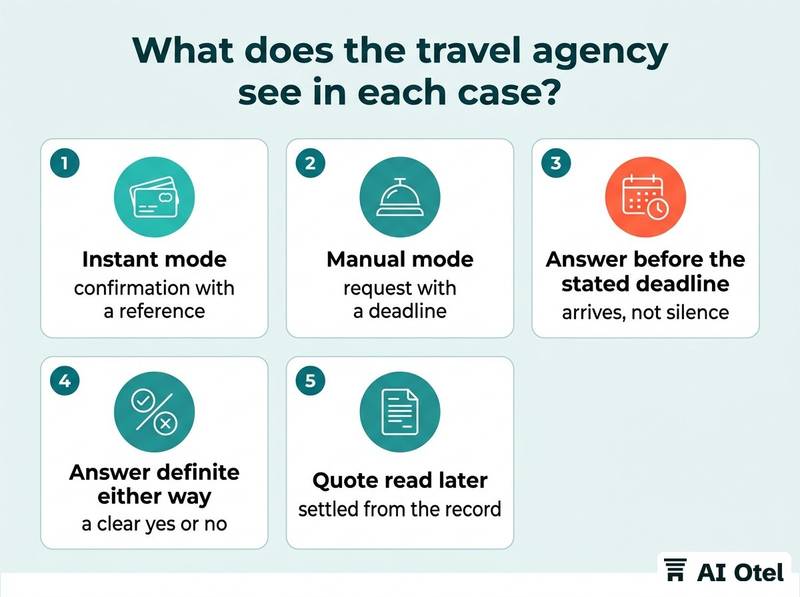
In instant mode, a confirmation comes back with a reference the agency can pass to its client straight away, and the room is taken out of the shared inventory at that moment. The agency does not need to call the hotel, and the hotel does not need to know the booking happened until it appears in the day's arrivals.
In manual mode, the agency sees that the request is open, when it expires, and then a clear yes or no before that time. A decline should be explicit and carry a reason category the agency can act on: rate not available, minimum stay not met, room type closed. A bare "no" gives the agency nothing to sell instead.
What a good request looks like from the agency side
The agency is not the end customer. It is carrying a traveler's expectation, and a slow answer pushes it to re-shop the same dates elsewhere. A good request flow, from the agency's side, has three properties: the answer arrives before the stated deadline, the answer is definite either way, and the quote behind it can be read later, so a question about the price can be settled from the record rather than from memory.
No agency is connected to the hub yet, so this describes what the hub is built to show, not what agencies have reported.
How does the hub treat a request that waits for a person?
It routes the request to the hotel that confirms by hand and keeps the answer tied to a deadline, so the room ends up either confirmed or released, never left in doubt.
Routing means the request lands with the hotel, and the hotel sees the same net and the same pricing rules that produced the quote the agency received. Both sides are looking at the same numbers, which removes a recurring argument in hotel-agency correspondence: what price was actually quoted, and how it was built.
The deadline is the hotel's to set, per channel and per season. When the response window passes, the request expires and the room returns to inventory. Without that expiry, the room is neither sold nor free.
Ownership matters as much as mechanics. One named person or one queue answers, with a named backup for nights and weekends, because requests do not arrive only in office hours. The record of the decision, who made it and when, is kept, so the agency's outcome and the hotel's reasoning can both be checked later.
Two rules protect the inventory itself. The room must be counted against the same inventory that feeds the hotel's own website and the booking sites, or the hotel can sell it twice while a request is open; this is the idea behind one room inventory feeding website, booking sites, agencies and AI assistants. And the request must never be answered by phone alone without updating the system, because the agency and the front desk would then hold different truths.
Who answers, and when
Decide this before the first request arrives, not after. The person who answers needs the authority to decline, not just to accept, and the response window needs to be written down where the agency can see it. A hotel that promises an answer within four hours and keeps that promise is easier to sell than one that promises an answer "soon".
Watch outAn open request with no deadline is the most expensive state in the flow
The room is neither sold nor free, the agency's client is waiting, and nobody at the hotel is accountable for the answer. Every request should carry its own expiry.
Why does the quote show its working in both cases?
Because the agency has to be able to check the price it was given, and the hotel has to be able to explain it weeks later.
A quote that shows its working has three visible parts: the hotel's net, each pricing rule that fired, and the final price. The confirmation mode changes who answers the request. It does not change how the price is built. The same three parts appear whether the answer is instant or by hand.
This matters most when something goes wrong. When an agency queries a rate in August about a booking made in March, the hotel can answer from the record instead of reconstructing the calculation from a contract PDF and a spreadsheet. Contracted rates are published by the hotel on its own terms, which keeps the commercial relationship between hotel and agency where it belongs. The design of the hub's quotes is covered in more detail in quotes that show their working.
A price nobody can explain is a dispute waiting for a busy week. The party that cannot explain it usually pays.
The three parts of a quote that shows its working
First, the hotel's net: the base price the hotel published for that agency. Second, each pricing rule that fired: for example, a seasonal adjustment, a minimum-stay condition, or a channel-specific rule, each shown with its effect. Third, the final price the agency pays. For example, a hotel might publish a net of 100 for a standard double in May, a shoulder-season rule might add 10, and the quote shows 100, the rule, and 110, with nothing hidden in between.
What is built, and what is not?
The two confirmation modes are built. The hub runs on seed data and no agency is connected yet.
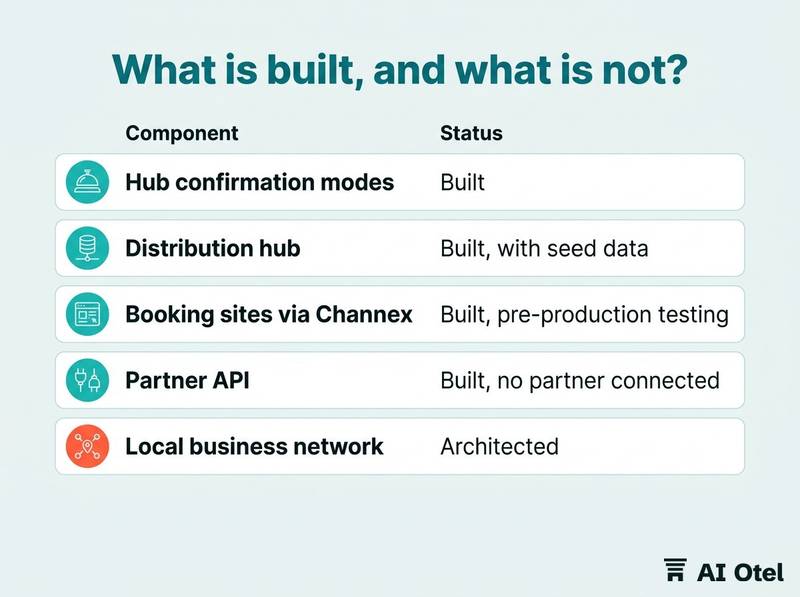
Built means working software ahead of launch, not software in customers' hands. AI Otel's distribution hub is built so that hotels publish contracted rates to travel agencies on their own terms, and every quote shows its working. One engine confirms instantly for connected hotels and routes requests to hotels that confirm by hand. It is built with seed data; no agency is connected yet.
| Component | Status | What it means for a hotel reading this |
|---|---|---|
| Hub confirmation modes (instant and by hand) | Built | The logic exists and works, ahead of launch |
| Distribution hub | Built, with seed data | Contracted rates published to agencies, every quote shows its working; no agency connected yet |
| Booking sites via Channex | Built, pre-production testing | Rates and availability flow to major booking sites, testing before go-live |
| Partner API | Built, no partner connected | Partners and AI assistants connect through a versioned, secured booking interface |
| Local business network | Architected | Designed; runs only in the demo environment |
Reading the status words correctly
"Built" describes software that works but is not yet in customers' hands. "Architected" describes a design, not running software outside a demo. The distribution hub is built with seed data, and no agency is connected yet. Availability and rates flow to the major booking sites through the Channex integration, which is in pre-production testing, and the partner API is built with no partner connected.
What should a hotel decide before it goes live?
Decide what you will sell without looking, who answers what you will not, and how long an agency should wait for that answer.
Start narrow. Put only standard retail room types on instant confirmation in the first season, and keep groups, long stays and negotiated rates by hand. Write the limits down: maximum rooms per booking, minimum stay, cut-off time, blackout dates, and the contracted rates each agency may see. Name the owner of the request queue and the response window, including weekends, and give that person the authority to decline.
Agree what a decline looks like from the agency's side, so a no arrives in time for the agency to sell something else. Review after the first month: which requests were declined, why, and whether any of them should have been instant. And give agencies their own portal rather than handling them by email, so requests, quotes and confirmations stay in one place; see an agency booking portal for your hotel.
A first-season setup that is hard to get wrong
ChecklistChecklist before go-live
- Room types on instant confirmation are listed and limited
- Maximum rooms per booking is set
- Minimum stay and cut-off are set
- Blackout dates are loaded
- The person who answers requests is named, with a backup
- The response window is agreed per channel
- The decline reasons the hotel will use are chosen
- The review date for the first month is in the calendar
What to do next
The two modes are one decision made twice: what you sell unattended, and how fast you answer what you do not. Write both down before any agency sees your rates, because the system can only enforce limits a person has already chosen. If you want to walk through how the hub handles a request from quote to confirmation, request a briefing at ai-otel.com/contact.
Frequently asked questions
Is instant confirmation always better than confirmation by hand?
No. Instant confirmation wins on speed and on bookings the hotel would happily take unattended. Confirmation by hand keeps judgment on groups, allotments, long stays and unusual dates, where a wrong yes costs more than a slow answer. Most hotels need both, split by room type and season.
Can one hotel use both confirmation modes at the same time?
Yes. The modes sit on top of the same room inventory, so a hotel can confirm standard room types instantly and route everything else to a person. The hub is built so that one engine handles both cases.
What happens if the hotel does not answer a request in time?
The request should expire at a deadline the hotel has set, and the room should return to inventory so it can be sold elsewhere. An open request with no deadline leaves the room neither sold nor free, and the agency's client waiting.
Does the confirmation mode change the price the agency sees?
No. The mode changes who answers the request, not how the price is built. In both cases the quote shows the hotel's net, each pricing rule that fired and the final price, so the agency can check it and the hotel can explain it later.
Is AI Otel's distribution hub live with travel agencies?
No. The hub is built with seed data and no agency is connected yet. Booking sites through the Channex integration are in pre-production testing, and the partner API is built with no partner connected. Built means working software ahead of launch, not software in customers' hands.