Laundry cost per kilogram: a worksheet for a hotel that washes its own linen
This worksheet helps you calculate the true cost of washing linen in-house. It covers weighing methods, cost lines, and how to compare supplier quotes on a fair basis.
AI draft · awaiting editorial review

Contents
Key takeaways
- Cost per kilogram only means something when the kilograms are weighed on the same days as the costs are counted.
- Every cost line has a home: the electricity bill, the water bill, the chemical delivery notes, the payroll, the maintenance file and the asset register.
- Labor is the line hotels undercount most, because laundry hours are spread across housekeeping shifts and rarely booked to a cost center.
- A supplier quote is comparable only when both sides count the same scope: linen ownership, transport, replacement and the definition of a kilogram.
Laundry cost per kilogram is the total cost of washing linen in-house divided by the kilograms washed in the same period. Add energy, water and effluent, chemicals, the labor hours the laundry consumes, repairs, depreciation and linen replacement, then divide. The figure is only useful when the kilograms are weighed, not estimated from room count.
The electricity bill arrives, the chemical invoice arrives, and the housekeeping manager says the laundry is expensive. Nobody can say what a kilogram of linen costs, so the outsourcing quote on the table cannot be judged. This article gives you the sum behind that judgment: the cost lines that belong in hotel laundry cost per kg, where each number lives in your own paperwork, how to weigh and meter the laundry honestly, and how to rebuild a supplier quote onto the same basis before you compare.
What cost lines belong in laundry cost per kilogram?
Seven lines: energy, water and effluent, chemicals, labor, repairs and maintenance, depreciation of the machines, and linen replacement. Everything else is either a share of these or a cost that belongs to another department.
Energy is the electricity for washers and dryers, plus gas, fuel or steam for hot water and the ironer. Read it from the utility bills and any sub-meter. Water and effluent is metered water plus the sewer charge that usually follows the same volume, and the salt used by the water softener. Chemicals are detergent, alkali, bleach, sour and softener, taken from the delivery notes for the period rather than the annual contract value.
Labor covers the hours spent sorting, loading, unloading, stain treatment, mending, folding, ironing and putting away, costed at employer cost from payroll. Repairs and maintenance are parts, service visits and any maintenance contract. Depreciation spreads the purchase price of each machine over its expected working life, ideally expressed as expected lifetime kilograms. Linen replacement is the annual textile spend divided by the kilograms washed, if you want a fully loaded figure rather than a machine-only figure.
Decide and write down what is excluded: guest laundry, staff uniforms, spa linen and restaurant napery, if they run through the same room, either join the figure or stay out of it.
| Cost line | Where the number lives | What to watch |
|---|---|---|
| Energy | Utility bills, sub-meter readings | Boiler fuel allocation |
| Water and effluent | Water meter, sewer tariff | Softener salt |
| Chemicals | Delivery notes for the period | Not the annual contract value |
| Labor | Time log, payroll at employer cost | Hours hidden in housekeeping |
| Repairs | Invoices and service contract | Rising costs on an aging machine |
| Depreciation | Asset register, assumed life | State the life you assume |
| Linen replacement | Textile purchases, discard counts | Par levels drive the spend |
How do you measure the kilograms your laundry washes?
Weigh the linen, not the room count. Weigh every piece that leaves the laundry on a set of normal days, net of the trolley or bag, and record the dry weight.
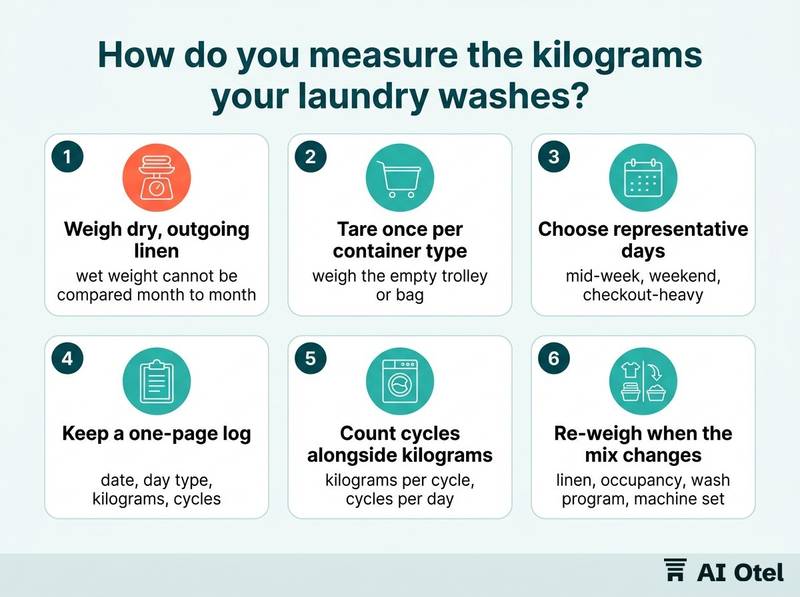
Weigh dry, outgoing linen. Wet weight includes water the dryer has not removed and moves with the extract setting, so it cannot be compared month to month. Tare once per container type: weigh the empty trolley or bag and subtract it every time, rather than estimating the container weight.
Choose representative days: one mid-week day, one weekend day and one checkout-heavy day, and avoid the day after a group departure if that day is not typical. Count cycles alongside kilograms, so the same log gives kilograms per cycle, cycles per day and kilograms per labor hour. Build kilograms per occupied room from the same days: kilograms divided by rooms occupied, kept separate for room linen and for food and beverage linen.
Keep a one-page log: date, day type, kilograms, cycles, rooms occupied and covers served, signed by whoever ran the shift. Re-weigh when the linen mix, the occupancy mix, the wash program or the machine set changes, because all four move the kilograms. A hotel that changes its linen standard, for example from one towel weight to a heavier one, is washing a different product afterward.
ChecklistA weighing checklist
- Tare the trolley or bag before the session
- Weigh dry linen only
- Cover three day types: mid-week, weekend, checkout-heavy
- Record cycle count on the same sheet
- Record rooms occupied and covers served
- Keep room linen and F&B linen on separate lines
- Repeat the weighing each quarter
How do you get energy and water per cycle from your own meters?
Read the meter before and after a known number of cycles, on a window when nothing else runs on that meter, and divide the difference by the cycles.
Sub-meter where you can: a laundry sitting on the hotel's main electricity or water meter cannot be separated afterward without a dedicated reading. Measure a shift, not a year: one shift with a counted number of cycles gives a usable per-cycle figure, while an annual average hides the mix of heavy and light programs.
Separate washer from dryer, because dryers usually carry the largest electrical load, and a gas-fired or steam-heated dryer moves that cost into the fuel bill instead. Handle hot water honestly: if the laundry draws hot water from the central boiler, the energy sits in the fuel bill, so agree with engineering on a stated allocation and keep it. Include softener regeneration in the water line, because it consumes both water and salt and runs on its own schedule.
Apply the tariff that actually applies to your meter, including demand charges and any time-of-use bands, and file the tariff sheet with the worksheet. Repeat the measurement when the machine set, the wash program or the water temperature standard changes.
TipMeasure one shift, not one year
Measure one shift with a counted cycle number rather than an annual average, and write the measurement date on the worksheet so the next figure is comparable.
How much labor belongs to the laundry?
Count the hours, not the headcount. Record the time each person spends on laundry tasks during the measurement days, then cost those hours at employer cost.
Laundry hours hide inside housekeeping shifts: a room attendant who loads a washer between rooms is partly laundry labor and should be counted as such. Run a simple time log for one week, filled in by the team, then keep the resulting ratio and refresh it when staffing or the linen standard changes. Include sorting, stain treatment, mending, folding, ironing and putting away, not only loading and unloading the machines.
Cost the hours at employer cost from payroll, including statutory contributions and benefits, not the gross wage, or the figure will flatter the in-house option. Calculate kilograms per labor hour: it is the number that moves when you change the wash program, the folding standard or the linen type. Allocate supervisor time by a stated share and write the share down, so that next year's figure uses the same rule.
Watch outThe hidden hours are the common error
The most common error is costing only the people who stand at the machines, while sorting, mending and folding happen in another room on another shift and stay out of the figure.
What do machines, repairs and linen replacement add?
Depreciation spreads the purchase price over the machine's working life, repairs are the actual invoices for the period, and linen replacement is the textile spend divided by the kilograms washed.
Express depreciation per kilogram where you can: purchase price divided by expected lifetime kilograms is more useful than years when the machine runs harder in summer. Include installation, the ironer, the boiler share and the trolley fleet if you want a full figure, and say so when you leave them out. Use the repair invoices for the period plus any service contract: a machine near the end of its life shows up here before it shows up in depreciation.
Count linen bought and linen discarded each year; the gap is loss, and the spend is the cost that belongs in the rate. Par levels drive replacement cost: more sets tie up capital but spread wear across more pieces, so the par decision changes the per-kilogram figure. The details of par levels and laundry flow are covered in hotel linen management: par levels, laundry flow and losses, and the fabric weights behind those decisions in how many linen sets a hotel needs and what the fabric weighs.
Decide whether linen replacement sits in the laundry rate or in the rooms cost, and keep the choice, because the supplier comparison needs it inside the rate.
Key pointDepreciation is a policy, not a measurement
Write down the working life you assume and keep it, so this year's figure can be compared with next year's.
How do you calculate cost per kilogram and per occupied room?
Add the seven lines for the period, divide by the kilograms washed in the same period, then divide the same total by rooms occupied to get the cost per occupied room.
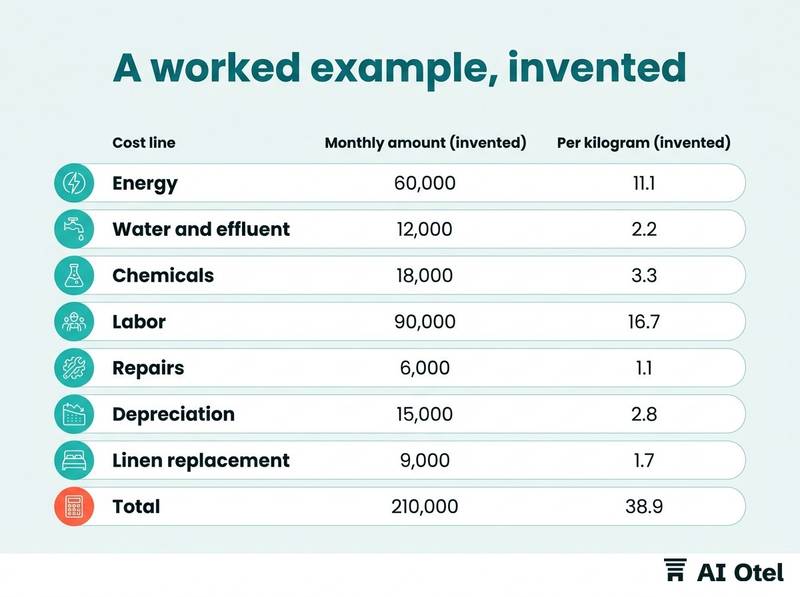
Keep the period consistent: monthly costs with monthly kilograms, and never an annual depreciation charge against one week of weighing. Work out both figures from the same total, so the per-kilogram and per-occupied-room numbers cannot drift apart. Show the arithmetic openly, line by line, so a reader can drop in their own amounts and see where the money sits.
Track the figure monthly and read the trend rather than the absolute value, because one heavy banquet month distorts a single reading. Split room linen from food and beverage linen where their kilograms per occupied room differ, which is usual in a hotel with banqueting. Carry the per-occupied-room figure into your rooms cost model, the way cost per occupied room, line by line builds it, so laundry sits beside the other cost lines rather than outside them.
A worked example, invented
For example, take a 120-room hotel over 30 days washing 5,400 kg, with 2,400 room nights sold. Every figure below is invented for illustration.
| Cost line | Monthly amount (invented) | Per kilogram (invented) |
|---|---|---|
| Energy | 60,000 | 11.1 |
| Water and effluent | 12,000 | 2.2 |
| Chemicals | 18,000 | 3.3 |
| Labor | 90,000 | 16.7 |
| Repairs | 6,000 | 1.1 |
| Depreciation | 15,000 | 2.8 |
| Linen replacement | 9,000 | 1.7 |
| Total | 210,000 | 38.9 |
The same total over 2,400 occupied rooms gives 87.5 per occupied room and 2.25 kg per occupied room. All figures are invented for illustration; the point is the shape of the sum, not the amounts. In this invented example labor is the largest line, which is exactly the line most worksheets undercount.
How do you compare a supplier quote on the same basis?
Rebuild the quote into the same seven lines and the same kilogram definition, then compare totals and cost per occupied room, not the headline price per kilogram.
Ask what the supplier's kilogram means: dry weight at pickup, wet weight at the door, or a formula based on rooms occupied and linen changes. Check scope: whether the price includes linen ownership, replacement, transport, sorting, stain treatment and delivery back to the floor. Read the volume terms: minimum charges, weekend and public holiday surcharges, and what happens in a low-season month when kilograms fall.
Your own residual costs do not disappear: the laundry room still needs cleaning, the machines still depreciate while you keep them, and someone still sorts and stores. Agree who pays for torn, stained or lost linen and how it is counted, because that clause decides the real comparison over a year. Compare on cost per occupied room as well as per kilogram, since a supplier billing on rooms and a hotel weighing kilograms are measuring different things. The wider make-or-buy decision is covered in in-house or outsourced laundry: how a hotel can decide; this article gives you the number that feeds it.
ChecklistA quote comparison checklist
- Kilogram definition agreed in writing
- Linen ownership and replacement included or excluded
- Transport and turnaround time
- Minimum volume and surcharges
- Loss and damage liability
- Residual in-house costs listed
- Contract length and exit terms
- Both per-kilogram and per-occupied-room totals compared
What to do next
Weigh one week of linen, read the meters across one counted shift, and put the seven lines on a single page for one month. That page is the next step: it turns the outsourcing quote on your desk into a comparison you can defend, and it gives you a per-kilogram and per-occupied-room figure you can track every month after.
Frequently asked questions
How many kilograms of linen does one occupied room produce?
There is no universal figure: it depends on the linen change policy, the hotel type, restaurant and banquet volume, and whether pool or spa linen runs through the same laundry. Measure it from your own weighed days by dividing kilograms by rooms occupied on the same days. Keep room linen and food and beverage linen on separate lines so the number stays usable.
Should hotel linen be weighed wet or dry?
Weigh dry, outgoing linen net of the trolley or bag. Wet weight carries water the dryer has not removed, so it moves with the extract setting and the program length. Whatever convention you choose, keep it and write it on the worksheet, or the monthly figures will not compare.
Does cost per kilogram include linen replacement?
It should if you intend to compare with a supplier who supplies the linen, because otherwise the two figures cover different things. If you keep linen replacement in the rooms cost instead, state that clearly on the worksheet. Either choice works as long as it is written down and applied consistently.
How often should the laundry worksheet be updated?
Update volumes monthly, since kilograms and occupancy move with the season. Refresh tariffs when the utility or chemical price changes, and revisit depreciation once a year or when a machine is replaced. Re-weigh the linen whenever the mix, the wash program or the equipment changes.
Is it cheaper to wash linen in-house or to outsource it?
It depends on your volume, your energy tariff, your labor cost and how much of the laundry room you would still pay for after outsourcing. The worksheet gives you an in-house figure that a supplier quote can be compared against on the same basis. The decision itself has more inputs than price, including turnaround, quality and loss.