The linen rewash rate: counting stained pieces, finding the cause and setting a target
Count stained pieces at the folding table for two weeks to find your linen rewash rate. Sort stains by cause, calculate the cost per piece, and set a defensible target for your laundry operations.
AI draft · awaiting editorial review
Contents
Key takeaways
- A rewash is a cost with no output: the piece was already washed once, and the second cycle adds water, energy, chemical, machine time and wear without producing an extra clean piece.
- Count at the folding table, where the decision is made, and count the denominator too: without pieces inspected there is no rate, only a tally.
- Sort every stained piece by cause before changing anything; chemistry, load, temperature, handling and guest stains need different fixes, and only the first four belong to the laundry.
- Set the target after two weeks of baseline, per piece type, and expect a floor: stains a guest brings in can be caught earlier but not eliminated.
The linen rewash rate hotel teams should track is the share of washed pieces that go through the machine a second time because a stain survived the first cycle: rewashed pieces divided by pieces inspected, counted per piece type. Count it for two weeks at the folding table, sort each stain by cause, then set a target per piece type.
The folding table is where a hotel's linen cost is decided, and it is usually not written down in the hotel's own records. A stained sheet is pulled out, dropped back into the trolley, and the only record of it is an extra wash cycle nobody sees. After reading this you will be able to count your own rate for two weeks, sort the stains by cause, price one rewash, and set a target you can actually defend.
What is the linen rewash rate, and why is it worth counting?
The rewash rate is the share of pieces that go through the wash a second time because a mark survived the first cycle: rewashed pieces divided by pieces inspected, counted per piece type over a fixed period. It is worth counting because a rewash produces nothing.
At inspection, a piece has three possible outcomes: clean and folded, rewash because the mark may still lift, or reject because the mark will not lift or the piece is torn or discolored. Only the middle outcome belongs in the rewash rate. Keep the rewash rate and the reject rate apart, because blending them hides whether the laundry is failing to clean or the linen is simply worn out.
The second cycle consumes water, energy, chemical, labor and machine time, and at the end of it there is no additional clean piece. The cost is real and the output is zero. Every cycle also ages the fiber: a piece that is washed twice as often reaches the end of its service life sooner, so part of the replacement price belongs in the cost of each rewash. How many sets you hold in the first place, and how fast they wear, is covered in how many sets of linen a hotel needs.
Where the stain is found changes what it is. A mark caught at the folding table is a laundry cost. A mark found by housekeeping or reported by a guest means a stained piece reached a room, which is a complaint as well as a cost.
If your hotel cannot state its rate, the decision is probably made by hand at the folding table and never recorded, so any figure is estimated from memory and likely understated. The rate is also the only honest baseline for any later change of chemical, program, machine or laundry contract.
How do you count stained and rewashed pieces for two weeks?
Put a tally sheet at the folding table, mark every piece that leaves the line as rewash or reject, and count the pieces inspected alongside it. Two weeks, one mark per piece, five or six columns, nothing more.
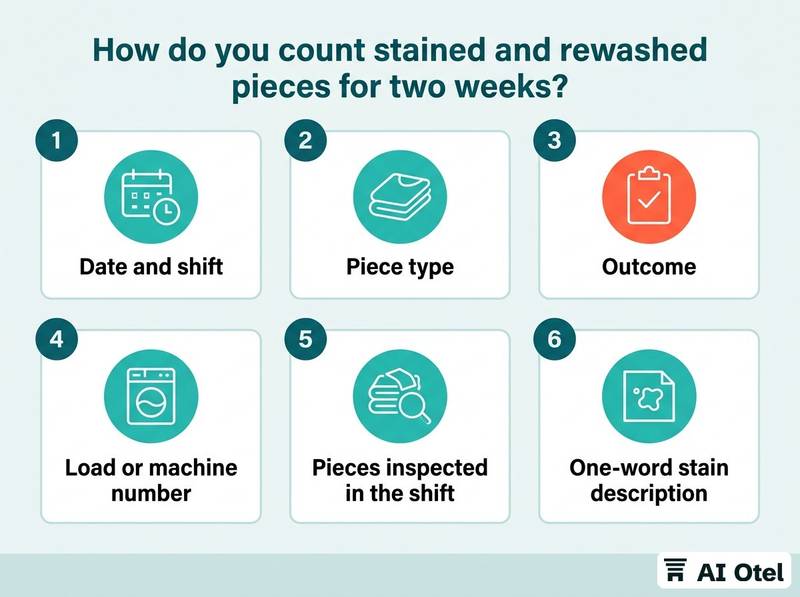
Count where the decision is made. The folding and inspection table is the one place every piece passes and where a person already decides its fate; a tally kept in the wash room records the wrong thing. Record per piece: date, shift, piece type, outcome, and the load or machine number when the laundry runs numbered loads. The load number is what later connects a stain to a program or a machine.
Keep the stained piece itself. Bag and tag it with date, load number, piece type and a one-word description of the stain, such as oil, blood, dye, rust, ink or unknown. A loose pile of unnamed stained linen cannot be diagnosed.
Count the denominator from the same source: pieces inspected per shift, or pieces washed taken from the load sheets. Without it you have a tally, not a rate. Run two full weeks and make sure they include a weekend and any group departure or banquet, so the count covers the soil types the hotel actually produces.
Keep the form short enough to survive the second shift; a sheet with twenty columns is abandoned by the third day. Say out loud at the briefing that marking a stain is the job done correctly, not a complaint against a colleague. Otherwise the marks quietly stop.
ChecklistTally sheet and stain bag
- Date and shift
- Piece type: sheet, duvet cover, pillowcase, bath towel, hand towel, bathrobe, F&B linen
- Outcome: clean, rewash, reject
- Load or machine number
- Pieces inspected in the shift
- One-word stain description on the bag tag
- Bag stored dry and out of the clean linen flow
What causes a stain to survive the wash?
Five families cover almost everything: chemistry, load, temperature, handling and the guest. Each leaves a different signature on the piece, and each needs a different fix.
Chemistry covers a dose too low for the soil level, the wrong product for the type of soil, water hardness consuming the detergent before it reaches the fabric, a dispenser fault, or a product that ran out mid-shift. Load covers overloading, which cuts mechanical action and the water and chemical available per kilogram of fabric, and mixing greasy kitchen linen with bed linen, which moves soil from one to the other.
Temperature cuts both ways: too cool for oil and grease, and too hot too early sets protein stains such as blood, so the temperature the program actually reaches matters more than the program's name. Handling is the quiet one: the stain is never reported when housekeeping strips the bed, the bundle waits before washing, the soil dries and sets, and stained and clean pieces are mixed at sorting. Guest stains are hair dye, sunscreen and self-tan, makeup, ink, wine, blood, rust from hangers and trolleys, and shoe polish; the laundry cannot prevent these, only catch them before the wash. Machine and water add a sixth family: a worn drum, a blocked filter, a soiled machine, rust in the water line, or marks left by the ironer.
Read the stain rather than the piece. An overall grey dullness points to chemistry or rinsing; a brown edge mark often points to rust or the ironer. For the product side of the problem, see choosing and dosing housekeeping chemicals.
| Cause | What you see on the piece | First thing to check |
|---|---|---|
| Chemistry | Grey dullness, soil spread evenly | Dose, product, dispenser, water hardness |
| Load | Soil redeposited in creases | Weight per load, mixed linen types |
| Temperature | Set protein stains, greasy film | Actual temperature reached, not program name |
| Handling | Dried, set stains in one bundle | Reporting at collection, time before washing |
| Guest | Localized marks: dye, ink, makeup | Catch and pre-treat before the wash |
| Machine and water | Brown edge marks, rust lines | Drum, filter, water line, ironer |
How do you turn the counts into a rate and a cost per piece?
Divide rewashed pieces by pieces inspected for the same piece type and the same period, multiply by 100, and price one extra cycle from the laundry's own load cost.
Keep the denominator disciplined: same piece types, same period, same counting method. A rate that changes its base every week cannot be compared with itself. Report per piece type: sheets, duvet covers, pillowcases, bath towels, hand towels, bathrobes and F&B linen. One blended figure hides which line is failing, and terry holds soil and chemical differently from cotton sheeting, as discussed in linen par levels, laundry flow and losses.
Price one extra cycle from the cost of running a load: water, energy, chemical, labor, machine time and depreciation, divided by the pieces that load carries. Then add the wear share: if a piece lasts a known number of cycles, each extra cycle consumes one of them, so add the replacement price divided by that cycle count. The cost per piece is what makes a fix decidable, because the price of a dosing change or a pre-treatment step can be set against the rewash cost it removes. Use the same arithmetic for the reject rate, where the cost is the whole piece rather than one cycle.
NoteWorked example, invented figures
For example, 4,000 pieces inspected in a week and 120 rewashed gives a rate of 3%. If a load costs 100 lira to run and carries 200 pieces, one extra cycle costs 0.50 per piece, so the week's rewash costs 60 lira before the wear share is added.
Which cause should you fix first?
Rank the causes by count times cost, then keep only the ones the laundry controls. The first fix is the most expensive cause you can actually change.
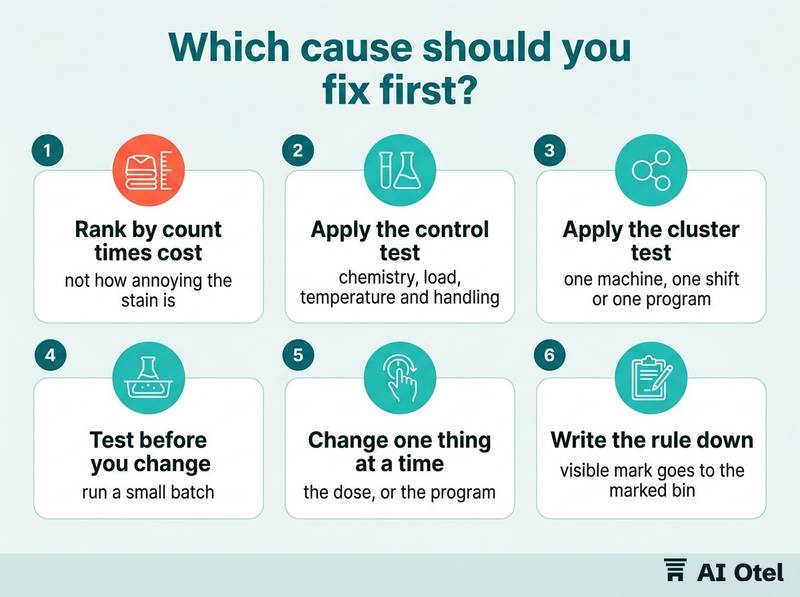
Count times cost, not how annoying the stain is. A rare stain on bathrobes can cost more than a common one on pillowcases. Then apply the control test: chemistry, load, temperature and handling sit inside the laundry; guest stains can only be caught earlier, so they are a separate campaign. Apply the cluster test too. If the rewash sits on one machine, one shift or one program, the cause is there, not in the product.
Test before you change. Run a small batch with the corrected dose or a pre-soak and see whether the stain lifts at all. Change one thing at a time: the dose, or the program, or the sorting rule. Change three and you learn nothing from the result.
Write the rule down: any piece with a visible mark goes to the marked bin and never into the bundle, and a named pre-treatment product with a stated contact time. Agree who owns the rule: the laundry supervisor for the wash, housekeeping for reporting a stain at collection. If you are weighing a bigger structural change, the same counts feed deciding between in-house and outsourced laundry.
How do you set a target and check that the fix held?
Set the target after two weeks of baseline, per piece type, and check it on a weekly line chart with the same denominator. A single good week is noise; four weeks after the change is a result.
Baseline for two weeks, make the change, then measure for four weeks, and mark the week the change started on the chart. Watch the denominator: if pieces inspected fell at the same time as the rate, the recording stopped rather than the staining. Set the target per piece type as a working level, not as zero, because guest-caused stains keep a floor under any honest target.
Report the cost per piece next to the percentage. The percentage moves slowly; the cost shows what the fix saved and keeps the attention. Review monthly. When the target holds, reduce the counting frequency but never to zero, and re-count for two weeks after any change of chemical, machine, program or laundry contract.
If the laundry is outsourced, the count taken at goods-in is the evidence for the contract conversation, and sorting and pre-treatment inside the hotel stay under the hotel's control.
TipOne page, one chart
Keep the chart on one page, one line per piece type, with a short note on every change of chemical, program, machine or contract. A chart with the changes marked answers whether the fix worked faster than any written report.
What to do next
Start tomorrow with one sheet of paper at the folding table: date, piece type, outcome, and a bag for the stained piece. Two weeks of that gives you a rate, a cause ranking and a cost per piece, and only then is a target worth setting.
Frequently asked questions
Is the linen rewash rate the same as the linen loss rate?
No. A rewash is a piece that goes through the machine again and stays in circulation; a loss is a piece removed for good, whether torn, permanently stained, discolored or missing. Measure them separately, and expect a high rewash rate to raise the loss rate later, because each extra cycle wears the piece.
Should sheets and towels be counted in one rate?
No. Terry holds soil and chemical differently from cotton sheeting, and a towel cycle costs differently from a sheet cycle. Use separate denominators and separate targets, then compare them only as a summary.
How long should the count run?
Two full weeks at minimum, and the two weeks must include a weekend and any group departure or banquet, because those produce the soil types the hotel actually sees. If occupancy swings sharply between weeks, run longer before setting a target.
What can a hotel do when the laundry is outsourced?
Count at goods-in inspection and keep the tagged stained pieces; that count becomes the evidence in the contract conversation. The hotel still controls what happens before the linen leaves the building: reporting a stain at collection, sorting it out of the bundle and pre-treating it.
Can the rewash rate reach zero?
No. Hair dye, sunscreen, ink and similar guest stains will always produce some rewash. The target is a working level for the causes the hotel controls, reviewed monthly and reset after any change of chemical, machine, program or contract.