Payment links for hotel bookings: when to send one, how long it stays open and how to match it to the reservation
A hotel payment link guarantees a booking only if it is sent at the right time and matched correctly. This guide explains when to send one, how long it should stay open, and how to ensure every payment lands on the correct reservation.
AI draft · awaiting editorial review
Contents
Key takeaways
- A payment link is a message the guest pays through: it carries an amount and a reference outward, and never asks for a card number inward.
- Send a link when the guest is not in front of you and the booking is not yet guaranteed; take payment at the desk when the guest is standing there.
- The expiry is the hotel's own commercial decision, written into its booking rules, and it must never outlast the hold on the room.
- A payment is matched to a reservation by the reference that travels with it, checked by one named person on the day it lands.
- A refund goes back the way the money came, against the same reference, or the original payment stays open and turns into a dispute.
A hotel payment link is a web address that carries one amount and one reservation reference, and the guest pays on the hotel's own payment page. Send it when a booking needs money before arrival, set an expiry the hotel chooses and writes down, and match each payment to its reservation by the reference.
A reservation is held, the guest is not in the building, and the money has not arrived. The link you send decides whether that booking becomes guaranteed or quietly disappears, and the reference on it decides whether the payment lands on the right bill. This article gives the working rules: which bookings get a link, what the message must contain, how long the link stays open, who checks that payments land on the right reservation, and how to refund through the same route.
What is a hotel payment link, and what is it not?
A payment link is a web address that opens a payment page for one amount and one reservation; the guest pays there and the hotel receives a payment carrying a reference it can match. It is a message, not a place where card numbers are stored.
The link carries the amount, the currency and a reference to the reservation. The card details are typed on the payment page, never into the message. The page belongs to the hotel's own payment setup, so the money arrives in the hotel's account and the hotel holds the record of who paid and when.
Two limits matter. A link is not a guarantee: until the payment lands, the booking is only as firm as the hotel's own written booking rule says it is. And a link is not a fiscal document: a payment and an invoice or e-document are two separate things, issued by two separate steps.
| A payment link is | A payment link is not |
|---|---|
| A web address that opens a payment page for one amount | A request for card details in a message |
| Tied to one reservation by a reference | Proof that the booking is paid |
| Open until the expiry the hotel set | Valid forever |
| Evidence that a payment was made, with a time and a reference | A fiscal document |
| Reversible on the same route | A stored card the hotel can charge later |
A link also does not give the hotel the right to charge a no-show later. That depends on what the guest agreed to at booking, so confirm the wording with your bank and your legal adviser. And no hotel should ask a guest to type a card number into an email, a message or a reservation note.
When does a payment link beat a card number by phone?
A link wins whenever the guest is not standing in front of you and the booking has to be guaranteed before arrival. A card read out over the phone wins only when the guest is at the desk and the payment is happening now.
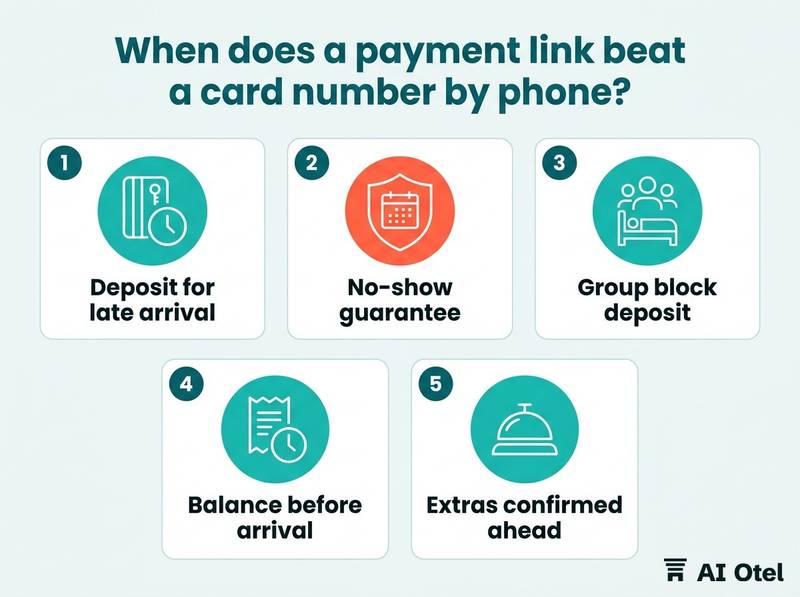
Use a link for a deposit that holds a late arrival, a no-show guarantee on a flexible rate, a group block deposit, the balance before arrival on a long stay, and extras confirmed ahead of time. The mechanics behind that payment page, virtual POS, 3D Secure and tokens, are worth knowing before you choose a provider.
Do not send one where payment is already arranged elsewhere: a booking the booking site collects for, a corporate account billed after the stay, or an agency arriving on a voucher. If you are unsure who collects on a channel, read up on hotel collect, OTA collect and virtual cards before sending anything.
Never take a card number by message or write one into a reservation note. A card number typed into a note lives in the system and in every export from then on. If a guest offers, send the link instead.
The link leaves a record: which address it went to, when, for how much, and who sent it. A phone call leaves a note that somebody typed afterwards. One caution: a link can be forwarded, so treat it as a bearer message. Usually that is fine, for example a company paying for a guest; occasionally it is not, and the payment then belongs to a reservation the payer has never seen.
At the desk, speed beats tidiness. A guest checking in now should pay at the desk, not wait for an email to arrive.
What must the message contain?
Six things: the amount and currency, what the money is for, which reservation it belongs to, when the link stops working, who to contact, and the sentence that the hotel never asks for card details by message.
State whether the amount is a deposit or the full stay, and whether it is refundable and under which rule. A guest who does not know what they are buying will call, and the call costs more than the sentence would have. Give the guest name, arrival and departure dates, room type and the reservation number, written the same way in the message and in the payment reference field.
The expiry goes in as a date and a local time, matching exactly what the payment page enforces. Two different deadlines in one message teach the guest that neither is real. Add a phone number and an address the guest can check against the hotel's own website, so a suspicious guest has somewhere to verify instead of guessing. Send from an address the hotel owns, and save a copy to the reservation record: that copy is the evidence if the payment is later questioned.
One link per purpose. A deposit link and a balance link are two messages with two references, not one message with a running total.
ChecklistBefore you press send
- Amount and currency stated
- Deposit or full payment named
- Refund rule named
- Reservation number in the message and in the payment reference field
- Expiry date and local time written
- Contact phone and address included
- The never-ask-for-card-details sentence included
- Copy saved to the reservation
How long should a payment link stay open?
Exactly as long as the hotel is willing to hold the room, and not one hour longer. The expiry is the hotel's own commercial decision, written into its booking rules, and it has to be shorter than or equal to the hold on the room.
Two clocks run at once: the hold on the room and the life of the link. If the link outlives the hold, the hotel can take money for a room it has already sold. Set the window by distance to arrival rather than by habit. For example, a booking arriving tomorrow might get twenty-four hours and a booking for next summer a week; the numbers are the hotel's to choose and to write down.
Enforce the expiry on the payment page, not only in the message text. A link that still accepts money after the stated deadline teaches every guest that the deadline is decorative. Send one reminder, before expiry, on the same channel, with the same link and the new deadline stated once. A second reminder is a decision, not a default. When it expires, decide once and record it: release the room and tell the guest, or call and take payment another way.
The guest's bank is not on the hotel's clock. A payment made minutes before the deadline may post the next morning, so either leave room for that in the expiry or write down what happens when it occurs.
Watch outThe expensive mismatch
A link that still works after the room was released is the worst case. The guest pays, the hotel has no room, and the only way out is a refund and a difficult conversation. The payment page's expiry and the room hold must be set from the same decision, on the same day.
How do you match a payment to the right reservation?
By a reference that travels with the payment, checked by one named person on the day it lands, and posted to the guest's bill in the same step.
Put the reservation number in the payment reference or description field wherever the payment page allows it. Where it does not, the amount, the date and the payer's name become the reference, and someone has to read them. Match on reference first, then amount, then name and date. Amount alone fails the moment a guest pays a deposit and the balance in two separate transfers.
One person owns the daily check: the bank statement against the links sent yesterday, with an unmatched list that carries an owner and an age. Post the payment to the reservation and to the guest bill, not only to the bank account. Money sitting in the bank and not on the bill ends with a guest being asked to pay twice at check-out. When a link reached the wrong person, the payment still belongs to the reservation the link was created for; record who actually paid and why before posting it. Two payments against one link usually mean the guest paid twice, so refund one the same day rather than leaving it as a credit on the account.
The night audit is the backstop: a payment that is not on a bill when the business day closes should stop the close until someone explains it. A hotel operating system that keeps reservations, billing and the day-end close in one place makes that check a matter of reading one screen instead of reconciling three.
ChecklistThe daily five-minute check
- Every link sent yesterday has a status of paid, open or expired
- Every payment on the statement has a reservation
- Every reservation expecting a deposit has one
- Every unmatched item has a name and an age
- Every refund raised yesterday is closed or has a date
What about fake links that pretend to be the hotel?
A guest cannot tell a real link from a fake one by looking at it, so the hotel's defense is a route the guest can predict and a rule it states everywhere.
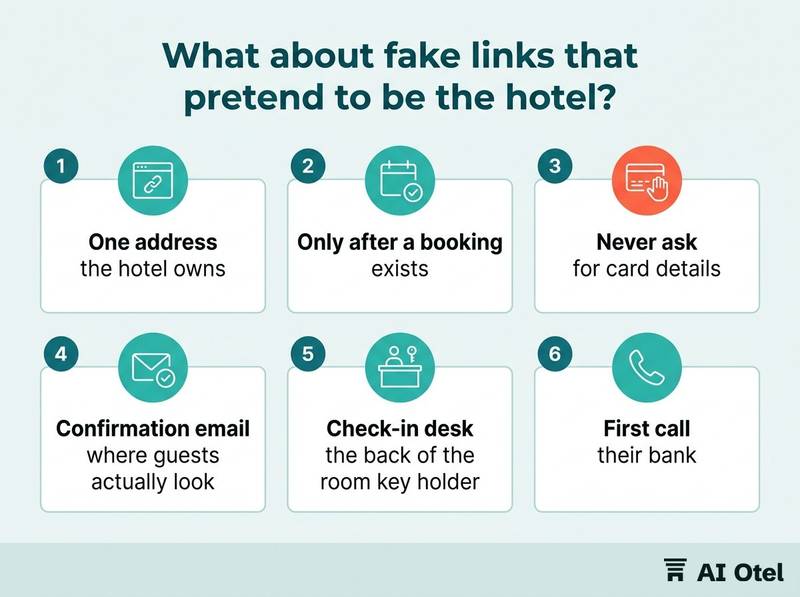
Fake links usually arrive in a channel the hotel does not use, or from an address one character away from the hotel's own. The guest sees the hotel's name and a payment page, and pays. Make the real route predictable: links come from one address the hotel owns, only after a booking exists, and never ask for card details. Publish that rule where guests actually look: the confirmation email, the website, the check-in desk, the back of the room key holder.
Train the front desk for the call that starts "is this link yours?". The answer is a check of the sending address and the reservation, not an opinion about how the page looks. If a guest paid a fake link, the money never reached the hotel: their first call is their bank, and the hotel's job is to document exactly what it sent and when. The same discipline protects the hotel's own money, because a supplier who changes bank details by message is the same attack with a different target. Fake messages aimed at hotels themselves are a wider problem; see fake booking messages and extranet takeovers for how those work.
How do you refund through the same route?
Reverse the payment on the route it came in, against the same reference, with the reason written on the reservation. A refund to a different card or a different person is how disputes start.
A refund is a reversal of one specific payment, so it needs that payment's reference, amount and date before anyone touches a screen. For a partial refund, state the amount and the reason: a cancellation under a named rule, a service that was not delivered, or a duplicate. Tell the guest when the refund was sent, and that the posting time belongs to their bank rather than to the hotel.
Keep the pair together on the reservation record, original payment and refund, so the bill shows both and the balance is explainable months later. If the guest paid a fake link, there is nothing for the hotel to refund: say that plainly and point them to their bank, because a goodwill payment here hides the crime and teaches nobody.
NoteOne sentence on the bill
Write the refund as a reversal of a named payment with its reason, for example "refund of the deposit paid on the booking date, guest cancelled under the flexible rule". Whoever reads the bill later, including a dispute reviewer, needs that sentence and not a number on its own. If a dispute does arrive, the evidence you kept is what answers it; see answering a card chargeback with the right evidence.
Write the rule on one page
Write the hotel's payment-link rule on one page: which bookings get a link, the amount and the wording, the expiry and the single reminder, the person who checks payments each day, and the route refunds take. Give the same page to reservations, front desk and accounting, then run it against the next ten bookings and fix whatever the ten expose. If you are thinking about how payments, deposits and refunds fit into a wider distribution setup, the distribution platform overview covers how one inventory feeds several channels.
Frequently asked questions
How do payment links work for a hotel booking?
The hotel creates a link for one amount tied to one reservation and sends it by email or message. The guest opens it and pays on the hotel's own payment page, and the hotel receives a payment carrying a reference, a time and a payer name. The link is not a stored card and not an invoice; it is a payment route with a record.
Should a hotel ask for a deposit by payment link or by card over the phone?
By link whenever the guest is remote and the booking must be guaranteed before arrival, because no card number passes through a conversation or a note. By card at the desk when the guest is present and paying now. Card numbers should never be requested by message under any circumstances.
What happens when a payment link expires?
The payment page stops accepting payment, and the room hold is released according to the hotel's own booking rule. The hotel then decides once, either releasing the booking and telling the guest or calling to take payment another way, and records which. A payment made just before the deadline can still post the following day, so the rule should say what happens then.
How long should a payment link stay valid?
As long as the hotel is prepared to hold the room, and never longer. The window is a commercial decision tied to how close the arrival is, written into the booking rules and enforced by the payment page itself, with one reminder sent before it closes.
Can a payment link be forwarded to someone else?
Yes. A link is a bearer message, so whoever holds it can pay it, which is often what a company paying for a guest wants. The payment still belongs to the reservation the link was created for, so the hotel records who actually paid and why before posting it to the bill.