Payment words in agency dealings: transfer, cheque, promissory note, direct debit and credit period
Define hotel agency payment terms clearly. Learn how transfer, cheque, promissory note, direct debit and credit period work in contracts to avoid disputes.
AI draft · awaiting editorial review
Contents
Key takeaways
- Every payment word in an agency contract needs three things: a trigger date, a document that proves it, and a named person on each side.
- A credit period without a credit limit is half a rule: the period says when the money is due, the limit says how much exposure the hotel carries at once.
- A cheque or a promissory note is a promise, not a payment: the invoice stays open until the money is in the hotel's account.
- A bank transfer is proved by the credit on the hotel's own account and by the invoice number in the reference field, not by a screenshot of the instruction.
- The glossary card works only when the sales manager and the accountant sign the same one-page version of the contract's payment words.
Hotel agency payment terms are the words a hotel and a travel agency use to fix when money arrives and in what form: advance, deposit and balance; a credit period with a payment day; bank transfer, cheque, promissory note or direct debit; and the statement that reconciles them. Each word belongs in the contract, not in memory.
The sales manager agrees a credit period on the phone, and the accountant reads the signed contract a week later. One of them thinks the clock starts at checkout; the other thinks it starts at the invoice. The deal is the same; the words are not. This article defines each payment word in plain language, with the trigger, the proof and the risk for each, so that both departments read the same definitions and can build a one-page card from them.
What do advance, deposit and balance mean in an agency deal?
Advance is money paid before the stay, deposit is the part of the total that secures the booking, and balance is what remains due. The three words only work when the contract says which one it means.
An advance is money the agency pays before arrival, held against the final bill or applied to it. It cuts the hotel's exposure, and it creates a refund question if the booking shrinks. A deposit is a share of the total, either a percentage or a fixed sum per room night, paid to secure the booking; the contract must say whether it is refundable and until which date. The balance is the rest, due on a stated date. If it does not arrive, the hotel's own written rule decides what happens to the rooms, for example releasing them back to inventory on a named day.
Write each term with three parts: the trigger (booking date, arrival date, invoice date), the amount basis (per booking, per room night, per period) and the document that proves it (proforma invoice, receipt, statement). Who holds the money matters too. An advance sitting in the hotel's account is not the same as an advance the agency holds on the hotel's behalf, and the second one needs a rule for what happens if the agency stops trading.
| Term | What it means in the contract | What the contract must state |
|---|---|---|
| Advance | Money paid before the stay, held against or applied to the final bill | Trigger date, whether it is refundable, which document proves it |
| Deposit | The share of the total that secures the booking | Basis, refund rule, last date for payment |
| Balance | The remainder | Due date, consequence of a missed date, who releases the rooms |
The word deposit hides two different things
Across contracts, deposit can mean a prepayment or a security sum held against damage. These are different obligations with different refund rules. Define it in the contract's own words rather than assuming the reader shares your meaning.
What is a credit period, and what is a payment day?
A credit period is the number of days between a stated trigger and the date the money must be in the hotel's account. A payment day is the fixed day on which the hotel checks what arrived and chases what did not.
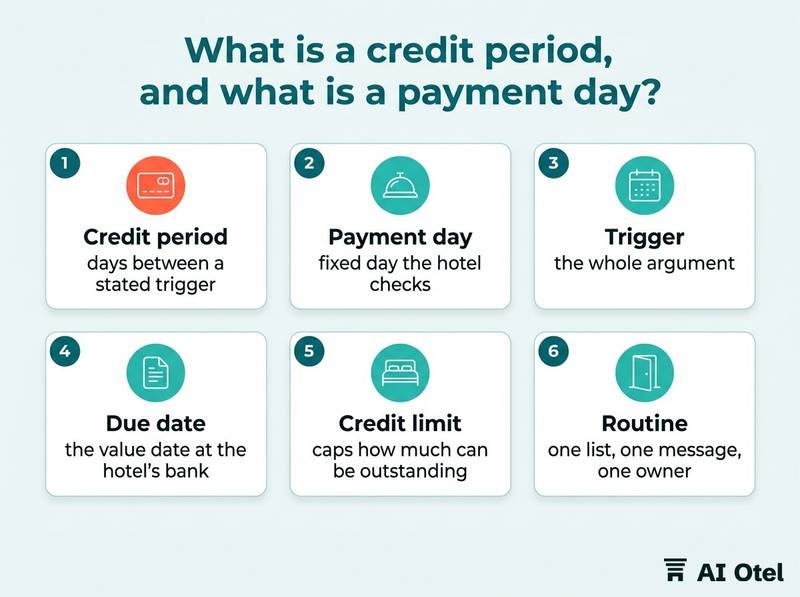
The trigger is the whole argument. Invoice date, checkout date, statement date and month end give four different due dates for the same stay, so the contract has to name one. Count in calendar days and say so, and give a period that ends on a weekend or a public holiday its own rule, otherwise the due date moves every time. The due date is the value date at the hotel's bank, the day the money becomes usable, not the day the agency says it instructed the payment.
A credit period without a credit limit is half a rule: the period sets timing, the limit caps how much can be outstanding at any moment. A payment day, for example the 5th and the 20th of each month, turns chasing into a routine: one list of open items, one message, one owner. A longer credit period is a price the hotel pays for volume, so trade it for something written down: a deposit, a shorter statement period, a lower credit limit or a named finance contact at the agency. When an invoice ages past routine chasing, the decision stops being a sales decision and becomes an accounting one, including when an unpaid agency invoice can be treated as doubtful.
Watch outThe trigger trap
A clause that says, for example, "payment within 30 days" names no starting point. From the invoice, the checkout, the statement or the month end, that is four different due dates. Two departments read it two ways, and the argument arrives on the day the money does not.
What proof counts when an agency says it has paid by transfer?
The proof is the credit on the hotel's own bank account, matched to an invoice. A screenshot of the agency's payment instruction is a claim, not a payment.
A bank transfer moves money from the agency's bank to the hotel's bank. The hotel knows it has been paid when the money appears in its account, not when a message arrives. Ask agencies to put the invoice number in the reference field; without it, one transfer covering several invoices has to be allocated by guesswork. Ask for a remittance advice, a short list saying which invoices the money covers, so a single payment becomes a closed set of items.
Bank charges belong in the contract: who pays the sending and the receiving bank's charges. A deducted charge leaves an invoice open by a small amount that nobody chases for months. Currency needs the same treatment: if the contract is in one currency and the payment arrives in another, name the rate and the day it is taken, for example the central bank's daily rate on the value date. Record the value date next to the invoice. It is the date the credit period is measured against, and it is the date an auditor will ask for.
ChecklistWhen an agency says it has paid, work through this list
- Is the money in the hotel's account, not merely promised?
- Does the amount match the invoice after bank charges?
- Does the reference or the remittance advice say which invoices it covers?
- Is the value date recorded against those invoices?
- If the amount is short, who is told and by when?
- Is the agency's finance contact named in the file?
Cheque and promissory note: what is the difference for a hotel?
A cheque is a written order to a bank to pay a stated sum from the drawer's account. A promissory note is a written promise by the debtor to pay a stated sum on a stated date. Neither is money in the hotel's account.
Both are instruments, not receipts. The invoice stays open until the instrument is honored and the money arrives, and the statement keeps showing the item as open. What the hotel controls is whether to accept instruments at all, who is authorized to accept one and hand it over, and the register that records each instrument, its date, its amount and the invoices it covers.
Whose name is on it matters. An instrument signed by an individual rather than the company changes who owes the money, and whether that helps or weakens the hotel's position is a question for your accountant or legal adviser. Keep a delivery record: who handed what to whom, on which date, and what was given back. A signed handover note ends the "we already gave you a cheque" conversation. Instruments carry dates, so one person should own the diary and know what falls due each week. Accepting an instrument is not a reason to stop chasing: the credit period still runs and the statement still shows the balance.
NoteA promise in a different shape
A cheque or a promissory note changes the form of the promise, not the fact of it. Until the money is in the hotel's account, the invoice is open and the statement says so.
Direct debit and agency card payments: what changes for the hotel?
Direct debit lets the hotel collect an agreed amount from the agency's account on agreed dates instead of waiting for the agency to send it. Agency card payments move the money at the moment of charge, within the card's limit and validity.
Direct debit needs a written mandate: who may collect, from which account, up to what amount, on which dates, with how much notice, and how the agency stops it. The mandate wording and the bank's own rules are for your accountant and the bank. The hotel takes on the timing work: a collection that fails costs a bank charge and a week, and a collection for the wrong amount costs the relationship. Set a ceiling and a schedule, and send a pre-collection notice listing the invoices the collection covers, so the agency's finance team can match it before the money moves.
Agency card payments, including virtual cards issued per booking, settle at the moment of charge but only within the card's limit and validity. A card that expires before the stay is charged is a booking with no money behind it. Record the charge reference next to the invoice the same way a transfer reference is recorded, so the statement can show how each item was settled. The OTA side of the same subject, where the booking site collects and the hotel is paid by virtual card, has its own vocabulary in OTA payment terms.
What belongs in an agency statement, and how is it reconciled?
A statement lists, for a stated period, every invoice the hotel issued, every payment it received and every item still open, with a closing balance. Reconciliation is matching each payment to the invoice it settles.
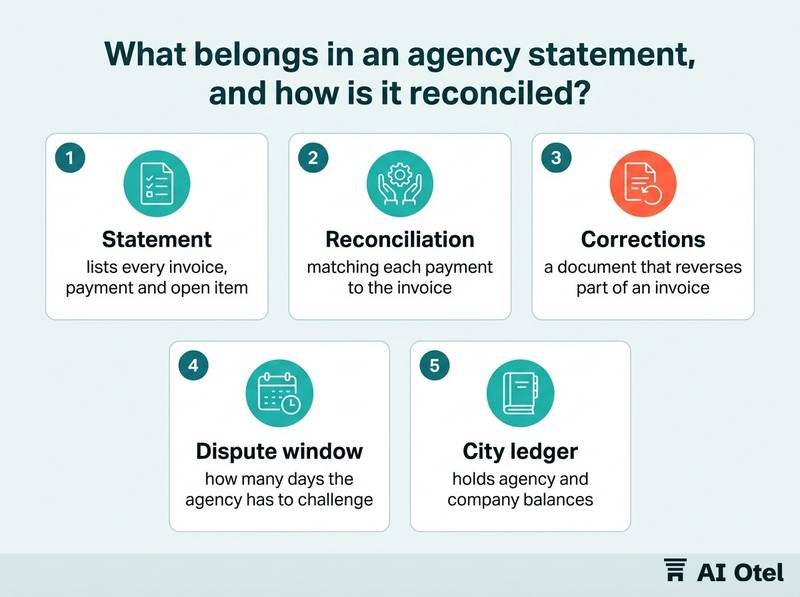
The statement is the hotel's document. It goes out on a fixed day, covers a fixed period and uses the same invoice numbers as the contract and the agency's own records. Reconcile item by item: an invoice is open, partly paid or closed; a payment is allocated or unallocated. Nothing closes by memory or by a phone call.
Corrections are made by a document that reverses part of an invoice, never by deleting the invoice. The record keeps both, which is what makes the statement defensible later. Name a dispute window in the contract: how many days the agency has to challenge an item before the statement is taken as agreed by both sides. Name the person on each side who owns the statement and the channel where disputes are raised, so a query does not sit in an inbox for a month. The statement draws on the city ledger that holds agency and company balances, so the two documents must agree at all times.
How do you build the one-page glossary card?
Take the payment words in the signed contract, define each one in the contract's own words, and put the definitions on one page that the sales manager and the accountant both sign.
One page, in the contract's language, using the contract's words. If there are two language versions, name which one controls. For each term write: what it means here, the trigger date, the document that proves it, who acts, and who is told. The card is a summary, not a replacement: it points to the clause behind each word, so a disagreement ends in the contract rather than in the card.
Review the card when the contract is renewed or a term changes. An old card is worse than none, because people trust it. Send it to the agency's finance contact too, so both sides measure the same dates and accept the same proof. The test: hand the card to someone who has never seen the deal and ask when the money is due and what proves it. If they hesitate, the card is not finished. The same one-page discipline works for the wording used when agreeing corporate rates, not only the payment side.
ChecklistThe card's fields
- Each payment word, defined in the contract's own words
- The trigger that starts the credit period
- The payment day or days
- The credit limit
- Accepted payment instruments and who may accept them
- Currency and the day the rate is taken
- Who bears bank charges
- Statement period and dispute window
- The finance contact on each side
- Signature lines for sales and for accounting
What to do next
Write the glossary card for your next agency contract before anyone signs it: one page, the contract's own words, signed by the sales manager and the accountant. Everything else in this article hangs from that page, because a trigger date, a payment day, a proof for each instrument and a statement that closes items one by one only work when both departments are reading the same definitions.
Frequently asked questions
Who pays the bank charges when an agency sends a transfer?
The contract decides, so state it explicitly and cover both the sending and the receiving bank's charges. Say what happens when the amount that arrives is short by the charge: the hotel either absorbs it under a written rule or records the shortfall and decides whether to invoice it. Either way the decision is written down, so the invoice does not stay open by a small amount nobody owns.
An agency paid three invoices with one transfer. How should the hotel allocate it?
Ask for a remittance advice listing the invoices the money covers, and allocate against that list. If none arrives, apply a written rule, for example oldest invoice first, and tell the agency which items were closed. Never close an item by guesswork, because a wrong allocation hides a genuinely unpaid invoice and distorts the statement.
What is the difference between the invoice date and the value date?
The invoice date is when the hotel issues the document and may start the credit period. The value date is when the bank credits the money and it becomes usable in the hotel's account. The hotel measures the credit period against the value date, which is why the value date is recorded next to the invoice and not just in the bank statement.
Does a longer credit period win more agency business?
It can be part of what an agency values, but it is a price the hotel pays, not a free concession. Trade it for something written into the contract: a deposit, a credit limit, a shorter statement period, a named finance contact or committed volume. No single period fits every hotel, and the right one is the one the hotel can carry without chasing.