Pilferage in hotel stores and kitchens: controls that do not insult honest staff
Pilferage is stock that leaves a hotel without being used or recorded as waste. Control it with four routines that apply to everyone, so you find the missing item without losing a good employee.
Contents
Key takeaways
- Stock leaves a hotel in three ways, used, wasted or taken, and a control system that cannot separate them will treat honest staff as suspects.
- Goods that move without a signed issue slip cannot be traced to anyone, so the slip matters more than the lock.
- A spot count works when it is routine in the calendar, unannounced in detail, and done by two people, one of them from outside the store.
- A count difference is a question about the record first: a unit error, an unrecorded transfer, a short delivery or a complimentary issue all look like loss on paper.
- When the same difference repeats, change the process before you change your view of the person.
Pilferage is stock that leaves a hotel without being used or recorded as waste. Control it with four routines that apply to everyone: one store door and a key log, an issue slip signed before goods move, a weekly spot count of ten high-value items by two people, and a daily waste log. Check the record before the person.
The store keeper usually knows the count is short before the owner does. What happens in the next conversation decides whether you find the missing case of oil or lose a good employee. Hotel pilferage control is mostly not about catching anyone. It is about building routines that separate the three ways stock leaves a building, so that when a shelf comes up empty you know which exit it took. After reading this you will be able to set up the door routine, the issue slip, the spot count and the waste log, and handle a difference without turning paperwork into a personnel case.
What counts as pilferage in a hotel, and what does not?
Pilferage is stock taken without permission or record. It is one of several exits from the store, and the legitimate ones produce exactly the same empty shelf when the paperwork is weak.
Name the three exits plainly. Issued and used, where a slip exists. Wasted, where a waste record exists. Taken, where no record exists at all. The third exit needs splitting further, because each part needs a different control: stock carried out of the building, stock consumed on site without a slip such as a cook's meal or a drink at the bar, and administrative loss such as a case counted as a piece, a transfer between outlets never written up, or a short delivery signed for in good faith.
The split matters because controls are specific. A camera at the store door answers the first part and does nothing at all for a unit error. A tighter lock does nothing for over-portioning in the kitchen. Before anyone says the word theft, apply one test: can the difference be explained by a document? If it can, it is a paperwork problem and the fix is a routine, not a conversation with a person.
A control that assumes theft first is wrong every time the cause is paperwork, and it spends trust every time it is wrong. Note also that the size of a difference says little on its own. The pattern, which item, which department, which shift, which day of the week, says much more. This sits inside the wider discipline of food and beverage cost control in hotels.
| Exit | How it shows up in the record | First control to check | Who owns the fix |
|---|---|---|---|
| Used | Issue slip exists, usage compared with sales | The slip file | F&B controller |
| Wasted | Waste log: trim, spoilage, over-production | The daily waste entry | Chef |
| Taken off site | No record | The door and key log | Duty manager |
| Consumed on site without a slip | Staff meals and complimentary items missing from the issue file | The staff meal record | Chef and store keeper |
| Administrative | Unit error, unrecorded transfer, short delivery | The delivery note and transfer slips | Purchasing |
How do you control the storeroom door, the key and the issue slip?
One door in use, one named keyholder at a time, and no goods across the threshold without a signed issue slip. The routine has to bind the chef and the general manager exactly as it binds the store keeper, or it is a rule about one person.
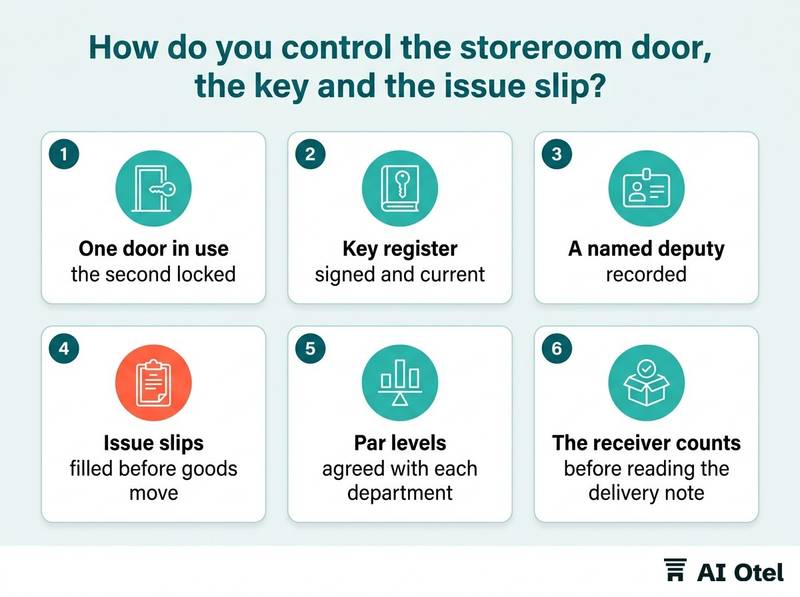
Keep one store door in daily use. A second door stays locked from the inside and opens only for deliveries, with the same written log as the main door. Run a key register: who holds the store key, the date it was issued, the date it came back, and a named deputy for days off. The master key should not open the store, so that access is always attributable. The same logic applies across the building, as covered in key control in hotels: master keys and the key log.
Design the issue slip so it can be filled in fast: department, item, quantity, unit, date, who issued, who received. It is written before the goods move, not reconstructed at the end of the shift. Issue against a par level agreed with each department rather than against a verbal request, and have the chef or the department head sign for what the department takes.
Receive blind: the receiver counts and writes the quantity before seeing the supplier's delivery note, then compares. This catches short deliveries without accusing the supplier of anything. Separate the three roles: the person who orders, the person who receives and the person who counts should not all be the same person. In a small hotel, rotate one of the three every few months. The full flow from purchase order to storeroom shelf is covered in hotel purchasing and receiving from order to storeroom.
Apply the slip to the manager's own withdrawals. A bottle taken for a VIP room with no slip is the single fastest way to teach the whole team that the rule is optional.
ChecklistStoreroom door and issue routine, tick weekly
- One door in use, the second locked
- Key register signed and current
- A named deputy recorded
- Issue slips filled before goods move
- Every slip carries a receiving signature
- Par levels agreed with each department
- The receiver counts before reading the delivery note
- The manager's own withdrawals have slips in the same file
Which items should you spot count, and how often?
Count ten items a week, chosen for value, turnover and how easily they leave the building, and count them with two people, one of whom does not work in the store.
Use a selection rule rather than a feeling: high unit value, fast turnover and small physical size. For example, beef fillet, salmon, spirits, wine by the bottle, coffee, olive oil, cheese, cigarettes where the hotel sells them, concentrated cleaning chemicals and small kitchen equipment. Ten is a working number because it keeps the count under an hour and makes a weekly rhythm possible. A count nobody has time for is a count that stops in the second month.
Put the spot count on a fixed weekday in the calendar but do not announce which items. Predictable in schedule, unannounced in detail: that is what makes it read as routine rather than as suspicion. Count with two people and have both sign the sheet, the store keeper plus one person from outside the store, such as the cost controller, the F&B controller or the duty manager.
Compare three numbers, not two: the book quantity, the counted quantity, and the quantity that the week's sales imply should have been used. The third number is what separates waste from removal. Rotate the list each quarter so that the same ten items are not the only ones ever checked, and keep the old sheets in one file so patterns can be seen. Keep the full store count separate: a monthly or year-end count across stores, minibars, linen and equipment is a different exercise with a different purpose, covered in the year-end inventory count at a hotel, step by step.
TipThe three-number comparison
For example, the book says 40 bottles, the shelf has 34, and the week's sales of that bottle at the recorded pour size imply 35 should have been used. The gap to explain is one bottle, not six, and the conversation is about the missing slip, not about a person.
What do you watch at the kitchen back door and in the waste bin?
The back door is where stock leaves without a slip, and the bin is where over-production shows up as cost. Both are managed with routines that apply to everyone, not with suspicion aimed at someone.
Give staff one entrance with lockers, and keep bags out of production areas. That is a building rule about where things belong, and it needs no search to enforce. If the hotel checks bags at the exit, a written rule that applies to every employee including managers, and a check carried out by two people with a witness, is easier to defend and easier to apply consistently. Confirm the wording of your own policy with a legal adviser.
Treat the back door like the store door: kept locked, on the key log, opened for deliveries in through receiving and for waste out at set times, with the same person accountable for it each shift. Keep a waste log per service and per outlet, with four separate lines: spoilage, trim, over-production and returned plates. Four lines give four different fixes; one line called waste gives none.
Review the log weekly with the chef. A rising trim line is a butchery or portioning question, and a rising over-production line is a purchasing and forecasting question. Record staff meals and complimentary items as issues, so that they do not reappear later as a mysterious shortage in the monthly count. Watch the bin as a training tool rather than a trap: what comes back on plates tells you more about portion size than any conversation about discipline.
Watch outA control that only the junior staff meet is not a control, it is a message
Any check at the exit must be written, universal and witnessed. The manager walking out at midnight should be checked in exactly the same way as the commis at six.
How do you handle a count difference without accusing anyone?
Treat the first difference as a question about the record. Ask for the paper before you ask about the person, and write down what you find.
Hold the conversation privately and keep it short and factual: the book says 24 bottles, the shelf has 21, walk me through the week. No audience, no raised voice, no opening line that already contains a verdict. Work through the causes in order: unit error between case and piece, a transfer to another outlet never written up, a complimentary or staff issue not recorded, a short delivery signed for in good faith, a return to the supplier never credited, and only then the count itself.
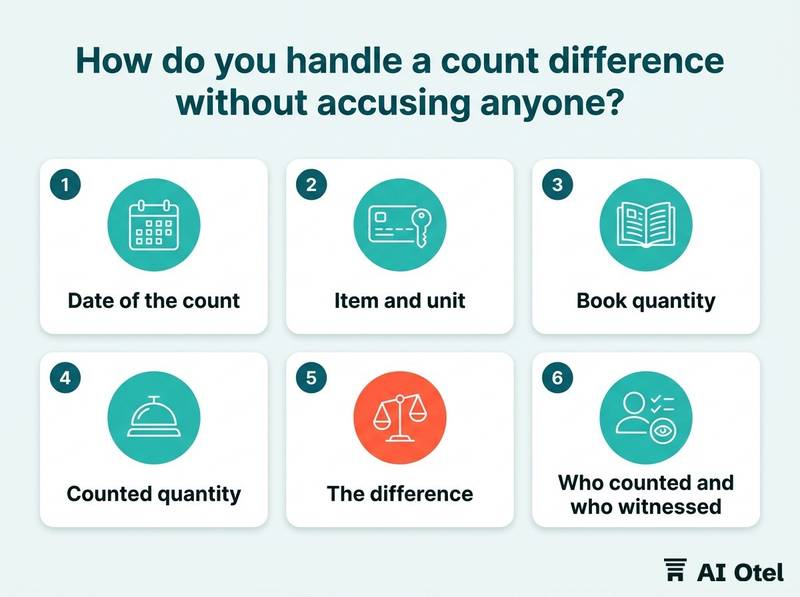
Write the difference down in a fixed format and keep opinion out of it. Facts and corrections only, no sentence about what anyone intended. Let the person correct the record where the cause is paperwork: a store keeper who can fix a slip without being treated as a suspect keeps bringing you problems early. Keep the shared record factual and the personnel note separate and confidential. The two documents answer different questions and should never be the same file. Never name and shame: a notice board list of people with differences ends the flow of information you actually need, because from that day the team stops reporting anything.
ChecklistWhat the difference record must contain
- Date of the count
- Item and unit
- Book quantity
- Counted quantity
- The difference
- Who counted and who witnessed
- What was found when the paper was checked
- What was corrected and who approved the correction
What do you do when the same difference repeats?
Change the process before you change your view of the person. A repeat on one item, in one department or on one shift each points somewhere different.
A repeat on the same item points at access and habit: who can reach it, at what hours, and whether the slip system is quietly bypassed for that item, as in "we always take the oil straight off the delivery". A repeat across many items in one department points at consumption rather than removal: portioning, staff meals, transfers out of the kitchen that nobody wrote down. A repeat on one shift or on one person's days moves the matter into a formal, documented process with your human resources lead, with the employee's right to respond and a written outcome.
Change the control for that item rather than tightening everything: two-person issue, sealed cases, a camera at the store door announced to staff, or a shorter issue period. Weigh the cost of over-control. Slower service, hoarding, and staff hiding waste to avoid a conversation are real costs, and a system that punishes the honest majority buys less than it spends. Have the owner sample the routine each quarter rather than only reading the results: ten issue slips, ten waste entries and one spot count sheet tell you whether the system is running at all. A wider sampling method is described in hotel internal audit: what an owner can check each quarter.
| Pattern | What to check first | First action |
|---|---|---|
| Same item, week after week | Access, and whether the slip is bypassed | Two-person issue for that item |
| Many items in one department | Portioning, staff meals and transfers | Portion and staff meal review with the chef |
| One shift or one person's days | That shift's paperwork first | Formal documented process with HR |
| Differences only after deliveries | Receiving practice | Blind receiving for a month |
What to do next
Write the four rules on one page this week: one store door and a key log, an issue slip signed before goods move, a weekly spot count of ten items by two people, and a daily waste log with four lines. Hand the page to the chef and the store keeper on the same day, and apply it to the manager's own withdrawals first, because a control that starts with the most senior person in the building is the one that survives its second month.
If you want the records to check themselves as they are written, a hotel operating system keeps financial records so that corrections are voided and reversed rather than deleted. It is built and working, ahead of launch. A wider view of how the pieces fit together is on the platform overview.
Frequently asked questions
What is the difference between shrinkage and pilferage?
Shrinkage is the umbrella term for all stock that never turns into a sale: used without a record, wasted, taken, or lost in paperwork. Pilferage is only the taken part. Using the two words interchangeably makes every count difference sound like theft, which is how a paperwork problem becomes a personnel problem.
Is a bag check at the staff exit allowed?
It depends on the contract and on how the check is carried out. Write the rule down, apply it to every employee including managers, and have the check witnessed by two people. Confirm the wording of your own policy with a legal adviser before it is used.
How often should a hotel count its store?
Three rhythms, three purposes: a weekly spot count of ten high-value items, a full store count monthly, and a full count across stores, minibars, linen and equipment at year end. The weekly count is the one that catches drift early; the year-end count values the stock.
Who should hold the store key?
One named keyholder and one named deputy, both recorded in a key register with issue and return dates. The master key should not open the store, so that every entry has a name attached to it.
Should the chef sign for what leaves the store?
Yes. The department that receives signs the issue slip, and the person who orders, the person who receives and the person who counts should not all be the same person. In a small hotel, rotate one of those three roles every few months.