Pricing a cocktail list at a hotel bar: recipe card, pour size, cost per drink and the price ladder
Cost hotel bar cocktails by building recipe cards with measured pours and garnish costs. Set prices with tiered ladders, find spillage gaps, and rebuild or retire drinks based on cash margin.
AI draft · awaiting editorial review
Contents
Key takeaways
- A cocktail's cost comes from its recipe card: bottle price divided by the pours a bottle yields at your measured pour size, multiplied by the measure that goes into the glass.
- Garnish, ice and small items are cheap per drink and are the first thing left off a costing sheet, so they belong on the card.
- A price ladder sets house, signature and premium drinks from their own cost bands, not from a single percentage applied to the whole list.
- The weekly gap between what the recipe cards say should have been poured and what the stock count says was used is where spillage, over-pour and free pours show up.
- A drink that sells well and costs too much is rebuilt before it is dropped.
Cost a hotel bar cocktail by writing a recipe card with every measure, dividing each bottle's price by the pours it yields at your measured pour size, adding garnish, ice and small items, then setting the menu price from a ladder of house, signature and premium tiers rather than one target across the list.
The cocktail list looks healthy on the sales report and thin on the bottom line. The reason is rarely the price of the gin: it is that nobody wrote down how much of it goes into the glass. This article walks hotel bar cocktail costing from the recipe card to the price ladder: how to measure a pour, how to cost one drink, what ice and garnish add, how variance finds spillage, and when to rebuild or retire a drink.
What belongs on a cocktail recipe card?
A recipe card lists every input that reaches the glass, in a fixed measure, so the same drink costs the same on any shift and in any bartender's hands. It is the same document the bartender works from and the cost sheet is built from. Two documents means two truths, and the second truth is usually the wrong one.
Every spirit and modifier goes on the card in milliliters, never in counts of seconds or splashes. Juices and syrups carry their batch yield: if a liter of syrup makes 20 servings, the card says so, because the batch is where sugar and citrus quietly disappear. Glass type and ice belong on the card too, since cubed, crushed or a single block changes both dilution and the cost of the ice itself.
Garnish is counted as a unit or weighed: one wedge, one twist, one sprig, with the trim loss from the fruit written next to it. Method and approximate time go on as well, because prep time is a real cost in a busy bar even though it never appears on an invoice. Finally, the card carries a version number, a date and the name of the person who signed the change, so a price can always be traced back to the card it was built from. The same discipline governs standard recipes and portion cost in hotel kitchens.
ChecklistRecipe card checklist, one line per drink
- Base spirit and measure in ml
- Each modifier and measure in ml
- Juice or syrup with batch yield
- Glass type
- Ice type
- Garnish by unit or weight, with fruit trim loss
- Method and approximate time
- Version number and date
- Signed by
How do you cost one drink from a bottle price and a pour size?
Divide the bottle price by the number of pours it actually yields at your measured pour size, then multiply by the number of those pours the recipe uses, and add the components together. This is the arithmetic at the heart of hotel bar cocktail costing, and it fails only when the inputs are guesses.
Pours per bottle is bottle volume divided by pour size, minus an allowance for what is left in the bottle and what is spilled. A bottle that should give 14 pours at 50 ml rarely gives 14. Use the price you actually pay, and keep one basis across the whole list, with or without tax, so the ladder compares like with like. Which basis to use for pricing decisions is a question for your accountant.
Measure the pour with a jigger or a measured pour spout. A free pour is a guess, and a guess cannot be costed or audited. Record the date of the bottle price on the card: a cost built on last year's supplier price is a fiction that survives until the invoice arrives.
For example, a bottle bought at a stated price, poured at 50 ml, gives about 13 usable pours after the allowance; a drink using two of those pours carries two thirteenths of the bottle price as its spirit cost. Add the modifiers the same way, then the garnish and small items, and only then look at the total. Costing the spirit alone flatters every drink on the list.
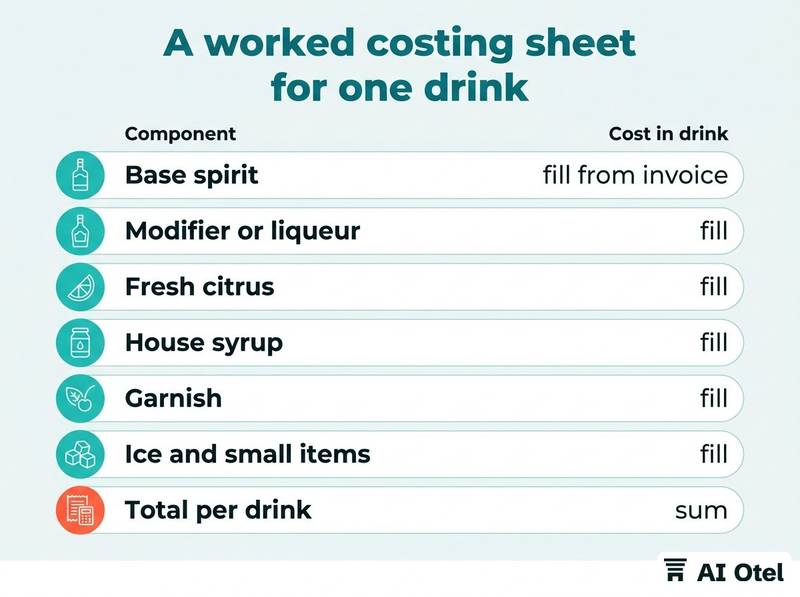
A worked costing sheet for one drink
| Component | Measure (ml) | Pack price and size | Servings per pack | Cost in drink |
|---|---|---|---|---|
| Base spirit | 50 | illustrative | about 13 | fill from invoice |
| Modifier or liqueur | 15 | illustrative | fill | fill |
| Fresh citrus | 20 | illustrative | fill | fill |
| House syrup | 10 | illustrative | fill | fill |
| Garnish | one unit | illustrative | fill | fill |
| Ice and small items | fixed | allowance | n/a | fill |
| Total per drink | sum |
Figures are illustrative and each hotel fills them from its own invoices.
What do ice, garnish and the small items add?
They add little per drink and they are the part most often missing from a costing sheet, which is exactly why they belong on the card. Individually cheap, collectively they shape the real cost of every serve.
Citrus is bought by weight and used by piece. A wedge, a wheel and a twist cost different amounts from the same fruit, and the trim loss differs with each. Ice is an input with a cost: production, storage and the space it takes. Crushed ice fills more of the glass and dilutes faster than a single block. Bitters, sugar, salt, egg white, straws, napkins and the occasional broken glass are small per serve and large across a month.
Choose one method and keep it: either itemize each small input on the card, or add a fixed small-items allowance per drink and review that allowance when supplier prices move. The allowance is a house convention. Set it, write it down, and apply it to every drink so the ladder stays comparable.
NoteOne method, every drink
The small-items allowance is a house number, not an industry figure. Whatever method a bar chooses, the same method must apply to every drink on the list, otherwise the price ladder compares drinks costed two different ways.
How do you set a price ladder across the list?
Sort the list into house, signature and premium tiers, and set each tier's price from its own cost band rather than applying one target percentage to the whole list. The ladder reflects what each drink does for the bar, not a single ratio.
House drinks are the volume: familiar recipes, cheap base spirits, fast to build. They carry the bar's throughput and should be priced to keep guests ordering a second one. Signature drinks carry the bar's identity and usually more labor: house syrups, more steps, a specific glass. Their price reflects the work as well as the liquid. Premium drinks use aged or top-shelf spirits. They often carry a lower percentage of cost in the price and a higher cash margin per serve, which is why a single percentage target across the list distorts them.
| Tier | What puts a drink there | How the price is set | Check before it goes on the list |
|---|---|---|---|
| House | Familiar recipe, cheap base, fast to build | Priced for volume and repeat orders | Cost band holds at high volume |
| Signature | House ingredients, more labor, specific glass | Reflects the work as well as the liquid | Not priced above a premium drink |
| Premium | Aged or top-shelf spirits | Own cost band, lower percentage, higher cash margin | No inversions against signature tier |
Check the ladder for inversions: a premium drink priced below a signature, or two drinks with nearly identical cost sitting in different tiers. Round to menu-friendly steps so the list reads as a set of choices rather than a spreadsheet, and keep the ladder consistent with how the restaurant prices wine and food. The same grouping logic underpins menu engineering for hotel restaurants. The target cost percentage for each tier is a house decision made from your own payroll, rent and margin needs. There is no universal figure to copy.
How do spillage and free pours show up in a weekly check?
Compare what the recipe cards say should have been poured, given the week's sales, with what the stock count says was used. The gap is spillage, over-pour, comps or loss, and it has a name and a cost. This is the practical side of beverage cost control: measures, par stock and the monthly count.
Theoretical usage: for each drink sold, multiply its recipe measures by the number sold, then add the same for every spirit sold by the glass. Actual usage: opening stock plus deliveries minus closing stock, in bottles and in milliliters. State the variance in milliliters and in money, per spirit, not as one number for the whole bar. One number tells you something is wrong; a per-spirit number tells you where.
Free pours and comps need a written rule and a log: who may give a drink away, to whom, and where it is recorded. Without the log, every comp looks like a loss. Keep a spillage and breakage log at the bar, filled in when it happens, not reconstructed at month end. Run the check weekly and the full count monthly, and have one named person review the variance with the bar manager. The same daily discipline that keeps counts honest is part of the hotel bar opening and closing checklist.
Watch outA variance is a question, not a verdict
Over-pour, unrecorded comps, a mis-keyed recipe, a supplier short-delivery and theft all produce the same gap. The check exists to find the cause before anyone is accused.
When should you drop or rebuild a drink that sells but costs too much?
Rebuild it first, because most expensive drinks can be fixed without losing the guest; drop it only when the rebuild still leaves it a poor use of the bar. The decision rule matters more than the decision itself.
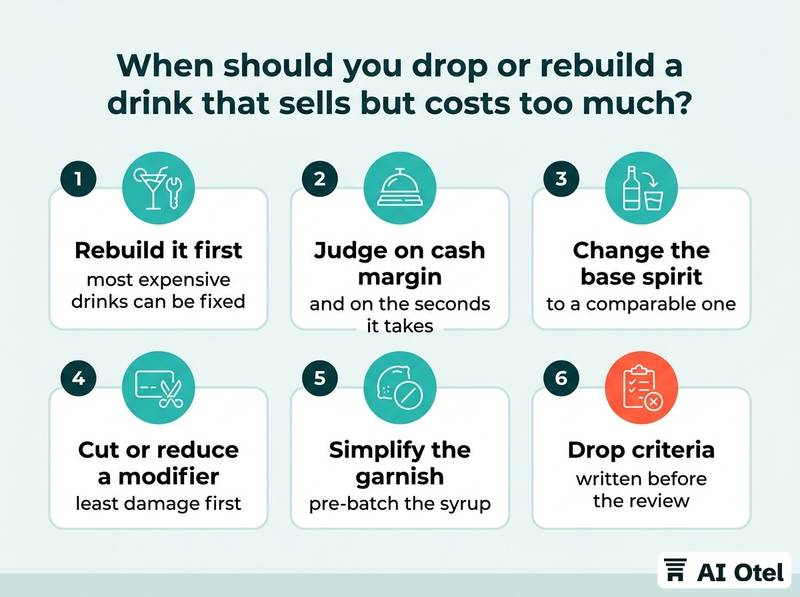
Judge a drink on cash margin per serve and on the seconds it takes to build, not on cost percentage alone. A cheap drink that takes ninety seconds and two tins can be worse than an expensive one built in twenty. Rebuild levers, in order of least damage: change the base spirit to a comparable one, cut or reduce a modifier, simplify the garnish, pre-batch the syrup or the drink itself, adjust the serve size, and only then raise the price.
Test a rebuild on a small run before it goes on the list, and keep the old card so the change can be measured against it. Drop criteria should be written before the review, not decided in the argument: for example, a drink that stays above its tier's cost band after two rebuilds, or one that no longer fits the list's identity. Retire quietly: take it off the printed list, keep it available on request for a season, and tell the team what to offer instead. The wider frame is food and beverage cost control in hotels.
How do you review the cocktail list each season?
On a fixed calendar, re-cost every drink from current supplier prices, re-check the ladder, and retire what no longer earns its place. A card that has not been touched since spring is a card you cannot trust.
Re-cost quarterly and change the menu seasonally. Supplier prices move between the two. Check garnish seasonality with the kitchen: fruit that is out of season costs more and looks worse in the glass. Compare the sales mix against the ladder: a tier that nobody orders is either priced wrong or described wrong on the menu.
Archive every old recipe card with its date and version, so a returning drink is costed the same way it was before and the comparison is honest. Give one person the sign-off, and tie the review to the annual budget so pricing changes and margin expectations move together.
ChecklistSeasonal review checklist
- Re-cost every drink from current invoices
- Re-check each tier's cost band
- Confirm garnish availability with the kitchen
- Review sales mix by tier
- Rebuild or retire flagged drinks
- Archive the old cards with dates
- Sign off and reprint
What to do next
Write one recipe card today for the drink you sell most, cost it from the invoice in front of you, and compare the result with its menu price. That single card gives you the method, the pour discipline and the ladder logic that the rest of the list can then be built on.
Frequently asked questions
What is a good pour cost for a hotel bar?
There is no universal figure to copy. Pour cost is a house target derived from your own rent, payroll and margin needs, and it differs by tier: house, signature and premium drinks should not share one target. Set the target, write it down, and apply it consistently.
How many cocktails does one bottle make?
Bottle volume divided by pour size, minus an allowance for the last of the bottle and for spillage. The arithmetic is simple; what matters is that the pour size is measured rather than guessed, and that the same allowance is used on every card.
Should every bar in the hotel use the same price ladder?
No. A lobby bar, a pool bar and a rooftop bar have different labor, glassware, waste and guest expectations, so each needs its own ladder. What should be shared is the method: the same recipe card format, the same costing basis and the same review calendar.
How often should cocktail prices change?
Re-cost quarterly and change the printed list seasonally, or sooner if a supplier price moves sharply. Frequent small corrections beat one large annual increase, which guests notice and resent.
Does a high-margin drink always belong on the list?
No. Margin per serve is only one test. Prep time, glassware, ingredient shelf life and whether the drink fits what the bar is known for all matter, and a drink that slows the bar at peak can cost more than it earns.