Quiet hours in a hotel: choosing the times, writing the rule and applying it kindly
Set quiet hours by guest mix and publish them before arrival. Apply them with a friendly knock, a repeat and a duty manager decision, never an argument at the door.
AI draft · awaiting editorial review
Contents
Key takeaways
- Quiet hours are a house rule about named zones and named times, not a promise that the building will be silent.
- Set the band from who sleeps in the building: a family resort and a city hotel with a lobby bar do not share a clock.
- A guest who read the hours in the confirmation message is easier to remind than one who meets the rule for the first time at midnight.
- The night response has three steps in order: a friendly knock, a repeat with the time noted, and a duty manager decision.
- Event end times belong in the contract and in a letter under every door, not in an argument at 01:00.
Hotel quiet hours are the times a hotel asks guests and its own teams to keep noise low in named zones, usually overnight. Choose them from your guest mix, publish them before arrival and on the room card, and apply them with a knock, a repeat and a duty manager, never an argument at the door.
It is 00:40. A guest in 412 calls the desk about the room above, and the room above is a wedding party that booked the terrace until midnight and stayed. The rule the hotel needed was written months earlier, or it was not. This article gives you that rule: how to choose the hours, where to publish them, what the night team says at the door, and how to review the results once a month.
What do hotel quiet hours actually cover?
Quiet hours cover two kinds of sound: what guests make and what the hotel makes. Write the list of zones and sources into the rule, because a guest told to be quiet without a place and a time hears an opinion, not a rule.
Guest-made sound lives in rooms, corridors, lift lobbies, balconies, terraces, the pool deck, the courtyard and the car park. Hotel-made sound is longer and more often forgotten: pool and bar music, deliveries, glass bins, housekeeping trolleys, door closers, laundry, extractor fans and early maintenance. A rule that only addresses guests is half a rule, and staff break it more often than guests do.
Name the exceptions in the same document: event nights, the pool music schedule and any refurbishment window, each with its date. Say what the rule does not reach: street traffic, neighbouring buildings and the acoustics of the building itself. A hotel controls its rule and its fabric, not the city.
Zones must be physical. Write "the terrace", "the corridor outside rooms 400 to 430" and "the pool deck", not "outdoor areas" and "the floor". Give the rule one owner: a duty manager by night, the rooms division manager by day, so the wording and the hours do not drift between shifts.
ChecklistThe scope checklist a written rule should name
- Guest rooms and balconies
- Corridors and lift lobbies
- The pool deck and its music
- The terrace and outdoor bar
- The courtyard and car park
- The event venue
- Deliveries and glass collection
- Housekeeping trolleys and door closers
- Maintenance windows
How do you choose the hours?
Choose the band from who sleeps in the building and from the calendar, then keep it fixed for a season so staff and guests can learn it.
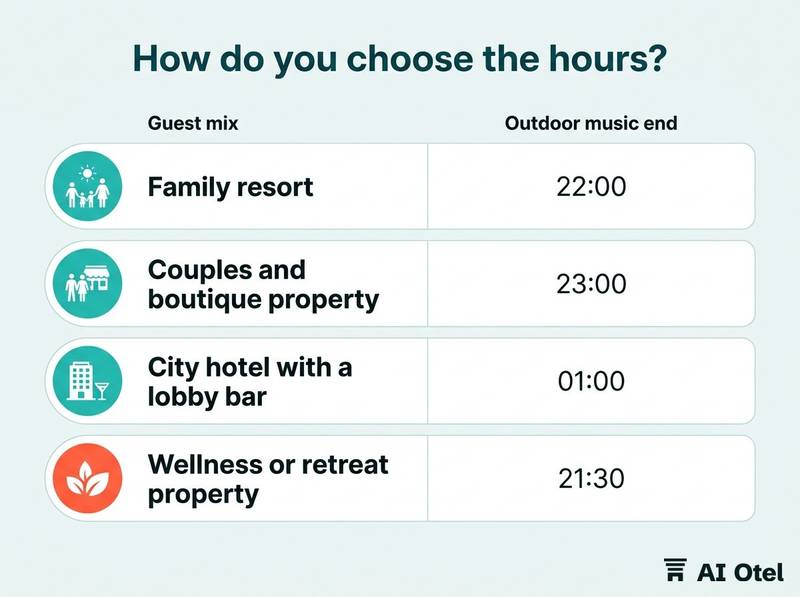
Start with the guest mix. Families and wellness guests sleep earlier; a city hotel with a lobby bar and a late restaurant has a different center of gravity. Run two bands, not one: an outdoor music end time for the pool, terrace and bar, and a building-wide quiet band for rooms and corridors. The first is usually earlier, because music carries and conversation does not stop on a schedule.
Event nights shift the outdoor band, and the shift should be published in advance so the music does not decide on the night. A seasonal shift is fine when it is written and dated; an unwritten summer exception is a complaint waiting for July. Name the trade-off out loud: an earlier music end costs bar covers, a later one costs sleep and reviews. Decide which one the property is selling.
Write the band as a start and an end, and apply it to the hotel's own teams too. A trolley at 06:15 breaks the rule faster than a guest does.
| Guest mix | Outdoor music end | Building quiet band | What the choice protects |
|---|---|---|---|
| Family resort | 22:00 | 22:30 to 07:00 | Children's bedtimes and parents' patience |
| Couples and boutique property | 23:00 | 23:00 to 08:00 | The calm the rate sells |
| City hotel with a lobby bar | 01:00 | 01:00 to 07:00 | Late revenue without corridor noise |
| Wellness or retreat property | 21:30 | 21:30 to 07:30 | Early sleepers and morning programs |
For example, not a recommendation: the table shows how the same mechanism serves four different properties. If you run quiet programs at a weekend retreat, the band follows the program, not the bar.
Where should guests see the rule before they arrive?
In the confirmation message, in the pre-arrival message, on the room card and on a sign at each zone. The confirmation is the one place a guest reads before the stay, so the hours belong there in the same words used everywhere else.
The confirmation message carries one short paragraph with the hours, the zones, what to do instead and the reception number. The pre-arrival message, a day or two before, repeats the same words and adds that week's event-night exception if there is one. Group and event contracts carry the end time and any sound limit as contract terms, not as a note added at the welcome meeting.
The room card and the in-room card repeat the wording, in the languages the property actually serves at the desk. Zone signs at the pool, the terrace and the lift lobby meet the guest where they are standing when the rule matters.
Run a consistency check each season. If the confirmation says 23:00 and the sign says 00:00, the guest is right and the hotel has no rule. This is one piece of the wider task of how to write hotel house rules and where guests see them.
How should the night team apply the rule?
In three steps, in this order, with the time written down at each one: a friendly knock with a specific request, a repeat with the time noted, and a duty manager decision.
Step one: knock, name yourself, name the specific sound and the specific request, give the hour and thank the guest. No lecture and no threat at the door. Step two: if it continues, return after the interval the hotel has chosen and written down, repeat the request, note the time and say what happens next. Step three: the duty manager decides. The options, in order, are moving the complainant, moving the group, offering earplugs and a fan, and applying the consequence the house rule already states.
Write the consequence before the night it is needed. A rule with no stated consequence is a request, and staff will treat it as one. Log every step, because the log is what makes the monthly review possible.
ChecklistThe three-step response with its log fields
- Knock: time, room, sound named, request made
- Repeat: time, interval, what changed
- Duty manager: time, decision, outcome, guest informed
Never argue at the door, and never send one person alone to a large group; two staff, one speaking, is the safe pattern. Keep this separate from the complaint call routine, covered in answering the night noise call and preventing the next one. The desk answers the call; the knock is a decision with a sequence.
What wording keeps the tone friendly?
Write the rule as a promise to the guest who is sleeping, not as a threat to the guest who is not.
Put the hours and the zones in the first sentence, so the reader knows within five words whether it concerns them. Say what to do instead: the lobby bar, the terrace until its own end time, the beach, the lobby lounge. Give a number to call and say who answers it; a rule with no route to a person invites the guest to solve it alone.
Drop "strictly prohibited", "zero tolerance" and any penalty the hotel will not actually apply on the night. Keep two versions: the printed rule, calm and short, and the door script, spoken and specific. They must not contradict each other. Use the same words in every language the property serves, because a loose translation reads as a different rule, and the guest will quote the version they read.
TipBefore and after
Before: "Guests are strictly prohibited from making noise after 23:00. Violations will result in a fine." After: "Between 23:00 and 07:00 we ask for quiet in the rooms, corridors and balconies, so the guests around you can sleep. The lobby bar stays open until 02:00, and reception answers at any hour."
How do you handle weddings and event nights?
Agree the end time in the contract, tell every guest in the building before the night, and give one named person the authority to end the music.
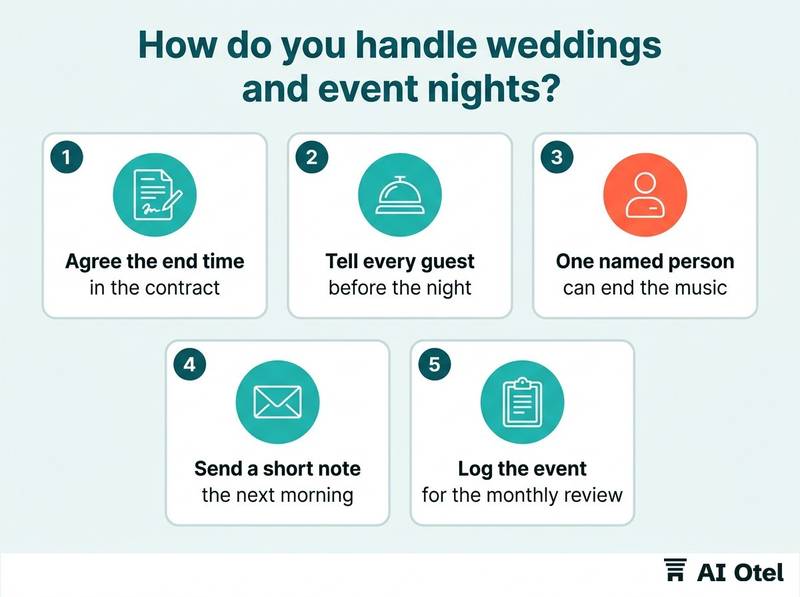
The contract carries the amplified music end time, any sound limit the venue works to, the clean-up window and who is responsible after the end time. Leave a buffer between the music end and the building quiet band, so the walk back to the rooms is not the noise event itself.
A letter under every door on the morning of the event tells guests what is happening, when it ends, the desk number and how to ask for a room move. Offer the move before the event, not at 01:00 when the complainant is already awake and the house is full. One named hotel person can end the music; a venue manager who has to phone someone is a delay the corridor hears.
NoteThe four lines of the under-the-door letter
What the event is, the music end time, the reception number, and how to ask for a room move.
Send a short note the next morning and log the event for the monthly review, so the next contract is written with last month's evidence.
How do you review noise complaints each month?
Count them by zone, hour and cause, then change one thing a month: the hours, the fabric or the wording.
The log fields are date, time, room, zone, cause, action taken and outcome. Without the cause column the review becomes a list of names. Separate hotel-made noise from guest-made noise: the first is a scheduling or maintenance fix, the second is a rule and response fix.
Look for repeats: the same room, the same corridor, the same night of the week, the same event series. Fabric fixes are cheaper than arguments: door closers, trolley wheels, bin locations, glass collection times, balcony door seals. Check whether the guest who complained had the rule in their confirmation message; if not, the failure started at booking. A room-level review helps too, alongside a room check for noise, light, temperature and pillows.
Make one written change per month, with a date and an owner, so the review produces a decision instead of a meeting.
What to do next
Write the one-page rule this week: the two bands with their hours, the zones by name, the wording that goes into the confirmation message and onto the room card, the three night steps with their log fields, and the event letter. Then run the monthly review against that page, changing one thing at a time, so the rule stays a decision the hotel made rather than a sentence a guest read once and forgot. If you are choosing where to stay rather than running the house, you can find a hotel in Türkiye (opens in a new tab) that suits your own hours.
Frequently asked questions
What time should quiet hours start in a hotel?
There is no single correct hour; it follows the guest mix. Set an outdoor music end time and a building-wide quiet band, for example 23:00 to 07:00 at a family property, and keep both fixed for a season. Publish them in the confirmation message and on the room card, and write any event-night shift in advance.
Do quiet hours apply to the pool and the terrace?
Only if the rule names them. Treat pool and terrace music as a separate schedule with its own end time, usually earlier than the building band, and put a sign where the guest is standing. The building band then covers rooms, corridors and balconies.
What should the room card say about quiet hours?
Four things in one short paragraph: the hours, the zones, what to do instead, and the number to call with who answers it. Use the same words as the confirmation message and the zone signs, in the languages the property serves.
How do you tell a group of guests to be quiet without a confrontation?
Knock, name the specific sound, make the specific request, give the hour and thank them. If it continues, return after the written interval, repeat the request and note the time. The duty manager then decides, and the consequence was written into the house rule before the night it was needed.