A weekend retreat at the hotel: yoga, wellness and quiet programs without making health claims
A hotel wellness retreat program requires clear contracts, a suitable studio and strict quiet hours. This guide explains how to manage the operation without making health claims.
AI draft · awaiting editorial review

Contents
Key takeaways
- The contract is normally with the teacher or organizer, not with the guests, so decide who carries the risk of an unfilled room block before you quote.
- A retreat needs one room that can be darkened, kept quiet and emptied of furniture for the whole weekend; if you cannot give that, say so before signing.
- Describe the schedule, the room, the food and the teacher; never promise calm, better sleep, weight loss, detox or any other result.
- Quiet is an operational promise: name the hours, the floors, the staff member who enforces them and how other guests are told in advance.
- Retreat guests are still hotel guests: identity is checked in person at the desk, and the stay still involves payment, a fiscal document, a guest identity notification (KBS) and personal data.
A hotel wellness retreat program is a weekend built around a teacher's schedule: the organizer sells and teaches, the hotel provides rooms, a studio room, food and quiet. Agree who sells, which room is the studio, what the kitchen serves, what quiet means and what your advertising may say before you accept.
For example, a yoga teacher emails in January about a weekend in March: a small group, one hall, vegetarian food and silence until noon. The hotel answers yes within the hour, then spends six weeks finding out what it agreed to. This article is the alternative: it walks through the decisions in order, so the next inquiry gets a one-page answer instead of a six-week negotiation. It covers the contract, the studio room, the kitchen, quiet hours, the advertising and the Monday debrief.
Who is your customer: the teacher, the group or both?
Your contract is usually with the teacher or the organizer, and the guests are that person's customers. Settle this first, because it decides who sells, who collects the money and who answers a cancellation.
Three models work in practice. In the first, the organizer buys a room block and a hall and sells the places themselves; you sell rooms and a room, not a program. In the second, the hotel sells the weekend as a package and pays the teacher a fee; you are the seller, and your advertising rules cover the whole offer. The third is shared risk: a guaranteed minimum room count, with a hall fee if the organizer falls short. The same weekend can be priced very differently under each model, so choose deliberately rather than by default.
Decide who holds the guests' money. If the organizer takes deposits, the hotel should not also take deposits for the same rooms, or a guest will be refunded twice or not at all. Decide who answers questions before arrival, too: the organizer should own the schedule, what to bring and dietary needs, while the hotel answers room, travel and building questions only. Mixed channels produce contradictory answers, and contradictory answers arrive at the front desk on Friday evening.
Personal data follows the same split. The organizer collects dietary and health information from their group; the hotel should receive only what the kitchen and housekeeping need, in a form you have agreed, and nothing more. Türkiye's personal data protection law (KVKK) applies to both sides, so write down who holds what.
Retreat guests do not skip the desk. In Türkiye every stay involves a payment, a fiscal document (an invoice or e-document), a guest identity notification (KBS) and personal data under KVKK, and identity is checked in person at the desk. A group booking changes the billing route, not the check-in.
Finally, name one decision-maker on each side who is reachable during the weekend. A program that starts at 07:00 cannot wait for a sales manager to answer on Monday.
What should the contract with the organizer cover?
A retreat contract is a group contract with three extra objects: a hall, a timetable and a standard of quiet. All three need dates, times and a price.
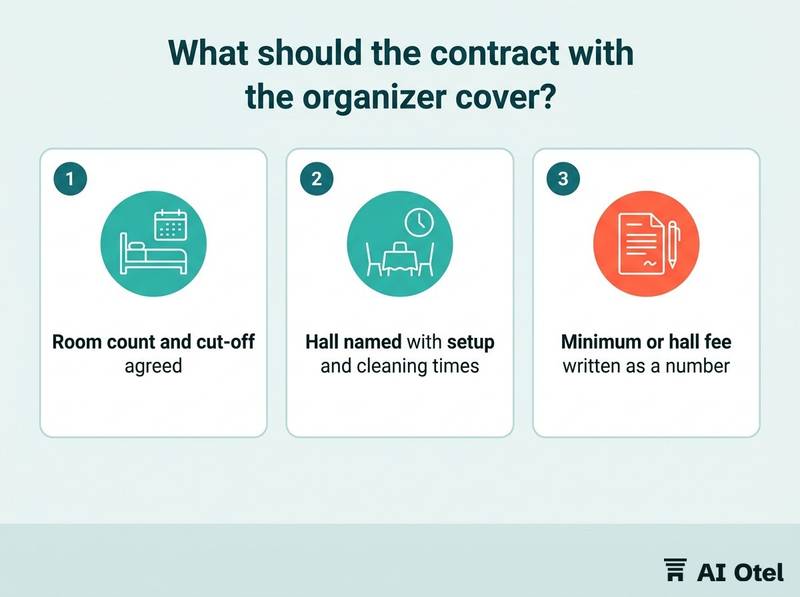
The room block is standard group business: number of rooms, room types, nightly rate, cut-off date, release of unsold rooms and what happens if the block is not picked up. The basics are covered in how to quote a hotel group: rates, free places, deposits and terms. The hall is not standard: name the room, the setup time and the end of cleaning, who moves the furniture, and who pays if the room cannot be sold that weekend.
The minimum matters most. Write a guaranteed room count or a flat hall fee, and the consequence of falling short. Use the number of places the organizer has already sold, not the number they hope for. Hope is not a contract term.
Cancellation needs both directions: dates and consequences if the organizer cancels, and what you owe, including whether you rehouse the group, if the hotel cancels. Extras always appear, so price them in advance: extra cleaning, late checkout on Sunday, water and tea stations, mat storage, a staffed desk near the studio.
Ask, in writing, for the organizer's liability cover, the teachers' first-aid arrangements, and who is responsible for a guest who becomes unwell during a session. Do not assume any of it. Payment terms close the contract: deposit, balance date, and how extras taken during the stay are billed, either to the guest's room or to the organizer's master account.
ChecklistBefore you sign
- Room count and cut-off date agreed
- Hall named with setup and cleaning times
- Minimum or hall fee written as a number
- Organizer cancellation dates and charges
- Hotel cancellation and rehousing position
- Insurance and first-aid documents received
- Meal times and prices fixed
- Extras billing route chosen
- One named contact on each side
- Deposit and balance dates in the calendar
Which room becomes the studio?
Choose the room by three tests: it can be darkened, it can be kept quiet, and it can be emptied. A ballroom that fails one test costs more than a smaller room that passes all three.
Neighbours come first. Rooms directly above and beside the studio hear every jump and every playlist. Move other guests off that corridor for the weekend if the house allows it, and say so in the contract. Light comes second: winter sessions often start before sunrise and evening sessions run after sunset, so the room needs blackout or dimming.
Floor and ceiling matter more than they look. Mats, blocks, straps and sometimes chairs need height and a surface that is not polished on Friday night. Ask the teacher what they need, then check the room against that list rather than against your own idea of a yoga room. A room full of moving people heats up quickly, so know who adjusts the temperature and how fast they can reach the room.
Access is an operational question: who opens the space at 06:30, who closes it at 21:00, and how the group reaches the room without crossing the breakfast queue in bare feet. Equipment needs a home: where mats are stored between sessions, who cleans them, and whether the hotel supplies any. If it does not, say so plainly rather than promising a cupboard you have not checked.
Safety closes the list: the room's capacity, exits kept clear, no candles or incense, and a written rule on what the organizer may and may not bring in. And treat a thirty-minute gap in the timetable as a cleaning slot, not free time for housekeeping to be somewhere else.
| What to check | Question to ask | What to write down |
|---|---|---|
| Neighbours | Who is above and beside the room? | Corridor blocked for other guests |
| Light | Can it be blacked out and dimmed? | Curtain or blind condition |
| Floor and ceiling | What surface does the teacher need? | Furniture to be removed |
| Heating and air | Who adjusts it, how fast? | Named person and response time |
| Locks | Who opens at 06:30, locks at 21:00? | Key holder on shift plan |
| Mats | Where stored, who cleans? | Storage room and cleaning duty |
| Capacity and exits | Legal capacity? Exits clear? | Number and floor plan |
| Cleaning | Gap between sessions? | Slot in the timetable |
| Access route | Barefoot route from rooms? | Route drawn on a map |
If your hotel also runs a spa, the studio decision sits next to the wider treatment operation described in running a hotel spa: the daily operation of hammam, sauna and treatments.
What can the kitchen promise, and how should the menu be written?
Promise food you can actually cook at the hour the group eats, and describe it plainly: what the dish is, what is in it and what it does not contain.
Meal times follow the timetable, not the buffet. A 07:00 session means breakfast at 06:15 or a served set menu afterwards, and the kitchen rota has to show it. Between a fixed menu and a buffet, the set menu is easier to cost and to label. A buffet needs a written label on every item, not a card at the end of the table.
Collect allergens and dietary needs through the organizer with a deadline, confirm the list in writing, and name one kitchen contact who owns it for the weekend. Plain labels work better than persuasive ones: "vegetable soup, contains celery" tells a guest more than "detox broth" and creates no promise you have to keep.
Ask the organizer what the group expects on alcohol and caffeine in the areas it uses, and write the answer into the contract rather than deciding on the day. Water and tea need the same treatment: where the station is, who refills it, and whether it is inside the price or billed as an extra. Cost per person per meal, plus a buffer for the two or three people who arrive without booking a meal.
Watch outMenu words that turn a dish into a health claim
Detox, cleanse, healing, immunity-boosting, superfood, doctor-approved, burns fat, cures. Replacement rule: name the dish and its ingredients, and let the guest decide what it does for them.
If the weekend is sold as a package rather than rooms plus a hall, the pricing questions in hotel packages: pricing a room with spa, dinner or transfer as one offer apply to the whole offer.
What does quiet mean in a hotel that has other guests?
Quiet is a set of named hours, named places and a named person who enforces them. Left as an intention, it becomes a complaint by Saturday lunchtime.
Define the hours and the places in the contract. For example, silence in the studio corridor between 22:00 and 08:00, and phones away inside the studio. Then tell the other guests before they notice: a short note at check-in about a group program on one floor, with its hours, prevents most complaints.
Move the conflict, not the guest. Put the group on one floor, keep housekeeping off that corridor until late morning, and lower the music by the pool for the weekend. Brief the front desk and the night shift on who to call, what to say, and what not to promise; a receptionist who improvises a refund creates a bigger problem than the noise.
Group communication belongs to the organizer. The hotel does not join the group chat, and the organizer does not promise hotel services the hotel has not agreed. Set a complaint path: a named duty manager, a written log, and a rule that a noise complaint is answered within minutes rather than at checkout. And do not sell silence to the rest of the house: the promise is a program for one group, not a change to the character of the hotel.
ChecklistQuiet weekend checklist
- Quiet hours written into the contract
- Group placed on one floor
- Housekeeping timing changed for that corridor
- Other guests told at check-in
- Pool and lobby music level agreed
- Front desk and night shift briefed
- Duty manager named
- Complaint log opened
- Organizer's communication channel agreed
- End-of-weekend review scheduled
What may the hotel's advertising say about the weekend?
Describe what happens: the timetable, the room, the food, the teacher and what the price includes. Do not describe what the guest will become.
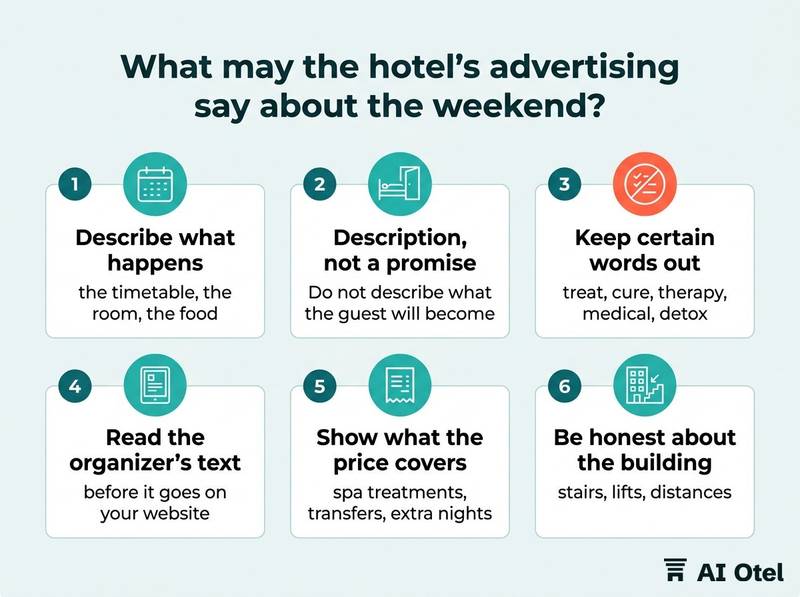
The line is between a description and a promise. "Two yoga sessions a day in a quiet room, breakfast served after the morning session" is a description. "Leave calmer, sleep better, lose weight" is a promise about a result, and the hotel should not make it. Keep certain words out of hotel channels entirely: treat, cure, therapy, medical, detox, cleanse, healing, clinically proven, doctor-designed. The same applies to before-and-after photographs and to guest quotes about health.
The organizer's claims become your problem when the hotel sells the package. Read the text the organizer sends you before it goes on your website or your guest app, and edit it. Print the teacher's training exactly as the organizer states it, and ask for the document; do not turn "completed a 200-hour training" into "certified therapist".
Show what the price covers and what it does not: spa treatments, transfers, extra nights, alcohol. Price display rules for in-house outlets vary, so confirm the display with your adviser. Be honest about the building: stairs, lifts, distances, and whether the studio can be reached without crossing a smoking area. Keep a dated copy of every text you published, so a question six months later has an answer.
Key pointThe one test before publishing
Could a guest reasonably ask for their money back because this sentence was not true? If yes, cut the sentence and describe the timetable instead.
What should the Monday debrief cover?
The debrief is where a weekend becomes a product: what the group actually used, what broke, and whether you would take the same booking at the same price.
Record the numbers you already have: rooms picked up against the block, meals served, extras billed, staff hours above a normal weekend, complaints logged. Ask the organizer three questions: what worked, what they will ask for next time, and whether they want to return on the same terms. Ask each department the same three: front desk, housekeeping, kitchen and night shift. The useful answers usually come from the night shift.
Review incidents: any guest who became unwell, any noise complaint, any damage. Check what the insurance question turned out to be in practice. Then decide, and write it down: repeat as it was, repeat at a different price, change the room, or decline. Next year's answer should not be improvised by whoever opens the email.
Keep one file: contract, timetable, menu, published text, complaint log and debrief. It is the cheapest sales document you will ever produce.
What to do next
Write a one-page retreat sheet before the next inquiry arrives: who sells, which room is the studio and for which hours, meal times and menu rules, quiet hours and who enforces them, and the sentences your hotel is allowed to publish. The sections above are the contents of that page, and the Monday debrief is how it improves.
Frequently asked questions
How many rooms should a hotel block for a yoga retreat?
There is no standard number, and any figure quoted without the organizer's sales history is a guess. Ask how many places have already been sold, size the block to the studio's capacity, set a cut-off date, and write down what happens to rooms released after it.
Do retreat guests still need to check in with ID?
Yes. Every guest is a hotel guest: identity is checked in person at the desk, and the stay involves payment, a fiscal document, a guest identity notification (KBS) and personal data under KVKK. A group booking changes the billing route, not the check-in.
Can a hotel advertise a weekend as a detox or a wellness retreat program?
"Wellness retreat" is a label for a program and can be used if the timetable supports it. "Detox" and similar words imply an effect on the body, which the hotel cannot promise. Describe the sessions, the room and the food, and confirm the final wording with your legal adviser.
Who is responsible if a guest is injured during a yoga session?
The contract with the organizer should say, and it should be agreed before the weekend. Ask for the organizer's liability cover and the teachers' first-aid arrangements in writing. The contract should also settle the room itself: capacity, exits, floor surface and access.
Should the hotel sell the retreat itself or let the organizer sell it?
It depends on who carries the risk of an empty room block. If the hotel sells the weekend as a package, the hotel is the seller and its advertising, pricing and guest communication cover the whole offer, including the teacher's claims. If the organizer sells, the hotel sells rooms and a hall, and should still check any text that carries its name.