The guest amenities list: what goes in a room, by hotel class, and what it costs to restock
Define your hotel guest amenities list in three tiers based on actual usage. Learn to set par levels, calculate cost per occupied night, and manage restocking efficiently.
AI draft · awaiting editorial review
Contents
Key takeaways
- An amenity list is a purchasing and housekeeping standard, not a copy of a competitor's room: three tiers, a count, a par level and a review date.
- Class sets the expectation a guest carries into the room; your own written standard, not a borrowed list, decides what you stock.
- Count what leaves the floor store for two weeks before you set a par level; what guests take and what they leave behind are two different numbers.
- Cost belongs per occupied night, not per room: a bathrobe is a laundry item with a replacement cycle, slippers are a consumable.
- Every item you stop providing needs a sentence in the booking confirmation and a card in the room, or the front desk absorbs the complaint.
A hotel guest amenities list is the written standard for what sits in each room zone, split into three tiers: always provided, on request, and premium. It records a count per room and per occupied night, a par level for the floor store, and a review twice a year against what guests actually used.
A guest opens the bathroom cabinet, finds a shower cap, a sewing kit and a shoe mitt, and uses none of them. The hotel pays for all three, every night, in every room. The list that put them there was probably copied from another hotel. After reading this you will be able to write your own list in three tiers, count what guests actually use, set a par level for the floor store, and hand purchasing a one-page order list they can buy from without walking to housekeeping.
What is a hotel guest amenities list?
It is the written standard that says what sits in each room zone, in what quantity, at what tier, and who restocks it. Draw the boundary first: an amenity is a consumable or a small reusable item the hotel places in the room for the guest's use. Furniture, televisions and mattresses are equipment; a massage or an airport transfer is a service. Mixing the three on one list is why amenity budgets drift.
The list has three tiers. Tier one, always: in every room, every night, without the guest asking. Tier two, on request: held in the floor store and delivered within a stated time. Tier three, premium: tied to a room category or a guest tier, never to the whole house.
| Tier | What it means in practice | Examples | Where it is stored |
|---|---|---|---|
| Always | In every room, every night, no request needed | Soap, water, towels, toilet paper | In room |
| On request | Floor store, delivered on a call within a stated time | Shaving kit, dental kit, adapter, extra pillow | Floor store |
| Premium | Room category or guest tier only | Suite coffee, welcome tray, higher-grade bathroom line | Floor or main store |
Every line needs, at minimum: item, room zone, tier, count per room, count per occupied night. A list without the last two columns cannot be ordered from and cannot be costed. The executive housekeeper writes it, purchasing buys against it, and the general manager signs it once a year. One document, three signatures.
A copied list fails because it carries another hotel's guest mix, price point, laundry capacity and storage space into your building. If you run VIP arrivals, the arrival set is a separate discipline; see VIP guests in hotels: levels, amenities and an arrival checklist.
Which amenities belong in each room zone?
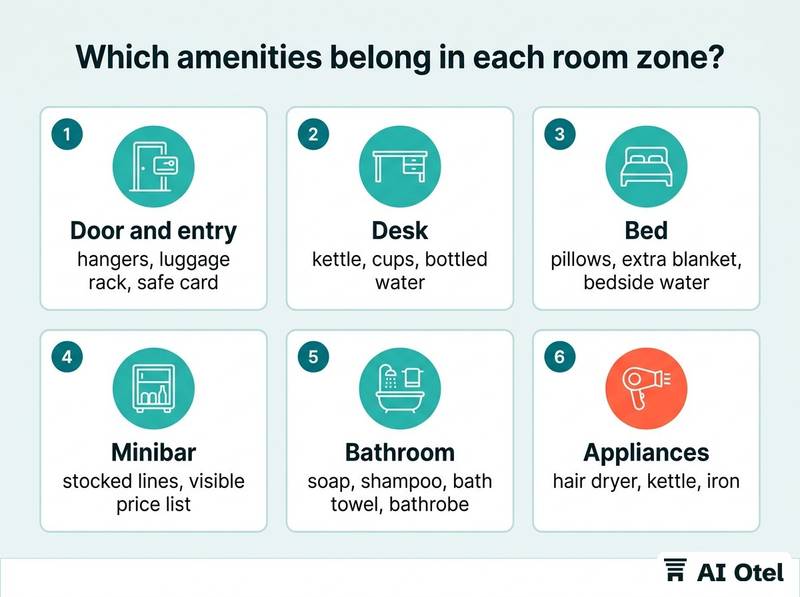
Walk the room in the order the guest does: door, desk, bed, minibar, bathroom, and write the list in that order so nothing is missed on the trolley. Write the zone on every line. When a floor supervisor finds a missing item, the zone tells them which trolley pocket should have held it.
Checklist
- Door and entry: hangers (count matches the occupancy the room is sold for), luggage rack, safe card, evacuation card, slippers
- Desk: kettle, cups, tea and coffee sachets, bottled water, notepad, pen
- Bed: pillows (count and types), extra blanket, bedside water, working reading light
- Minibar: stocked lines, deliberately empty lines, visible price list
- Bathroom: soap, shampoo, conditioner, body wash, shower cap, vanity kit, dental kit, shaving kit, bath towel, hand towel, bath mat, bathrobe, slippers, tissues, sanitary bags
- Appliances: hair dryer, kettle, iron, all checked and working
Decide once whether the hair dryer is fixed to the wall or kept in a drawer, and write it down. An empty minibar with a visible price list is a worse experience than a clearly labeled empty one. Kettles, irons and hair dryers are electrical appliances with a check cycle, not just stock; a failed appliance in a room is a complaint and a risk at the same time, so give them their own checklist, as in hair dryers, kettles and irons in guest rooms: a safety and replacement checklist.
How do you choose amenities by hotel class and guest mix?
Class tells you what a guest expects to find without asking; guest mix tells you what they will actually use. The two answers are often different, and the list has to hold both. Certified facilities in Türkiye are classified against published criteria; those criteria are a floor and a compliance file, not a purchasing list. Confirm the current text and your own classification file with your classification body or legal adviser.
Class works as an expectation signal. A guest in a higher-class room opens the wardrobe expecting a bathrobe and slippers to be there. A guest in a lower-class room expects to be able to ask for them. The item is the same; the tier is different.
Guest mix changes use in three ways. Length of stay decides how often an item is seen: with short stays, most guests meet the arrival set once and never see a mid-stay replacement, so the arrival set carries the whole impression. Travel purpose decides what is touched: business guests use the desk and the iron, families use extra towels and pillows, leisure guests use the bathroom line and the slippers. Room category decides where the visible difference goes: a suite with the same bathroom line as a standard room reads as an expensive standard room.
Whatever you decide to charge for, say it before arrival, in the same place the guest reads the rate. A charge discovered at checkout is a complaint, not revenue; the same discipline applies to the whole stay, as in free or charged? One clear list of what a stay includes. And treat price point as a constraint, not a verdict: a modest list that is always complete beats a generous list that runs out on the third floor.
Watch outDo not copy a list from a hotel of another class
The copied list arrives with another hotel's guest mix, storage space, laundry capacity and price point. It usually fails in one of two ways: the hotel cannot restock it consistently, or it pays every night for items its own guests never touch. Write the list from your own count and your own room categories.
How do you count what guests actually use?
Count what leaves the floor store against occupied nights for two weeks, and count separately what comes back unused. Pick one floor and one fortnight. A tally sheet at the store door beats an opinion from the corridor.
Record two numbers every day: items issued per line, and occupied rooms on that floor. Divide the first by the second to get use per occupied night. That single figure is what you order against. Separate arrivals from stayovers: a shower cap is an arrival item, soap and water are daily items, and averaging them together hides both.
Count the discards too. Half-used bottles thrown away by housekeeping are a cost with no guest benefit, and they usually mean the dispenser or the bottle size is wrong. Count the requests: what guests phone the desk for is the strongest signal you have. A frequent request means the item belongs on the always tier; a rare one means it belongs on request. Treat take-home as a cost line, not a fault. Guests taking slippers or a pen is normal; if the number is large, the item is priced into the room rate, not into the guest's honesty. Repeat the count after any change of season, guest mix or room category.
TipThe two-week tally
One floor, one sheet, two columns per day (items issued, occupied rooms), one line per item, signed by the store keeper at the end of each shift. At the end of the fortnight, divide issued by occupied rooms for each line and sort the lines into the three tiers using the result.
What is a par level, and what restock rhythm should you set?
A par level is the quantity the floor store must hold at the start of each day so the floor never runs out between deliveries. The formula: par equals daily use multiplied by the sum of delivery lead time in days and safety days. Daily use comes from your own count, not from a supplier's recommendation.
| Line | Calculation | Result |
|---|---|---|
| Daily use | 60 rooms × 2 bottles × 90% occupancy | about 108 bottles |
| Delivery lead time | 3 days | 3 days |
| Safety stock | 1 day | 1 day |
| Par level | 108 × 4 | about 432 bottles |
| Floor store share | one day | about 108 bottles |
| Main store minimum | par plus one delivery cycle | reviewed weekly |
The table above is for example only. Run two levels, not one: the floor store par is daily and small; the main store works on a minimum and maximum and is reviewed weekly or monthly. Load the trolley to a fixed standard before the shift starts, and top up the floor store at the end of the shift, not in the middle of it. Mid-shift trips to the store are where counts break down. One person signs the issue sheet per shift; a par level without a signature is a wish.
Textiles follow the same logic with a different unit: a par for towels and bed linen is counted in sets per room plus laundry turnaround, not in pieces. For the textile side of the calculation, see buying hotel textiles: towel weight, sheet fabric and how many sets you need. Review the par when occupancy patterns change, not only when an item runs out: a par built for August starves the floor in a full-house October.
What should you stop providing, and how do you tell guests?
Stop what the count shows nobody uses, and announce the change before the guest opens the cabinet. Decide on the count, not on a supplier's catalogue and not on a slogan. An item with near-zero use and a visible cost is the first candidate. The usual suspects: single-use kits nobody opens, welcome gifts that end in the bin, minibar lines that never sell, premium items placed in standard rooms.
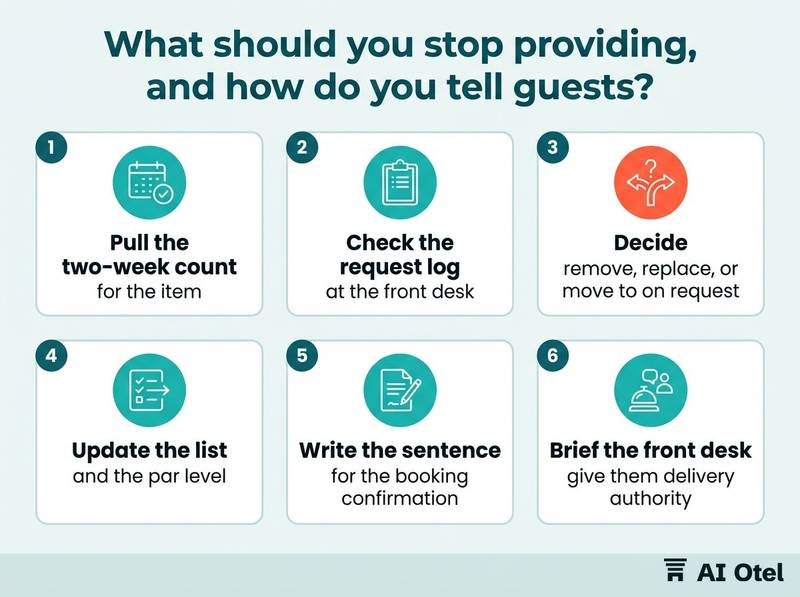
Replace rather than simply remove where you can. A refillable dispenser replaces three small bottles; a kettle and a tea tray replace a minibar line. Tell guests in three places: the booking confirmation, a card in the room, and a script at the front desk. The confirmation is the one that prevents the complaint, because it reaches the guest before the expectation forms. Often the better move is to keep the item anyway: move it to the on-request tier, hold it in the floor store, and state the delivery time. A guest who is told it is on request does not write about its absence.
Checklist
- Pull the two-week count for the item
- Check the request log at the front desk
- Decide: remove, replace, or move to on request
- Update the list and the par level
- Write the sentence for the booking confirmation
- Print the in-room card
- Brief the front desk and give them delivery authority
- Review complaints after one month
Give the front desk the authority to deliver without a discussion. A removal that turns into a negotiation at the desk costs more than the item did. Log the complaints for one month after the change: if one item keeps coming back, the count was right and the tier was wrong.
What does the one-page order list look like?
One page, one row per item, with the count, the par level and the order frequency, so a purchaser can order without walking to housekeeping. Columns: item, room zone, tier, count per room, use per occupied night, par level, order unit, order frequency, supplier, review date.
Keep two versions of the same page: housekeeping keeps the operational copy without prices; purchasing keeps the copy with unit cost and order unit. Cost per occupied night is unit cost divided by units per case, multiplied by use per occupied night. That figure is the one to compare between two suppliers, not the case price.
Separate purchase cost from operating cost. A bathrobe carries laundry, replacement and loss; slippers carry purchase only. Comparing them on purchase price alone is how a cheap item becomes an expensive one. Order frequency follows the par, not the calendar: an item ordered monthly with a three-day lead time needs a monthly par, not a weekly one. Review twice a year, and again after any change of guest mix, room category or supplier, and date the review on the page itself. Sign-off: executive housekeeper and purchasing, both dated. The page is the contract between the floor and the store.
If you want the list to reach guests as offers rather than paper, a hotel's own guest app can carry requests and extras during the stay; the wider platform is described separately.
What to do next
Write the list this week from what you already know, then correct it with a two-week count on one floor. That order matters, because a list written after the count tends to describe the floor you counted rather than the hotel you run. Once the count is in, set the par, print the one-page order list, and put a review date on it. The three tiers, the count and the par are one system: the tier decides what the guest sees, the count decides what you buy, and the par decides whether the floor can deliver it on a full house.
Frequently asked questions
How many towels should a hotel room have?
There is no single number; the count follows your own standard and the occupancy the room is sold for. A workable standard is one bath towel and one hand towel per guest, one bath mat per bathroom, and a spare set held in the floor store rather than in the room. Count towels by occupied night when you set the par, and remember that towels are a laundry item with a replacement cycle, not a one-off purchase.
Should slippers and bathrobes be free or charged?
The decision follows class and guest mix, not a rule. Slippers are a consumable with a low unit cost; a bathrobe is a laundry item with a replacement cycle and a loss rate, so its real cost is much higher than its purchase price. If you charge for either, say so before arrival, in the same place the guest reads the rate.
What is a par level in housekeeping?
The quantity the floor store must hold at the start of each day so the floor does not run out between deliveries. It is calculated as daily use multiplied by delivery lead time plus safety days, using the hotel's own count rather than a supplier's recommendation. The floor store par is daily and small; the main store works on a minimum and maximum reviewed weekly or monthly.
How often should an amenity list be reviewed?
Twice a year, and again after any change of guest mix, room category, supplier or season. Each review re-reads the count, the request log at the front desk and the complaint log, then moves items between the always, on-request and premium tiers. Date the review on the page so the next person knows when it was last touched.
Do hotels have to provide a hair dryer in every room?
Your classification file and your own written standard decide, and the two should agree. If you provide one, it is an electrical appliance with a check cycle: fixed or stored, tested, and replaced on failure. A hair dryer that works in one room and not the next is worse than a stated on-request policy.