Persian-speaking guests: service points from menu and signs to the first conversation
Prepare right-to-left signs and native-proofed menus for Persian-speaking guests. Learn key desk phrases and ask clear questions about food and prayer needs.
AI draft · awaiting editorial review
Contents
Key takeaways
- Persian is a language, not a nationality: a passport tells you nothing about what a guest eats, drinks or believes, and a Persian speaker may hold an Iranian, Afghan, European or Turkish passport.
- Translate from your existing Turkish or English original, never from memory, and have a native reader check every line before it reaches a wall, a menu or a phone screen.
- Right-to-left text fails in layout, not in vocabulary: alignment, punctuation, mixed Latin lines, numerals and font coverage are where Persian pages break.
- Learn a handful of desk phrases aloud from a native speaker's recording, and keep the written card at the desk rather than in a drawer.
- Ask about food, tea and prayer at check-in instead of inferring them from the passport.
Persian, or Farsi, is a language, not a nationality and not Arabic. Serve Persian-speaking hotel guests with a one-page Persian welcome, right-to-left signs and menu text proofed by a native reader, a short desk phrase list, and a check-in that spells the name as the passport does.
It is 23:40 and the desk has three languages ready: Turkish, English and Russian. The welcome folder in the guest's hand is in none of them, and she is reading the breakfast hours from a photograph on her phone. Every hotel that serves Persian-speaking guests without Persian material has this night eventually. After reading this guide you will be able to prepare a one-page welcome, proof right-to-left text, teach the desk nine phrases, and run a check-in that asks instead of assumes. This fits into a wider language plan for your guest mix.
Who counts as a Persian-speaking guest?
Persian, also called Farsi, is the official language of Iran and is spoken well beyond it. A guest who speaks Persian may hold an Iranian, Afghan, Tajik, European or Turkish passport.
Farsi is the Persian word for the language; English uses Persian. Dari in Afghanistan and Tajik in Tajikistan are close relatives, not identical, and Tajik is written in Cyrillic. Persian uses the Arabic script but is not Arabic: different grammar, different vocabulary and different numerals. A guest who reads Persian does not automatically read Arabic, and an Arabic welcome page does not serve a Persian speaker.
Many Persian speakers also speak English or Turkish well. The material matters most for the guest who does not, and for the moment when nobody at the desk shares a language with the person in front of it. Build the material around a language, not a nationality: the same page serves a family from Tehran, an Iranian-German couple and a translator living in İstanbul.
Count your own demand from your reservation records, by the language the guest wrote in rather than by the passport, and review it once a season. For context, Iran was among Türkiye's largest source markets in 2025, with 3,050,195 foreign visitors entering the country (Ministry of Culture and Tourism, border statistics, 2025). That is a country-level number, not a statement about any individual guest.
What belongs on a one-page Persian welcome?
One A4 side carrying the eight facts a guest needs in the first hour, translated from your existing Turkish or English original and read by a native speaker before it is printed.
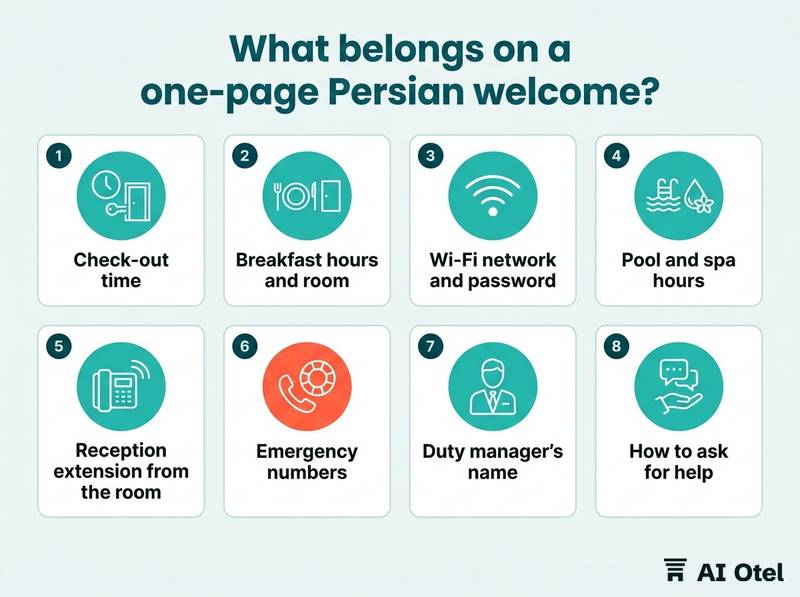
The contents: check-out time and how to ask for a later one, breakfast hours and room, Wi-Fi network and password, pool and spa hours, the reception extension from the room, emergency numbers, the duty manager's name, and one line on how to ask for help. Leave out rate conditions, cancellation policy, long legal text and seasonal price lists. Those belong in the reservation confirmation, in the language the guest booked in.
Translate from the original document, not from memory and not from another hotel's version. Keep the Turkish or English file as the source of truth and date the Persian version at the foot of the page. Have a native speaker read it aloud, not only silently: a sentence can be grammatically right and still be the wrong register, too formal or oddly casual for a hotel.
Print one side in large type, right-aligned, and put the same text in the guest app so a guest can read it at 02:00 without finding a paper copy. A hotel's own guest app, installed from the browser with no app store, is one place the same text can live; a printed copy at the desk and one in each room folder are the others. A QR code alone fails when the guest has no data yet or a phone that will not scan.
Name one person who owns the page and the date it was last checked, so the Persian version does not drift two seasons behind the Turkish one.
ChecklistBefore the Persian welcome page goes to print
- Translated from the current Turkish or English original, not an older version
- Every number, hour and extension checked against the original
- Read aloud by a native speaker
- Printed one side in large type and right-aligned
- The same text loaded into the guest app
- A printed copy at the desk and in each room folder
- Version date printed at the foot
- One named owner
Which signs need Persian, and which do not?
Signs that carry a safety instruction or a decision a guest must make in a hurry earn Persian. Decorative and brand signs do not.
A sign is read at three meters while walking. Use a pictogram first, then the Persian line, then English, and prefer two words to a sentence. Do not translate brand names, restaurant names or dish names on a directional sign: translate the instruction and keep the name.
| Sign | Why it earns Persian | Format |
|---|---|---|
| Fire exit, assembly point | Safety, read in a hurry | Pictogram plus one Persian line |
| Pool depth, pool rules | Safety and a decision | Pictogram plus two short lines |
| Lift capacity, stairs | Safety | Pictogram plus number |
| Breakfast room and hours | A decision every guest makes on the first morning | Pictogram plus hours |
| Spa and gym hours, rules | Decision | Short lines |
| No-smoking | Rule with a consequence | Pictogram plus one line |
| Direction to reception | Wayfinding | Arrow plus one word |
Keep one vocabulary across the building: if the lift sign uses one Persian word for lift, the welcome page uses the same word, not a synonym. Audit before you order: walk the building with a phone camera, list every sign, and mark each one as safety, decision or decoration. Order the safety signs first and the rest in a second batch, so a slow translation does not hold up a fire-exit sign.
What breaks when Persian text runs right to left?
The words survive; the layout does not. Alignment, punctuation, mixed Latin lines, numerals and font coverage are where Persian pages fail.
Alignment and flow: the block aligns right, bullets sit on the right, and a numbered list keeps its numbers on the right edge. Mixed lines are the most common failure: a line that mixes Persian with Latin, such as a Wi-Fi password, a room number, an extension or an e-mail address, can reorder on screen. Keep Latin strings on their own line or isolate them.
Numerals: Persian digits read naturally in prose, but keep phone numbers, passwords, room numbers and prices in Latin digits so they can be dialed and copied. Punctuation mirrors: parentheses, colons and question marks move with the direction, and the Persian question mark is a different character.
Fonts: many Latin fonts carry no Persian glyphs, so the system substitutes another font mid-line and the size jumps or letters disappear. Choose one font family with Persian coverage and use it for the whole page. Persian letters join, and a PDF exported from a word processor can lose the joins or reverse the order, so check the exported PDF, not the editing screen. On screen, set the direction and the language on the text block so the browser shapes and aligns it correctly, then test on a phone as well as a desktop monitor.
Machine translation gives a draft, not a finished sign. The check is a native reader looking at the printed page and the phone screen. For written guest messages the bar is different, and when machine translation is good enough for guest messages is worth deciding in advance.
ChecklistRight-to-left proofing, in this order
- Open the exported PDF, not the editor
- Print it and read it on paper
- Open the same file on a phone
- Confirm the font covers Persian and nothing falls back mid-line
- Read every line that mixes Persian and Latin aloud
- Confirm phone numbers and passwords are in Latin digits
- Confirm bullets and numbers sit on the right
- Get a native reader's sign-off on the final file
Which Persian phrases should the front desk learn?
A short list, heard and repeated with a native speaker, covering greeting, thanks, yes and no, one moment, and I do not understand.
Learn them by ear from a recording made by a native speaker, not from romanized spelling. Persian stress and vowel length do not survive transliteration, and a confidently wrong pronunciation lands worse than English. Keep a card at the desk with the Persian script, the transliteration, the meaning and when to use it. A card in a drawer is not a plan.
| Persian script | Transliteration | Meaning | When to use |
|---|---|---|---|
| سلام | salâm | Hello | At first eye contact |
| صبح بخیر | sobh be-kheyr | Good morning | Before noon |
| خوش آمدید | khosh âmadid | Welcome | At arrival |
| لطفاً | lotfan | Please | Attached to any request |
| متشکرم | moteshakkeram | Thank you | At any handover |
| بله | bale | Yes | Confirming |
| نه | na | No | Declining |
| یک لحظه لطفاً | yek lahze lotfan | One moment please | While checking the screen |
| نمیفهمم | nemifahmam | I do not understand | Before calling a colleague |
Every row must be confirmed by a native speaker, script and transliteration both, before the card reaches the desk. Use the phrases for warmth, not for transactions: money, complaints, medical questions and anything with a consequence go through a written translation, an interpreter or a colleague. Rotate the practice: five minutes at the start of a shift, one phrase a week, so the list is still alive after the first month. Never ask a staff member to speak Persian because of a name or a birthplace. Offer the training to everyone who wants it and let people opt in.
What should you ask about meals, tea and prayer instead of assuming?
Ask one short question at check-in or in the pre-arrival message and let the guest answer. The passport is not a dietary record and not a statement of belief.
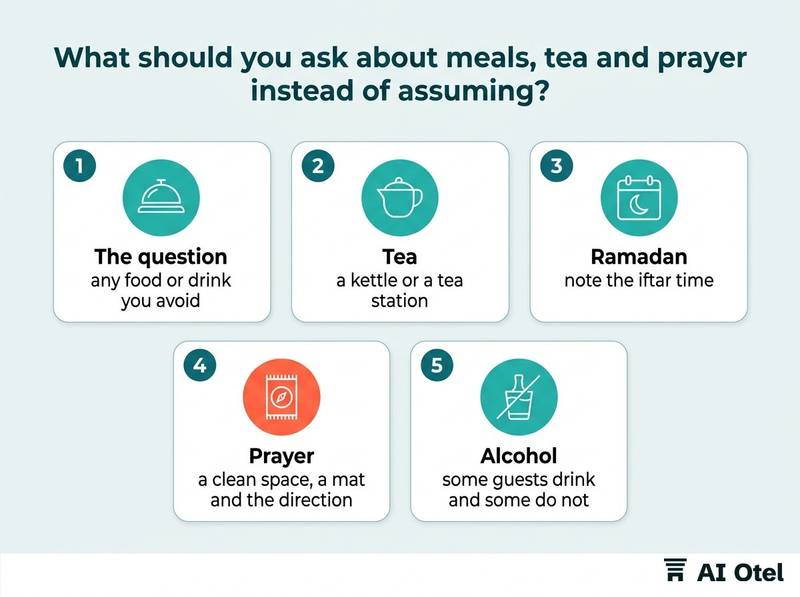
The question: is there any food or drink you avoid, and would you like tea in the room. Two questions cover most of what a kitchen and a housekeeping team need to know. Be able to name ingredients precisely on the menu: pork, alcohol used in cooking, gelatin and meat stock are the four that most often decide a dish. A menu line that says only meat tells the guest nothing.
Tea: offer a kettle or a tea station and a way to get hot water outside breakfast hours. Do not assume coffee, and do not assume the guest wants tea either. Ramadan: ask whether the guest is fasting, note the iftar time, and keep a quiet corner and a way to eat after sunset. Prayer: ask whether the guest would like a clean space, a mat and the direction. Provide it quietly, do not label a room a mosque, and do not assume every Persian speaker prays.
Alcohol: some guests drink and some do not. A minibar and a bar list are offers, not statements, and nothing should be removed or added because of a name. If you describe a halal or alcohol-free offer, describe it exactly, ingredient by ingredient, because a vague claim is worse than no claim. How to describe a halal offer exactly is its own discipline, and it applies to every guest who asks.
TipOne question, asked once
Put it in the pre-arrival message: "Is there any food or drink you avoid, and would you like tea in your room?" The answer goes into the reservation note that housekeeping and the restaurant can see, not into a chat thread nobody reads on the shift.
How do you get names and spelling right at check-in?
Take the spelling from the passport, read it back to the guest, and write the pronunciation where the whole team will see it.
Persian names transliterate inconsistently: Mohammad, Muhammad and Mohammed are one name, and so are Hossein and Hussein, or Rezaei, Rezai and Rezaee. The passport decides the spelling for the reservation and for the identity notification. Ask how the guest says it, and write the pronunciation in a note that reaches housekeeping, the restaurant and the phone line, not only the reservation screen.
Persian name order matches Turkish: given name first, family name second. Do not reverse it, and do not shorten a name to make it easier to call across a lobby. Titles: Agha for a man and Khanom for a woman, used with or without the family name, in the places where you would use Mr and Ms. The name a guest gives at the desk is the name to use in conversation, even when the passport carries a longer formal version.
Check the name on the bill and in the guest app before the guest sees it. A misspelled name on a folio is a small thing that reads as carelessness. The same check belongs in the hotel operating system your team works from, whatever system that is: the spelling entered once at check-in should reach every document and screen without being retyped.
Watch outDo not shorten, translate or correct a name
If the passport spelling looks unusual to you, it is still the spelling that goes on the reservation, the identity notification and the bill.
What to do next
The welcome page, the signs, the desk phrases and the two check-in questions are one system: each one removes a moment where a guest has to guess. Before the next Persian-speaking arrival, take your existing welcome page, translate it from the Turkish original, and have a native speaker read it aloud with the desk team in the room. Then put the phrase card at the desk, add the two questions to the pre-arrival message, and walk the building once with a camera to list the signs that still need a Persian line.
Frequently asked questions
Is Persian the same as Farsi?
Yes: Farsi is the Persian word for the language and Persian is the English name for it. Dari in Afghanistan and Tajik in Tajikistan are close relatives, and Tajik is written in Cyrillic. Persian is not Arabic, even though it uses the Arabic script, so one page cannot serve both languages.
Can we machine-translate the menu into Persian?
A machine translation is a usable draft and a poor finished menu. Dish names carry ingredients and cooking methods that machine output flattens, and a wrong ingredient line is a service failure, not a typo. Have a native reader check every line against the kitchen's actual recipe before printing.
Do Persian-speaking guests also read Arabic?
Not necessarily. The two languages share a script but not grammar, vocabulary or numerals, and a Persian page will not serve an Arabic reader or the reverse. If your guest mix includes both, prepare two pages and label them clearly.
What should we prepare first if we have one afternoon?
The one-page welcome and the desk phrase card, both checked by a native speaker, because they cover the first hour of the stay. The sign audit comes next, starting with fire exits and pool rules, and the menu after that.
Should we translate the whole website into Persian?
Start with the pre-arrival message and the welcome page, which is where a guest actually needs the language. Decide on a full site translation from your own booking records and the language guests write in, not from a guess about the market.