"Why is the price different today?": how the desk answers a guest who saw another rate
A guest shows a lower price on their phone. This guide gives you the four honest reasons rates differ, the five checks to run before speaking, and a short script to confirm the correct price without arguing.
AI draft · awaiting editorial review
Contents
Key takeaways
- A rate is a snapshot: it belongs to specific dates, a room type, a rate plan and the availability at the moment of the search, so two different numbers can both be correct.
- Before answering, the desk checks five things: dates, room and guest count, rate plan and its conditions, what the number includes, and where and when the guest saw it.
- A confirmed booking keeps the rate its own terms set; additional nights, upgrades and extras are priced at today's rate.
- Only a written override limit lets the desk adjust a price, and every adjustment carries a reason code and an approver's name.
- One line per case in a shared log turns repeated price questions into a decision the revenue meeting can act on.
A hotel rate is the price for one room, on specific dates, under a named rate plan and its conditions. When the dates, the room, the plan, the remaining availability or the selling channel change, the number changes. The desk answers by naming which of those changed, then stating the confirmed price.
A guest holds up a phone at the desk. The screen shows a number lower than the one you just quoted, and the guest asks why. The honest answer is usually short, specific and checkable, and it starts with what the guest is actually looking at. This article gives you the four honest reasons a price differs, the checks to run before you speak, a two-sentence script, and the rules for when a manager may adjust the number.
Why is the price different today? Four reasons, in plain words
A rate is the price of one room for specific dates under a named rate plan, so a different number usually means one of those inputs changed, not that the hotel invented a new price overnight.
The first reason is the date and the rooms left. A hotel sets a price for each date, and as rooms for that date sell, the price of what remains can move. The same room can cost one figure on a Tuesday and another on a Saturday.
The second is a different rate plan or room. A non-refundable plan, a refundable plan, a room with a view, a room with breakfast included and a room sold to one person instead of two are different products, each with its own price.
The third is an offer that ended. A campaign, an early-booking window or a member rate has a start and an end. The price after it closes is the normal price, and neither number is wrong. You can read more about early booking and non-refundable rates: when do they pay off.
The fourth is a different selling channel. A booking site can show its own combination of room, plan, currency and conditions, and its display may not match what the desk quotes for the same night. Currency and inclusions add further differences: a converted figure, a price shown per person rather than per room, or a number that leaves out taxes and local fees all change the total without changing the room.
The desk's rule: name the input that changed before saying anything about the price itself. A guest who hears which detail differs stops arguing about the number.
| What the guest says | What usually changed | What the desk checks first |
|---|---|---|
| "It was cheaper yesterday" | The date and the rooms left for that date | The rate for those exact dates today |
| "I saw it cheaper on my phone" | Channel, currency, plan | The same dates, room and plan on the hotel's own page |
| "My friend paid less" | Room type, occupancy, rate plan | The other booking's room and conditions |
| "The page said one thing and you said another" | What the number includes | Taxes, breakfast, extras, per person or per room |
| "It was on sale last week" | An offer that has closed | Whether the offer had an end date and what the normal price is |
What should the desk check before answering?
Check the product before the price: five details decide whether the two numbers are even comparable, and most disputes end at this step.
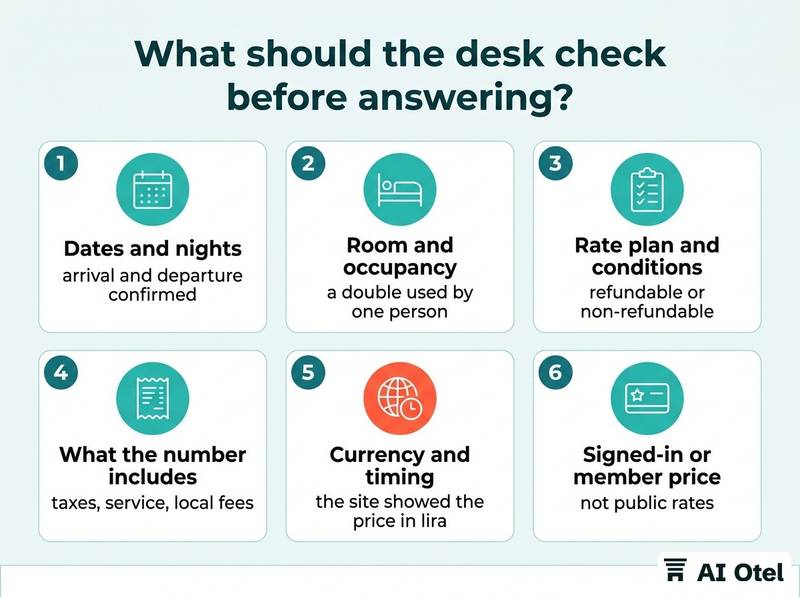
Dates and nights come first. Confirm the arrival and departure the guest is looking at, including whether the search crossed a weekend, a public holiday or a minimum-stay rule. Then room and occupancy: a double used by one person and the same double used by three are different prices; so is a room with a view and a room without one.
Rate plan and conditions matter as much as the number. Read the plan name aloud: refundable or non-refundable, breakfast or room only, cancellation window, minimum stay. Then confirm what the number includes, because taxes, service, local fees and extras are either inside the figure or added later, and the guest needs to know which.
Currency and timing complete the picture. Ask whether the site showed the price in lira or converted it, because a converted figure carries the site's own exchange rate. A screenshot with a timestamp is worth more than a remembered number; a page left open since yesterday can show a price that has already moved. Finally, check whether the guest was signed in: member, app-only and logged-in prices are not public rates, and they are not available at the desk.
ChecklistBefore replying, the desk ticks
- Dates and number of nights confirmed
- Room type and number of guests confirmed
- Rate plan name and cancellation terms read
- What the price includes confirmed
- Currency and conversion checked
- Screenshot or timestamp obtained
- Signed-in or member price ruled out
What do you actually say? Two sentences and a next step
Acknowledge the guest's number, name the one thing that differs, then state the price you can confirm and the next step, in that order.
The first sentence acknowledges without agreeing that the hotel was wrong: thank the guest for showing the screen and say you will check what that price covers. The second sentence names the specific difference and gives the confirmed figure with its inclusions, so the guest hears one clear number rather than a range. Then a concrete next step: a manager review, a different room, a different set of dates, or a written quote by email.
Avoid "the system decides the prices". It explains nothing, sounds like an excuse and invites the guest to argue with a machine. Never blame the guest, and never criticize another company's page. Say what the hotel's own price is and what it includes.
Never promise to match a price. Promise to check, and say who will check and by when. Keep the exchange under half a minute. If the check needs longer, offer a seat and a time rather than a running commentary.
TipScript to keep at the terminal
"Thank you for showing me. That price is for [dates, room type, rate plan], and the price I can confirm for your stay is [number], which includes [what]. I can ask [role] to look at it and come back to you by [time]."
The guest already booked: what changes and what does not
A confirmed reservation keeps the rate and the conditions written in its own rate plan; what can change is what the guest adds during the stay.
Read the reservation before answering. The rate plan, the cancellation window and the inclusions are written there, and they decide the answer. Additional nights are new room-nights, priced at the rate for those dates, not at the rate the guest paid for the original nights. Upgrades and extras are separate prices: an accepted offer goes onto the guest's bill as its own line, so the original room rate stays untouched.
A flexible booking can be cancelled and rebooked under its own terms, but the new booking carries today's price and depends on the room still being there. A non-refundable booking has no reprice path. If the hotel chooses to do something as a gesture, that is a manager decision with a recorded reason, not a habit at the desk.
Never edit a confirmed rate in the system to make a conversation end. Financial records are corrected by voiding and reversing, and a silent edit is invisible until an audit finds it.
Watch outDo not cancel and rebook to chase a lower number
Without a manager's approval, cancelling and rebooking a guest's reservation risks losing the room, the original conditions and the old price. The guest carries the risk of the new price, and the room may not come back into the same booking.
Why does a booking site show a different price?
A booking site shows its own combination of room, plan, currency and conditions, so its number can differ from the desk's without either one being wrong.
Compare like with like: same dates, same room, same rate plan, same number of guests, same currency, same inclusions. Many reported differences disappear at this step. A site may add its own service charge, convert currency at its own rate, or display a figure per person rather than per room. Member, app-only and signed-in prices are not the public rate, and the desk cannot produce them for a guest who is not signed in. A page opened earlier can show a price that has since changed, because the page does not refresh itself.
The desk states the hotel's own price and what it includes, and does not comment on a named site or promise to match it. If the guest has not booked and the difference is real for the same product, pass the screenshot to reservations. The revenue team decides whether the hotel's own channel price needs attention. The hotel's own website price is the one the desk can always confirm, and it is the number to quote when a guest asks what the room costs. For the wider policy, see best rate guarantee wording and when to honor a claim.
NoteThe desk's job
Your job is to explain the hotel's own price and what it includes, not to defend another company's page or to guess how that page was built.
When may a manager adjust the price, and who decides?
Only inside a written limit, and only with the reason recorded, so that the same case gets the same answer next week and from the next shift.
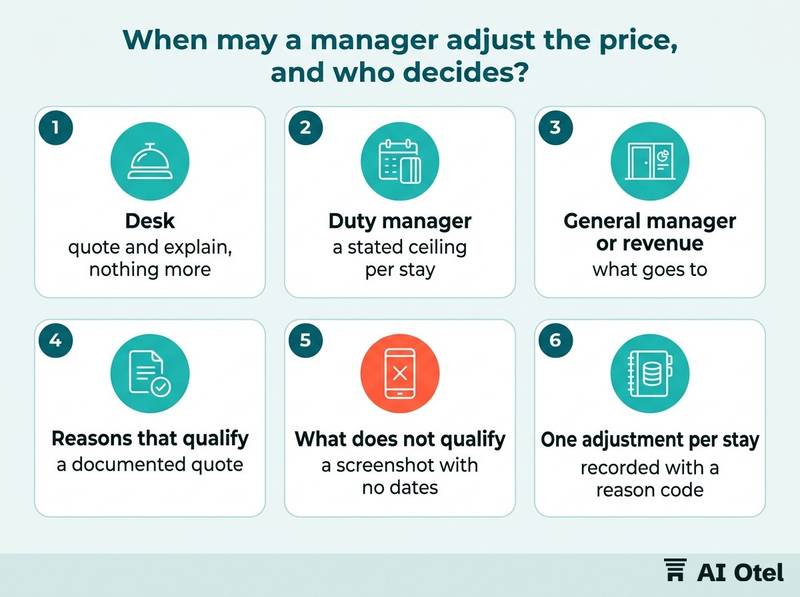
Write three levels: what the desk may do (quote and explain, nothing more), what a duty manager may approve (a stated ceiling per stay), and what goes to the general manager or revenue. Define the reasons that qualify: a documented quote from the hotel's own channel for the same dates and room, a service failure during the stay, or a contracted or group rate that was not applied. Define what does not qualify: a screenshot with no dates, a remembered number, a price for a different room, or pressure at the desk at midnight.
Allow one adjustment per stay, recorded with a reason code and the approver's name, so the guest cannot collect adjustments from three shifts. Never reprice confirmed nights retroactively; adjust the current or future nights, or offer a gesture such as an upgrade or breakfast instead of a lower room rate. Review the limits every quarter against what was actually approved. A ceiling that is used every night is not a limit, it is the real price. The detailed framework is in discount limits and override rules for hotel staff.
How do you record the case so the revenue meeting can use it?
One line per case in a shared log, with five fields, turns repeated price questions into a decision the revenue team can act on.
Keep the log where the front desk already writes its shift notes. A new tool nobody opens produces no data. Record the five fields every time, even when the answer was a simple explanation and nothing was adjusted, because the questions themselves are the signal.
| Field | What to write |
|---|---|
| Date and time of the conversation | The shift and the staff member |
| Where the guest saw the price | Own website, a booking site, a screenshot, word of mouth |
| The product quoted | Dates, room type, rate plan and inclusions |
| The two numbers | What the guest saw and what the hotel confirmed, with currency |
| The resolution | Explained; adjusted with a reason code and approver; or passed to a manager |
Review the log weekly. The same date, the same room type or the same channel appearing again is a pattern, not a coincidence. Typical findings: a rate plan description that never says what is included, a channel still showing an old price, or a date where the hotel's own website is the most expensive place to book.
Bring counts and examples to the revenue meeting, not opinions. "Eleven questions about the same Saturday" is a decision; "guests keep complaining" is not. The log protects the staff too. An adjustment with a reason and an approver is a recorded decision, not a favor someone has to justify later. When a complaint runs deeper than price, a front desk recovery routine for guest complaints keeps the conversation on track.
What to do this week
Write the two-sentence script, agree the three approval levels with your manager, and start the five-field log at the desk. The parts fit together as one loop: the checks keep the answer honest, the script keeps it short, the limits keep it consistent across shifts, and the log turns the same question asked twenty times into a pricing decision the revenue meeting can make. A hotel operating system built to keep the rate, the reservation and the bill in one place, and a guest app built so the guest can see the bill and its inclusions, are both built and working, ahead of launch.
If you are reading this as a traveler rather than hotel staff, the same logic applies: compare dates, room, plan and inclusions before comparing numbers, and you can find a hotel in Türkiye (opens in a new tab) with the conditions you want stated plainly.
Frequently asked questions
Can a hotel change the price after a booking is confirmed?
A confirmed reservation keeps the rate and conditions written in its own rate plan, so the number on the confirmation stands. What is priced at today's rate is anything added later: extra nights, an upgrade, an extra bed or a service. Any change to a confirmed rate is a manager decision under the hotel's written rule, recorded with a reason, never a quiet edit at the desk.
The guest shows a cheaper price on their phone at the desk. What now?
Check the same dates, room type, rate plan, guest count and currency, and ask whether the guest was signed in. If the products are not the same, explain the difference in one sentence. If they are the same and the room is available, pass it to a duty manager, who may act only inside the written limit. The desk itself does not promise a match.
Does a price the guest saw yesterday still apply today?
A quoted price belongs to a search at a moment, for specific dates and conditions, and it is not held unless the hotel confirmed it in writing. Today's price applies to today's booking. If the hotel sent a written quote with a validity date, honor it until that date passes.
How do you explain a rate that went up because the hotel is nearly full?
Say it plainly: the price is set for each date, and as rooms for that date sell, the price of the remaining ones can rise. Keep it factual and short, avoid predicting what the price will do next week, and add that the guest's own confirmed booking is unaffected.
Should the front desk match a price from another website?
Not as a habit, and never as a promise. The desk explains the hotel's own price and what it includes. Whether the hotel matches anything is a written policy decision, with a limit and an approver, and the guest should be told who will look at the case and when.