Golf guests at a hotel: tee-time desk, club storage, early breakfasts and the evening round-up
Golf hotel guests need five linked routines: tee-time confirmation, tagged bag storage, early breakfasts, timed shuttles and kit drying. This guide sets out the procedures to prevent common failures.
AI draft · awaiting editorial review

Contents
Key takeaways
- Golf guests ask for five things in a fixed order, and the first tee time sets the clock for the other four.
- The hotel requests a tee time, but the course confirms it; until that confirmation arrives the guest is told the time is requested, with an hour for the callback.
- A bag room needs a tag, a written log and controlled access, and the storage terms must be visible at the moment of drop-off, not in a folder at reception.
- Breakfast time is calculated backwards from the tee time, not set by the hour the buffet happens to open.
- One group sheet and a short evening round-up prevent the three failures golf groups remember: a cold box, a missing bag and a missed shuttle.
Golf hotel guests are travelers whose day is built around a tee time, so a hotel serves them with five linked routines: a tee-time desk that requests and confirms, a tagged bag room, an early breakfast calculated backwards from the tee time, a timed shuttle, and an overnight drying route for wet kit.
For example, eight players check in at 21:40 with eight golf bags, a first tee time of 07:20 and a breakfast that opens at 07:00. None of that is unusual, and any of those four can go wrong unless someone wrote them down the night before. This article sets out the five routines that cover golf guests end to end, from the tee-time desk to the evening round-up that hands the morning to the night shift.
What do golf guests actually ask a hotel for?
Five things, always in the same order: a tee time, somewhere safe for the bags, breakfast early enough to make it, a way to reach the course, and a place for wet kit to dry. The tee time sets the clock for the other four.
The order is set by the first tee time, not by the arrival time. Every other service is counted backwards from it, which is why a golf group's day is planned the evening before, not in the morning. A group of eight is eight sets of the same five questions; answer them once, on one sheet, and the desk stops repeating itself.
Two of the five fail quietly. Breakfast is the request most easily refused by default, because the buffet opens at a fixed hour and nobody thought to ask the kitchen the night before. Wet kit is asked for at the end of the round, when the laundry is already closed and housekeeping has gone home. Bags, meanwhile, arrive before the room is ready and stay after checkout, so storage is needed at both ends of the stay, not only in the middle.
| Request | When it usually arrives | Who owns it | What done looks like |
|---|---|---|---|
| Tee time | At booking or on arrival | Front office, named owner per shift | Written time from the course, relayed with a meeting point |
| Bag storage | Before the room is ready, after checkout | Front office and bag room attendant | Tagged bag in, logged, stub with the guest |
| Early breakfast | The evening before | F&B with the kitchen | Start time agreed for that group, plus a count |
| Transport | The evening before | Front office | Departure derived from the tee time, return pickup confirmed |
| Wet kit | End of the round | Housekeeping | Overnight drying route, stated return time |
The tee-time desk: who books, who confirms, what does the course need?
The hotel takes the request and owns the follow-up, but the course owns the time. Nothing is confirmed to the guest until the course confirms it, and the confirmation is written down.
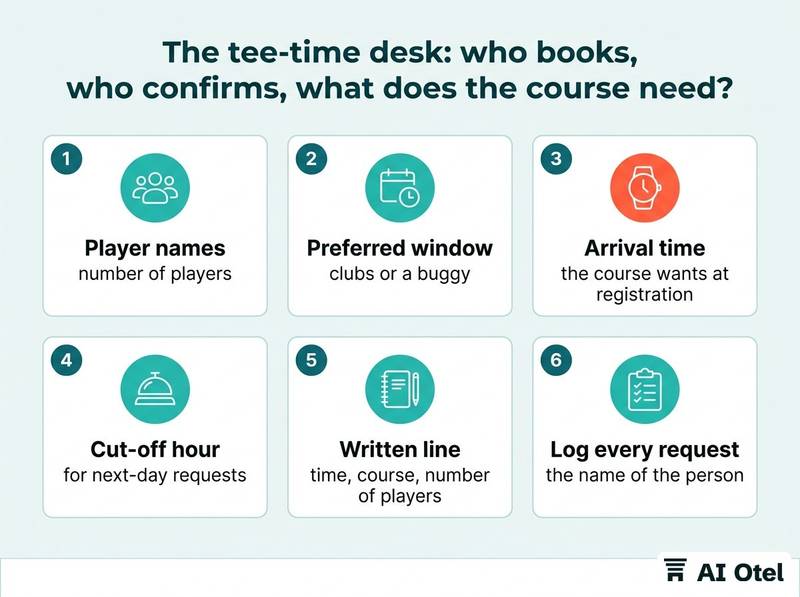
Choose one of two models and write it down. Either the hotel requests on the guest's behalf and is the course's single contact, or the guest books directly and simply tells the hotel the time so the day can be planned around it. Mixing the two produces double bookings and arguments about who called whom.
Ask the course once for its own list of what it needs, then keep that list. In practice it runs to player names, number of players, the preferred window, whether clubs or a buggy are hired, and the arrival time the course wants at registration. Agree a cut-off hour for next-day requests too: after the cut-off the desk says so plainly instead of taking a request it cannot place.
Confirmation to the guest is a short written line: time, course, number of players, meeting point, and the number to call if something changes. Verbal confirmation at a busy desk is lost by the time the guest reaches the lift. Log every request with the time it was taken, the time it was confirmed and the name of the person who confirmed it; that log is the only defense when a group disagrees about what was promised.
Give the desk one named owner per shift and one handover line in the shift book: requests open, times confirmed, callbacks due, and who owes each one. If the golf element is sold as part of a package, the same confirmed time should drive the price and the promise, as with pricing a room with a golf or transfer element as one package.
Watch outRequested is not confirmed
A golf course holds its own inventory, and the hotel cannot guarantee a time. Use the word requested until the course replies in writing, and give the guest a callback hour and the name of the person who will call. Saying the group is booked when it is not is a complaint waiting to be written.
Golf bag storage: tags, space, security and what to write down?
A bag room is a luggage room with three extra rules: every bag is tagged to a room and a group, every movement is written down, and the guest is told the terms at the moment of drop-off.
The tag carries the room number, the group name, the departure date and the number of items, with a tear-off stub that stays with the guest. A bag without a stub does not leave the room. The log records in time, out time, who took the bag and who released it, with initials or a signature; the same log covers the return at the end of the stay, where a bag can leave without a matching stub.
Measure space per bag, not per suitcase. Golf bags are long, do not stack and arrive with trolleys and shoes, so a luggage room sized for suitcases will not take a group of eight. Keep one key holder per shift, lock the room when it is unattended, and make the stub the only way out. A room that anyone can open is not a storage service, it is a corridor.
Separate the two promises. A bag held for two hours before check-in and a bag held for a week are different services with different records; decide which one the hotel offers and say so. Clubs are expensive and personal, so never move a bag to another room or another guest's name without a written note from the person who owns it. The full procedure for tags, logs and long holds is the same one described in a hotel luggage storage procedure with tags and a log.
Storage terms, including what the hotel accepts responsibility for, are the hotel's own decision and belong where the guest sees them at drop-off. Agree the wording with the hotel's insurer and legal adviser rather than copying another hotel's sign.
ChecklistBag room checklist
- Tags printed with room, group, departure date and item count
- Tear-off stubs for every bag
- In and out log with initials
- One key holder named per shift
- Floor marked with a bag footprint and a clear aisle
- Separate shelf for shoes and trolleys
- Written storage terms displayed at the drop-off point
- Rule: no bag leaves without a matching stub
How early does breakfast need to open for a first tee time?
Work backwards from the tee time: subtract the transfer, subtract the warm-up the course expects, subtract the time a guest actually needs to eat, and the result is the breakfast start time for that group.
For example, a 07:20 tee time, 20 minutes to the course, 30 minutes for registration and warm-up, and 30 minutes to eat puts the group at the table at 06:00, so the buffet has to be open at 05:45 for them. The method matters more than the number, because transfer times differ by course.
There are three options, in rising order of cost and falling order of guest satisfaction: open the buffet early for the group, lay a set cold breakfast in a side room, or hand out boxes. A box is ordered the night before with a name, a room number and a collection time. Unclaimed boxes are counted and recorded, because an unclaimed box is usually a guest who overslept and will ask for one at 07:00.
What survives a golf cart: sealed, cold, nothing that leaks, nothing that needs a fork. A hot drink in a paper cup does not survive the first bump. Packed lunch is a separate decision taken at the same moment, and it is the item groups forget to order until they are standing in the lobby. Post the charge to the room when the box is handed over, not at the end of the stay, so the bill matches what the guest remembers taking.
Tell the kitchen in numbers the evening before. A note on the board saying golf group does not tell a baker how many rolls to make, and the kitchen's quantities are better set from tomorrow's arrivals than from habit, as with setting buffet quantities from arrivals rather than habit.
TipDo the calculation once, on the group sheet
Tee time, minus transfer, minus warm-up, minus eating time, equals the breakfast start. Do it once per group and write the result on the group sheet rather than recalculating it at the desk at midnight.
Shuttle or taxi to the course, and who hands over on arrival?
Set departures from tee times, not from a fixed timetable, and agree the return pickup at the moment of drop-off rather than by phone later.
Build the departure from the earliest tee time in the block, then run one vehicle per block instead of one per player. Two vans leaving ten minutes apart cost more and arrive together. Bags go in first and are counted against the tag list before the vehicle leaves the hotel; the count is written on the same sheet as the tee times.
Name the handover at the course: who meets the group, where the bags are left, and which person at the course takes responsibility for them from that point. Agree the return time at drop-off and give the guest a number to call if the round runs long. A round that runs over is normal, not an emergency, and the shuttle should not be the thing that punishes it.
Keep a written arrangement with a local taxi or transfer operator for the days the shuttle is full or out of service, so the fallback is a phone call rather than a negotiation. Weather delays change the timetable before they change the tee time, so decide in advance who calls the course and who calls the guest.
NoteSeats and bags are two different capacities
Write the seat count and the bag count of each vehicle on the group sheet, and test the combination once with real bags before the season starts. A vehicle that seats eight may not take eight bags plus eight players.
Wet and muddy kit: drying, laundry and towels?
Shoes are the real problem, not shirts. Plan a drying route that runs overnight and tell the guest about it at check-in, not at 22:00 when they call the desk.
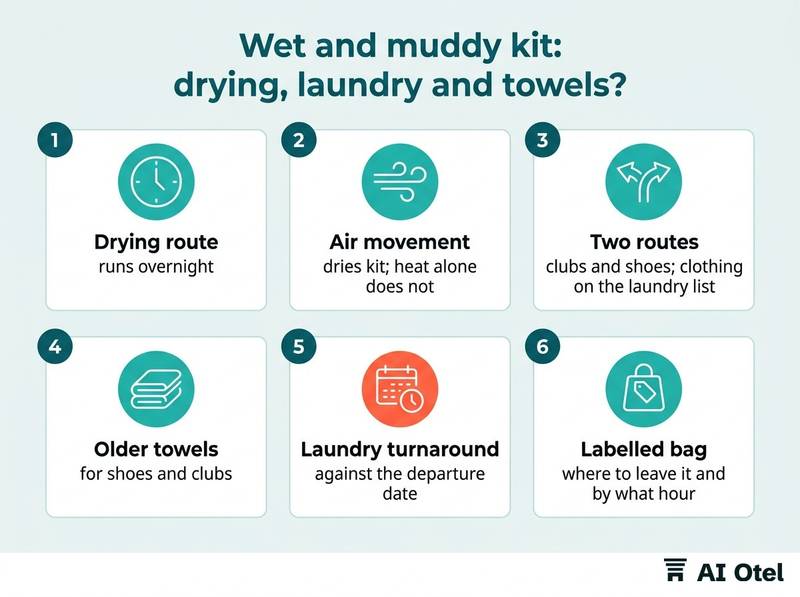
Air movement dries kit; heat alone does not. A room with a fan and space between the items works better than a radiator with everything piled on it, and a sealed plastic bag in the wardrobe makes the problem worse. Run two routes, not one: clubs and shoes go through housekeeping or the bag room, clothing goes on the laundry list. Mixing them means a shirt comes back with mud on it.
Keep a stock of older towels for shoes and clubs so bath towels stop disappearing into the bag room, and count them out and back like any other linen. Check the laundry turnaround against the departure date: if the guest leaves before the laundry returns, say so at drop-off and offer the alternative rather than promising a time the laundry cannot meet.
Put a labelled bag in the room with a line on it saying where to leave it and by what hour, so the guest does not have to guess or call. Rain is a normal part of golf, so the service is a promise about time and handling, not about the weather. Say what the hotel will do and by when.
Group handling: one sheet, one owner and a short evening round-up
One sheet per group, one named owner, and a fifteen-minute round-up at a fixed hour that ends with a written list for the next morning.
The group sheet holds the group name, number of players, rooming list, tee times confirmed and requested, breakfast times and counts, shuttle times, bag counts and the departure date. One page, one version, one place. Hold the round-up at a fixed hour, for example 18:30, with front office, F&B, housekeeping and the person who owns the group in attendance; anyone who cannot attend sends the answer in writing before the meeting.
Every item ends with a name and a time, or it is not finished. An item that ends with "we will see" is the item that fails at 06:00. The output is one page for the night shift and one for the morning desk, on the screen the desk actually uses rather than in a folder nobody opens.
The night handover is where golf groups break: a 05:45 breakfast, a 06:30 shuttle and a bag count are all decided the evening before, by people who will not be there in the morning. When the course changes a time, one person calls the guest and one person updates the sheet, and the shuttle is re-timed before the guest is told anything. The same sheet logic scales to other sports blocks, as with quoting and running sports and training groups at a resort.
Key pointThe five standing items of the evening round-up
Tee times: what is confirmed for tomorrow and what is still open. Breakfast: how many, at what hour, boxes or buffet. Transport: departure times, vehicles, bag counts. Kit: what is drying and when it returns. Group sheet: who owns tomorrow and who hands over.
What to do next
Take the next golf group already on the books and run it once on one sheet: the five requests written down with a named owner and a time for each, then a fifteen-minute round-up the evening before. The five services are not five departments, they are one routine that starts with the tee time and ends with a dry bag and a bill that matches what the guest remembers.
Frequently asked questions
Who should book the tee time, the hotel or the guest?
Either can work, but only one should own it. If the hotel requests on the guest's behalf, the hotel is the course's single contact and owns the follow-up and the callback. If the guest books directly, the hotel only plans breakfast, transport and bags around the confirmed time. The failure mode is both doing it, so write the choice down and tell the desk.
Can a hotel store golf bags overnight or for several days?
A hotel can offer storage, but the terms are its own decision: what it accepts, for how long, and under what record. The practical minimum is a tag with a stub, a written log, controlled access and the terms shown at drop-off. The wording of those terms belongs with the hotel's insurer and legal adviser, not copied from another property.
What time should breakfast open for a 7 am tee time?
Count backwards: tee time, minus the transfer to the course, minus the warm-up and registration the course expects, minus the time a guest needs to eat. For a 07:20 tee time that usually lands around 06:00 at the table. The method matters more than the number, because transfer times differ by course.
How do you move eight players and eight golf bags to the course?
Count seats and bags separately before promising anything, because a vehicle that seats eight may not carry eight bags as well. Run one departure per block of tee times rather than one per player, load and count bags against the tag list, and keep a written fallback arrangement with a local transfer operator.
What should go in a golf breakfast box?
Sealed, cold items that survive a moving cart and need no cutlery: bread, fruit, a wrapped pastry, a sealed drink, nothing hot and nothing that leaks. The box is ordered the night before with a name, a room number and a collection time, and unclaimed boxes are counted so the kitchen learns the real number.