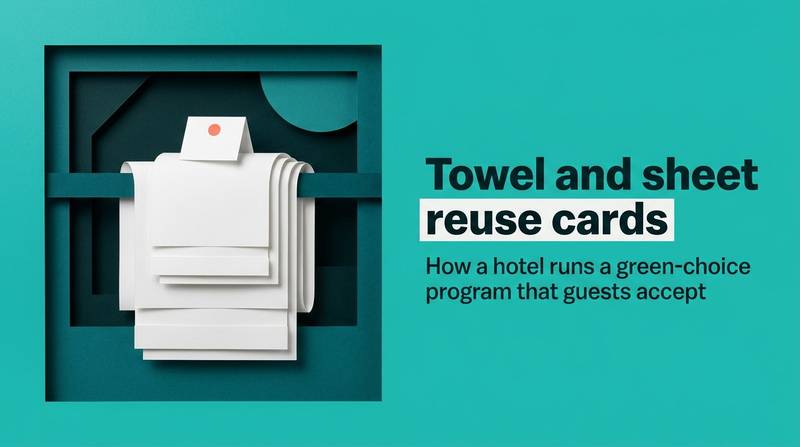
Towel and sheet reuse cards: how a hotel runs a green-choice program that guests accept
A reuse card is a housekeeping rule, not a marketing message. Learn how to define the guest's choice, brief staff with a clear decision table, and measure laundry savings from your own logs.
AI draft · awaiting editorial review
Contents
Key takeaways
- A reuse card is a housekeeping instruction, not a marketing message: if the card and the room attendant disagree, the guest believes the attendant.
- The guest makes three decisions, not one: bath towels, bed linen and the bath mat, and the bath mat is changed every day regardless of where it is left.
- Hygiene exceptions override the guest's choice every time, and no card should ever be read as permission to leave soiled linen in a room.
- Measure the program in kilograms of laundry per occupied room from your own laundry log, compared with the same weeks at the same occupancy band.
- Never print a certificate mark or a saving percentage on the card that the hotel cannot reproduce from its own records.
A hotel towel reuse program is a written housekeeping rule: the guest's signal, a towel on the rail or a card on the bed, decides whether linen is changed that day, and hygiene exceptions override it. It works when the card states exactly what staff will do, and when the hotel measures the saved laundry from its own log.
The guest comes back at four, sees the towel still on the rail and the card still on the pillow, and cannot tell whether the room was serviced or skipped. That doubt is what a reuse program has to remove, and it is settled in the housekeeping rule, not in the wording. This article gives you the rule as a decision table, a model card text, a briefing and spot-check method for supervisors, and a way to count the saving from the laundry log you already keep.
What is a hotel towel reuse program, and what does the guest actually decide?
It is a standing housekeeping rule that lets the guest choose whether towels and bed linen are changed today, with the card as the guest's way of setting that choice. The card is the visible part; the rule is the product.
Start by separating the three decisions the guest is really making: bath and hand towels, bed linen, and the bath mat. Most cards blur them into one line, and the room attendant then has to guess. The bath mat is not a reuse item at all, and treating it as one is the fastest way to a complaint.
Decide the default before anything is printed: change every day unless the guest asks otherwise, or reuse unless the guest asks for a change. The default is what most guests will live with, because most guests never read the card. Write down what silence means: a guest who moves nothing, leaves nothing on the bed and says nothing is the most common case in every hotel, and the rule must answer it in one sentence.
Keep the program optional for the guest and mandatory for the staff. The guest may opt out with no explanation; the attendant may not improvise. Name an owner for each part: housekeeping runs the rule, guest relations words the card, the laundry supplies the numbers. A program owned by nobody is overridden by habit within a month.
Finally, decide where the choice is recorded, on the room status or the housekeeping sheet, so the afternoon shift and the supervisor see the same decision the morning shift saw. If your property records room status inside a hotel operating system, the reuse choice belongs in that same record, not on a separate sheet.
What should the reuse card actually say?
It should say what to do with the item, what the hotel will do in return, and nothing else. One instruction per item, tied to a physical action the guest can perform in two seconds.
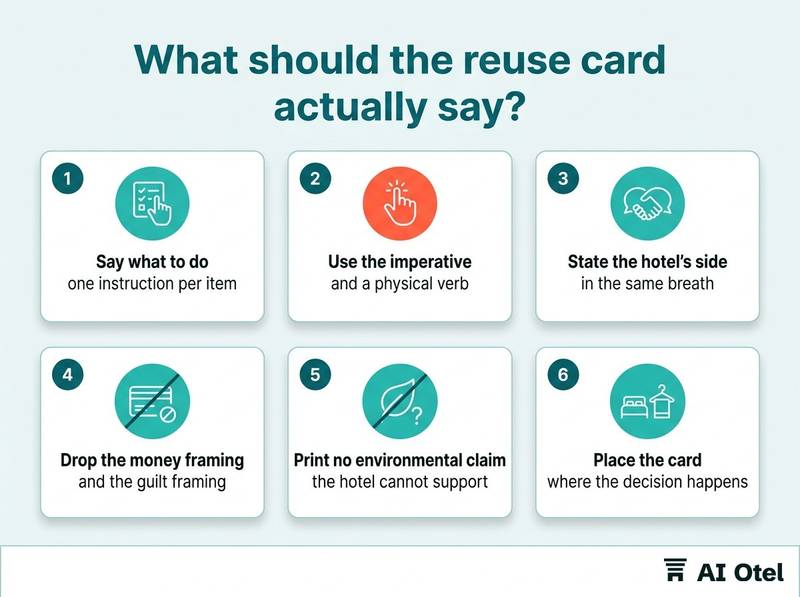
Use the imperative and a physical verb: hang it on the rail to use it again, leave it in the bath or on the floor to have it changed. Avoid abstract appeals such as "help us protect the environment", which do not tell anyone what to do. State the hotel's side of the bargain in the same breath: what happens if the guest hangs it up, and what happens if they do not. A card that only asks is a card that gets ignored.
Drop the money framing and the guilt framing. Both invite the suspicion that the program exists to reduce the laundry bill, and once a guest thinks that, no wording recovers the program. Print no environmental claim the hotel cannot support: no eco label, no green certificate mark, no carbon-neutral line unless the certificate exists and can be shown on request. The card is an operational instruction, not a certificate.
Translate into the languages your own reservation data justifies, keep the layout identical in each, and pair the text with two simple pictograms so a guest who reads none of those languages still gets the choice. Place the card where the decision happens: on the towel rail or the bathroom hook for towels, on the pillow for linen. A card on the desk under the television is read after the decision has already been made. Add one line for the guest who wants a change anyway, with no reason required and no charge.
TipA model card, three lines
Towel on the rail: we leave it for you to use again. Towel in the bath or on the floor: we replace it. Bed linen: we change it every third night, or today if you leave this card on the pillow. Want a change at any time? Call reception, no reason needed. Translate the same three lines, keep the layout, and add two pictograms: a towel on a rail and a towel on the floor.
What is the housekeeping rule behind the card?
It is a small decision table that every room attendant applies the same way: the position of the towel or the state of the bed tells them what to do, and hygiene overrides the guest's choice every time.
Towel on the rail or the hook: fold and leave it. Towel on the floor, in the bath or in the shower: replace it. The position is the whole signal, so the card must describe exactly the positions the staff are trained to read. Bed linen: make the bed with the same linen when the guest has chosen reuse, and strip and change on the stated cycle, for example every third night, or immediately when soiled. The cycle must be printed, because an unstated cycle becomes neglect.
Hygiene exceptions are not negotiable and need no permission: blood, vomit, urine, visible soiling, illness in the room, a reported infection, pests, smoke or heavy odor. The attendant changes the item and notes why. A new guest in the room always gets a full change, whatever the previous guest chose: the program belongs to a stay, not to a room.
| Guest signal | Housekeeping action | Override |
|---|---|---|
| Towel on rail or hook | Fold and leave | None |
| Towel on floor or in bath | Replace | None |
| Card left on pillow | Change the linen today | Hygiene exception |
| No signal at all | Apply the stated default | Hygiene exception |
| Bath mat | Replace daily | Always |
| New guest arriving | Full change | Always |
| Visible soiling or reported illness | Change and note | Always |
Record the choice in the room status so the next shift and the supervisor read the same thing. A paper card that nobody logs is a card that gets overridden by the next attendant's habit. For the linen side of the rule, the hotel bed making standard fixes what "made" means, so reuse does not drift into a bed that looks untouched by anyone.
How do you brief the staff and check the rule holds?
Brief the rule once in writing, then check it in the room rather than in the corridor: the only evidence is what the attendant did with the towel. Two failure modes matter more than any other.
Brief in the attendant's own language with the decision table in hand, and have each attendant walk one real room and apply the table while a supervisor watches. A briefing read aloud is not a briefing. Name the first failure mode: the attendant who changes everything out of habit. The program then exists only on paper, and the laundry log shows no change at all. Name the second failure mode: the attendant who leaves soiled linen to avoid wasting it. This is the failure that produces the complaint, and it must be treated as a hygiene error, not as enthusiasm for the program.
Spot check a sample of rooms per shift against the table and record the result, not the impression. The record is what shows whether the rule is stable across shifts and across supervisors. Check the guest's side too: is the card visible, is it in a language the current guest reads, is it still in the room on day three, or has it been cleared away with the paper cups. Give the attendant a way to escalate: a room that looks wrong gets changed and reported, with no argument at the door and no discussion in front of the guest. Review the overrides monthly: which rooms were changed against the guest's choice, and why, is the only reliable signal of where the rule is unclear.
ChecklistSupervisor spot-check list
- Card present and legible in a language the guest reads
- Towel position matches the action taken
- Bed linen matches the stated cycle or the guest's card
- Bath mat replaced
- No hygiene exception left unaddressed
- Choice recorded in the room status
- Any override noted with a reason
When should the program be switched off?
Switch it off for the room, not for the hotel. Any hygiene exception, any new guest and any guest request ends the reuse rule in that room immediately, with no explanation required and no charge.
Stained or soiled items are changed at once, and an item that will not come clean leaves circulation rather than returning to a room. Reuse must never mean a guest receives a marked towel. Long stays need a stated maximum, for example a full linen change every third or fourth night, so that reuse does not drift into neglect; the guest should be able to read that number on the card. Illness, a reported infection, a medical request or a detergent allergy ends the program in that room and is noted for the next shift.
A guest request in any form, a note, a call or a word at the desk, is honored the same day. The program is a default, never a rule imposed on the person paying for the room. Extra beds, sofa beds and cots are made up fresh for each new occupant and are not carried over from the previous guest's choice.
Reuse and item loss interact: the towel that stays in a room for four days is also the towel that can leave with a guest, so the reuse rule and the loss policy must be written by the same person. The policy for items that leave with guests is a separate decision, but it should be written with this one. Any room where the hotel cannot guarantee the table is applied should be outside the program until it can.
Watch outThe failure that ends the program
The most damaging version of a reuse program is a soiled towel left in place because the guest hung it up. Hygiene exceptions override the card, always, and an attendant who changes a soiled item has followed the rule, not broken it.
How do you count what the program saves in laundry loads?
Count kilograms of laundry per occupied room from the log you already keep, week by week, and compare like with like. A figure you cannot reproduce is worse than no figure at all.
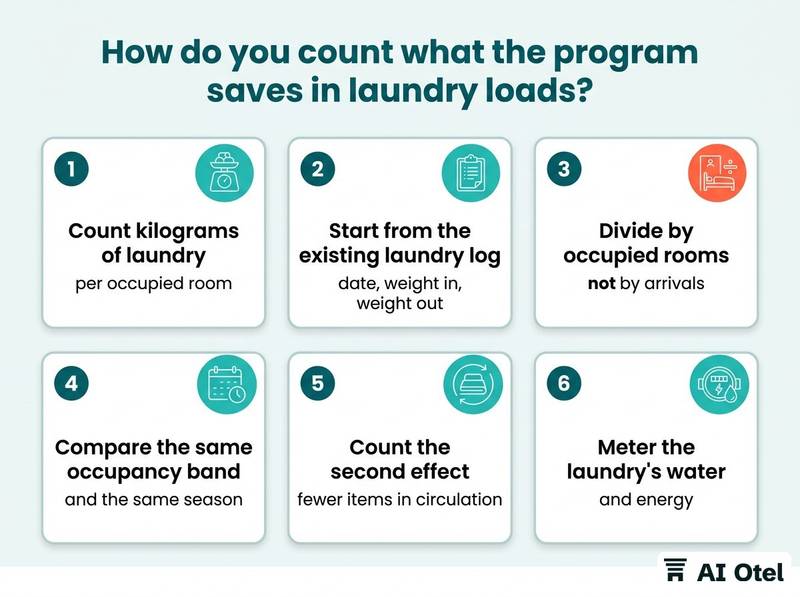
Start from the existing laundry log: date, weight in, weight out, number of loads, machine and program. If the log records only loads, add a scale reading before you start the program, so the baseline exists. Divide by occupied rooms, not by arrivals: the saving is per room-night, and arrivals move for reasons that have nothing to do with the card.
Compare the same occupancy band and the same season. A week at low occupancy and a week at high occupancy say nothing about the program, and mixing them produces a number nobody should publish. Count the second effect as well: fewer items in circulation lowers the par level and the replacement rate, which appears in the linen purchase line rather than the laundry line. The mechanics of par levels and laundry flow are covered in hotel linen management.
Meter the laundry's water and energy, because the laundry is a large water user in most hotels and the program's real saving sits there as much as in detergent. The method for daily readings is in energy and water per occupied room. Keep the raw weeks: if the hotel ever publishes a figure, the weeks behind it are the only thing that makes the figure defensible. Do not convert kilograms into a saving percentage for the website unless the baseline period, the occupancy and the method are printed next to it.
NoteRecord these fields every week
Week dates, occupied room-nights, laundry weight in kilograms, number of loads, water and energy meter readings, linen items withdrawn from circulation, and any event that distorts the week, such as a group departure or a machine breakdown.
How do you tell guests the result honestly?
Report what you counted, over the period you counted it, in the unit you counted it in, and say plainly that it is the hotel's own figure. Anything else invites a question the hotel cannot answer.
Use the measured unit: kilograms of laundry, loads run, cubic meters of water. Avoid the phrase "percent less impact", which describes a calculation nobody can check. Name the period and the comparison in the same sentence, for example the laundry weight per occupied room in June against the same weeks of the previous year at a similar occupancy. Say where the number comes from: the laundry log, the meter reading, the linen withdrawal record. A source line costs one line and buys the whole claim.
Attach no certificate the hotel does not hold. A reuse program is an operational practice, and guests who work in sustainability will ask which scheme, which auditor and which scope. Keep it short and put it where the guest already is: the card itself, the in-room information, the departure message. A sustainability page nobody opens carries no weight.
Answer the obvious question before it is asked: if the hotel spends less on laundry, what changes for the guest? The honest answer is usually better linen kept in circulation and a room that is still cleaned every day. If the number is small, say it is small. A modest figure a guest can trace is more credible than a large one nobody can reproduce.
What to do next
Write the decision table first, then the card, then the log, in that order: the table is what the staff follow, the card is only its translation for the guest, and the log is what lets the hotel say anything true about the result. Run the program for a full month at a stable occupancy before printing a single figure, and keep the hygiene exceptions in writing where every shift can see them.
If you are a traveler reading this rather than a hotelier, you can find a hotel in Türkiye (opens in a new tab) for your next stay.
Frequently asked questions
Do guests actually use hotel towel reuse cards?
Acceptance depends on the default and on whether the instruction is clear and placed where the decision is made, so the only useful answer is the hotel's own. Count rooms where towels were left on the rail, and read the laundry log per occupied room, rather than counting printed cards or asking guests at checkout.
Should the default be a daily change or reuse unless asked?
Daily change is the safer service default and costs more laundry; reuse by default saves more but depends on a visible card and a firm exception list. Either default is defensible if the guest can override it in one action and the staff apply it the same way on every shift.
Is a towel reuse program an environmental certification?
No. It is an operational practice inside the hotel, not an audited scheme. Certifications are separate, audited and scoped, and a hotel should not print a certificate mark or a green label on a reuse card unless it holds that certificate and can show its scope.
How many languages should the reuse card be in?
As many as the hotel's own reservation data justifies, with an identical layout in each language and two simple pictograms so a guest who reads none of them still gets the choice. The card should also make clear that a request at reception works in any language.
What do we do when a guest asks for fresh towels every day?
Change them every day, without comment, without a charge and without asking why, and note the preference so the team stops applying the default in that room. The program is a default for guests who do not want to decide, not a rule imposed on the guest who does.