Water in the guest room: glass carafe, plastic bottle or refill station, with a cost sum
Compare sealed bottles, glass carafes and refill stations on cost per occupied room. Learn to price labor, waste and breakage, then run a four-week trial before committing the whole hotel.
AI draft · awaiting editorial review
Contents
Key takeaways
- A bottle, a carafe and a refill station differ far less in what they cost to buy than in what they cost to run: labor, breakage, waste and the guest's walk down the corridor.
- Cost per occupied room, not cost per liter, is the number that lets you compare the three options honestly.
- A refillable carafe only works when the wash, dry, fill and check routine has a named owner and a written spot check.
- Whatever you serve, the room card and the minibar list must say whether the water is free before the guest opens it.
- Run the change on one floor for four weeks and count consumption, minutes, comments and waste before you touch the whole hotel.
Free water in a guest room comes in three shapes: a sealed plastic bottle, a glass carafe the hotel fills, or a refill station in the corridor. Compare them on cost per occupied room, not per liter: unit cost, consumption, housekeeping minutes, breakage and waste all land in the same sum.
A guest arrives at eleven at night, drinks both bottles on the desk and leaves the empties in the bathroom. In the morning housekeeping replaces them, the corridor bin fills with plastic, and nobody in the building knows what that pair of bottles actually cost. Hotel plastic water bottles in rooms look like a small purchasing line, but they carry labor, waste and guest-perception costs that never appear on the invoice. After reading this you will be able to price all three options on one comparable number, write the housekeeping routine behind the carafe, and run a four-week trial before committing the whole hotel.
What are the three ways to put water in a guest room?
There are three: a sealed bottle the hotel buys, a glass carafe the hotel fills from its own water point, and a refill station the guest uses in the corridor or lobby. Each changes who does the work and what the guest is asked to trust.
With the sealed bottle, the guest sees a closed, branded unit and has nothing to question. The hotel's work is buying, storing, chilling, replacing and disposing. With the carafe, the guest sees glass and a lid, and the trust question moves from the seal to the routine behind it: was this washed, and where was it filled? With the station, the work moves out of the room to a shared point, and the guest takes a walk down a corridor, which is a real cost at night in sleepwear.
A mixed model is often the honest answer: a carafe in the room plus a small sealed bottle kept for guests who ask, or a charged bottle in the minibar for the guest who wants one at two in the morning. Decide per room type, not per hotel. A suite and a standard room do not need the same answer, and the suite is where the carafe earns its keep.
| Option | What the guest sees | Who does the work | What the guest may doubt |
|---|---|---|---|
| Sealed bottle | Closed, branded unit | Purchasing, storing, replacing | Nothing, but the plastic is visible |
| Glass carafe | Glass and a lid | Housekeeping: wash, dry, fill, check | "Was this washed?" |
| Refill station | Dispenser and cup | A named person on each shift | "Do I want to walk there at night?" |
| Mixed model | Carafe plus bottle on request | Both routines | "Which one is free?" |
Each option also says something about the hotel. The sealed bottle reads as standard, the carafe reads as care, and the station reads as a policy the hotel is willing to explain on a card.
How do you calculate the cost per occupied room?
Add four lines for one occupied room: what the water and its container cost, what the labor costs, what breakage and fittings cost, and what waste handling costs. Divide by occupied rooms, not by available rooms and not by guests.
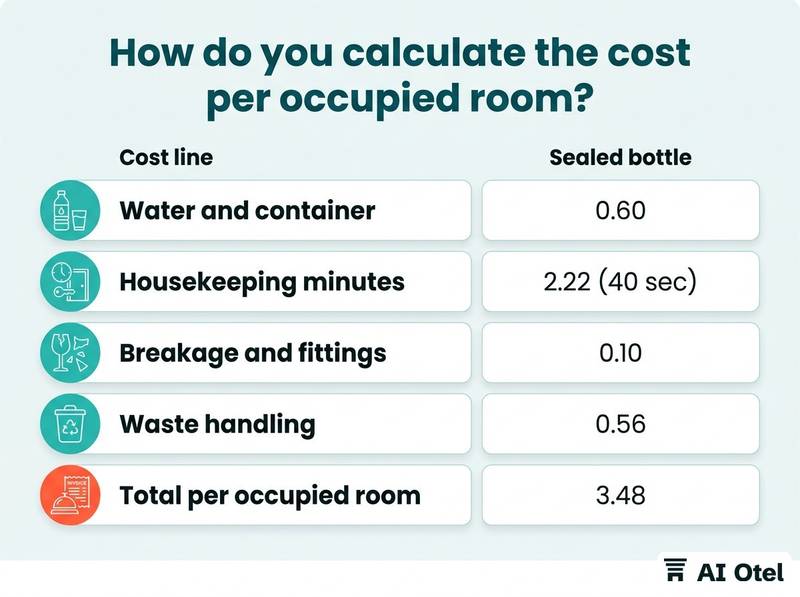
Fix the denominator first. An occupied room counts once whether one guest or three sleep in it; if you also want a per-guest figure, keep it as a separate number and label it. Consumption is not one unit per room: count the bottles that leave unopened in a suitcase, the ones housekeeping discards half full, and the ones a guest asks for at reception.
Labor is minutes per room multiplied by the loaded hourly cost of the person doing the work, meaning wage plus employer costs, not the wage on the contract. Breakage and fittings are easy to forget: carafes break, glasses chip, dispensers need filters and a drip tray, and the corridor station needs cleaning whether or not anyone used it.
Here is a worked sum with invented figures, for illustration only. At a loaded housekeeping cost of 200 per hour, two bottles at 0.30 each, 40 seconds of work, 10 seconds of waste handling and 0.10 for breakage and fittings come to roughly 3.50 per occupied room. A carafe at 0.05 for the water plus two minutes of wash, dry, fill and check, with its breakage and waste, comes to roughly 6.90.
| Cost line | Sealed bottle | Glass carafe | Refill station |
|---|---|---|---|
| Water and container | 0.60 | 0.05 | 0.10 |
| Housekeeping minutes | 2.22 (40 sec) | 6.67 (2 min) | 0.14 |
| Breakage and fittings | 0.10 | 0.15 | 0.30 |
| Waste handling | 0.56 | 0.02 | 0.02 |
| Total per occupied room | 3.48 | 6.89 | 0.56 |
Invented figures, for illustration only. Substitute your own wage, prices and timings; the station's fixed daily routine is also spread over more rooms in a full house and over fewer in a quiet week, so run the sum at your own occupancy.
The lesson from that sum: the water itself is the smallest line in all three options, and the labor line usually decides the winner. Measure minutes before you compare purchase prices.
How much housekeeping time does each option add?
The bottle adds seconds and a bin; the carafe adds a wash, a dry, a fill and a check; the station removes per-room work and adds a daily routine on the floor.
Glass handling has a sequence: wash, rinse, dry, store upside down on a clean surface. A glass or carafe dried with the cloth used on the bathroom is the failure that ends up in a review. Two carafes per room let one dry while the other is in use, so the room is never left without water and the attendant is never tempted to fill a wet carafe. Plan where the glass rides on the trolley: glass on a moving trolley breaks, and a broken carafe in a corridor is a safety job, not a housekeeping job.
The half-full bottle left by the previous guest cannot be re-served. Housekeeping must remove it and count it as waste, which means the bottle's real consumption is higher than the purchase order suggests. The station's routine belongs to a named person on every shift: wipe the tray, check the cups, check the water level, log the check. An unowned station becomes a sticky tray within a week.
Peak load is where the difference shows. At full occupancy the carafe adds minutes to every single room, so the daily labor total moves with occupancy while the water bill barely moves at all. The right cleaning products and a trained sequence matter here; the choice and storage of housekeeping cleaning supplies and chemicals is a separate decision, but the carafe routine lives or dies with it, and so does the guest's reading of what to tell guests about kettles, glasses and room hygiene.
Watch outDo not add a carafe without adding the minutes
If the standard room clean is timed to the second, the carafe will be skipped on busy days, and a skipped carafe is worse than no carafe. Add the minutes to the room's cleaning time before the first carafe goes upstairs.
How do you keep a refillable carafe hygienic and checkable?
Write the routine down, name who does each step, and have a supervisor spot-check rooms against it. A carafe is only as good as the check behind it.
Four steps, in this order: empty and rinse, wash with the designated detergent and a bottle brush, rinse again, dry upside down. Then fill at the designated point, not before. Name the water source: a tap or filtered point in the pantry, stated on the room card, is a routine; filling from the bathroom tap in the room is a story the guest will tell.
A lid changes the reading of the object. A lidded carafe looks protected; an open jug looks like a glass someone left out. The spot check is the control: one room per floor per day, opened by a supervisor, looking for a dry carafe, a clean glass, a filled carafe and the card in place. Record the check on the floor sheet with an initial and a time, so the routine survives a busy Saturday and a change of shift.
Keep a small stock of sealed bottles for the guest who asks for one. Hand it over without an argument; the point of the carafe is the default, not the rule.
ChecklistThe carafe routine, for the attendant to initial
- Carafe emptied and rinsed
- Washed with bottle brush and designated detergent
- Rinsed
- Dried upside down on the clean surface
- Glass washed and stored upside down
- Carafe filled at the pantry point
- Lid on
- Room card in place
- Supervisor spot check initialed
What should the room card and the minibar list say?
Say what the water is, where it came from, whether it is free and how to get more, and make the minibar list agree with what is actually standing in the room.
Free or charged, stated before the guest drinks. A guest who finds a water charge at checkout for something they read as a gift is a complaint the hotel chose to create. The minibar list must match the room: if the list shows a bottle and the room holds a carafe, the list is wrong and the bill will be wrong too. The refill station needs its own sign at the station, not only a line in the room card, because the guest meets the station without the card in hand.
Write the card in the languages the hotel actually serves at the desk, checked by a person, not a machine translation added on the day. On the tap, the hotel states only what it can stand behind: if it recommends the tap, it says so plainly and identically on every floor, and the front desk gives the same answer on the phone. Keep the wording short enough to fit the card and specific enough that the front desk can repeat it word for word. Charges that arrive late, or disagree with the list, feed straight into the wider problem of minibar control: stock, charges and late postings.
Key pointThree statements of one fact
The card, the minibar list and the bill are three statements of the same fact, and a guest who finds them disagreeing stops believing all three.
How do you run a four-week trial and decide?
Take one floor or one room type, run each option for a set period, and measure four things: consumption, housekeeping minutes, guest comments and waste.
Start with a baseline week on the current setup, so you have your own number before anything changes and something to compare against. Rotate by room number or by fortnight, and keep everything else in the room identical, including the tea and coffee tray, or you will not know what the guest reacted to. The tray is its own comparison, covered in the kettle, the capsule machine and the lobby station compared; keep it constant here.
Time a sample with a stopwatch: ten rooms per option is enough to see the difference in minutes, and it is far more reliable than asking attendants to estimate. Read the guest signal in three places: comment cards, review mentions of water, and the front desk's log of requests for a bottle. Weigh cost per occupied room against that guest signal; a cheaper option that produces complaints is not cheaper once the complaint is handled.
TipKeep the communication constant
Keep the guest communication identical across the trial weeks. If the carafe fortnight also gets a new card, a new tray and a note from the manager, you have measured the card, not the water.
Write the decision down with the date and a review date, so the next manager inherits the reasoning and not just the dispenser on the wall. If you want the routine, the room card and the guest's requests for water to live in one system rather than on paper, a guest app that puts offers and requests in one place can carry that routine, on a hotel platform that also holds the rest of the room's service.
What to do next
Choose one option for the standard room and one for the suite, write the routine and the card before the first carafe goes upstairs, and run the four-week trial on a single floor. The cost sum tells you what the option costs; the trial tells you what it costs in your hotel, with your occupancy and your guests, and only the second number is worth acting on.
If you are reading this as a traveler rather than a hotel manager, you can browse hotels across Türkiye (opens in a new tab) and compare how they approach water during your stay.
Frequently asked questions
Is bottled water or a glass carafe cheaper for a hotel?
Neither is cheaper by default; the comparison only works per occupied room. The bottle carries a visible purchase price and hidden labor and waste; the carafe carries almost no purchase price and a visible labor cost. Time the room work first, then price it, then compare.
Should the water in a hotel room be free?
It is a positioning decision, not a cost decision, and either answer works if it is stated before the guest drinks. The room card and the minibar list must say free or charged, and the bill must match both. A surprise charge is the only version that reliably costs more than the water.
Can guests drink the tap water in the room?
The hotel decides what it states and must be able to stand behind it. If it recommends the tap, it says so on the card and the front desk gives the same answer. If it is not sure, it supplies water it controls and says nothing about the tap.
How many hotel plastic water bottles should housekeeping leave in rooms?
There is no universal number; the right figure comes from your own trial. Count what leaves unopened, what is discarded half full, and what guests request at reception, then set the number from that evidence rather than from habit.
What should a hotel do with half-empty bottles left in the room?
They cannot be re-served, so housekeeping removes them at departure and counts them as waste rather than stock. If the waste count is uncomfortable, that is the signal to test a carafe or a station, not to leave the bottle in the room.