A review in Russian, German or Arabic: reading it correctly and replying in the guest's language
Read foreign reviews for facts, not just tone. Draft short, checked replies in the guest's language using back-translation and a second reader to ensure accuracy.
AI draft · awaiting editorial review
Contents
Key takeaways
- Translation keeps the facts of a review and loses the tone, so read for the claim first and the feeling second.
- A reply that has to survive translation is three short parts: the guest's fact named back, what is true or what changed, and one private channel.
- Back-translation catches meaning errors; only a second reader catches tone. Publish after both, not after one.
- A promise, a personal detail or a named staff member in a public reply stays public, in a language you may not be able to correct.
- Ten approved sentences per language, each stored with the name of the person who approved it, cover most of the replies a hotel writes.
Translate the review, list the facts it claims, then reply in the language it was written in with three short parts: name the fact, say what is true or what changed, give one private channel. Back-translate the draft and have a second person read it before publishing.
A review arrives in Russian at 23:40. Nobody on the night shift reads it, so it waits until someone pastes it into a translator and posts a reply that sounds like a form letter, or answers a complaint the guest never made. Both outcomes are worse than a short, checked reply. After reading this you will be able to read a foreign-language review for what it actually claims, draft a reply that survives translation, check it without a native speaker on shift, and keep a small bank of approved sentences so the next one takes minutes, not hours.
Why does a foreign-language review deserve a reply at all?
Because the reply is read by the next guest who writes in that language, and silence is the only answer they can read. A short, checked reply does more than a long one nobody verified.
A review page is a public page. The reply sits under the review permanently, so it is read by future guests in that language, not only by the person who wrote it. The reviewer may not read English at all, and an English-only reply under a Russian review answers a different audience and leaves the writer out of the conversation.
Silence is not neutral. It is the one message the hotel sends without editing it, and to a reader scanning reviews before booking it reads as either indifference or absence. A wrong machine reply is worse than a short plain one, because it shows the hotel did not read the review. If you reply to a hotel review in another language, the reply itself proves someone read it.
There is a second benefit that has nothing to do with reputation. Writing the reply forces the team to extract the fact, and that is the same fact operations needs to fix the room, the bill or the shift. A complaint about a cold room in German becomes a maintenance record in Turkish.
Decide once, in writing, who owns foreign-language replies and how quickly they go out. If the decision is remade every shift, the review waits for whoever feels responsible, which means nobody.
NoteTwo readers, one reply
A reply has two readers: the guest who wrote the review, and the next guest who reads that language before booking. Write for the second one.
How do you read a translated review without losing the point?
Read for facts first and tone second. List the concrete nouns, times and amounts, then decide what the guest felt, because translation keeps the facts and flattens the tone.
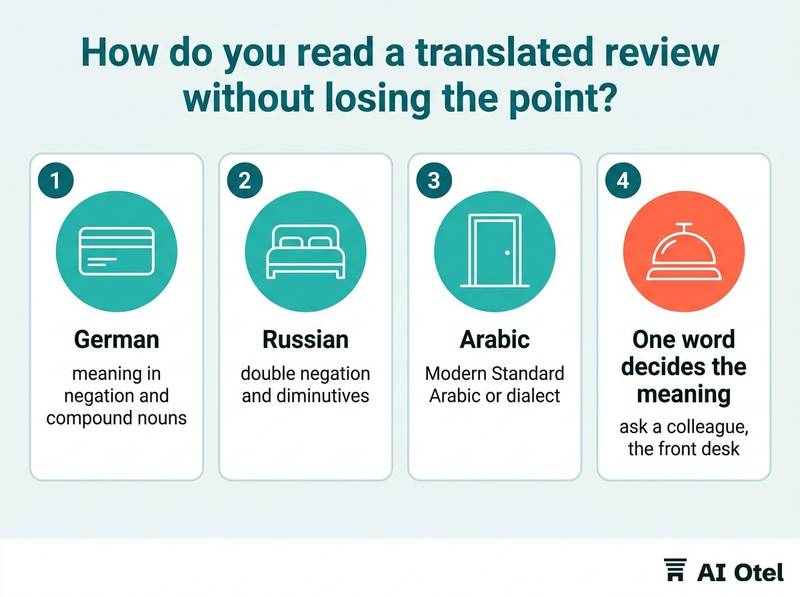
Machine translation preserves names, numbers, times and places. It flattens hedging, politeness, sarcasm and anger, so the facts are the part you can trust. Separate the claim from the stance. The claim is checkable: the room was cold, the charge was wrong. The stance is anger, disappointment or irony. Answer the claim and acknowledge the stance in one line.
Reading German, Russian and Arabic: three specific traps
German carries meaning in negation and compound nouns. Find the verb and the position of the negation before you decide what was actually complained about, because a sentence with two negatives can reverse the complaint entirely.
Russian uses double negation and diminutives. A diminutive can be warm or cutting depending on context, and short blunt sentences are normal register, not rudeness. Do not read aggression into a style that is simply direct.
Arabic may arrive in Modern Standard Arabic or in dialect, and right-to-left text mixes digits with Latin brand names. Check every number against the reservation, not against the translation. Check the guest's name as it appears in the reservation, not as the translator rendered it, before it enters a public reply; a spelling routine for names in other alphabets helps here.
If one word decides the meaning, ask: a colleague, the front desk who handled the stay, or the guest in a private message. Then write the fact in one line in your own language at the top of the draft. The reply is built from that line, not from the translation. For the limits of machine translation itself, see AI translation for guest messages: when it is good enough and when it is not.
ChecklistBefore you draft, extract
- The one fact the guest claims, in a single line in your own language
- The date, time, room type and amount, checked against the reservation record
- What the guest wants: an apology, an explanation, a correction, or simply to be heard
- The emotion word the guest used, and whether it reads as anger, disappointment or irony
- Whether the claim can be checked in the system today
- Whether the guest is still in-house
- The guest's name as the reservation spells it
What does a reply look like when it has to survive translation?
Three short parts: name the guest's fact back, say what is true or what changed, and give one private channel. Short sentences with one idea each survive translation; idioms and long apologies do not.
Name the fact in the guest's own words once. It proves the review was read and it translates cleanly, because it carries no adjectives. State what is true or what changed in the past or present tense, never in the future. A repair date beats a promise to do better. Give one private channel written out in full, a named mailbox or the front office, not the words "contact us".
Keep sentences to one idea and roughly fifteen words. Avoid idioms, humor, metaphors, sports and military language, abbreviations and internal jargon. Drop stacked politeness and conditionals: long courteous openings turn into noise in translation and bury the one sentence that matters. Sign with a role such as Guest Relations unless a named person has agreed to be named. A name in a public reply is a commitment.
Keep it shorter than you would write in your own language. Every extra sentence is another chance to mistranslate.
| Part | What it does | Illustrative sentence | What to avoid |
|---|---|---|---|
| Opening line | Shows the review was read | For example: "Thank you for writing about your stay in March" | "We are thrilled you chose our award-winning hotel" |
| Name the fact | Proves the complaint was understood | For example: "You write that the room was cold on the second night" | "We regret any inconvenience caused" |
| What is true or what changed | Gives the guest something checkable | For example: "The heating in that wing was repaired on 14 February and the room has been checked since" | "We will always make sure every guest is comfortable" |
| Private channel | Moves money and details out of public | For example: "Please write to our guest relations mailbox so we can look at your bill with you" | "Contact us" |
All sentences above are illustrative examples, not templates to copy. For worked examples by complaint type, see example replies by complaint type.
Which language do you post in?
Post in the language the review was written in. If the platform shows one reply, that is the one, and a Turkish or English version underneath a Russian review leaves the writer out. Two versions only where the platform shows them separately and the guest wrote in two languages themselves.
How do you check a reply in a language nobody on the team speaks?
Back-translate it and have a second person read the final text. Back-translation catches meaning errors, a second reader catches tone, and you need both before publishing.
Back-translation means putting your finished reply through a translator back into Turkish or English and comparing it with the one line you wrote at the start. If the meaning moved, rewrite the original sentence, not the translation. The original is what the guest will read.
Back-translation does not catch tone. A sentence can come back with the right meaning and the wrong temperature, which is why a person reads it. The second reader can be a native speaker on staff, a colleague from another department, or a partner who agrees to read. Give them the review, your reply and one question: does this sound like a hotel that read the review?
Check the fixed items separately: the guest's name, dates, amounts, room type and the hotel's own name. Confirm that nothing in the reply promises something the hotel has not agreed to. A promise is a promise in any language. Record who read the reply and when, next to the draft, so the next similar review starts from a checked text. If no reader is available before the reply goes out, publish the shortest version built from approved sentences and mark it for review. A fuller workflow for AI-drafted replies with a person in charge is described in AI-drafted replies to hotel reviews.
ChecklistBefore you publish
- The back-translation compared with your one-line fact
- A second reader's name and the date written next to the draft
- The guest's name spelled as the reservation has it
- Every date, amount and room type checked against the record
- No promise, no personal detail, no staff member named in blame
- One private channel written out in full
- The final text and its translation saved to the sentence bank
What should never appear in a reply to a foreign review?
No promises, no personal details and no blame. A public reply is a publication, and everything in it stays visible in a language you may not be able to correct.
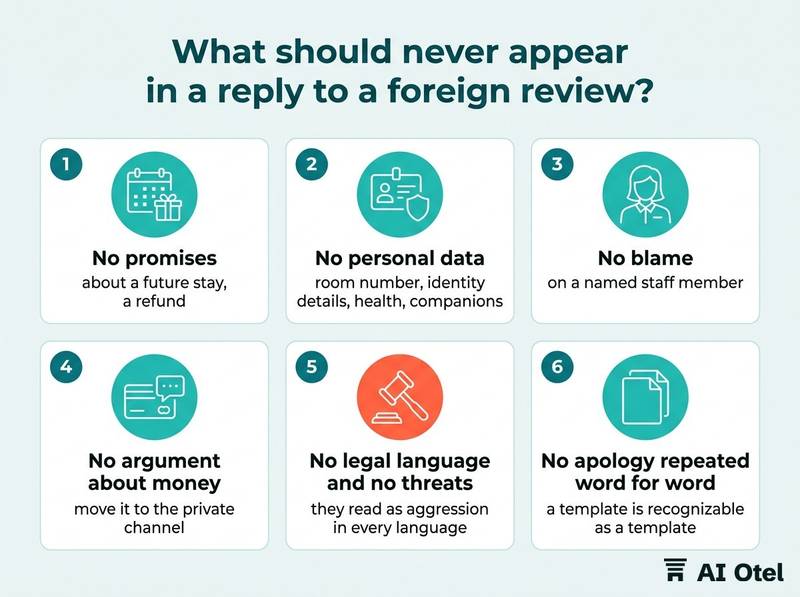
No promises about a future stay, a refund or an upgrade. The guest can quote a promise, and so can the next reader. No personal data: room number, identity details, health, companions or payment details, and no stay dates beyond what the guest already published. No blame on a named staff member and no description of internal discipline; handle that inside the hotel, in writing. For reviews that name staff, see when a review names a staff member.
No argument about money, invoices or charges in public. Move it to the private channel in one sentence. No legal language and no threats: they read as aggression in every language and translate badly. No adjectives about the hotel, no comparisons with other hotels and no claims about what other guests think.
No apology repeated word for word across languages. A template is recognizable as a template, and it tells the guest the review was not read. And no fact you have not checked: if the reply says a repair happened on a date, that date must exist in the maintenance record.
Watch outIt stays public
Write the reply as if the next guest will read it before booking, because they will, and as if the guest who wrote the review will forward it, because they can.
How do you keep a bank of approved sentences by language?
Write the sentences you use most in Turkish or English, have a native speaker produce the Russian, German and Arabic versions once, and store each one with the name of the person who approved it and the date.
Start from situations, not phrases: late check-in, noise, cold food, cleaning, a charge query, a broken fixture, praise for a staff member, a language misunderstanding, a booking mix-up, a departure complaint. Write the Turkish or English original first. The original is the source of truth and the translations are versions of it, so a policy change edits one line, not four.
One native speaker produces each language version and a second person reads it before it enters the bank. Store four fields: situation, language, sentence, approved by and date. Add a fifth: what must be changed each time, such as a date, a room type or a name. Mark the sentences that cannot be reused as they stand, meaning anything carrying a number, a date or a promise.
Review the bank when a policy or a service changes. An approved sentence about something the hotel no longer offers is worse than no sentence. The bank never replaces the first line: every reply still names the guest's own fact in the guest's own words. Keep it short enough that a night-shift receptionist finds a sentence in under a minute. A bank of two hundred sentences is a library nobody opens.
TipFixed part, variable part
Write the original in Turkish or English, translate it once, approve it once, and change only the variable parts. The fixed part carries the tone; the variable part carries the facts.
A hotel that replies to guests in several languages can also look at what a hotel operating system (built and working, ahead of launch) makes possible with guest communication in Turkish, English, Arabic, Russian and German, or how a guest app installed from the browser serves its guests.
What to do next
Pick the two or three languages your guests actually write in, and this week write the first ten approved sentences with a native speaker. Then use them on the next foreign-language review that arrives, with a back-translation and a second reader before it goes out. The routine is small; what matters is that it is the same routine every time, so the reply sounds like the hotel and not like a translator.
Frequently asked questions
Can I reply to a foreign review with a machine translation?
Yes for reading the review and for a first draft, never as the published text. Machine output keeps the facts and loses the tone, so back-translate the draft and have a person read the final version. If no reader is available, publish the shortest reply built from approved sentences.
What if nobody at the hotel speaks the guest's language?
You do not need a speaker on every shift, you need a reader for a short window each day. Build the sentence bank once with a native speaker, borrow a reader from another department or a partner, and keep replies shorter and plainer than usual. The front desk can also ask the guest in a private message what they meant.
How long should a reply in another language be?
Shorter than in your own language: three or four sentences, one idea each. Length does not read as care once it is translated, it reads as a template. Every extra sentence is another chance to mistranslate a fact or a promise.
Should I post the same reply in two languages?
Post in the language the review was written in. If the platform shows one reply, that is the one, and a Turkish or English version underneath a Russian review leaves the writer out. Two versions only where the platform shows them separately and the guest wrote in two languages.