When a review names a staff member: sharing praise, handling blame and keeping records fair
A named review needs two tracks: a public reply about service and a private conversation about the person. This guide explains how to handle praise, address blame, and keep records fair.
AI draft · awaiting editorial review
Contents
Key takeaways
- Praise and blame run at different speeds: praise can be shared within the shift, blame waits until the roster, the bill and the logbook have been read.
- The public reply answers the guest and informs future guests; it is not the place to confirm or deny what an employee did.
- A review is one guest's account, not a finding, so the private conversation starts with the record and the employee's own version.
- Named mentions are too few and too self-selected to carry a bonus; use them at appraisal as dated illustrations, not as a score.
- One monthly log of named reviews, with what was checked and what was done, turns scattered mentions into a pattern a department head can act on.
A named review is a review that identifies an employee by name, role or shift. Handle it on two tracks: a short public reply about the hotel's service that does not judge the person, and a private, documented conversation with the employee that starts from the facts, not from the review's verdict.
A guest checks out, writes four lines, and names the receptionist who, in their account, was slow and dismissive. By nine the next morning the review is on three sites, the receptionist has read it, and the front office manager wants to know what to do first. This article gives you that order of operations: how to split the public reply from the private conversation, how to share praise so it lands, what to say to a person named in a complaint, and how to keep a record that stays fair.
What should a hotel do when a review mentions staff by name?
Split it into two jobs that run at different speeds: a public reply about the hotel's service, and a private process about the person. The reply goes out within the day; the private process waits for facts.
Treat a review as named when it identifies a person by name, by role plus shift (the night receptionist on Tuesday), or by a detail that makes them obvious to colleagues. The two tracks have different audiences: the guest and future guests on one side, the employee and the hotel's own record on the other.
Name an owner for each track before the next one arrives. A reputation or front office manager owns replies; a department head, with the general manager or human resources, owns the people side. The employee should hear it from the hotel before they find it themselves: a short heads-up on the same day beats a perfect process a week later.
Never let the review be the only evidence. It records what a guest experienced, not what happened on the floor. And keep the opener identical for praise and blame, so the conversation does not announce its verdict in the first sentence. A weekly reputation routine for a small team gives the reply track a rhythm; this article covers the person side.
Key pointThe two-track rule
The public reply is about the stay; the private conversation is about the person. Never let one do the other's job, and never let the reply wait for the investigation.
How do you share praise so it lands?
Tell the person first, in private, using the guest's own words, and only then let the team hear it.
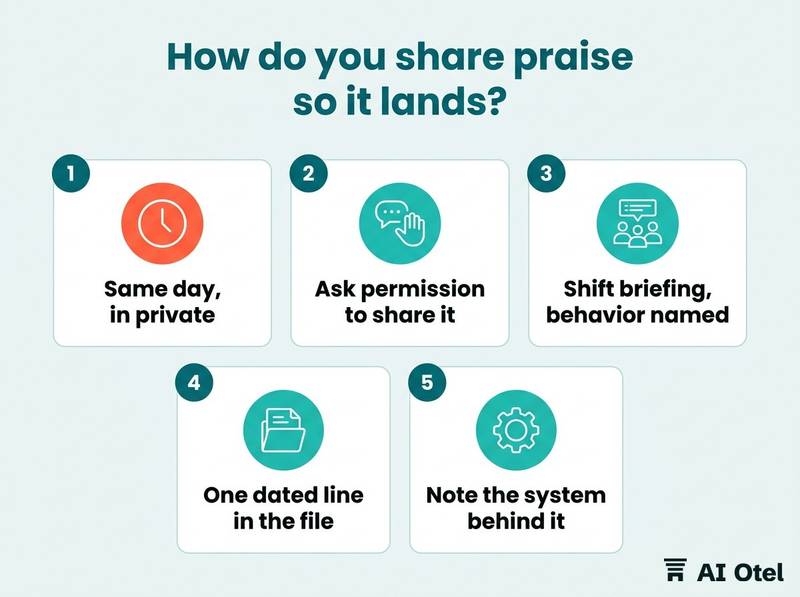
Order matters: person, then team, then the file. A team announcement before the person knows turns recognition into a surprise they have to perform. Quote the guest rather than summarizing: the sentence about remembering a daughter's allergy lands harder than a general well done.
Ask before you publish. A first name in an internal note is a different thing from a name and photo on a lobby screen or the hotel's own social account. Share at the shift briefing and name the behavior, so colleagues can copy the move rather than just applaud the person.
Write one line in the person's file with the date and the guest's words. That is what makes the mention usable at appraisal time. Skip leaderboards of named mentions: they reward chasing names and quietly punish the people who work the shifts where nobody writes reviews.
ChecklistPraise cascade
- Same day, in private, with the guest's exact words
- Ask permission to share it
- Shift briefing, behavior named
- One dated line in the file
- Note the system behind it: was the desk staffed, was the information available, did the rota allow it?
Should the public reply repeat the staff member's name?
Usually not. Thank the guest, address the service, and move the personal part to a private channel.
The name is already in the review. Repeating it in the hotel's reply creates a second, permanent link between a person and a bad night, and search results keep both. On praise, a first name can be fine if the employee agrees. On blame, the reply should never confirm or deny what an individual did.
Write the reply for the next guest, not for the reviewer. It shows how the hotel responds, not who was at fault. Correct the service facts you can verify (the wait, the room move, the charge reversed) and leave the person out of the sentence. Offer a named private channel, such as a duty manager's address, so the guest has somewhere to continue. Keep one voice: the hotel replies, not the employee and not the department head writing in the first person. Example replies by complaint type show the tone.
| What the review says | Name in the public reply? | What the reply does instead |
|---|---|---|
| Praise naming a waiter | First name only, with consent | Thanks the guest, names the behavior, no photo or surname |
| Complaint naming a receptionist | No | Apologizes for the wait, states what changed at the desk, offers a private channel |
| Complaint naming a manager | No | Accepts responsibility at hotel level, no defense of the individual |
| Long mixed review with one name inside it | No | Answers the two service points, ignores the personal aside |
| Mention by role and shift only | No | Answers the service, never narrows it to a person |
How do you handle a complaint that names a person?
Check the facts before the conversation, and treat the review as a claim to test rather than a verdict to apply.
Gather the record first: the reservation, the roster for that shift, the guest's bill, the logbook and handover notes, and the hotel's own written rule for what should have happened. Separate three questions: did the event happen, did the person follow the hotel's rule, and was the rule itself wrong.
Read the review twice, once for the guest's experience and once for what it actually asserts. "Rude" is an impression; "told me the room was not ready and walked away" is a claim you can check. Talk to the person before deciding anything, and hand them the guest's words rather than your paraphrase. Write their account down on the day: memory shifts once a decision is in the air.
Distinguish a person's failure from a system's. One clerk at 23:00 with a queue at the desk is a staffing decision, not a character flaw. Decide the outcome, tell the person directly, and tell them what the guest will hear back.
ChecklistBefore the talk
- Roster for that shift checked
- Bill and logbook read
- The hotel's written rule at hand
- The guest's exact words copied out
- A private room and half an hour booked
- Three questions written down: what happened, what did you do, what did the system allow you to do?
What do you say to the staff member in private?
Open with the fact that a guest mentioned them, hand over the guest's words, and ask for their account before you say anything about consequences.
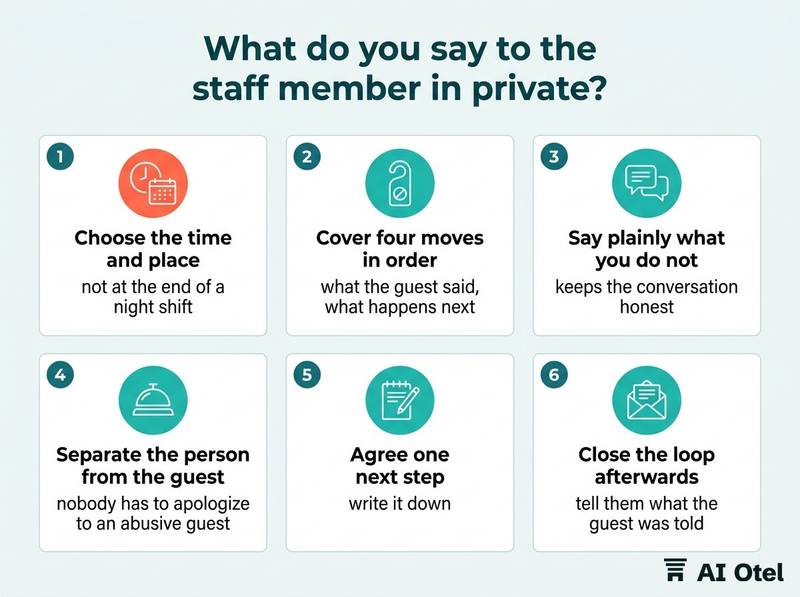
Choose the time and place: not at the end of a night shift, not in the corridor, not within earshot of the desk. Cover four moves in order: what the guest said, what you have checked so far, what they saw, what happens next.
Say plainly what you do not know yet. That keeps the conversation honest and stops the person filling the gap with the worst version. Separate the person from the guest: nobody has to apologize to an abusive guest, and nobody returns to a guest alone after a threat.
Agree one next step with a date and write it down, so the talk ends with a task rather than a mood. Close the loop afterwards: tell them what the guest was told and what changed, if anything.
TipA four-line opener to adapt
A guest mentioned you in a review. Here is what they wrote. I have not decided anything yet. Tell me what you remember, and we will agree what happens next.
How should you record named reviews, and why not pay bonuses on the count?
Keep one monthly log with what the guest said, what you checked and what you did, and keep money out of the count.
The log is a management record, not a scoreboard: one row per named mention, praise and complaint alike. Record the guest's words in a single line, then what was checked, what was done, who spoke to the person and the follow-up date. Review it monthly with department heads and look for a pattern across three months, not at two mentions in one.
Counts fail as a bonus basis. Reviews are a small, self-selected sample, and the guests most likely to name someone are the delighted and the furious. A named complaint can reflect a rota, a queue or an unclear rule, so a bonus on mentions rewards chasing names while a bonus on the absence of complaints rewards suppressing them. Use named mentions at appraisal as dated illustrations with quotes, next to attendance, training and observed work. The same logic applies to front desk bonus design, where each scheme can be gamed in its own way.
| Date | Channel | Praise or complaint | Name and department | The guest's words (one line) | What was checked | What was done | Who spoke | Follow-up |
|---|---|---|---|---|---|---|---|---|
| 12.03 (for example) | Review site | Complaint | First name, front desk | Guest wrote that check-in took too long | Roster showed one clerk on shift during a group arrival | Group arrival now split across two desks | Front office manager | 19.03 |
What to do next
Decide this week who owns each of the two tracks and where the log lives. Then take the next named review, praise or blame, through both tracks once, and trim the log columns to the ones you actually used. The reply protects the guest relationship; the private conversation and the log protect the person and give the pattern somewhere to show up.
If your team is small and this all lives in one person's head, a shared core, built and running in a public demo environment, that serves hotel teams, partner systems and the AI assistants people already use can carry the same discipline, and a hotel operating system, built and working ahead of launch, can hold the log, the roster and the guest's words in one place, so the record does not depend on memory.
Frequently asked questions
Can a hotel get a review removed because it names an employee?
Each review platform applies its own content rules, so read those rules before reporting anything, and expect most named mentions to stay up. Plan for the review to remain visible and put the effort into the reply and the internal process instead of the removal request.
Should the employee reply to the review personally?
No. One voice from the hotel keeps the reply consistent and stops a named person from arguing in public. The employee's account belongs in the private conversation and in the log, not under the review.
What if the guest's account of the incident is wrong?
Correct the service facts you can verify, such as the time of arrival or a charge that was reversed, without disputing the person's conduct in public. Offer a private channel, and record what you checked so the file shows the reasoning rather than only the outcome.
Does a named compliment count as evidence at appraisal time?
It counts as one illustration among several. Use the date and the guest's words next to attendance, training and observed work, and do not convert a handful of mentions into a score that outranks everything else.
What if the person named in a review that mentions staff by name has already left the hotel?
Record the mention, skip any action on the individual, and ask the system question: was the rota, the rule or the information at the desk part of what the guest experienced? That is the part a new team member will inherit.