Review and reputation terms for hotel teams: score, response rate, sentiment, verified review and more
This glossary defines the terms dashboards and owner reports use, from score and rating to sentiment and verified reviews. Learn to read review metrics correctly and standardize how your team reports performance.
AI draft · awaiting editorial review
Contents
Key takeaways
- A guest rating is the guest's mark, a review score is the platform's calculation, and a ranking is a position in a list; none of the three can be compared across platforms without checking the scale and the window.
- Response rate is replies divided by the reviews the platform lets you reply to in a stated period; response time is how long a reply took, and the two measure different things.
- A verified review means the platform matched the review to a stay; it says nothing about whether the content is accurate or fair.
- Sentiment is a tool's reading of the words in a review, not a guest's rating, and a sentiment figure is only as good as the sample and the languages it covers.
- A score moves because of the window, the volume behind it and the recency of the reviews, so any report should state all three next to the number.
A review score is a number a platform calculates from guest ratings; a rating is the guest's own mark; a ranking is a hotel's position in a list; sentiment is a tool's reading of the words in a review. This hotel review terms glossary defines the words dashboards and owner reports use, so every reader in the room means the same thing.
Two reports land on the same desk in the same week. One says the hotel's score is 8.6, the other says 4.3 out of 5. Both are correct, and neither means what the reader assumes. After reading this glossary you will be able to name each figure precisely, spot the pairs most often confused in owner reports, and standardize how your team reports review performance.
What do score, rating and ranking mean in hotel reviews?
A rating is what the guest gives, a score is what the platform calculates from ratings, and a ranking is where the hotel sits in a list the platform builds. They move for different reasons and answer different questions.
| Term | What it measures | Who sets it | Usual mix-up |
|---|---|---|---|
| Guest rating | the guest's own mark on a fixed scale | the guest | treated as if the hotel controlled it |
| Review score | the platform's calculation over a window | the platform | compared across platforms as if scales matched |
| Ranking | position among hotels in a list | the platform | read as a quality grade |
| Index | a composite built by a publisher | the publisher | quoted without its inputs |
| Recommendation rate | share who said they would recommend | the guest, aggregated | used as a synonym for score |
A rating is the mark a guest chooses on a fixed scale: 1 to 5, 1 to 10, or a thumbs up or down. The guest owns it. The hotel cannot change it, only answer it.
A score is the platform's own arithmetic on top of ratings, usually an average over a stated period with its own rounding, weighting and exclusions. Two platforms can hold the same ratings and publish different scores. A ranking is a position, not a number out of ten: it depends on the other hotels in the same list, so a hotel can improve its score and still fall in rank, or hold its score and rise because a neighbor slipped. An index is a composite figure built by whoever publishes it, joining several inputs with weights the publisher chooses; ask for the inputs and the weights before you put it in a board pack. A recommendation rate is the share of respondents who said they would recommend the property, which is a different question from how they rated it and can point the other way.
Why the same stay produces three different numbers
The same guest, on the same night, produces a rating the guest chose, a score the platform calculated and a ranking the platform assigned against its neighbors. Each answers a different question: how the guest felt, how the platform summarizes many guests, and where the hotel sits in a competitive set. For a worked example of two scales not agreeing, see why your Google rating differs from a booking site's score.
Which figure belongs in an owner report
The practical rule: never convert one scale into another by multiplying. State the platform, the scale and the period, and keep the original number. Owner reports should carry the guest rating and the platform score in separate columns.
What is response rate, and how is it different from response time?
Response rate is the share of reviews you replied to; response time is how long the reply took. A hotel can have a high response rate and a slow response time, or the reverse.
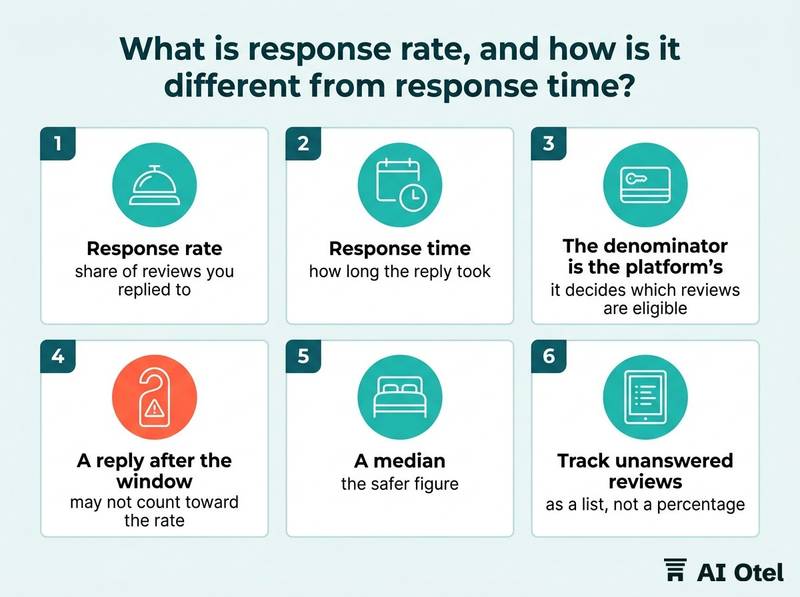
The denominator is the platform's, not yours: it decides which reviews are eligible for a reply and over what period, so the same behavior can produce different rates on two sites. A reply posted after the platform's reply window may not count toward the rate even though a reader can still see it; check the window before you set an internal target. Response time is usually reported as a median or an average, and a median is the safer figure, because one late reply can drag an average far from the normal case.
Which reviews count in the denominator
A template reply posted within the hour raises both figures and satisfies neither: readers recognize the template, and the guest who complained learns nothing. Report the two together, with the period and the platform named, or the number tells the reader nothing about the work behind it. Track unanswered reviews as a list, not a percentage, because the list is what someone can act on this week. For wording that goes beyond the template, see example replies by complaint type.
TipKeep a weekly sheet
Keep a simple weekly sheet with four columns: review date, platform, replied yes or no, and reply date. The response rate and the response time both fall out of it, and the unanswered rows are the to-do list.
What is a verified review?
A verified review is one the platform has matched to a stay, usually through its own booking record or a receipt the guest submits. Verification is a statement about the stay, not about the content.
The platform sets what counts as proof and how long after checkout a review can still be verified. Read that page once and write the rule into your own notes. An unverified review is not automatically false: guests book by phone, through an agency or directly, and a platform may have no record of that stay.
What verification does not tell you
A verified review can still contain a factual error, a wrong room number or a date that does not match. Verification answers "did this person stay", not "is this accurate". The evidence for a factual dispute is your own record: the reservation, the folio, the maintenance log, the duty manager's note from that night. Never argue about verification in a public reply; answer the substance, take the factual dispute to the platform's process, and keep the tone a future reader would respect. When a review names a staff member, the same care applies to praise and to blame: record what happened before you write anything public. For the platform side of a dispute, see what each platform removes and how to report a review.
Watch outTwo shortcuts that damage credibility
Do not treat "verified" as "accurate" and do not treat "unverified" as "fake" in a report or a reply. Both shortcuts damage the hotel's credibility with the reader who checks.
What does sentiment analysis mean on a hotel dashboard?
Sentiment is a tool's classification of the words in a review, usually as positive, neutral or negative, sometimes per sentence or per topic. It is a reading of language, not a guest's verdict.
A sentiment figure is a model output. Ask what it classified: whole reviews, sentences, or mentions of a topic such as breakfast, noise, cleanliness or staff. A number like 0.8 is the tool's own scale for how positive or how confident it is; it is not the share of guests who were happy, and it should never be printed next to a rating as if the two were the same unit.
Sentiment, topics and the difference between them
Topics are counts of mentions, not counts of complaints: a topic can be mentioned often and praised often in the same set of reviews. Mixed and sarcastic reviews are where tools disagree most, so read a sample of twenty classified reviews by hand before you trust the aggregate. Language coverage matters in Türkiye: a tool strong in English may handle Russian, Arabic or German reviews poorly, and the gap will not show in the dashboard. Use sentiment to find what to read, not to replace reading. It sorts the pile; a person still decides what the pile means.
Why does a review score move when nothing changed at the hotel?
Because a score is an average over a window, and the window, the volume behind it and the age of the reviews all change without the hotel doing anything.
The window: a rolling twelve months drops old reviews automatically, and a good month leaving the window can lower the score while the hotel is improving. The volume: a small base moves violently. For example, a hotel with forty reviews averaging 9.0 that receives one 1.0 review falls to about 8.8, while a hotel with four hundred reviews barely moves. Recency: some platforms weight recent reviews more heavily, and readers do too; a score built on two-year-old praise describes a hotel that may no longer exist.
Reading a score next to its volume and its window
The mix matters too: a new source market brings new expectations and new complaint types, which shows up in the score before anyone has named the cause. So can the platform's own changes: a revision to the scale, the rounding or the exclusions can move every hotel on the site at once. Before any explanation, pull the reviews behind the change for the same period and read them. The cause is usually visible in ten reviews, not in the average.
How do you use these terms the same way in every report?
Write the definitions down once, in one page, and attach them to every report. Most arguments about review performance are arguments about definitions, not about the hotel.
Fix the window for every figure in the report and print it in the header, for example "rolling twelve months to the last day of the month". Name the platform next to every score: a report that averages scores across platforms produces a number that exists nowhere. Print the pull date, because dashboards refresh on their own schedule and two readers comparing screens a week apart will otherwise think one of them is wrong.
A one-page definition sheet for the report
Keep the guest rating and the platform score in separate columns, and never convert one scale into another. Show the number of reviews behind each figure, so a reader can see whether a change is signal or noise. Decide which sites you actually watch and why, so the report does not grow a column every time someone mentions a new platform; which review sites a hotel in Türkiye should watch is a separate question worth settling once. Change a definition only at a quarter boundary, and say so in the report when you do.
Checklist
- Platform named for every figure
- Metric named exactly as the platform names it
- Window stated
- Pull date stated
- Number of reviews behind each figure
- Guest rating and platform score in separate columns
- No cross-platform averages
- Definitions last changed on a stated date
What to do next
Write the one-page definition sheet this week and attach it to next month's review report: platform, metric, window, pull date and the number of reviews behind each figure. The terms in this glossary only help once everyone in the room is using the same one for the same thing, and that is a decision the hotel makes, not a setting a dashboard offers. If you are reviewing tooling at the same time, it helps to know what a hotel operating system covers and where review handling sits in it, and how a guest app fits into the guest's own journey.
Frequently asked questions
Is a score of 9.2 out of 10 good?
It depends on the platform's scale, the window and the number of reviews behind it. A high score on a small base is fragile, and a 9.2 on one site is not comparable with a 4.6 on another. Read the recent reviews and the distribution of ratings, not the headline number alone.
Does replying to a review change the score?
A reply does not change the rating the guest gave. It changes the response rate, the response time and what the next reader sees when they open the review. Treat replies as communication with future guests, not as a lever on the number.
What is the difference between sentiment and a rating?
A rating is the guest's own mark on a fixed scale. Sentiment is a tool's classification of the words in the review text. They usually agree and sometimes do not, and a disagreement is worth reading by hand rather than averaging away.
Can a hotel ask a guest to take a review down?
Each platform sets its own rules for removal and for reporting a review, and those rules differ. Keep the hotel's own record of the stay first, use the platform's process for factual disputes, and answer the substance in public where a reader can see it.
What is a reputation index and should a hotel report one?
An index is a composite built by whoever publishes it, joining several inputs with weights that publisher chooses. Before quoting one, ask which inputs and weights it uses and whether your hotel can see them. If not, report the underlying figures instead.