Refunding a guest: card, booking site or cash, how long it takes and what to record
A hotel refund returns money already taken, unlike a void. This guide explains who approves, which route the money takes, and what to record to keep the audit trail clear.
AI draft · awaiting editorial review
Contents
Key takeaways
- A refund is a second transaction that returns money already collected; a void removes a charge that was never valid, and the two must never be used for each other.
- The route follows the money: whoever collected the payment is the party that returns it, so a booking-site payment is refunded by the site, not by the front desk.
- Card refunds go back to the card that paid; a different card or a cash payout is a decision above the front desk, written down with its reason.
- Every refund needs three things on record: an approver within a limit the hotel set, a reason code, and a folio line that leaves the original charge intact.
- Never promise a date: tell the guest when the hotel released the money and with what reference, and say the bank or the booking site sets the rest.
A hotel refund returns money already taken; it is not the same as voiding a charge. Approve it, send card refunds to the original card, let the booking site refund what it collected, and post the refund as a new folio line so the original charge stays visible. Timing belongs to the bank or provider.
A guest checks out a day early, or the room was not what the photos showed, and the front desk agrees to give money back. The charge is already on the folio, the card was taken days ago, and the booking came through a site that collected the payment itself. What happens in the next ten minutes decides whether this ends as a receipt or as a complaint. This article walks a hotel refund procedure from request to confirmation: who approves, which route the money takes, what the folio and the register must show, and what to tell the guest about timing.
What is the difference between a refund and a void?
A void removes a charge that should never have existed; a refund returns money the hotel has already collected. They use different records and different approvals, and mixing them is how audit trails break.
A void applies when the charge was wrong from the start: a posting to the wrong room, a duplicate entry, a wrong amount. The folio shows the charge and its reversal next to each other, with the reason written in words. A refund applies when the guest paid and is entitled to money back: an early departure, a service failure, a reduction agreed at the desk. The original charge stays, and a refund line is added underneath it.
Deleting a line to make the numbers look right destroys the story. The night audit, the monthly reconciliation and any later dispute will show a gap where a charge used to be. If you need the mechanics of reversing a posting correctly, see how to void a folio charge without breaking the audit trail.
A chargeback is a third thing. The guest's bank pulls the money back and the hotel answers with evidence. It is not a refund the hotel chose to make, and it needs its own file.
The decision rule is short. If the guest should never have been charged, void. If the guest paid and should get money back, refund. If the bank has already taken the money, it is a dispute, not a refund. And both need a reason a stranger can read in six months: one sentence naming what happened, not a code alone.
The three actions side by side
| Action | What moves | When it applies | Who decides |
|---|---|---|---|
| Void | No money moves | The charge was wrong | The person on duty, within a posting limit |
| Refund | Money moves back to the payer | The guest paid and is owed money | The approver named in the hotel's authority table |
| Chargeback | The guest's bank pulls the money | The guest disputes the charge with the bank | Finance, with the evidence pack |
Who approves a refund, and up to what amount?
The hotel decides this in writing before the situation arrives: a short table naming each role, the amount that role may approve on its own, and the reason codes it may use.
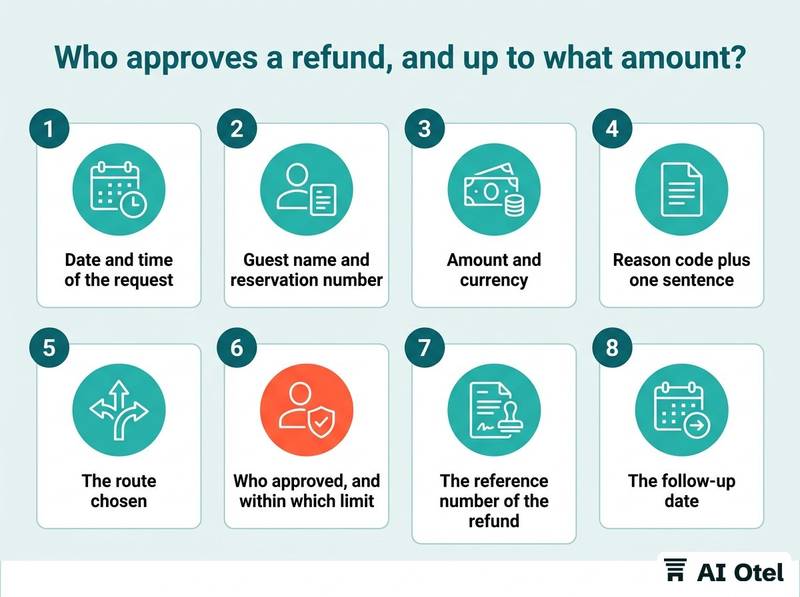
Build the table by role, not by person: front desk, duty manager, front office manager, general manager, finance. The amounts are the hotel's own choice; what matters is that a number exists and everyone knows it. Above the top limit, two people approve. The approver should not be the same person who reconciles the bank statement, or the check disappears.
Fix a short list of reason codes and keep it short: early departure, room not as sold, service failure, duplicate charge, deposit release, goodwill, booking-site instruction. A long list gets used carelessly. Record the approval where the money is: a folio note, a line in the refund register, or both, with the approver's name and the time.
Handle the shift handover explicitly. A refund agreed at the end of the late shift and released in the morning is the classic double refund; a note in the register prevents it. Never split one refund into smaller amounts to stay under a limit. It is the most common abuse of an approval table and the easiest to spot in a monthly review.
Give staff words they may say. "I can approve this part now, and I will ask my manager for the rest" is better than a promise nobody can keep.
What the approval record must contain
Checklist
- Date and time of the request
- Guest name and reservation number
- Amount and currency
- Reason code plus one sentence in plain words
- The route chosen (card, booking site, cash)
- Who approved, and within which limit
- The reference number of the refund once it is released
- The follow-up date
Which route should the refund take: same card, booking site or cash?
Follow the money. Whoever collected the payment returns it: the hotel refunds what the hotel charged, and the booking site refunds what the booking site collected.
When the hotel charged the card, the hotel sends the refund back to that same card and keeps the terminal reference. When the booking site holds the money, the hotel cannot refund a card it never charged. The hotel confirms the cancellation or the reduction to the site, records the instruction and the site's case reference, and the site pays the guest. If the site issued a single-use virtual card to the hotel, the refund goes back to that virtual card and the site passes it on; the hotel's record must show the virtual card reference, not the guest's card. For a fuller picture of who holds the money in each model, see how OTA payment terms decide who holds the money.
Cash refunds belong only where the hotel actually took cash. A cash payout against a card payment creates a mismatch between the payment record and the money, and the fiscal side of it is a question for the accountant. The same-card rule stands otherwise: refunds go to the original payment method. A different card, a different person or a different currency is a decision above the front desk, with the reason and the approver written down.
State partial refunds precisely: the amount and what it covers, for example one night out of four, the spa charge, or the minibar. A partial refund with no description will be read as a mistake. And remember that a pre-authorization hold is not a charge: releasing a hold is not a refund, and the guest should hear the difference in plain words.
Route matrix
| Who collected the money | Who refunds | What the hotel records | What the guest is told |
|---|---|---|---|
| Hotel charged the guest's card | The hotel | Terminal reference, amount, date | Release time and reference |
| Booking site collected from the guest | The site | Instruction to the site, case reference | Site's case reference |
| Site paid the hotel by virtual card | The hotel, to the virtual card | Virtual card reference | Site will pass it on |
| Hotel took cash at the desk | The hotel, in cash | Signed cash receipt with the folio | Signature required at payout |
| Hotel placed a hold, not a charge | The hotel releases the hold | Hold release reference | This is a release, not a refund |
What should you tell the guest about timing?
Tell them there are two clocks. The hotel's clock ends when the refund is released with a reference number; the bank's or the booking site's clock starts after that, and the hotel does not control it.
Never give a date the hotel cannot keep. Give the release time, the amount and the reference, and say the rest depends on the guest's bank or on the booking site. Explain the two clocks in one sentence, without jargon: "We have sent the money back today; your bank decides how quickly it appears on your statement."
Say it while the guest is still in the building, before checkout, not in an email afterwards. Most repeat complaints come from a guest who left without knowing what would happen. Put the same wording in writing by email or in the hotel's guest app, so the guest has the reference and the amount in a message they can forward to their bank. For booking-site payments, tell the guest what the hotel has told the site and give the site's case reference. Do not promise the site's timing on the site's behalf.
Ask your bank or payment provider for its own timing and use their answer, not a number from memory. The hotel's promise should never be longer than its own step.
TipA script the desk can use
"We have released your refund of the amount agreed, back to the card you paid with, today at the time on this receipt. Our reference is the number printed here. Your bank decides how quickly it appears on your statement; if it has not arrived within the time your bank quotes, call us with this reference and we will trace it."
How do you post a refund without deleting the charge?
Post the refund as its own line against the original charge, keep both visible, and route it to the right account so the night audit and the monthly reconciliation agree with the bank.
The folio keeps the charge and gains a refund line that names it. The net figure is what the guest owes or is owed; the two lines together are the explanation. Route correctly: the room account while the guest is in house, the house account for a goodwill item, and receivables after checkout. A refund after the guest has left does not belong back on a closed folio.
A refund posted after the business day closes lands on the next business date. Write the original charge date in the line text so the two can be matched later. The folio line is not the fiscal document: whether a refund needs its own document, and how an issued invoice is corrected, is a question for the accountant, because the answer depends on the hotel's taxpayer scope. For cash refunds, take a signature for the cash received and keep the copy with the folio, or the payment cannot be traced to a person. For foreign currency, post in the currency that was charged and record the rate you used, so the reconciliation can follow the money through the bank.
Never edit the original amount to make the net come out right. That hides the reason and turns a clear record into a guess. A hotel operating system built so that financial records are never deleted, only voided and reversed, makes this rule structural rather than a matter of discipline. The wider platform is designed around the same habit: a correction is added, not written over.
Watch outThe one thing not to do
Never delete or change the original charge to make the balance match. A refund is a second entry that points at the first, and a deleted charge cannot be explained to an auditor, a bank or a guest.
How do you follow up and close a refund case?
A refund is closed when the guest confirms the money arrived, or when the reconciliation shows it left the hotel's account. It is not closed when someone pressed the button.
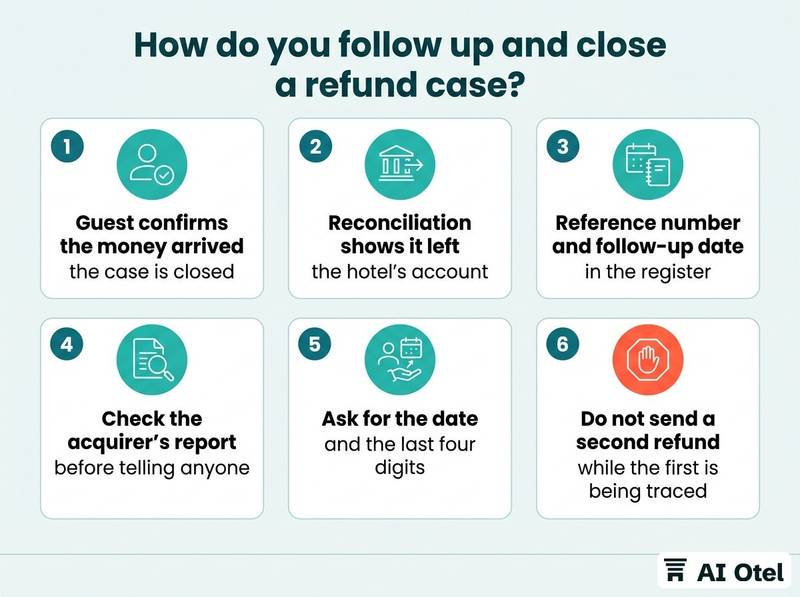
Every refund gets a reference number and a follow-up date in the register. The reference is what the guest quotes to their bank and what the hotel quotes to the acquirer. Check the acquirer's report or the booking site's statement before telling anyone the case is finished; released and received are two different states.
If the guest says the money never arrived, ask for the date and the last four digits of the card, check the reference, and ask the bank or provider to trace it. Do not send a second refund while the first is being traced. Double refunds usually come from a booking site that refunded the guest at the same time as the hotel; confirm who holds the money before releasing anything.
If the guest escalates to their bank, the case becomes a chargeback. The evidence pack is the folio, the approval record, the refund reference and the correspondence, and it should already exist. For what belongs in that pack, see answering a card chargeback with the right evidence. Close the register line with who confirmed it and when, so the monthly review counts closed cases rather than intentions.
What should a monthly refund review look like?
Group the month's refunds by reason code and amount, and look for the two or three causes that repeat. The individual case is already closed; the pattern is what costs money.
Who attends: front office, reservations, accounting, and whoever owns the cause, for example housekeeping for room condition or maintenance for a unit that was sold while out of order. Read the register as a table: reason code, number of cases, total amount, route used, whether the guest was told in writing, and whether the case was closed on time.
Look for repeats: the same room, the same shift, the same booking site, the same early-departure reason, the same deposit that was never released. Feed the result back into the written rule: the cancellation terms, the deposit wording, and the way rooms are described on the hotel's own site and on the booking sites. If the terms themselves are the weak point, start from writing cancellation terms the desk can actually apply.
Let the accountant see the register before the fiscal year closes, because the fiscal side of refunds is theirs to sign off. End with one decision, written down, with an owner and a date. A review that produces six observations and no decision changes nothing.
What the review table shows
Checklist
- Reason code
- Number of cases
- Total amount and currency
- Route (card, booking site, cash)
- Average time from request to release
- Cases still open past their follow-up date
- The one cause the hotel will fix this month, with an owner and a date
What to do next
Write the authority table and the reason codes this week, before the next refund request arrives at the desk. Everything else in this article hangs from those two documents: the route follows who collected the money, the folio keeps both lines, the guest hears two clocks, and the monthly review reads the register for patterns instead of arguments.
If you are reading this as a traveler rather than hotel staff, you can browse hotels across Türkiye (opens in a new tab) when planning your next stay.
Frequently asked questions
Can a hotel refund to a different card from the one that paid?
It is the hotel's own decision, written into its rule, and it should sit above the front desk. A refund to another card breaks the link between the payment and the return, which is hard to defend if the guest later disputes the original charge. If the original card is closed, the hotel asks its acquiring bank or payment provider for the correct route and records the answer with the case.
How long does a hotel refund take to reach the guest's card?
There are two clocks: the hotel approves and releases, then the acquirer and the guest's bank move the money. The hotel should give the release time and a reference, not a date. The hotel asks its own bank or payment provider for its timing and passes that on, and the guest's bank is the only party that can say when the money will appear on a statement.
Does a refund need a new invoice?
The folio line and the fiscal document are different records. Whether a refund needs its own document, and how an already issued invoice is corrected, depends on the hotel's taxpayer scope and the e-document rules that apply to it. The hotel's accountant decides this, and the front desk should never improvise it at the counter.
The booking site says it has already refunded the guest. Should the hotel refund too?
No. Check who collected the money first. If the site collected it, the site is the party that returns it, and the hotel's job is to confirm the cancellation or the reduction and keep the site's case reference. Paying as well creates a double refund that is difficult to recover and easy to see in the monthly reconciliation.
Should a deposit and a room charge be refunded on the same line?
Keep them separate. Releasing a pre-authorization hold is not a refund, and a deposit returned against damage is a different event from a room charge being reduced. Separate lines let the guest, the bank and the accountant see what each amount was for, and they stop a hold release from being counted as money paid out.