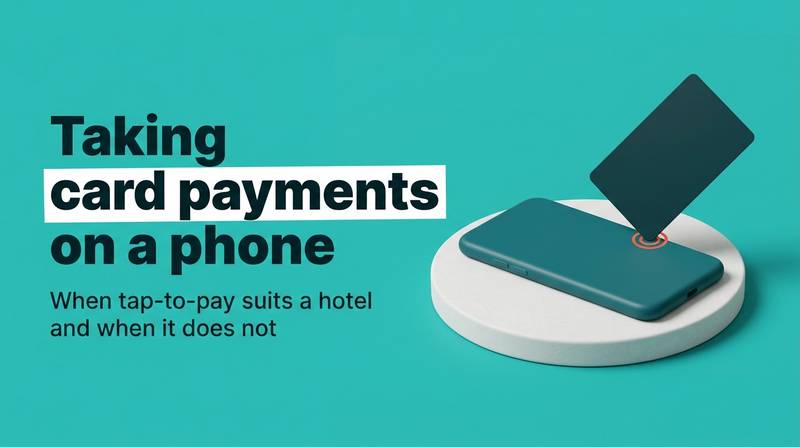
Taking card payments on a phone: when tap-to-pay suits a hotel and when it does not
Phone terminals suit small, immediate sales away from a fixed till but cannot post charges to a room bill. Learn where they fit, what to ask your bank, and how to reconcile takings.
AI draft · awaiting editorial review
Contents
Key takeaways
- A phone terminal takes a payment; it does not post a charge to the guest's folio, so a room charge still needs the hotel's own system.
- Card-on-phone fits where the guest is away from a fixed till and the sale is small and finished on the spot: poolside, beach, bell desk, event bars.
- Ask the acquirer for the settlement report format, the refund window and the transaction limits in writing before the first shift, not after it.
- One device, one named user and one written refund rule: a shared phone with a shared PIN is how takings go missing.
- The provider's report and the hotel's day-end are two different records, and a named person has to match them every day.
Card-on-phone payment, often called SoftPOS or tap-to-pay, turns a staff phone into a card terminal: it reads a contactless card or wallet and sends the authorization through a payment provider. It suits small, immediate sales away from a fixed till, such as poolside service or the bell desk. It does not post a charge to a room bill.
A guest on a sunbed orders two drinks and holds out a card. The waiter has no terminal, so the card travels to the bar and comes back with a paper slip, or the drinks go on a tab that nobody reconciles at the end of the shift. A phone in the waiter's pocket could take that payment where the guest is sitting. Whether it should is a different question, and this article answers it: what the phone actually does, where hotel tap to pay phone card payments belong and where they do not, what to ask the bank first, and how the money reaches the day-end.
What does a phone actually do when it takes a card payment?
The phone becomes the card reader. It reads the card over the air, sends the amount to a payment provider, and shows whether the payment was approved. The money, the receipt and the accounting entry are three separate things that follow.
The phone's short-range radio reads a contactless card or a phone wallet held near it. The payment app is supplied or approved by the acquirer, meaning the bank or payment institution that holds the hotel's merchant account. Some setups add a small clip-on reader for chip cards; a phone-only setup handles contactless and, depending on the provider's settings, asks for a PIN on the phone screen or declines the transaction.
The phone is a door, not a ledger. The acquirer authorizes the amount and settles it into the hotel's account, while the hotel's own records need the transaction imported or keyed before the sale exists in the hotel's books. It needs four things at once: a merchant account enabled for this mode, the provider's app, a data connection, and a phone model and operating system version the provider supports.
The guest sees a tap, sometimes a PIN or a fingerprint on the phone, and a receipt by message, email or print. The hotel sees a list in the provider's portal, a settlement file and a fee per transaction. The names differ by provider: card-on-phone, tap-to-pay and SoftPOS all describe the same family of software, where a general-purpose phone does the work of a dedicated terminal. For the wider vocabulary around hotel payments, see hotel payment technology terms: virtual POS, 3D Secure, tokens and chargebacks.
NoteFive plain definitions
Authorization is the provider's yes or no on the amount. Settlement is the money arriving in the hotel's account. A pre-authorization, or hold, is an amount reserved on the card without being taken. The acquirer is the bank or payment institution holding the merchant account. The folio is the guest's bill inside the hotel system.
Where does card-on-phone fit in a hotel, and where does it not?
It fits where the guest is away from a fixed till, the amount is small and the sale is finished on the spot. It does not fit where the sale has to land on a room bill or where the guest expects one bill at the end.
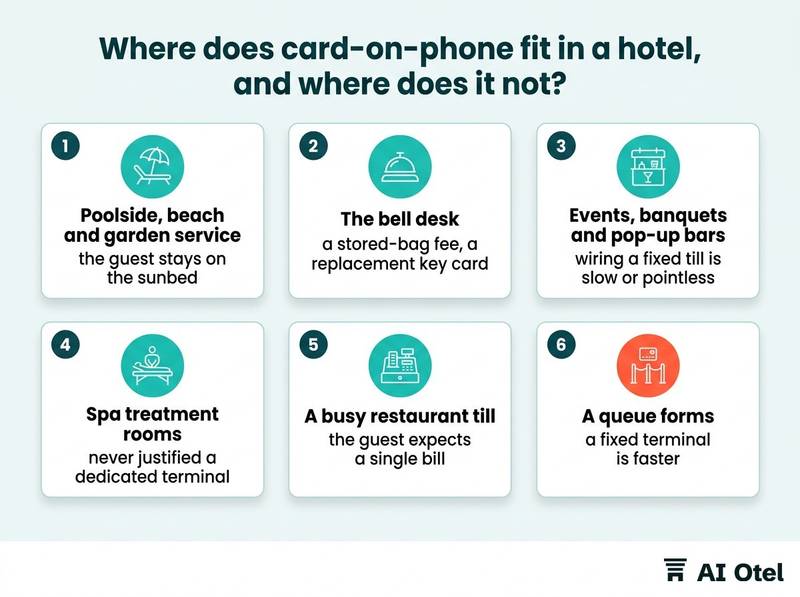
Poolside, beach and garden service is the clearest case: the guest stays on the sunbed, the sale is small, and the staff member returns to the bar with a completed payment instead of a handwritten tab. The bell desk is another: a stored-bag fee, a replacement key card, a departure charge that would otherwise be written down and chased. Events, banquets and pop-up bars are overflow points where wiring a fixed till is slow or pointless and the guest is standing in front of the staff member. Spa treatment rooms, the fitness area and small retail corners often never justified a dedicated terminal at all.
Apply one test: would the guest otherwise walk to a till, or would the charge go on a tab? If it would go on a tab, the phone moves the payment but does not solve the reconciliation problem the tab created. The counter-test is a busy restaurant till, a check-out desk, anywhere the guest expects a single bill: a phone there adds a second record that someone has to match at night. There is also a practical limit. The phone suits one staff member serving one guest; where a queue forms, a fixed terminal with a printer and a drawer is faster.
What can a phone terminal not do?
It cannot post a charge to a guest's room bill, and it cannot replace the hold a hotel places on a card at check-in. Those belong to the hotel's own system and to the acquirer's authorization rules.
A room charge is a folio entry inside the hotel system, tied to a room number and a guest name. A phone payment is a separate transaction with the acquirer, so a poolside drink goes on the room only if someone enters it against the room in the hotel system, the mechanism described in restaurant and bar charges to the room: connecting the POS and the PMS. A hold, by contrast, reserves an amount on the guest's card without taking it, which is how incidentals are covered at check-in; whether the phone app can place one depends entirely on the provider, so ask rather than assume.
Splitting a bill across two cards means two transactions and two records, and merging two separate phone payments into one guest bill is manual work at the desk. Refunds and voids follow the provider's rules and windows: once the business day has closed, a refund is usually a new transaction in a later report, not an edit of the old one. If the app offers to charge the guest in their home currency, that is a choice the guest makes and needs explained at the moment of payment, not discovered on the statement; see dynamic currency conversion at the hotel card terminal. Tips and service charges may settle with the payment or separately; find out which, because the difference shows up in the payroll and in the day-end.
Watch outThe most common mistake
Treating a phone payment as if it were a room charge. The guest is charged at the sunbed, the charge is also written to the room, and the hotel either bills twice or closes the folio with a payment nobody can match.
What should you ask your bank and your device provider?
Ask for the whole commercial and operational picture in writing before the first shift: who holds the merchant account, what each transaction costs, when the money arrives, and what the app can and cannot do.
Start with the account itself. Which merchant account receives the money, and is it the same account the fixed terminals settle into? Two accounts mean two reconciliations. Then the full fee schedule: per transaction, per device, monthly, minimum volume, and what a refund costs. Settlement timing matters as much as price: how many days, in what file format, and whether it can be exported and imported rather than retyped.
The same meeting should cover limits and verification, card coverage, refunds and offline behavior. The background on POS devices at a hotel: bank contracts, room-number entry, settlement and reconciliation applies to phone terminals too, because the contract structure is the same.
ChecklistTake these ten questions into the meeting
- Which merchant account receives the money, and is it shared with the fixed terminals?
- What is the full fee schedule: per transaction, per device, monthly, minimum volume, refund cost?
- How many days to settlement, and in what report format can it be exported?
- What are the minimum and maximum amounts per transaction, and any daily cap?
- When is a PIN required, and who sets those thresholds?
- Which cards are covered: domestic, foreign, debit, prepaid, commercial, phone wallets?
- Who starts a refund or a chargeback, where, within what window, and who carries the loss?
- Does the app work without a connection, and what happens to those transactions on reconnect?
- Which phone models and operating system versions are supported, and can the app be locked to one merchant and one user?
- What does the contract say about a device that is lost?
Ask your accountant whether the receipt the app produces is acceptable for the outlet's own records, because that answer sits with your adviser, not with the bank.
How do the phone's takings reach the end-of-day?
Only if a named person matches the provider's report to the hotel's own records every day. The night audit closes the business day on the hotel's numbers, not on the provider's.
Three records exist for every phone payment: the transaction list in the provider's portal, the settlement into the bank, and the hotel's own record of the sale. They agree only when someone checks. Name one person and one time. For example, the shift supervisor exports the list at close and the night auditor matches it against the outlet's sales before the day is closed. Match on amount, time and reference: a payment in the provider's list with no matching sale is the one to chase that night, while the staff member is still on shift.
Refunds processed after the day closes appear in a later report, so note them in the day's paperwork and the next day does not look short. Tips and service charges need their own line, or the outlet's takings and the staff's tips will disagree at month end. The receipt the app issues and the outlet's own fiscal documents are separate questions; ask your accountant how the outlet's sales are documented and whether that outlet uses a fiscal device at all, the territory covered in ÖKC in hotel outlets: fiscal devices, room charges and invoices.
TipA five-minute test before the first live shift
Take one small real payment, refund it, export the provider's list, and check that both appear where the night auditor will look for them. If you cannot find the refund in the afternoon, you will not find it at midnight either.
Who holds the phone, and what happens if it goes missing?
One named person per shift, one hotel-owned device, one PIN that is not shared, and a written procedure for the moment it disappears.
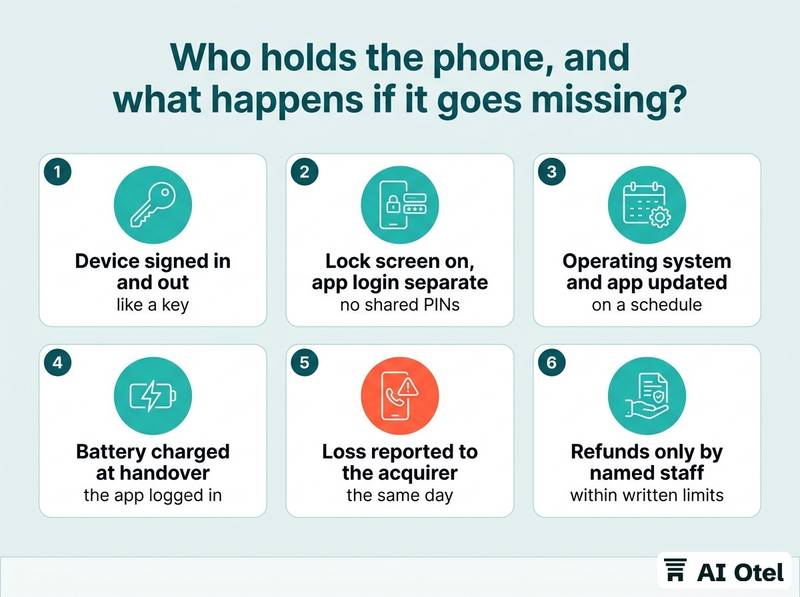
Hotel-owned devices only. A staff member's personal phone mixes a guest's card data with personal apps and leaves with the employee. Put a lock screen on the phone, a separate login for the payment app, and no shared credentials between staff members or shifts. Remote disable through the provider and through the phone's own management tools should be tested once before you need it. If a device goes missing, report the loss to the acquirer the same day and read the transaction list for that device; the speed of the report matters more than the paperwork.
Keep operating system and app updates on a schedule, because an out-of-date phone is the weakest point in the whole setup. Prefer the hotel's own network or mobile data over an open guest network, and check what the app does when the connection drops. Refund authority belongs in writing: who may press refund, up to what amount, and whose approval is needed above it. At shift handover, count the device in and out like a key, with the battery charged and the app logged in.
Checklist
- Device signed in and out each shift, like a key
- Lock screen on, app login separate, no shared PINs
- Operating system and app updated on a schedule
- Battery charged at handover
- Loss reported to the acquirer the same day
- Refunds only by named staff, within written limits
So when should a hotel say yes?
Say yes when the sale is small, finished on the spot and does not need the room bill. Say no when the guest expects one bill at the end or the hotel needs a hold on the card.
Ask three questions in order: does this sale need the folio, is the amount small, and is the guest away from a till? Two yeses out of three is the point where a phone earns its place. Start with one outlet and one shift, and keep the fixed terminal where the guest expects to pay at a counter. Write the rule down before the first shift: where the phone may be used, by whom, for what amounts, and who approves a refund. Review after a month against two things only, the provider's report and the hotel's day-end; if they still need a manual hunt, the process is wrong, not the phone.
| Situation | Phone? | Fixed terminal? | Why |
|---|---|---|---|
| Drink at the sunbed | Yes | No | Small sale, finished on the spot |
| Lunch at a pool table | Yes, if no table-side terminal | Otherwise | Guest stays seated |
| Stored luggage fee | Yes | No | One small charge at the bell desk |
| Restaurant bill at the table | Depends | Depends | Sale must reach the outlet's records either way |
| Check-out bill | No | Yes | Folio must close against a known payment |
| Incidentals hold | Only if provider supports holds | Desk and acquirer rules | A hold is an authorization, not a payment |
| Event bar | Yes | If wired | Overflow point, guest standing |
| Spa treatment room | Yes | No | Never justified a terminal |
The phone is a payment point, not a billing system. Every design decision follows from that one sentence. If you are evaluating how payments, room charges and day-end records connect in one place, a hotel operating system that carries restaurant and bar sales alongside the folio is the layer where the matching happens, and the approach to how guest and hotel data are handled is worth reading before choosing any payment setup.
What to do next
Pick one place in the hotel where a guest is currently waiting or a charge is currently going on a tab, run the phone there for one shift, and match the provider's report to the day-end that same night. If the two records meet without a manual hunt, widen it; if they do not, the problem is the process around the phone, not the phone itself.
Frequently asked questions
Can a hotel take a card payment at the pool without a fixed terminal?
Yes, if the hotel's acquirer enables card-on-phone on a merchant account and supports the phone model in use. The guest pays at the sunbed and the payment is a separate transaction with the acquirer. It does not put the drink on the room bill unless someone also enters it against the room in the hotel system.
Does tap-to-pay on a phone work without internet?
It depends on the provider's offline mode, and the hotel has to ask rather than assume. Offline transactions carry a real risk: a payment accepted without a connection can still be declined when it reaches the acquirer. If offline mode exists, the hotel needs a written rule for the amounts allowed and a check of those transactions at the next connection.
Can a guest pay the room bill by phone at check-out?
The payment itself can be taken on a phone if the provider supports it, but the folio has to be closed against that payment in the hotel system, which means the desk still does the closing. At a check-out desk a fixed terminal is usually the simpler route, because the receipt, the folio and the day-end line up in one place.
Is a phone cheaper than a fixed card terminal?
The pricing structures differ rather than one being cheaper in general. A phone setup usually carries a per-transaction fee and possibly a monthly fee, while a fixed terminal carries device rental and its own transaction pricing. Ask both providers for the full schedule, including refunds, chargebacks and minimum volume, and compare on the hotel's own expected volume.
What happens if the phone used for payments is lost or stolen?
The device is disabled remotely through the provider and through the phone's management tools, and the loss is reported to the acquirer the same day. The transaction list for that device is then read line by line. This is why the device is hotel-owned, locked, tied to one named user, and counted in and out at shift handover.