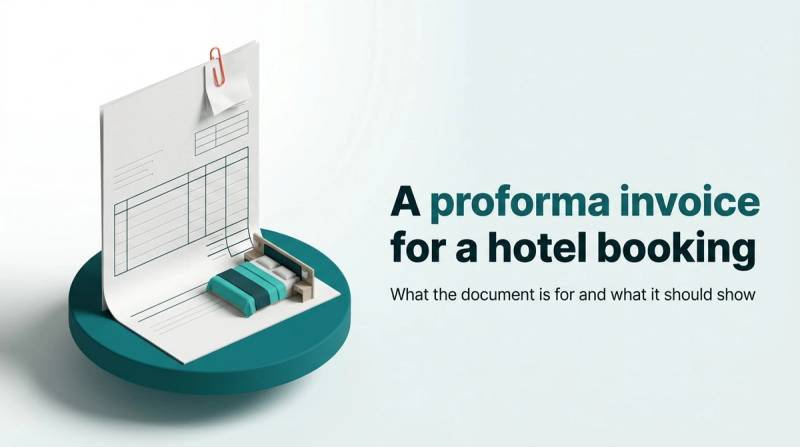
A proforma invoice for a hotel booking: what the document is for and what it should show
A proforma invoice is a payment request, not a fiscal document. This guide explains its purpose, required fields, and how to keep it aligned with the reservation.
AI draft · awaiting editorial review
Contents
Key takeaways
- A proforma invoice is a payment request, not a fiscal document: it states the offer and the deadline, and accounting issues the final invoice.
- A clear proforma carries the booking reference, the dates, the room and board, the rate and total in one named currency, the payment deadline and the cancellation terms.
- Write the deadline as a calendar date and a local time, and say what happens when it passes: the hold expires and the room returns to inventory.
- Generate the proforma from the reservation record rather than a separate template, so the document and the booking cannot drift apart.
- When the dates, the payer or the amount change, reissue the proforma with a new version number and mark the old one superseded.
A proforma invoice is a hotel's written payment request sent before a stay: it repeats the booking, states the price, the payment deadline and the cancellation terms, and asks the payer to transfer the money. It is not a fiscal document; accounting issues the final invoice.
A company's travel booker asks for a proforma before its finance team will release the money. The reservations agent sends a screenshot of the booking screen with an account number typed underneath, and two weeks later nobody can say which version of the price the transfer was based on. That failure is common and avoidable. After reading this, you will know what a proforma invoice for a hotel booking must contain, how it differs from the confirmation and the final invoice, and how to keep it in step with the reservation.
What is a proforma invoice for a hotel booking?
A proforma invoice is a document a hotel sends before payment: it repeats the booking in full, states the price and the payment deadline, and asks the payer to transfer the money. It is a request, not a fiscal document.
Its job is to turn an agreement made by email or phone into one page a stranger can act on: who to pay, how much, by when, and for exactly what. The people who ask for one are usually not the guest. They are a company's finance or purchasing unit that cannot release money without a document, a travel agency preparing a client's file, a family paying by bank transfer, or an institution that needs a reference before it raises an order. For example, a company booking four rooms for a training week will ask for one before it pays anything.
The document appears at two moments: before a deposit or a full prepayment, and when a company or agency will be invoiced after the stay but needs a document now to open the account.
A proforma does not confirm the booking by itself. The confirmation is a separate document that says the rooms are held; the proforma says what they cost and how to pay. What a hotel reservation confirmation must say is its own subject.
The proforma is also not the fiscal document. Accounting issues the final invoice, and the proforma should say so on its face so nobody files it as one. The practical test of a good proforma: a clerk who has never spoken to the hotel can pay it correctly, in the right currency, quoting the right reference, without calling back.
Proforma, confirmation and final invoice: how do they differ?
Each answers a different question: the confirmation says the booking exists, the proforma asks for money, the bank receipt proves money moved, and the final invoice is the fiscal document accounting issues.
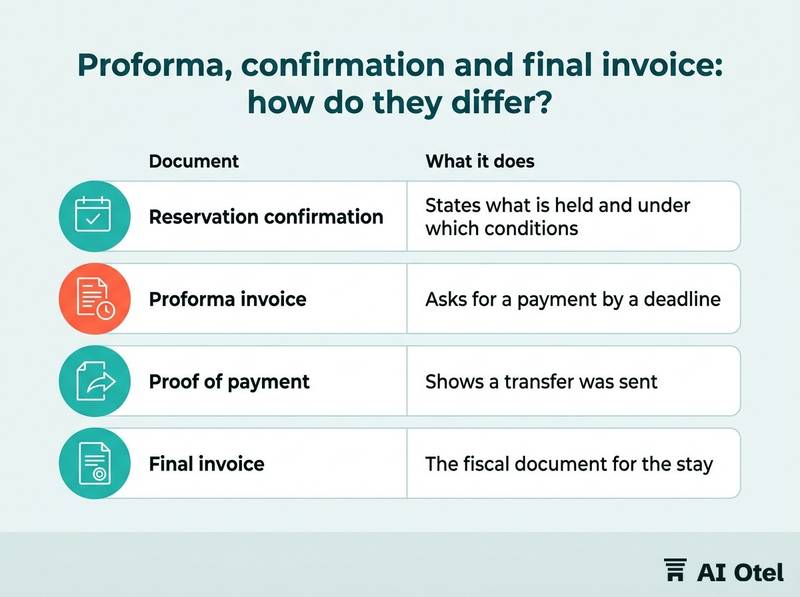
The confirmation states what was booked, for whom, at what price and under which conditions, and it is sent when the booking is made. The proforma repeats those facts and adds the two things a payer needs: bank details and a deadline. A payment request is often the same page as the proforma, or a short email that points to it. The failure mode is a payment request with no booking reference, which the payer's finance team cannot match to anything.
Proof of payment comes from the payer's bank, not from the hotel. Treat a screenshot as a claim until the money is visible on the hotel's account, and check the sender name against the payer on the proforma. Forged receipts are a real enough problem that verifying a prepayment before you confirm a booking deserves its own routine.
The final invoice is the fiscal document. Accounting issues it, and it carries fiscal details the proforma does not; the proforma must never look like it. A simple rule for staff: if a document could be mistaken for the fiscal document, label it more clearly, not less.
| Document | Who issues it | What it does | What it is not |
|---|---|---|---|
| Reservation confirmation | Reservations, at booking | States what is held and under which conditions | Not a request for money |
| Proforma invoice | Reservations or sales | Repeats the booking and asks for payment by a deadline | Not a fiscal document |
| Proof of payment | The payer's bank | Shows a transfer was sent | Not proof the money arrived |
| Final invoice | Accounting | The fiscal document for the stay | Not a payment request |
Which fields should a clear proforma invoice show?
Enough for a stranger to pay it correctly, and enough for both sides to recognize later exactly what was bought.
The header carries the hotel's registered name, address and a contact, the words proforma invoice, a document number and a date, and how long the quoted price holds. The payer block names the legal name and billing address of whoever pays, with a contact person; if the guest is someone else, the guests are named separately in the booking block.
The booking block carries the booking reference, arrival and departure dates, the number of nights, room type and room count, the number of adults and children, and the board basis written out rather than abbreviated. The money block shows the rate per night, the nights, extras as named lines, the total, and the currency written as a code as well as a symbol. Any taxes or fees the hotel applies appear as named lines, never folded silently into the rate.
The terms block states the payment deadline, the bank details with the reference the payer must quote, the cancellation and change terms, and what the hotel does on a no-show. The footer says who issued the document, how to reach them, and one line stating that this is a proforma and not the fiscal document.
ChecklistBefore you send a proforma, check every line
- Hotel legal name and address
- The words "proforma invoice"
- Document number and date
- How long the quoted price holds
- Payer legal name and billing address
- Payer contact person
- Booking reference
- Arrival and departure dates with nights
- Room type and count
- Adults and children
- Board basis spelled out
- Rate per night and total
- Currency as a code
- Taxes or fees as named lines
- Payment deadline as date and time
- Bank details with payment reference
- Cancellation and change terms
- No-show rule
- Issuer name and contact
- The line saying it is not the fiscal document
How should the payment deadline and cancellation terms be worded?
As a date, a local time and a consequence, so both sides know exactly when the hold ends and what a cancellation costs.
Write a calendar date and a local time, not a duration. If the payer is abroad, name the time zone the deadline is measured in. State the consequence of a missed deadline in operational words: the hold expires, the rooms return to inventory, and the booking is released. That is a mechanism the payer can plan around, not a threat.
Tie cancellation to the arrival date as a short schedule, and repeat the conditions that belong to the rate that was actually sold rather than inventing new ones for the document. Keep the terms on the proforma identical to the terms on the confirmation. If they differ, the payer will quote the friendlier one, and the hotel will be arguing against its own paper.
Say which currency the hotel will credit and who carries the bank charges on a cross-border transfer, so the amount that arrives is the amount that was asked for. Name a person and an email address to contact if the payment will be late: a payer with a slow approval process needs a route, and the hotel needs to know before the hold expires. Where a question touches consumer law, penalties or refunds, the hotel's own written rule is what the document must state, and the wording is settled with counsel before it is printed. The mechanics of prepayment, deposits and installments sit behind these terms.
Watch outPhrases to replace
Replace "as soon as possible" and "immediately" with a date and a time. Replace "upon request" with the named contact and address. Replace "the usual cancellation policy" with the schedule itself. Replace "price subject to change" with the date the quoted price holds until. Replace "bank charges may apply" with who pays them.
How do reservations and accounting keep the proforma and the booking in step?
By making the reservation record the only source of the numbers, and giving every document a version that points back to it.
Generate the proforma from the booking, not from a separate template in a word processor. The dates, rate, room type and board then come from one place and cannot disagree with the reservation. Put one booking reference on everything: confirmation, proforma, receipt, invoice, and the reference the payer is asked to quote on the transfer.
Split the ownership. Reservations owns the content, meaning dates, rooms, rate and board. Accounting owns the money and the fiscal document. Any change that moves the amount passes to accounting before it goes back out. When the payment arrives, record it against the booking, not against the email it came in with. The booking then shows what is paid and what is still open, and the proforma stops being the only record.
For companies and agencies that pay after the stay, the same discipline moves to the city ledger, where the payer, the guest and the invoice are three different things that must still line up; the city ledger is worth understanding on its own. Keep superseded proformas, marked as superseded, instead of deleting them. The point of the trail is that a later question can be answered from the file.
TipThree checks before pressing send
Does the total on the proforma equal the total on the booking? Does the deadline match the conditions of the rate that was sold? Is the payer name exactly the name that will appear on the incoming transfer?
What changes when the payer changes the dates, the name or the amount?
Reissue the proforma with a new version number and mark the old one superseded. Never edit the old file and send it again under the same number.
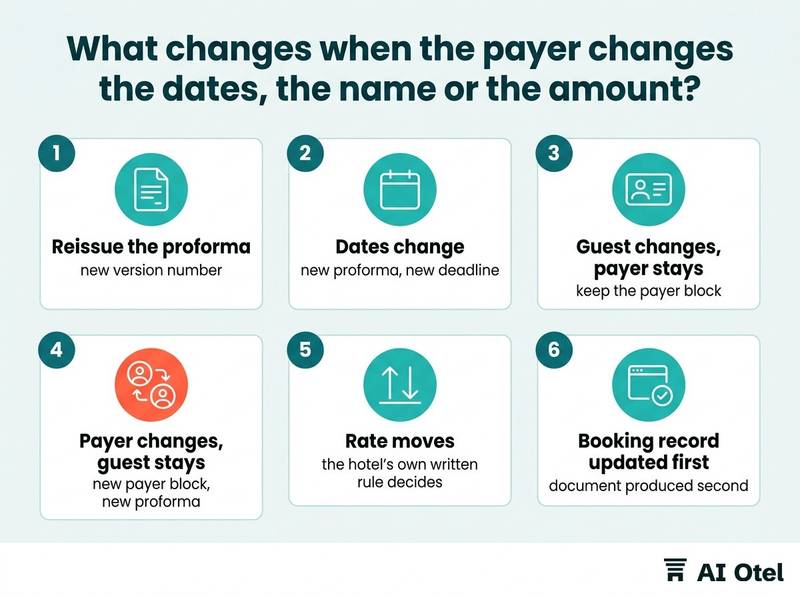
Dates change: the price usually changes with them, so a new proforma goes out with a new deadline, and the old one is cancelled in writing. The guest changes but the payer stays: keep the payer block, change the guest names on the booking, and make clear on the document which names it covers.
The payer changes but the guest stays, for example when a company pays for a guest or a relative pays for a family: a new payer block means a new proforma, because the name on the incoming transfer must match the name on the document. If part of the money has already arrived, the new proforma shows the total, the amount received and the balance due, so nobody pays the full amount twice.
If the rate moves after the proforma was sent, the hotel's own written rule decides whether the quoted price holds, and the document must say which rule was applied. A name change on a booking that will be invoiced to a company is a payer question, not a guest question: the invoice follows the payer. Every one of these cases ends the same way: the booking record is updated first, and the document is produced from it second.
What should a one-page proforma look like?
Five blocks, top to bottom: who is asking, who is paying, what is booked, what it costs and when, and what happens if plans change.
The order matters. A finance clerk reads top-down and stops at the first item that is missing, so the payer block comes before the money block. Keep it to one page: long booking conditions belong on an attached sheet that the proforma names, not in the middle of the amounts. Use the same layout every time, so staff fill it correctly and repeat payers recognize it without reading it twice. Put the bank details and the payment reference inside the money block, not in the footer where they get cut off by a printer or a phone screen.
| Block | What goes in it | The mistake to avoid |
|---|---|---|
| Who is asking | Hotel legal name, address, contact, document number and date, price validity | Sending it without a document number |
| Who is paying | Payer legal name, billing address, contact, guest names if different | Addressing it to the guest when the company pays |
| What is booked | Booking reference, dates and nights, room type and count, adults and children, board basis | Abbreviating the board basis |
| What it costs and when | Rate per night, nights, named extras, total, currency code, taxes or fees as named lines, deadline, bank details and reference | Burying the deadline in a paragraph |
| If plans change | Cancellation schedule, change rule, no-show rule, named contact, the "not a fiscal document" line | Leaving the terms off and pointing to a website |
What to do next
Take the proforma your hotel sends today, hold it against the checklist above, and fix the three things it is missing before the next request arrives. Then move the document's source of truth to the reservation record, so the confirmation, the proforma, the payment and the final invoice all describe the same booking. A hotel that wants its documents generated from one system rather than assembled by hand can look at how a hotel operating system approaches this, or at the OtelCiro ecosystem page for the consultancy side of revenue and distribution work. If you are a traveler rather than hotel staff, you can find a hotel in Türkiye (opens in a new tab) and ask the property directly for its confirmation and payment terms.
Frequently asked questions
Is a proforma invoice a real invoice?
No. It is a payment request that sets out the booking and the amount to transfer. The fiscal document is issued by accounting, and how and when that happens follows the hotel's own process. A payer who needs to know how it will be treated in their books asks their accountant.
Does a proforma invoice mean my booking is confirmed?
Not by itself. The confirmation is the document that says the rooms are held, and it should arrive separately with its own reference. If a hotel sends only a proforma, ask for the confirmation and check that the dates, rooms and board match.
Can a hotel ask for the full amount up front with a proforma?
That depends on the rate and the terms the booking was sold under, which are the hotel's own written conditions. The proforma must state the amount due, the deadline and the cancellation terms plainly, so the payer can see what they are agreeing to before transferring anything.
Which currency should a proforma invoice use?
The currency the booking was priced in, written as a code as well as a symbol, with the total in figures. If the payer will transfer in a different currency, the hotel's written rule should say which rate applies and who carries the bank charges, and that rule belongs on the document.
Who should a proforma invoice be addressed to?
The party that will actually pay, with its legal name and billing address, because the incoming transfer has to match that name. The guests are named separately in the booking block, and when the payer and the guest differ, both appear on the page.