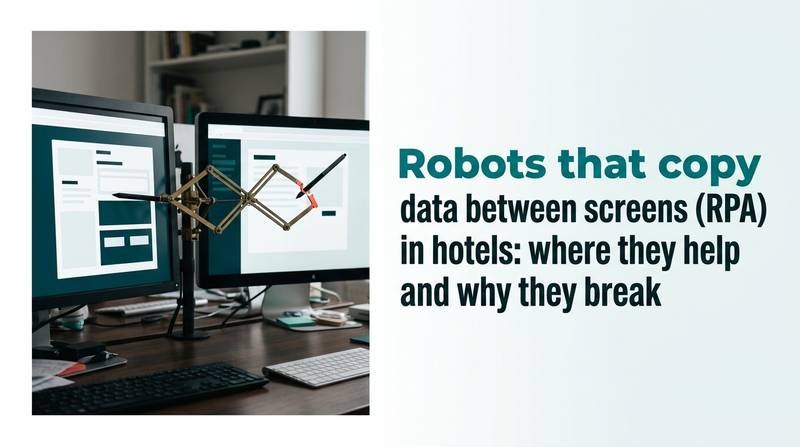
Robots that copy data between screens (RPA) in hotels: where they help and why they break
RPA in hotels bridges systems without interfaces but breaks when screens change. Learn which jobs are safe for robots and how to manage their upkeep and risks.
AI draft · awaiting editorial review
Contents
Key takeaways
- A screen robot is a user, not an integration: it sees what a member of staff sees and inherits every change made to that screen.
- RPA earns its place where data must cross a gap that has no interface, the volume is steady, and a person is doing the same keystrokes every day.
- Read-only jobs fail quietly and cheaply; jobs that write reservations, rates, charges or guest messages fail expensively.
- Every robot needs a named owner, a run log and a manual fallback, or it stops working and nobody notices.
- Choose an integration when one exists or can be bought; choose a robot when it cannot, the job is temporary, and you can carry the upkeep.
RPA, robotic process automation, is a program that operates another program's screen the way a person does: it opens a window, reads the fields, types and clicks. In a hotel it bridges systems that have no integration, and it breaks whenever a screen, a login or a loading time changes.
Every evening someone on the night shift copies the day's reservations from an old screen into a spreadsheet, then copies the spreadsheet into something else. It is dull, it is error-prone, and it looks like the perfect job for a robot. Sometimes it is. After reading this you will be able to tell which of your hotel's repetitive jobs a robot can safely carry, why robots stop working without warning, and what to ask a vendor before you buy one.
What is RPA in a hotel, in plain words?
RPA, robotic process automation, is a program that drives another program's screen the way a person would: it opens a window, reads what is displayed, types into fields and clicks buttons. The hotel's systems do not know a robot is there.
An integration is two systems exchanging data through an interface the vendors agreed on. A robot has no such agreement: it sits in front of the screen and behaves like a user with a keyboard and a mouse. It needs a login, a browser or a desktop session, and the same screens staff use. It has no special access and no privileged view of the data.
The robot reads the screen either from the page structure underneath it or from what is drawn on it. Both methods depend on the screen looking the way it looked when the robot was built. Some robots are attended: a person starts them at the moment of need, for example a clerk pressing a button to pull a supplier invoice. Others are unattended and run on a schedule on a machine nobody is watching.
Typical hotel candidates are old on-premise tools, supplier and agency portals, and any system whose vendor offers no interface and no plan to build one. A robot moves data. It does not create a shared source of truth, and it does not remove the second system that holds the copy.
NoteThree words readers mix up
An integration is two systems exchanging data through an agreed interface. A screen robot is a program operating a screen as a user. A scheduled report is a system exporting its own data on a timer. Only the middle one depends on the screen staying still.
Where does RPA actually help in a hotel?
It helps where data must cross a gap that has no interface, the job repeats on a steady rhythm, and the rules for doing it fit on one page. If any of those three is missing, the robot costs more than the task.
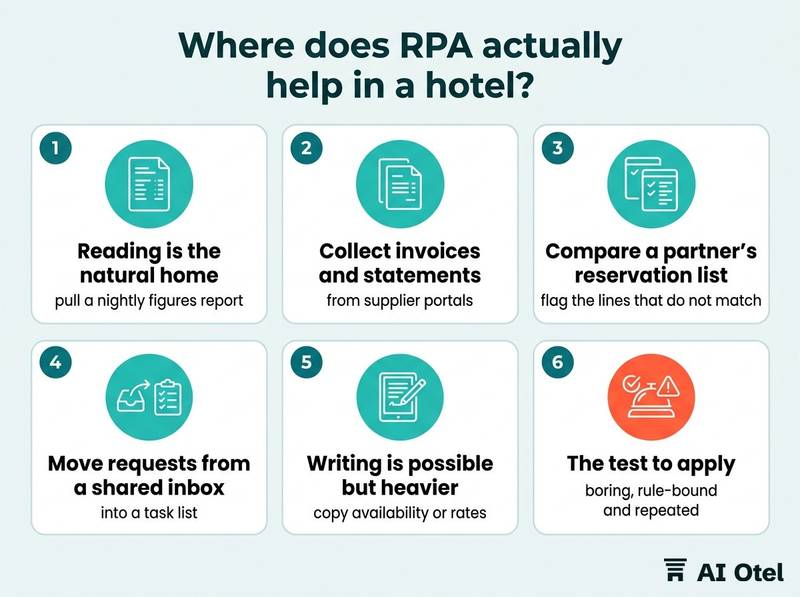
Reading is the natural home. A robot can pull a nightly figures report out of an old system and save it where the rest of the team can read it, with no typing by hand. It can collect invoices and statements from supplier portals into one folder for accounting, at a fixed hour, in a fixed format. It can compare a partner's reservation list against the hotel's own list when no feed exists, and flag the lines that do not match. It can move requests from a shared inbox into a task list, so that nothing sits unread overnight.
Writing is possible but heavier. A robot can copy availability or rates into a portal that offers no feed. Before you do this, read that portal's terms: the account belongs to the hotel, and the hotel carries the consequence of breaking its rules. The same thinking applies to deciding what to automate at all, which we cover in what to automate in a hotel back office and what to leave alone.
The test to apply is simple. Is the job boring, rule-bound and repeated, and is a mistake either harmless or caught before it reaches a guest or a ledger? If not, it is not a robot job yet.
Why do screen robots break?
Because a robot depends on things nobody promised to keep still: the layout of a page, the life of a login session, and the time a screen takes to load. Each of those changes without warning, and none of them is the hotel's to control.
The screen changes. A button moves, a field is renamed, a cookie banner covers the click, a vendor ships a redesign on a Tuesday. The login changes: passwords expire, rotation is enforced, a second confirmation step appears, or a captcha is added to stop exactly this kind of traffic. Timing changes too. The robot clicks before the page has loaded, or a slow night makes a step that usually takes a second take ten.
Small interruptions accumulate. A maintenance window, an upsell pop-up, a default currency or language that resets, a session that times out mid-run. Each break needs a person who knows how the robot was built. Without that owner, the robot does not fail loudly, it simply stops being run.
The dangerous failure is the quiet one. A robot that stops is annoying; a robot that half finishes and writes a wrong value into the second system is a data problem nobody sees for a week. Systems that exchange data through interfaces have designed ways to notice change, as explained in how hotel systems learn that something changed, by webhook or by polling. A robot has none of that unless you build it.
Watch outPartial runs
The robot has already written three of ten lines when the fourth screen fails, so the second system now holds a half-truth. Plan the check that catches this, for example a count of rows written against a count of rows expected, before the run is marked complete.
Which hotel jobs are safer for a robot?
Reading is safer than writing. A robot that copies data out of a screen and changes nothing can at worst produce a wrong report; a robot that writes into a live system can move money, inventory or a guest's booking.
Sort jobs by direction first: read-only, then write into an internal system, then write into a system a guest or a partner also sees. Sort by reversibility second: a saved file can be deleted, a posted charge can be corrected, a message already sent to a guest cannot be taken back. Sort by blast radius third: one wrong line in a monthly report is a conversation; one wrong rate published to a sales channel is a night sold at the wrong price.
Anything that produces a fiscal document, a payment or a legal notification belongs to a person, with the robot at most preparing the draft. Where a robot must write, give it a narrow window: one direction, one date range, one property, and a stop before anything is sent outward.
| Job | Direction | Why it sits where it sits |
|---|---|---|
| Copy a nightly report into a shared folder | Read-only | Nothing downstream changes |
| Compare two reservation lists, flag differences | Read-only | A wrong flag is caught by a person |
| Create a reservation in a partner portal | Write | A duplicate or wrong date reaches the guest |
| Change rates or availability | Write | Immediate revenue effect |
| Post a charge or prepare a fiscal document | Write | Money and a legal document |
| Send a guest message | Write | Cannot be unsent |
How do you run a robot safely?
Start read-only, give the robot a named owner, log every run, and keep a manual version of the same job that staff can still perform. A robot without those four things is a private experiment, not an operating tool.
Run it read-only for a first period and compare its output against a person's output line by line before it is allowed to write anything. Name one owner, with a deputy. The owner knows how the robot was built, checks the log, and is the person the night shift calls. Give the robot its own account with the narrowest rights that still do the job, and keep its credentials in a vault rather than in a shared spreadsheet, for the reasons set out in shared passwords in hotels and the routine that replaces them.
Log every run: start, finish, what was read, what was written, and what was skipped. A run with no log is a run nobody can defend. Keep the manual fallback alive: if staff can no longer do the task by hand, the robot has become a single point of failure. Agree a review date and a kill switch, and write down what the robot is not allowed to touch.
ChecklistBefore the first unattended run, work through this list
- Read-only trial completed and compared against a person's output
- One named owner and one deputy
- Its own account, least rights, credentials in a vault
- Run log switched on and read weekly
- Manual fallback still practiced
- Stop switch documented
- Target site's terms of use read and accepted by the hotel
- Review date in the calendar
RPA or an integration: how do you decide?
Choose an integration whenever one exists or can be bought, because the vendor carries the upkeep. Choose a robot only when no interface exists, the job is temporary, and the hotel can carry the maintenance itself.
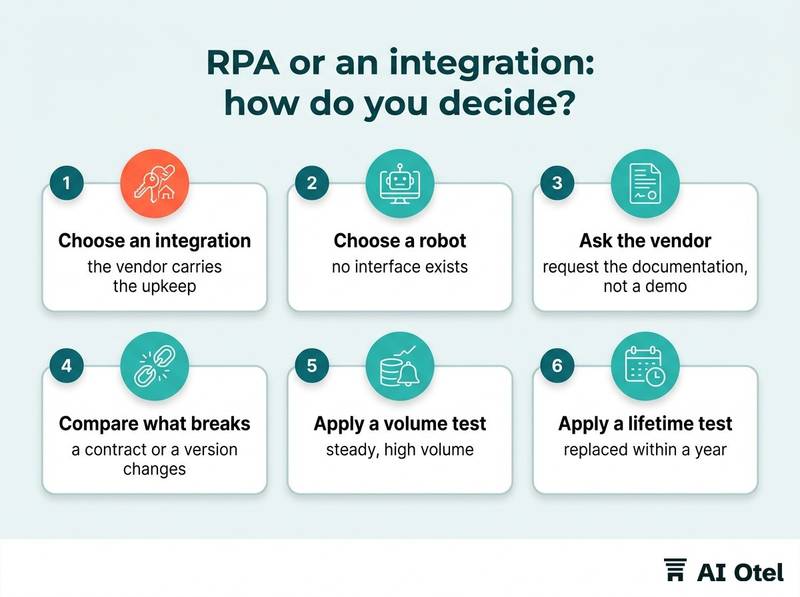
Ask the vendor whether an interface exists and request the documentation, not a demo. A demo shows a happy path; documentation shows what the interface promises. If you are new to the vocabulary, PMS integrations explained: APIs in plain words covers what an interface actually is, and a hotel operating system, built and working ahead of launch, that holds reservations, billing and reporting in one place, described at ai-otel.com/platform/pms, reduces the number of gaps a robot would need to bridge in the first place.
Compare what breaks. An integration breaks when a contract or a version changes; a robot breaks when a page changes, which is far more often and far less announced. Apply a volume test: steady, high volume through a stable interface belongs in an integration, because a robot's cost is per change, not per record. Apply a lifetime test: if the old system will be replaced within a year, a robot can be the cheaper bridge, provided everyone accepts it is temporary.
Check the data quality on the screen. A robot copies what is displayed, including the typo a clerk typed in 2019. And write down who maintains what: an integration is the vendor's problem; a robot is the hotel's.
What should you ask before you buy a robot?
Ask who fixes it when the screen changes, how fast, and at whose cost. The purchase price of a robot is small next to the years of upkeep that follow it.
Ask who repairs the robot when the target screen changes, within what time, and whether that is inside the support contract or billed by the hour. Ask what the log shows, and whether the hotel can read it without the vendor's help. Ask what happens on a partial run: does it stop, roll back, or alert someone, and who receives that alert?
Ask where the credentials live, and whether the robot can run under its own account rather than a person's. Ask whether the vendor has read the target site's terms of use, and what the contract says if the account is restricted. Ask whether you can run it read-only first, and who owns the robot's definition if the hotel ends the contract. How a vendor answers questions like these tells you a lot about how they handle accountability generally, a topic covered on ai-otel.com/trust.
Key pointThe one question that decides most of the others
If the vendor cannot say who repairs the robot within a working day of a screen change, the hotel is buying an unfinished job.
What to do next
Pick one job that only reads, run a robot beside a person for a month, and compare the two outputs before you let anything write. If the job turns out to be permanent and the volume is real, put the same effort into asking the vendor for an interface instead: the robot is a bridge, and a bridge is only worth building where nobody will build a road.
Frequently asked questions
Is screen scraping in hotels legal?
It depends on what is being read and on the terms of the site being read. The hotel's own systems are one matter; a partner portal or an extranet is governed by a contract the hotel signed. Read those terms before pointing a robot at any portal, and take advice on your own case from a legal adviser.
Can RPA replace a channel manager?
No. A channel manager holds one inventory and pushes it out through interfaces; a robot copies values from one screen to another and holds nothing. A robot used in place of a channel manager multiplies the ways the same room can be sold twice.
How many robots does a hotel need?
Start with one job, run it read-only, and add a second only when the first has an owner, a log and a fallback that work. The limit is not the software, it is the number of people who can repair a broken robot on a Sunday.
What happens when a robot fails at three in the morning?
Usually nothing visible, which is the problem. Plan the alert, the partial-run check and the manual fallback before the first unattended run, and decide in advance whether a failed run blocks the morning or is simply repeated.
Should a robot log into a booking site's extranet?
Check that site's rules first, because the account and its terms belong to the hotel, not to the vendor. Automated access may be restricted, and a suspended account costs more than the hours the robot saved.