Shift swap requests between hotel staff: a form, an approval step and the rota record
A hotel shift swap procedure needs a form, an approval step, and an updated rota. Learn how to document swaps, verify authorization for sensitive posts, and keep handover notes accurate.
AI draft · awaiting editorial review
Contents
Key takeaways
- A swap is complete only when three things change together: the form, the approval and the rota record.
- The person who approves a swap confirms two things, not one: that the post is covered and that the replacement is authorized for it.
- Night audit, cash handling, key control and pool supervision need an extra check before any swap is approved, because the replacement carries a specific authorization.
- A monthly count of swaps by post shows where the rota does not fit the work, before the mismatch turns into absence.
- An informal swap fails quietly: the rota keeps the wrong name, the handover note is addressed to someone who is not there, and the gap appears at the busiest hour.
A hotel shift swap procedure is a short written rule for two colleagues who agree to exchange shifts: a form that names both people, the post and the dates, an approval step before a set cut-off, and an updated rota plus handover note so the post is covered by someone trained for it.
Two receptionists agree to exchange a Saturday shift. Both are happy, nobody tells the supervisor, and the printed rota still carries the name of the person who is at a wedding. The problem is not the swap. It is that the hotel has no route for it shorter than the corridor conversation. After reading this, you will be able to write that route: a one-page form, an approval step with named approvers, and the rota and handover changes that make the swap real. This is part of hotel shift planning that covers the desk, the floors and the nights, not a separate discipline.
Why do informal shift swaps cause trouble at the desk and on the floors?
Because the rota, the handover note and the person standing at the post stop matching, and nobody notices until the shift is already short.
The rota is the hotel's record of who is accountable for a post in a given hour. An unrecorded swap leaves that record naming someone who is not in the building, which is worse than a gap, because a gap is visible. The handover note is written to a named person: the cash count, the open guest bills, the promised callbacks, the room that is not ready. If the name is wrong, the incoming shift starts without the facts it needs.
Competence is the quiet failure. A replacement who is not trained on the post is physically present and cannot finish the work: the night audit close stalls, the card encoder is left alone, the pool sits unwatched. Hours and pay drift too, because the rota feeds the hours worked, so an unrecorded swap creates a correction at month end, when nobody remembers the arrangement.
Repeated swaps in the same post are a signal, not a discipline problem. They usually mean the pattern does not fit the work, the transport or the school day. The answer is not to ban swaps. It is to make the approved route faster than the informal one, so people use it. Write the rule down once, one page, and post it with the rota. A procedure nobody can find in two minutes gets bypassed.
What belongs on a hotel shift swap form?
Six fields are enough: who gives the shift, who takes it, the date and hours, the post, the reason, and the approvals.
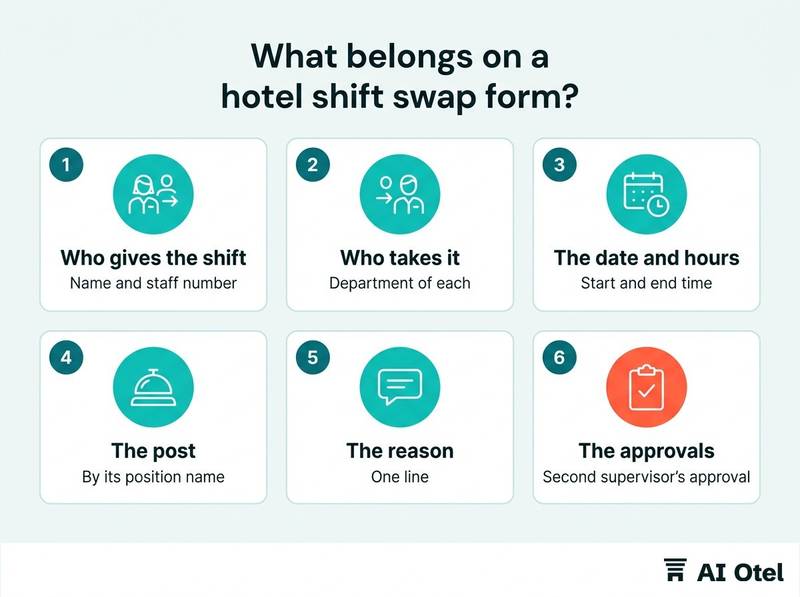
Both people, identified by name and staff number, with the department of each, so a cross-department swap is visible on the paper itself. The exact shift: date, start and end time, and the post by its position name, not simply reception or floors. A swap of a front desk morning is not a swap of a night audit.
The reason sits on the form in one line. It is not there to judge the reason. It is there so that a pattern, such as school hours, the last bus or a second job, becomes visible across months. Next to it, a confirmation that the replacement is trained and currently authorized for that post, with the name of the supervisor or trainer who confirms it.
Where the two people belong to different departments, the second supervisor's approval is required, because two rotas change, not one. The form closes with the rota change itself: who edited the rota, when, and which handover note was amended. Keep it to one page, available on paper at the desk and on the staff noticeboard, and accept a photograph of a signed form as a valid submission.
ChecklistCheck the form before it is filed
- Both names and staff numbers present
- Date, start and end time written, not implied
- Post named by position, not by department
- One-line reason filled in
- Replacement's authorization for the post confirmed with a name
- Second supervisor's signature where departments differ
- Rota edit recorded with the editor's name and the time
- Handover note amended and the incoming person named
Which posts never swap without an extra check?
Posts where the replacement needs a specific authorization, holds cash or keys, or carries a duty of supervision that the hotel's own rules and insurance require.
Night audit is first. The person who closes the business day must know the close sequence and what to do when a number does not reconcile. A swap here is a training question before it is a scheduling question. Cash and banking follow: whoever counts the drawer and prepares the deposit must already be on the hotel's cash-handling authorization list. The list is the check, not the person's willingness.
Keys and key cards are a security decision. The key holder controls master keys and the card encoder, and the approver should treat a swap in this post as one. Pool supervision requires whatever certification the hotel's own operating rules and its insurer require for that post: no certificate, no swap. Kitchen and food safety records, and technical spaces such as the boiler room, need the same treatment: only staff on the hotel's authorized list, regardless of who is available.
| Post | What the replacement must hold | Who confirms it |
|---|---|---|
| Night audit | Training on the close sequence and reconciliation steps | Front office manager |
| Cash desk and deposit preparation | Place on the cash-handling authorization list | Front office manager and accounting |
| Keys and card encoder | Place on the key-holder list | Security or duty manager |
| Pool supervision | Certification the hotel's rules and insurer require | Department head and, where required, the insurer's condition |
| Food safety records | Knowledge of the food safety plan and its record locations | Kitchen head |
| Boiler room and technical spaces | Place on the authorized equipment list | Technical manager |
In every one of these cases the extra check is a named person confirming a named qualification, written on the form, not a general assurance that the replacement is experienced. The same question sits behind the cross-training matrix that shows who can cover which post: the form tells you about one swap, the matrix tells you about the whole season.
Who approves a swap, and how far ahead must it be asked?
The supervisor accountable for the post being covered approves, and the hotel sets a cut-off early enough to find cover if the answer is no.
Approval belongs to the post, not to the person. The supervisor who will answer for that shift decides, and where the two people sit in different departments, both supervisors sign. Set two cut-offs and publish them with the rota: a shorter one for ordinary day posts and a longer one for night audit, cash and key posts. For example, a hotel might set 24 hours for a day shift and 72 hours for a night audit, and label them as its own rule rather than a legal requirement.
The approver checks three things: is the post covered, is the replacement authorized for it, and does the swap leave either person without the rest the hotel's own rules promise. The answer is written, even as a short message, so the record exists. A verbal yes in a corridor is not an approval. A refusal carries a one-line reason, so the same request is not re-argued every week and the pattern behind it can be seen.
Working time, rest periods and consent sit in the hotel's contracts and the rules that apply to it. This procedure runs inside those limits and does not replace them; where a swap touches them, confirm the position with your adviser. Name the approvers for each department in the procedure, and a deputy for each, so a swap does not wait two days because one manager is off.
Key pointThe three questions before any yes
Is the post covered for the whole shift? Is the replacement authorized for this post today? Does the swap leave either person without the rest the hotel's own rules promise? Three yes answers, then sign.
How do the rota and the handover record change after a swap?
The rota is edited on the day the swap is approved, and the handover note names the person who will actually be standing there.
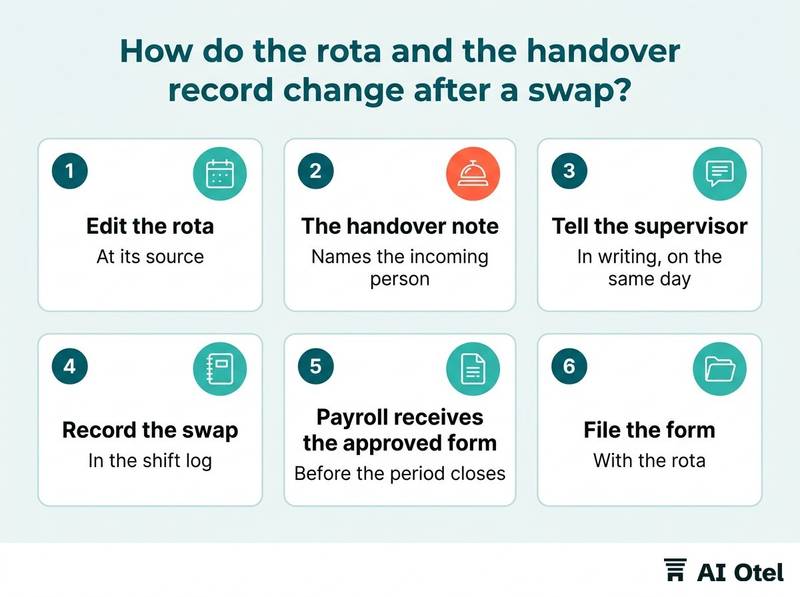
Edit the rota at its source, not only on a printed copy. If the rota is printed, reprint it, remove the old sheet and note which version is current. The handover note for the outgoing shift names the incoming person, and the incoming person signs for the cash count and the open items, so responsibility moves with a signature. This is the moment the swap becomes real at the desk, and it is worth pairing with a front desk shift handover checklist for cash, arrivals and promises.
Tell the supervisor who will be on duty during the swapped shift, in writing, on the same day. That person is the one who will discover a gap. Record the swap in the shift log or the daily briefing, so the desk does not send a guest, a supplier or an inspector to the wrong name.
If the swap crosses a payroll period or changes the hours worked, payroll receives the approved form before the period closes, not after. File the form with the rota for as long as the hotel keeps rota records. It is the evidence that the change was approved, and it is what makes the monthly count possible.
How do you spot a rota that does not fit?
Count swaps by post and by day of the week once a month; a post that swaps repeatedly is telling you the pattern is wrong.
Count four things: requests received, swaps approved, swaps refused, and the posts they came from. Nothing more complicated is needed in the first month. Look for concentration. One post, one day, one shift time repeating is a rota design problem, not a discipline problem.
Measure the swaps that never got a form by comparing the rota name with the person actually on duty at the handover. That difference is the honest number. Read the reasons column across the month: transport, school hours and a second job show up as clusters, and each cluster has a different fix.
Compare the count with lateness and absence in the same post. They usually move together, and the swap count gives you the earlier warning. Act on the pattern: change the shift pattern, add a cross-trained cover for that post, or adjust the start time. Changing the procedure is the last resort, not the first. Review the procedure itself once a season: the cut-offs, the form fields and the list of approvers.
TipKeep the monthly count to one page
Four columns, one row per post, and one sentence at the bottom naming the post that needs a rota change. A count that takes an hour gets done; a report that takes a day does not.
What to do next
Write the one-page procedure this week: the form, the two cut-offs, the named approvers and their deputies, and the short list of posts that need an extra check before any yes. Then run the first monthly count, because the count is what turns a rule about swaps into a better rota. If your rota, handover notes and staff records live in a hotel operating system rather than on paper, the same procedure applies with less re-keying: a hotel operating system that keeps reservations, front desk and reporting in one place is described in the hotel operating system page, and the wider hotel platform overview sets out the rest.
Frequently asked questions
Can two hotel employees swap shifts without telling a manager?
No, not if the hotel wants the rota to mean anything. The swap itself may be the employees' idea and their agreement, but the approval confirms two things the pair cannot confirm alone: that the post is covered for the whole shift and that the replacement is authorized for it. Without that step the rota, the handover note and the payroll record all name the wrong person.
How far in advance should a shift swap be requested?
The hotel sets this itself and publishes it with the rota. A common shape is a shorter cut-off for ordinary day posts and a longer one for night audit, cash and key posts, so that cover can still be found if the answer is no. The cut-off is a management rule, not a legal deadline, and it should be written where staff can see it.
What if the two people work in different departments?
Then two rotas change and both supervisors sign. The receiving supervisor confirms that the replacement is trained and authorized for that post, and the releasing supervisor confirms the person can be spared. A cross-department swap without the second signature is the most common way a post ends up covered by someone who cannot complete the work.
Does a shift swap change pay or the recorded hours?
The rota record must show who actually worked, because that record feeds the hours. Payroll should receive the approved form before the period closes so the correction is made once, in the right period. How a swap interacts with overtime, rest periods and contracts is a question for the hotel's own contracts and its adviser.
What should the hotel do when a swap request is refused?
Give a one-line written reason, keep the form, and count the refusal with the others. Refusals concentrated in one post or one day of the week are as informative as approvals: they usually show that the shift pattern does not fit the people available, which is a rota question rather than a staffing shortage.