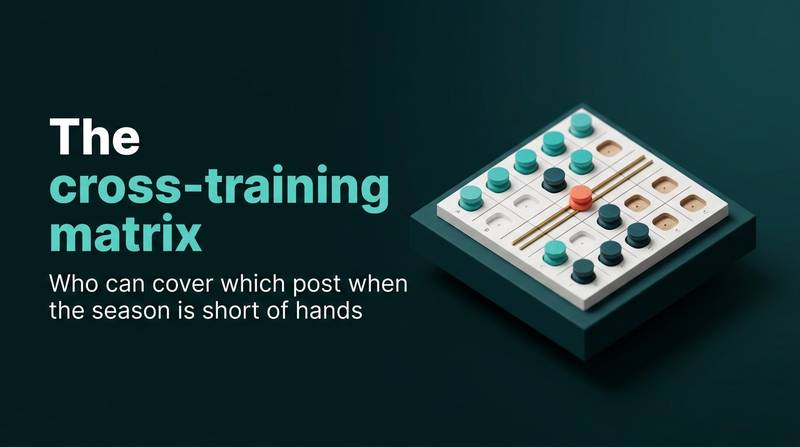
The cross-training matrix: who can cover which post when the season is short of hands
A cross-training matrix shows who can run each post alone. Learn to rate skills by evidence, not self-report, and run a six-week rotation that does not empty departments.
AI draft · awaiting editorial review
Contents
Key takeaways
- A post is a single point of failure when the answer to "who covers it tomorrow?" takes more than a few seconds.
- Four levels are enough: cannot do it, has watched and assisted, can do it with someone reachable, can do it alone including the closing step.
- Rate a cell from evidence, not from self-rating: the person has done the task unsupervised, twice, and the date is written in the cell.
- A manager who fills in is a workaround, not cover; the matrix should name people below that level.
- Lower a cell the same week a person leaves, and date every cell, or the grid describes last season.
A cross-training matrix is a grid of people against posts, with a skill level in each cell. It shows who can run a post alone, who needs someone reachable, and who has only watched. Hotels use it to find posts that depend on one person, and to choose the next two people to train.
The night auditor calls in sick at four in the afternoon and the front office manager starts rebuilding the rota, because there is no second name next to the night audit. Most hotels learn which posts depend on one person on the day that person does not come in. This article gives you a method that fits on one sheet: a cross-training matrix for hotels, four skill levels, a way to fill it without flattering anyone, and a six-week rotation that does not empty the department that lends the trainee.
Why does one post end up with only one person who can do it?
Because hotels train by department and by shift, so knowledge collects around whoever happens to be on duty when a task first appears. Nobody decides to create a single point of failure; it forms quietly, one rota at a time.
The post is learned by accident. A task appears during one person's shift, they work it out, and from then on the rota routes that task to them. Shift patterns then lock it in: the person longest on nights keeps the night audit, and new hires are kept away because the shift is treated as sensitive. The steps live in one head and one notebook, so a willing colleague still cannot take over without the person standing next to them.
The test is a question, not a survey. Name the post, then ask who does it tomorrow if the usual person is off. A pause longer than a few seconds is the finding. This works better than any skills questionnaire, because it forces a name, not a rating.
Separate skill from authority. Some posts need a system role, a signature or an authorization as well as the ability, and training alone does not create cover. A person can be fully able to close the business day and still not be allowed to, because the system role sits with someone else.
In a hotel that hires for the season, the gap is widest in the first weeks, when the grid has the most empty cells and the fewest people who have seen a full cycle. The organization chart lists the posts; it never shows who can stand in for whom, which is why the two documents are needed side by side. For the floors, a housekeeping organization chart by hotel size is a useful companion, and the general manager's own duties and authority are covered separately in what a hotel general manager does from the owner's side.
What does a cross-training matrix look like?
A grid with posts down the side, people across the top, and one of four levels in each cell. It fits on one sheet for one department, and it is filled in pencil before it is filled in ink.
Four levels are enough:
- Level 0: cannot do it and has not been shown. Write a dash, not a blank, so the gap is visible.
- Level 1: has watched and assisted, cannot be left alone with the task.
- Level 2: can do it with someone reachable, and the result is checked before it is signed.
- Level 3: can do it alone, including the step that closes the task: closing the business day, signing the handover, releasing the room, closing the cash.
Name posts precisely. "Night audit and business date close", not "front office"; "pool plant and daily water tests", not "technical". Add three columns beside the levels: what level 3 means for this post, who signed the level, and the date of the last evidence. The level belongs to the person and the post together, not to the person: a strong receptionist can be level 0 on the pool plant.
| Post | What level 3 means here | Primary | Second | Third | Last evidence |
|---|---|---|---|---|---|
| Night audit and business date close | Closes the day alone, handles exceptions | Night auditor · 3 | Front office supervisor · 2 | dash | 12.03.2026 |
| Check-in with guest identity notification (KBS) | Registers guests and sends the notification | Front office supervisor · 3 | Receptionist · 3 | Receptionist · 2 | 28.04.2026 |
| Pool plant and daily water tests | Tests and doses alone, logs results | Technician · 3 | dash | dash | 05.05.2026 |
| Key card encoder and lock faults | Encodes cards, resets a faulty lock | Night auditor · 3 | Technician · 2 | dash | 19.04.2026 |
| Reservation changes and overbooking control | Moves and reassigns rooms under pressure | Front office supervisor · 3 | Receptionist · 2 | dash | 02.05.2026 |
| Restaurant cash-up and till close | Counts, reconciles and closes the till | Restaurant supervisor · 3 | Waiter · 2 | dash | 30.04.2026 |
The cells above are for example only; the roles and dates are illustrative. The pattern to copy is the shape: a role and a level in each cell, or a dash.
How do you fill the grid without flattering anyone?
Rate each cell from evidence, not from what people say about themselves and not from a training attendance sheet. A level exists when someone has done the task unsupervised and a second person has seen the result.
Ask the person who currently holds the post. They know who actually can, and they are usually blunt about it. Ask for two unsupervised repetitions in the current season before a level 3, and write both dates in the cell. Test the closing step, not the easy part: can they close the day, correct an entry, handle the exception at eleven at night.
Treat "I was trained on it" as an input, never as a level. Training is what you did; cover is what the hotel has. Expect polite inflation: have the department head and one other person sign each level, and compare the two sheets before you accept either. Record the date of last evidence in every cell, because a level with no date is a memory, not a fact.
ChecklistBefore you accept a filled grid, check it against this list
- The person who holds the post was asked.
- Two unsupervised repetitions are recorded with dates.
- The closing step was tested, not only the routine.
- The level is signed by the department head and one other person.
- Every cell holds a level and a date, or a dash.
- No cell says "trained" without evidence behind it.
Which posts must have a second and a third person?
The posts where an absence stops money, stops a required record, or stops safety. Everything else can wait a day, and the grid should say so plainly.
Four tests for a post: does it stop revenue, does it stop a record the hotel must keep, does it touch safety, and is there any workaround at all. A post with no workaround gets three named people; a post with a workaround gets two. Name people, not roles. "The front office supervisor" is not a name, and roles move between seasons.
A manager who fills in is a workaround, not cover. It hides the gap and consumes the one person who should be training somebody else. Rank posts by how long the hotel can run without them being done, not by how senior they sound. Some posts need an authorization as well as a skill; keep that in a separate column, and check that the authorization is still current for the named people.
Key pointRule of three
Any post that stops money, a required record or safety needs three named people, and at least one of them must be able to hold it for a single day without the primary.
How do you run a six-week rotation without emptying a department?
One trainee per post, short blocks inside a normal shift, and never two people out of the same department in the same week. The department keeps its service level because nobody is removed from it.
Weeks one and two: watch and assist, two to three hours inside the trainee's own shift, on a quiet day. Weeks three and four: do the routine with the primary reachable, then the closing step with the primary watching. Weeks five and six: do the whole task alone on a normal day, with the primary off the floor but on call, and sign the level at the end.
Cap the load at one cross-training block per person per week, so the trainee's own post does not suffer. Choose the day deliberately: midweek and low occupancy, not an arrival-heavy Friday. Write down what the trainee got wrong; that list, not the original training material, is the next session.
For example, a 60-room seasonal hotel moves its reception supervisor to level 3 on the night audit over six Tuesdays of two hours, ending with one full close supervised from the back office. If the trainees are new to the season, run this alongside a seasonal staff onboarding checklist for the first week, and anchor the handover step with shift handover forms for hotel departments, since the handover signature is part of what level 3 means.
TipThe six-week shape in one line
Watch and assist (weeks 1 and 2), do it with backup (weeks 3 and 4), do it alone with the primary on call (weeks 5 and 6), then sign the level and write the date.
When does the grid go stale, and what usually goes wrong?
The grid goes stale the day someone leaves, and it goes wrong when it is filled for the file rather than for the rota. Both are fixed by the same habit: update it where the rota is made.
Update on every hire, departure, promotion, new system, new outlet and season start, and after any absence that exposed a gap. Review it monthly in season, and lower a cell to a dash in the same week the person leaves.
The five usual failures:
- Training for its own sake, giving people levels on posts they will never be asked to cover.
- Hidden favorites, the same two names in every column, which builds a new single point of failure with extra steps.
- The grid lives in a folder. Keep it next to the rota, or it will be out of date by the time anyone opens it.
- A level 3 who is not allowed to sign, so the skill exists and the cover does not.
- No removal. A matrix that only ever goes up is a training record wearing a matrix's clothes.
Watch outFive ways a matrix fails
Training for its own sake; the same two names in every column; the file nobody opens; a level 3 without the authority to sign; cells that were never lowered when a person left.
Where to start this week
Start with one department, one sheet and one post: the one that would stop the hotel tomorrow if its usual person were off. Name the second and third person, write the date of their last evidence, and book the first two-hour block this week. The grid then stops being a document and becomes the rota's second opinion, and each month you add one post and one name rather than rebuilding the whole picture.
If you want the grid to live next to the systems it describes, a hotel operating system, built and working ahead of launch, that keeps reservations, front desk, housekeeping, billing and reporting in one place gives each post a single set of steps to train against, and a wider look at how the pieces of hotel software fit together helps when you decide which posts a new system will change.
Frequently asked questions
How many people should be able to cover a critical hotel post?
Three named people for a post that stops money, a required record or safety, and two for a post with a workaround. One of the three must be able to hold the post for a single day. Managers do not count as the third, because a manager filling in hides the gap instead of closing it.
Is a skills matrix the same as a training plan?
No. The matrix records what the hotel can do today, post by post and person by person. The training plan is what you decide to do about the empty cells. Keeping them separate stops the matrix from turning into a wish list of courses.
Should department heads rate their own teams?
Yes, but not alone. The department head knows the work; a second signature from outside the department catches polite inflation. The person who currently holds the post should be asked first, because they know who actually can.
How long does it take to bring someone to the top level on a post?
Measure it in evidence, not in weeks: two unsupervised repetitions plus a tested closing step. The six-week rotation is a shape for planning, not a guarantee, and a post with a difficult exception step will take longer than a routine one.
Where should the matrix be kept?
Where the rota is made, with a copy held centrally. A matrix in a folder nobody opens describes last season. Date every cell so anyone reading it can see how old the evidence is.