Short video for a hotel: a shot list a small team can film in one afternoon
This guide provides a fixed shot list for hotel short videos, designed for small teams to film in a single afternoon. It covers filming techniques, privacy rules, and how to sort clips for your website, listings, and social channels.
AI draft · awaiting editorial review
Contents
Key takeaways
- A clip earns its place by proving one thing a guest is deciding about: the bed, the water pressure, the view at the hour guests see it.
- Fifteen to twenty-five clips, filmed in building order on one page, cover a website, listings and a season of social posts.
- Daylight, a locked exposure and a braced phone do more for a hotel video than any camera purchase.
- Film hands, backs and tasks rather than faces, and write the hotel's own rule for guests and staff before the camera comes out.
- Sort each clip by what it proves: room proof goes where the guest chooses a room, atmosphere goes where the guest chooses whether to come.
A hotel short video shot list is a fixed set of clips, one per area and one per moment of service, filmed on a phone in a single afternoon and reused on the website, booking-site listings and social channels. Each clip must show one thing a guest is deciding about, within five seconds, without faces or music carrying it.
The camera is already in someone's pocket, the light in the lobby is good until eleven, and the room is made up until check-in. What is missing is a list that tells one person with a phone what to film, in what order, before the afternoon runs out. This guide gives you that list, the filming habits that make phone clips usable, the privacy rule to write before the camera comes out, and a sorting plan so each clip lands where it does its job.
What must a hotel clip show in the first five seconds?
One thing the guest is deciding about, framed so it reads without sound, text or a caption.
The first frame is the decision, not the logo: a made bed, a plate, the pool edge, the view from the window. A guest scrolling decides whether to keep watching from that single frame. Decide the clip's job before filming: a room page needs proof of size, light and storage, while a social post needs a moment of service, and the same shot rarely does both.
Cut the walk-in. Corridors, door handles and lift doors are context, not proof, and they spend the five seconds you have. Judge every clip muted, on a phone, at arm's length, before it goes on the list; if it does not read there, it will not read anywhere. Write one sentence per clip on the shot list: what it proves. If you cannot write the sentence, do not film the clip.
Keep one look across the whole set: same time of day, same lens, same color treatment, so the pieces can still be cut together next season.
ChecklistApply the five-second test to every clip before it joins the list
- Name the decision the clip serves.
- The subject fills the frame.
- One movement only, or none.
- Nothing has to be read to understand it.
- It still works with the sound off.
- It starts on a still frame and holds one beat after the action ends.
The shot list: which clips does a hotel actually need?
Between fifteen and twenty-five clips, grouped by area and by moment of service, is enough to cover a website, booking-site listings and a season of social posts.
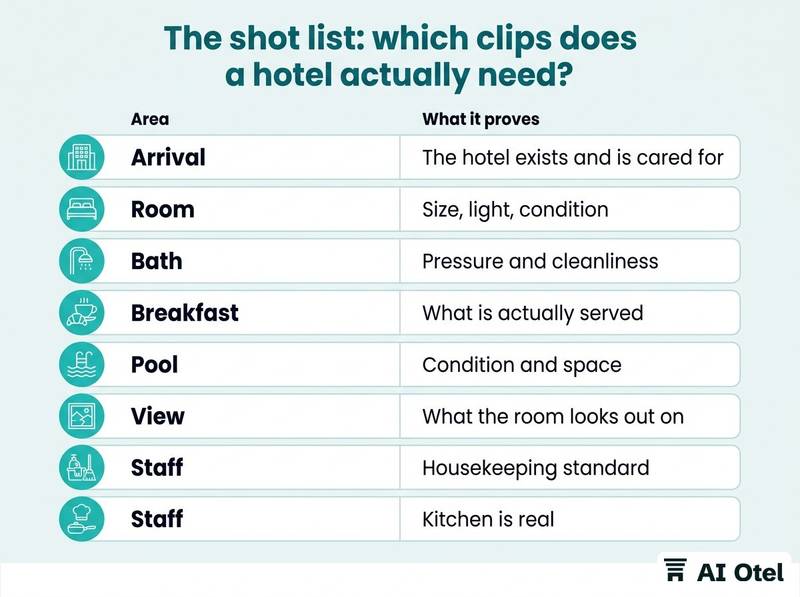
Arrival clips are orientation and welcome, not decoration: the exterior in daylight, the entrance, the first ten steps inside, the desk with someone working, the lift or the stair. Room clips prove size, light and storage: the door opening onto the made bed, a slow move from window to bed, the desk and the sockets, the storage, the view from the window, the blackout curtain closing.
In the bathroom, guests check water pressure and cleanliness before anything else, so film the shower head with water running, the shelf with amenities, the towel and the light. Breakfast works from the guest's own height: the buffet, one plate being finished, the terrace with tables set, coffee poured into a cup. For the pool and outdoors, capture the water surface, sunbeds in both shade and sun, the shallow end, and the walk from the pool to the bar. For the view and setting, film at the hour guests actually see it, plus the walk to the beach or the town and the street at dusk.
People at work carry service better than faces: a hand smoothing a sheet, a plate leaving the pass, a receptionist pointing at a map. Keep the whole list on one page in filming order, so the afternoon follows the building floor by floor rather than doubling back. Note that a 360 tour and a shot list answer different guest questions; if you already have a tour, the video set should show what the tour cannot: moments, water running, service happening.
| Area | Clip | What it proves | Where it goes |
|---|---|---|---|
| Arrival | Exterior, entrance, desk | The hotel exists and is cared for | Website, profile |
| Room | Door opening onto bed | Size, light, condition | Room page |
| Room | Window to bed move | Layout and daylight | Room page |
| Room | Desk and sockets | Workability | Room page |
| Room | Blackout curtain closing | Sleep quality | Room page |
| Bath | Shower running | Pressure and cleanliness | Room page |
| Bath | Amenities shelf | Standard of care | Room page |
| Breakfast | Buffet at guest height | What is actually served | Social, dining page |
| Breakfast | One plate finished | Quality, not layout | Social |
| Breakfast | Terrace set | Setting | Social, dining page |
| Pool | Water surface, sunbeds | Condition and space | Social, facilities |
| Pool | Shallow end | Family suitability | Social |
| View | Window view at guest hour | What the room looks out on | Room page |
| View | Walk to beach or town | Location claim | Website |
| Staff | Bed being made | Housekeeping standard | Social |
| Staff | Plate leaving the pass | Kitchen is real | Social |
| Staff | Map being pointed at | Help at the desk | Social |
How do you film steady, well-lit phone video with no crew?
Shoot in daylight near a window, lock exposure and focus on the subject, brace the phone on something solid, and record a few seconds before and after each action.
Light first: turn off the ceiling lights and open the curtains. Mixed daylight and room lighting turns skin green and makes two clips of the same room impossible to match later. For steadiness, rest your elbows on a surface or stand the phone against a folded towel; a slow walk with the phone at chest height looks calmer than a fast pan from a tripod.
Lock the image by tapping and holding the subject until focus and exposure lock, so the picture stops hunting when a person or a curtain moves through the frame. Phone microphones collect air conditioning, corridors and cutlery, so record thirty seconds of room tone in each area and plan to add sound later or use none at all. Keep one movement per clip, either a push in or a pan, never both, and start and end on a still frame so the editor has handles.
Clean the lens before the first clip and again after breakfast: grease on the glass is the most common reason a phone clip looks worse than it is. Film the two or three clips that will carry the most weight in both vertical and horizontal, so nothing has to be cropped later.
TipThe two-minute setup before the first clip
Wipe the lens; put the phone in airplane mode with the screen locked; check storage; lock exposure and focus on the first subject; pack a towel or small tripod; put the printed shot list in a pocket; and free one colleague to open curtains and move a chair out of frame.
Can you film guests and staff, and what should the hotel's rule say?
Film the property first and people second, and write the hotel's own rule before the camera comes out: what may be filmed, who asks, and what happens when someone objects.
In Türkiye every stay involves personal data (KVKK, kişisel verilerin korunması kanunu), so a recognizable face in a clip is a decision the hotel has to be able to explain later. Prefer hands, backs, silhouettes and over-the-shoulder framing; a clip of a bed being made needs no face at all. Ask before filming anyone identifiable, staff included, and record the answer next to the file. A staff member on camera is a work instruction, not a favor owed.
Do not film identifiable children, even with a parent standing nearby. Use the empty pool, the set table, the folded towel instead. Put the rule where guests can see it, keep the consent note with the clip file, and delete the clip if someone withdraws after filming. Settle the wording of the rule and the retention period with a legal adviser once, then keep the rule stable so staff can apply it without asking each time.
Watch outThree clips to delete on the spot
A guest's face at the pool edge; a child in the breakfast room; a staff member filmed without a recorded yes. Each one costs more to defend than the clip is worth.
Do hotel videos need subtitles, and in which languages?
Yes for anything with speech, and in the languages your own guests actually speak, taken from your reservation mix rather than a generic list.
Assume the sound is off, and treat on-screen text as the soundtrack rather than as an extra. Build the language list from the hotel's own guest mix over the past year: a hotel whose guests are mostly German and Russian does not need the same set as one full of domestic weekend stays.
Burn short captions into the video, three to six words per line, rather than relying on automatic captions that mishear dish names and room types. Keep one version with no text at all for the website hero and for listings where the channel adds its own overlay. Translate the words a guest needs, such as room type, view, meal and distance to the beach, not marketing adjectives. Check every caption on a small screen at arm's length; if it needs a pause to read, it is too long for the clip. The same discipline applies to written listings, where room descriptions and captions drafted in several languages work from the same guest mix.
Where does each clip go: website, booking-site listings or social?
Sort by what the clip proves. Proof of the room goes where the guest is choosing a room; atmosphere goes where the guest is choosing whether to come at all.
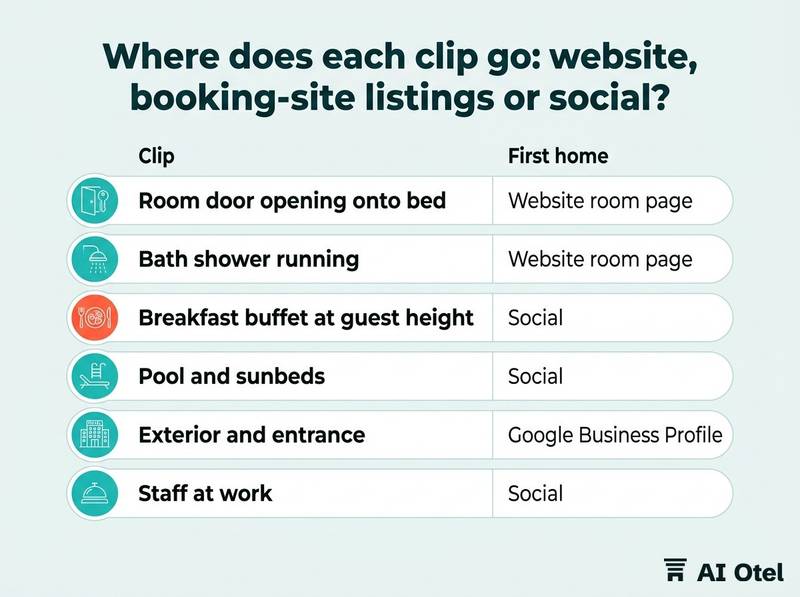
Website room pages and the booking flow take the room, bath and view clips, in the order a guest checks them: bed, bathroom, window, storage. Booking-site and agency listings need clips or stills that match the room type exactly; a clip that flatters the room and does not match it moves the complaint to the front desk at check-in. Social channels take arrival, breakfast, pool and staff at work, cut to the length and shape each channel prefers. Your Google Business Profile takes property and exterior clips, kept current, with the booking link in place.
Keep one folder per season with named files, using room type, area and date, so a clip can be found again without opening twenty of them. Note where each clip has been used, so the same shot does not appear twice in one feed or twice on one page. A hotel operating system built so that one room inventory feeds the hotel's own website and booking sites, such as a hotel operating system, keeps the room data a clip has to match in one place.
| Clip | First home | Also used for | Note |
|---|---|---|---|
| Room door opening onto bed | Website room page | Listing for that room type | Must match the room type exactly |
| Bath shower running | Website room page | Listing photo set | Keep it short, water only |
| Breakfast buffet at guest height | Social | Website dining page | Film before service starts |
| Pool and sunbeds | Social | Website facilities page | Film in shade and sun |
| Exterior and entrance | Google Business Profile | Website contact page | Refresh when signage changes |
| Staff at work | Social | Recruitment page | Recorded consent on file |
How often should the set be refreshed?
Once a season, in one afternoon, replacing only the clips that no longer match the property.
Set four filming dates a year and keep the same shot list. The list is the plan; the afternoon is the work. Replace what changed: a refurbished room, a new menu, new sunbeds, the season's light. Keep what did not change.
Film the same clips at the same hour each time, so the new set still cuts together with the old one. Retire clips with people in them at the end of the consent period you set, and retire clips that show offers you no longer sell. Keep last season's folder: a clip of the terrace in June is worth having again next June, and re-filming it costs an afternoon you may not have. If you plan the four dates against a content calendar a small team can keep, the refresh becomes part of the routine rather than an emergency.
What to do next
Pick one afternoon this week, print the shot list, and film the arrival and a single room before anything else. Judge those clips muted on a phone: if the bed, the bathroom and the window read in five seconds, the rest of the list is the same work repeated area by area, and the set you build in one afternoon will carry the website, the listings and a season of posts.
Frequently asked questions
How long should a hotel short video be?
Long enough to show one thing and short enough to be understood without a pause: usually five to fifteen seconds per clip. Length is set by the decision the clip serves, not by the channel, and a clip that needs twenty seconds to make its point is usually two clips.
Do I need a gimbal, a drone or a professional camera?
No. Daylight, a locked exposure and a braced phone produce a usable clip; a gimbal helps only once the operator can already hold a steady frame. A drone adds an exterior shot that most guests do not use to choose a room, and it brings its own permissions and rules.
Can the same clip be used on the website, a booking site and social media?
Yes, with two adjustments: shape and honesty. Crop for the channel, and make sure the clip used on a booking site matches the room type it sits next to. Keep a text-free version for places where the channel adds its own overlay.
What if the weather ruins the filming afternoon?
Film the interior list first, since rooms, bath and breakfast do not depend on the sky, and keep the exterior, pool and view for the next clear hour. A shot list in building order lets you stop and resume without losing the plan.
Who should be on camera?
Tasks rather than faces: hands making a bed, a plate leaving the pass, a receptionist pointing at a map. Where a face is needed, use staff who have agreed in writing, and keep guests out of identifiable frames.