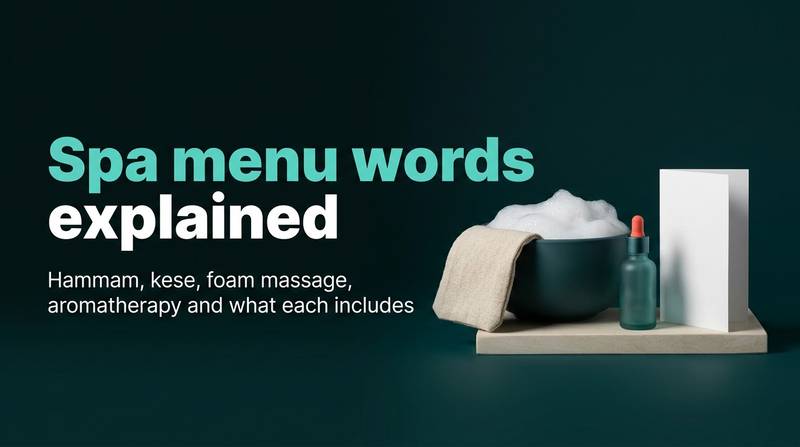
Spa menu words explained: hammam, kese, foam massage, aromatherapy and what each includes
This guide defines hammam, kese, foam massage and aromatherapy for hotel teams. It provides plain definitions and booking checklists to ensure consistent answers at the spa desk.
AI draft · awaiting editorial review
Contents
Key takeaways
- A hammam is a sequence, not a single treatment: warming, kese, foam, rinse and rest, in that order.
- Kese removes dead skin with a coarse mitt; foam massage is lather worked over the body, and the two are often sold together.
- Aromatherapy names the oil, not the pressure: the guest still chooses how firm the massage is.
- Every hotel sets its own durations, prices and rules, so the desk should quote the hotel's sheet, never a general figure.
- A spa menu describes what is done to the body, never what it cures.
A hammam is a steam bath in a heated marble room. Kese is the exfoliation with a coarse mitt that follows the warming, and foam massage is the soap lather worked over the body afterward. Aromatherapy is a massage with scented oil. Each hotel sets its own sequence, duration and price, so confirm at booking.
A guest stands at the spa desk holding the menu, points at the word kese and asks what it is. The receptionist says one thing, the therapist later says another, and the guest spends the treatment unsure what they bought. Spa menu terms hotel teams use every day are often foreign words to the guest, and one inconsistent answer turns into a dispute at checkout. This article gives each term one plain definition, so the desk, the therapist and reservations all answer with the same sentence.
What does a hammam include, step by step?
A hammam is a wet heat ritual in a marble room: the guest warms up, is scrubbed, is lathered, is rinsed and then rests. The order is fixed; the timing and the room are the hotel's.
The warming comes first. The guest sits or lies on the heated marble slab (the göbek taşı) in the steam until the skin softens. This step is the reason the scrub works, so it is never skipped to save time. Then comes kese: the therapist works a coarse mitt over the body in firm strokes, lifting dead skin. The guest will see the rolled skin, which is the point of the treatment, and it should be explained before, not after.
Foam massage follows. Soap lather is pressed and spread over the body with a cloth bag, then the guest is rinsed with bowls of water. It is a washing and a light massage, not a deep one. Afterward the guest showers or is rinsed, dries, and sits in a cooler area. Hotels usually serve water or tea here, and this rest time is part of what the guest paid for.
What the guest is told before entering
Dress is the hotel's decision, from a towel wrap to disposable underwear, and it belongs in the booking conversation so the guest is not surprised at the door. Some hotels run one shared marble room, others a private hammam per booking; the same word covers both, so the desk must say which one the guest is buying.
Where the hammam sits in a longer booking
A hammam is often sold before a massage, because the warmed body takes oil better. Say so when the guest books only one of the two. For the daily routines behind these bookings, see the daily operation of a hotel hammam, sauna and treatment rooms.
ChecklistDesk checklist for a hammam booking
- Which room: communal or private
- What the guest wears
- Whether kese and foam are both included or sold separately
- Total time from entering the changing room to leaving
- Whether the guest showers alone or is rinsed by the therapist
- What is served in the rest area
- What is charged to the room bill and what is paid at the spa
What is kese, and what is a foam massage?
Kese is exfoliation with a coarse mitt. Foam massage is soap lather pressed over the body with a cloth bag. They are two different actions, often sold as one hammam package.
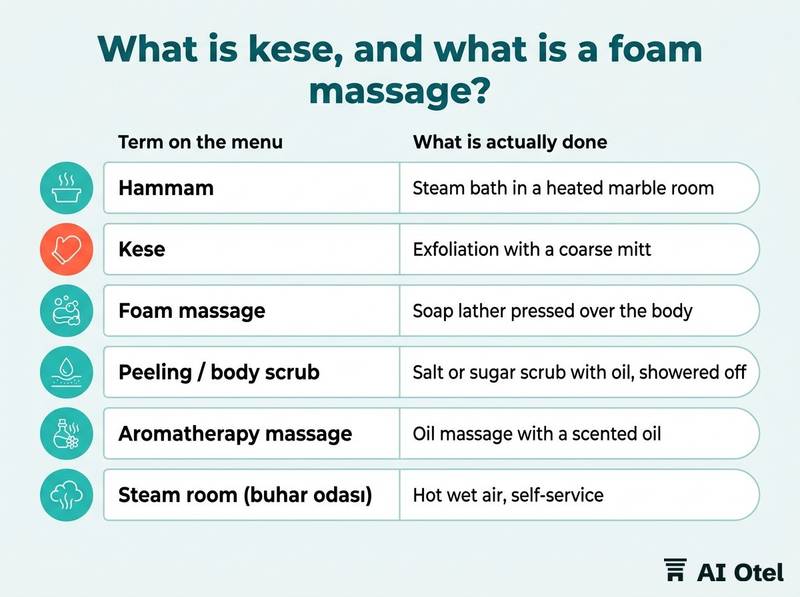
Kese acts on the skin surface: it lifts dead skin, so the guest should not shave or scrub on the same day, and staff should say this at booking. Foam massage acts with heat, water and light pressure: it cleans and relaxes, and it is not a substitute for a muscle massage. Pressure is a choice, and the guest should be told to speak up during kese, since firm strokes on sensitive skin are uncomfortable rather than effective.
The mitt itself is the tool. Hotels either use a fresh one per guest or wash and dry them between guests, and staff should be able to say which. There is also a language trap: guests hear the word massage and expect oil and a table. Explain that foam massage happens on the marble slab, wet, with no oil. A hotel may also offer kese alone for a guest who wants a quick scrub, and the menu should show that option plainly.
| Term on the menu | What is actually done | What the guest should know |
|---|---|---|
| Hammam | Steam bath in a heated marble room: warming, then washing | Communal or private, per hotel |
| Kese | Exfoliation with a coarse mitt | Avoid shaving that day |
| Foam massage | Soap lather pressed over the body on the slab | Wet, no oil, light pressure |
| Peeling / body scrub | Salt or sugar scrub with oil, showered off | Not the same as kese |
| Aromatherapy massage | Oil massage with a scented oil the guest chooses | Pressure still chosen by the guest |
| Steam room (buhar odası) | Hot wet air, self-service | Hotel posts its own rules |
Oil, aroma and relaxation massage: what is the difference?
Aromatherapy names the oil, relaxation names the pressure. Both are oil massages on a table, and the guest chooses the firmness in either one.
In an aromatherapy massage, the guest picks a scented oil from the hotel's list, then receives a flowing, light-to-medium massage. The scent is the product; the pressure is not fixed by the name. A relaxation or classic massage usually uses an unscented or lightly scented oil with long, even strokes, and it is the safest default for a guest who does not want to choose. Deep tissue or sports massage is firmer, slower work on specific areas; say plainly that it can leave the guest sore the next day, so nobody books it an hour before a flight.
Choosing between the three at the desk
Ask about sensitivity and scent preference at booking, and offer an unscented oil without making the guest explain themselves. Pregnancy, recent surgery and medication are policy questions: the hotel sets its own rules on who it treats and asks the guest to check with their own doctor, and staff do not give medical advice. Say what stays covered under draping, and that the guest can ask for a different therapist or stop at any point. After the oil, tell the guest whether a shower is available and whether the oil is meant to stay on the skin.
TipTwo questions at the desk
When a guest cannot choose, ask two questions only: scent or no scent, and firm or gentle. Those two answers place the guest in one of the hotel's oil massages without a lecture about techniques.
What is actually applied in a scrub, a mask or a body wrap?
A scrub is grains in oil worked over the skin and showered off. A mask or wrap is a paste or clay spread on the body, covered, left for a set time, then rinsed. The hotel chooses the product and the time.
A scrub uses salt or sugar in a carrier oil, applied with pressure and rinsed in a shower. It is a surface treatment and is not the same as kese. A mask or wrap uses clay, mud or a cream spread over the body, then covered with film and a blanket to keep it warm, and the guest is left alone for the set time. The rinse is part of the treatment: the guest needs a shower and a towel, and the booking time must include it.
Ask about sensitive skin, recent sunburn or shaving before a full application, and offer a small patch test. Describe the product, not the outcome: say what is in it and how it feels. The room, the table and the bowls are washed after each guest, and staff should be able to describe that routine if asked.
Watch outNo health claims
Never promise that a scrub, mask or wrap removes toxins, detoxes the body, or treats a skin condition. Describe the product and the sensation, and send any question about a skin or health condition to the guest's own doctor.
Sauna, steam room and jacuzzi: what is the difference?
A sauna is dry heat, a steam room is hot wet air, and a jacuzzi is warm moving water. All three are self-service, and each hotel posts its own rules at the door.
A sauna is a wooden room with a heater, dry air and a bench. Guests sit on a towel, and the hotel states how long a session may run and whether water may be poured on the stones. A steam room is a tiled room filled with hot wet air, often the warming step before a hammam; the floor is slippery, so the desk mentions footwear. A jacuzzi is warm water with jets, usually shared, and the hotel sets the rules on swimwear, showering before entry and session length.
Shower first: all three work better and stay cleaner when guests rinse before entering, and the sign at the door should say so in every language the hotel uses. Guests should be able to reach drinking water, and staff should point out the rest area rather than let someone sit in the heat too long. Health questions go to the hotel's posted rules and the guest's own doctor; staff do not decide who may enter. For the guest-facing side of this, see what to tell guests about jacuzzi and wet-area hygiene.
Which booking words does the desk need to explain?
Slot, therapist, private session and couples room each answer a different question: when, who, how alone, and with whom. A guest who understands all four rarely disputes the bill.
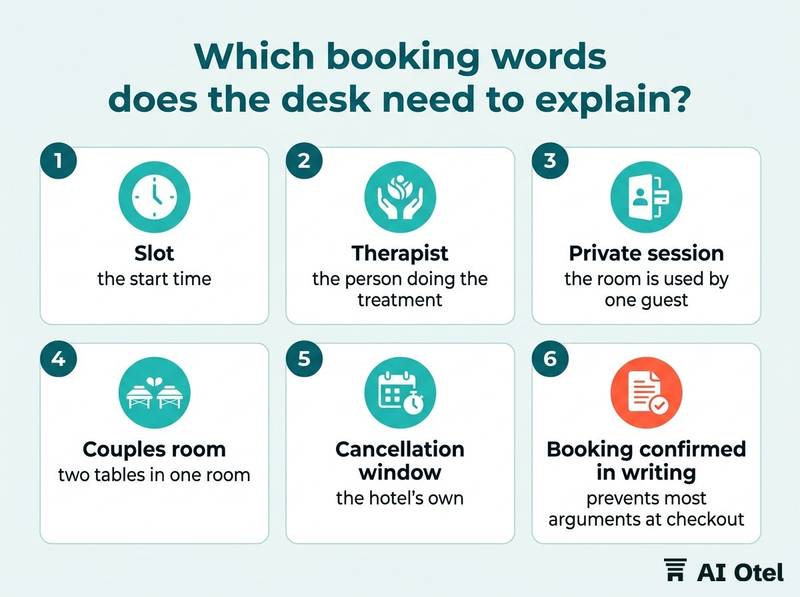
A slot is the start time. Ask the guest to arrive early for changing, and say whether the slot length includes changing and rest or only the treatment. A therapist is the person doing the treatment; record a gender preference at booking if the hotel allows it, and say honestly if the hotel cannot guarantee one. A private session means the room is used by one guest or party, and says nothing about the treatment itself. A couples room has two tables in one room, sold to two guests together, so confirm whether the two treatments must be the same and whether the price is per person.
State clearly what the room rate already covers and what goes onto the guest's bill, so the charge appears once and is expected. Give the hotel's own cancellation window and state the hotel's own rule for a late arrival, including whether a shortened slot is charged as booked. A booking confirmed in writing, on paper or on the guest's phone, prevents most arguments at checkout. For selling the spa together with the room, see putting a spa treatment into a hotel package.
ChecklistBooking checklist read back to the guest
- Day and start time
- Treatment name as printed on the menu
- Total time including changing and rest
- Therapist gender preference, if the hotel can hold one
- Private room or shared area
- Price and whether it is on the room bill
- Cancellation window
- What to bring or wear
Which words should a spa menu avoid?
Avoid any word that promises an effect on the body. Describe the action and the sensation, and let the guest decide what it does for them.
Drop the medical vocabulary: detox, heals, cures, treats, therapeutic, pain relief and medical-grade all promise outcomes the hotel cannot stand behind. Use the plain verbs instead: warms, exfoliates, softens, relaxes, rinses, covers. Each one describes something the therapist actually does.
Agree one approved translation for kese, foam massage and hammam in every language the hotel sells in, and print it on the menu, the website and the desk sheet. Train reception, the therapists and reservations from that same sheet, so the guest hears one hotel, not three. Questions about conditions get the hotel's policy, an unscented or gentler option, and a suggestion to speak to the guest's own doctor. When a treatment is withdrawn, it leaves the menu the same day, in every language. For the wider offer, see writing a wellness program without health claims.
Key pointSay this instead
For detox, say "a warm wrap followed by a shower". For heals skin, say "exfoliates and softens". For pain relief, say "firm pressure on the back and shoulders". For medical massage, say "deep tissue massage". For boosts immunity, say nothing, and describe the room and the rest period instead.
What to do next
Write one approved term sheet, in each language the hotel sells in, and keep it at the desk, in reservations and on the menu. The steps of a hammam, the difference between kese and foam, the oil and pressure choices, the booking words and the banned claims all fit on one page, and that page is what makes the answers consistent. A hotel that wants those answers delivered consistently, on the guest's own phone, through a guest app installed from the browser, can look at a guest app installed from the browser as part of a hotel operating system. A traveler planning a trip to Türkiye can start from the ecosystem's guest-facing address: find a hotel in Türkiye (opens in a new tab).
Frequently asked questions
Is a hammam the same as a Turkish bath?
Yes, hammam is the Turkish word for the bath, and English menus often print both. In a hotel it usually means a heated marble room with warming, kese, foam and a rest period. Whether the room is shared or private, and what is included, depends on the hotel, so the guest should ask at booking.
What should a guest wear during a hammam or a massage?
The hotel sets this. A hammam usually involves a towel wrap or disposable underwear, and a massage is given with draping so only the area being worked on is uncovered. The guest can ask for a different therapist or stop at any time. State the hotel's own rule at booking rather than leaving it to the door.
How long does a spa treatment take at a hotel?
Each hotel sets its own durations, and the printed length may cover only the treatment, not changing and rest. The desk should quote the total time from arrival to leaving. A guest booking before a flight or a dinner should be given that total, not the treatment time alone.
Can a guest with a health condition book a massage or sauna?
The hotel sets its own policy on who it treats and which facilities are open to whom. Staff state that policy, offer a gentler or unscented option where one exists, and suggest the guest check with their own doctor. They do not give medical advice or decide on a condition themselves.
Is aromatherapy a different massage technique?
It names the oil, not the technique. The guest chooses a scented oil and receives a flowing oil massage, and the pressure is still their choice. A guest who wants no scent should be offered an unscented oil without having to explain why.