Splitting one bill between payers: companies, couples and groups on separate folios
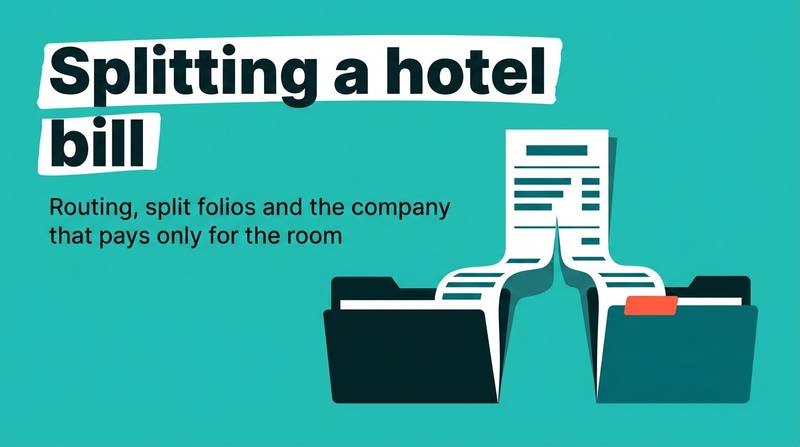
Set up hotel split bill folio routing at check-in to avoid checkout disputes. Route charges by department, transfer posted items safely, and close each folio with its own signature and document.
Contents
Key takeaways
- A split folio is a routing decision: every charge is sent to a named payer's folio at the moment it is posted, so the split has to exist before the first charge.
- Room and room tax to the company, every other department to the guest is the common shape, and it holds only when the exceptions are named one by one.
- A charge moves between folios by a transfer that leaves both entries visible, never by deleting it and retyping it on the other folio.
- Each payer leaves with their own folio, their own signature and their own document; one combined printout hands a guest another guest's spending.
A split folio means opening more than one folio, the running bill for a single stay, and routing each charge to the payer who owes it. The hotel split bill folio setup is decided at check-in, written down and signed, and the routing is set before the first charge is posted.
The company booked the room and said it would cover accommodation. On the last morning the guest is shown a bill that includes a dinner he did not attend, and the front desk has four minutes and no written instruction to work out which charges were meant to be his. After reading this you will be able to set up a split before the first charge, route each department to the right payer, move a posted charge safely, and close a split bill at checkout without an argument. The vocabulary, from folio to routing, is covered in front office terms such as folio, posting and routing.
Why is the split decided at check-in, not at checkout?
Because a posted charge already belongs to a folio, and moving it later costs a transfer, a signature and a note in the record. The split is a routing rule, and a routing rule has to be in place before the first charge lands.
Define the two words once for the team. A folio is the running record of what one payer owes for one stay. Routing is the rule that sends each charge to a named folio by department or charge type as it is posted.
One reservation can carry several folios. The reservation holds the room and the dates; the folios hold the money, one per payer. That distinction is what makes the split possible without rebooking anything.
Capture the split in writing at check-in: who pays for what, which departments each folio covers, and who is allowed to sign charges to it. A verbal arrangement at the desk is not a routing rule. For a company, the coverage should already be in the reservation confirmation or the contract. Without that document the front desk is guessing, and the guess is made in front of the guest.
Take a deposit or a card guarantee per folio. One guarantee for the whole stay leaves the guest's card securing a balance the company was meant to pay. Finally, leave a one-line note on the reservation so the next shift applies the same rule. Most split folio failures are handover failures, not system failures.
ChecklistWhat to record at check-in, before the first charge
- The payer's name and, for a company, the exact invoicing entity
- Which departments each folio covers, written as a list and not as "extras"
- Who may sign charges to each folio, by name
- A deposit or card guarantee per folio
- The payer's signature on the routing instruction
- A one-line note on the reservation for the next shift
How do you put the room on the company's folio and the extras on the guest's?
Route by department, not by amount: room and room tax to the company folio, every other department to the guest folio, and then name the exceptions one by one. This is the core of hotel split bill folio setup, and the default rule is short enough for anyone to apply: rooms department to folio A, food and beverage, minibar, spa, laundry and telephone to folio B.
Exceptions are where the arguments come from. Breakfast included in the room rate travels with the room; breakfast charged separately does not. Decide which one you sold before the first morning.
A rate change or an extra night then follows the rule automatically, which is why a rule beats a one-off instruction typed at the desk. Package elements split awkwardly: a half-board rate has a meal inside the room price, so decide whether the meal element follows the room or moves to the guest, and say so at check-in.
Tell the guest at check-in what the company covers and what they will be asked to pay. The checkout conversation is calm when it has already happened once, at the start. Check the routing on the first night, when there are two or three postings to inspect rather than thirty. A wrong rule found on night one is a correction; found at departure it is an argument.
At departure the company folio goes to the company account with its reference and a copy of the signed confirmation, while the guest folio is settled at the desk. How that company account is billed and collected is covered in how a company folio is invoiced through the city ledger.
| Charge | Folio | Payer | Watch for |
|---|---|---|---|
| Room rate and room tax | Company | Company | An extra night follows the same rule automatically |
| Breakfast inside the room rate | Company | Company | Travels with the room, not with food and beverage |
| Breakfast charged separately | Guest | Guest | Decide before the first morning |
| Minibar, spa, laundry | Guest | Guest | Check the routing on the first night |
| Restaurant dinner signed by the guest | Guest | Guest | The signature on the check decides |
| Group dinner, set menu | Master | Organizer | Drinks usually stay individual |
| Damage or a missing item | Guest | Guest | Needs a signed note and a photo, not a verbal charge |
| Early departure fee | Set by contract | Company or guest | The contract names it; the desk does not |
Two guests, one room, two payers: how do you keep the charges apart?
Open one folio per payer under the same reservation, name each folio after the person, and agree in writing which charges each of them will sign for. The name is what the night auditor reads and what the guest sees on the printout; "guest 1" and "guest 2" answer nothing.
A shared item is one charge. A dinner for two is split by cover or by item at the moment it is posted, and the split is written on the check before the guest signs it. Two colleagues sharing to save cost usually means the employer covers the room and each traveler covers their own extras. Agree that before arrival, because at the desk the employer is not there to confirm it.
Give each folio its own card or deposit. A single guarantee for the room cannot cleanly cover two separate balances if one payer leaves early. When one guest departs before the other, close their folio at their departure and re-check the routing for the nights that remain, so the room does not keep posting to a closed account. Cash-settled extras should be marked as paid where they happen, so they are not posted to either folio a second time at checkout.
Watch outOne bill shows two people's spending
A folio shows what a person consumed. Printing one combined bill and handing it to whichever guest reaches the desk first shows one payer another payer's spending, including the spa, the minibar and the phone calls. Print and hand over each folio separately, and say at check-in that you will.
How does a group master folio work with individual extras?
The master folio carries what the group contract covers, usually room and breakfast. Each room carries its own folio for everything else, and the routing is built from the rooming list before the group arrives. The rooming list is the input, not a document that arrives after the keys: names to rooms first, then the routing, then the block is ready.
The master folio belongs to the group, not to a room. It should not be attached to whichever room the organizer happens to sleep in. The organizer signs for the master folio; individual guests sign only for their own extras, which is what makes the two records stand on their own.
Group meals need a rule before service. A set menu usually goes to the master, drinks usually stay individual, and the waiting staff have to know which before they take the order. Some groups want no extras at all: say it at check-in, and decide in advance whether the room account is blocked or extras are settled in cash where they happen.
Reconcile the master against the contract before the group leaves. A mismatch found on the day is a conversation; found two days later it is a correction and a phone call. The wider mechanics are covered in group blocks, rooming lists and the master folio.
TipWalk the block before the coach arrives
Build the routing from the rooming list in one pass before arrival, then walk the block once: the guide's room, the organizer's suite, the two rooms a sponsor is paying for. Exceptions discovered at the desk during a coach arrival are the ones that end up on the wrong folio.
Can a charge be moved to another folio after it is posted?
Yes, by a transfer that leaves both folios visible in the record. It is never done by deleting the charge and retyping it on the other folio.
A transfer creates a pair of entries: a credit on the folio that should not carry the charge and a debit on the one that should. The total across the stay does not change. Deleting and re-posting breaks the link to the signed check and leaves a gap in the sequence that the night auditor has to explain later.
Name in your own procedure who may transfer a charge. A transfer after a guest has signed is a change to a record that guest relied on. Do it before the business day closes where you can; a correction made after the close belongs to the next business date and needs its reason written on the record. Once a folio is settled or the document has been issued, the correction is a financial document question rather than a front desk one, and it goes to your accountant.
Keep the signed check. The transfer note refers to it, and without it the transfer is an assertion rather than a correction. Watch what transfers do to reports: moving revenue between departments or accounts can hide a posting mistake instead of fixing it. The shared vocabulary for this work is in hotel accounting terms in Turkish and English.
What does the checkout routine look like when the bill is split?
Close each folio on its own: read it from the first posting to the last, confirm the routing caught every department, settle each balance with its own payer, and hand each payer their own copy.
Read the folios in posting order. A missing minibar shows up as a gap in the sequence, which is easier to spot than a total that looks slightly wrong. Check the balance per folio, not per reservation: a zero on the reservation can hide a positive and a negative folio that cancel each other out.
Settle each folio with its own payment. Do not net one payer's balance against another's, even when the same family is standing at the desk. The master folio is transferred to the company or agency account with the contract reference and the signed confirmation attached.
Get a signature per folio and hand each payer their own document for what they paid. Confirm the fiscal form of that document with your accountant. A balance left on a closed room after departure is an account to collect, not an open folio: move it and close the room. The business day should close with every folio either settled or transferred; a folio left open overnight is a decision someone has to own in the morning.
ChecklistThe checkout sequence for a split bill
- Read each folio from the first posting to the last
- Confirm the routing caught every department, including the ones with a single charge
- Check each folio's own balance after settlement
- Settle each folio with its own payment and never net one against another
- Get a signature per folio and hand each payer their own copy
- Transfer the master folio to the company account with the reference and the signed confirmation
What to do next
Write the split down at check-in and set the routing before the first charge. That one habit removes most of the argument at the desk, because the folios have been answering the question all along. The next company booking that arrives is the place to start, with a payer's name on each folio and the coverage written into the reservation note.
If you are evaluating software for this work, look at how a hotel operating system handles routing and multiple folios, and at what a connected hotel platform offers for groups and company accounts. If you are a traveler rather than a hotelier, you can find a hotel in Türkiye (opens in a new tab) for your next trip.
Frequently asked questions
What is the difference between a split folio and a split payment?
A split folio decides who owes what; a split payment decides how the money arrives, for example two cards or cash plus card on one folio. The two decisions are independent, and the folio structure comes first because it controls what each payer is asked for. One folio can be settled by two payment methods, and two folios can each be settled by one.
Can the room charge be split night by night between two guests?
It can be done by routing by date, so that the room posts to one folio for the first nights and the other folio for the rest. It is fragile because the payer changes mid-stay and the night audit has to follow the dates. If you do it, write the dates on the routing instruction and check the first night's postings, or keep one payer on the room and settle the share between the guests outside the folios.
What happens if the company refuses to pay an item it was meant to cover?
The folio is a record of who was charged, not a guarantee of payment. The reservation confirmation or the contract says what the company covers, which is why the front desk needs it in writing at check-in. Who absorbs the difference, the guest or the hotel, is a management and accounting decision, and the earlier it is taken the cheaper it is.
Do we need a separate reservation for each payer?
No. One reservation can carry several folios, and that is the normal way to handle a company paying for the room while the guest pays for extras. The reservation holds the room, the dates and the rate; the folios hold the money, one per payer, each with its own name, signature and settlement.