Hotel accounting terms in Turkish and English: from folio and city ledger to accrual and cut-off
Align your front desk and finance teams with clear hotel accounting terms in Turkish and English. Understand folio, city ledger, accrual, and cut-off to resolve revenue disputes.
AI draft · awaiting editorial review

Contents
Key takeaways
- A folio is one guest's running bill; a city ledger is the list of balances a company or agency will pay later, and it is a part of accounts receivable, not a synonym for it.
- A deposit or an advance is money the hotel holds, not revenue: it becomes revenue in the period the stay actually happens.
- Cut-off decides which period a night belongs to, not which date the invoice carries.
- Departmental income, GOP and EBITDA are three different lines of the same statement; agree which one a fee or a target refers to before the argument starts.
- Turkish hotel practice runs two vocabularies, the accountant's and the hotelier's: harcama is a charge on the bill, tahsilat is collecting the payment.
Hotel accounting terms name the same money from three angles: the guest's bill (the folio), the company or agency that pays later (the city ledger), and the period the money belongs to (accrual, deferral, cut-off). One shared glossary stops the front desk, the accountant and the owner from arguing about words instead of numbers.
The owner asks why the month's revenue is lower than the figure the front office printed, and gets two answers in two vocabularies. Nobody is wrong: the desk is describing charges, the accountant is describing a period. This article walks the money through the building in order, from the folio to the profit lines, and gives you the Turkish and English term for each step so you can write one glossary for your own property.
Why do the front desk and the accountant use different words for the same money?
Because they describe different objects: the front desk describes an event with a guest, the accountant describes where that money sits in a period's records. A room charge is an event at 14:20 and a line in a period at month end. Both statements are true; they are answers to different questions.
The same word also carries a different scope. At the desk, revenue is what was charged to bills today. In the accounts, revenue is what was earned in the period, after deferred deposits and cut-off are applied. In fact there are three vocabularies in one building, not two: front office operations, financial accounting (period, accrual, document) and management accounting (department, GOP, flow-through). A term can be correct in one and meaningless in another.
The cost of the gap is concrete. A charge posted to the wrong department or the wrong business date is invisible at the desk and material in the profit statement, and the correction later costs more than the original posting. The fix is administrative, not technical: one bilingual term list per property, agreed by the front office manager and the accountant, kept in the front office manual and used in every report heading. Turkish adds a second gap on top of the first, because the accountant's statutory word and the hotelier's operational word for the same thing often differ; the last section handles those pairs.
What is a folio, and how does it differ from a city ledger?
A folio is the running bill of one guest or one room; the city ledger is the list of balances that will be paid later by a company, an agency or a tour operator instead of the guest. The folio opens at or before arrival and closes at checkout. Every charge and every payment in between is posted against it, which is why it is the desk's single source of truth for one stay. For the operational side of these words, see front office terms explained: folio, posting and routing.
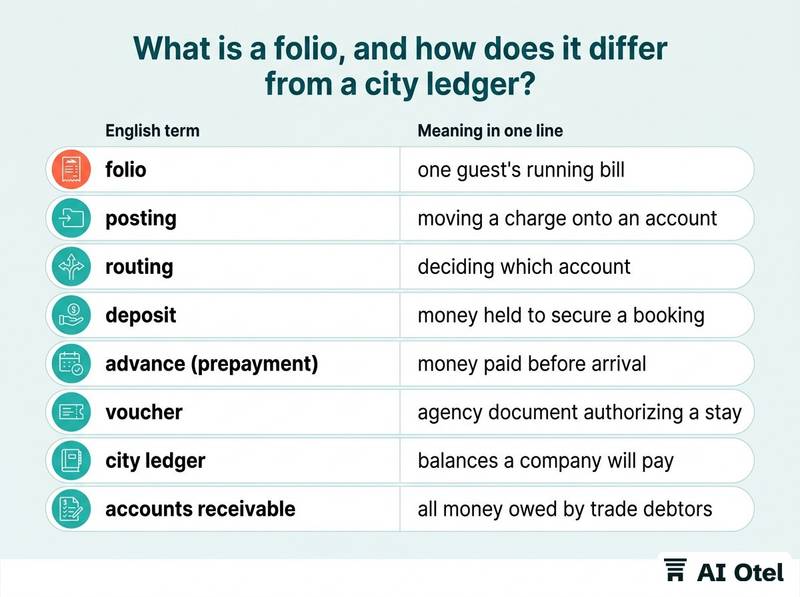
Posting moves a charge from an outlet (restaurant, bar, spa, minibar) onto an account. Routing decides which account: room and breakfast to a company master account, extras to the guest's own folio. A master or house account holds a group or an event, with individual folios routed into it. Groups are where folio and city ledger confusion costs the most, because one event can produce dozens of folios and one receivable.
A deposit and an advance are both money taken before arrival, and neither is revenue yet. A deposit secures the booking; an advance is prepayment against the bill. The contract wording decides which one you are holding, so ask before posting. A voucher is a document from an agency or operator authorizing the stay: the guest does not pay at the desk, the agency is billed, and the balance moves to the city ledger at checkout.
The city ledger is a subset of accounts receivable, not a synonym. Accounts receivable also carries other trade receivables; the city ledger is specifically the guest-related balances that left the front desk unpaid. The practical consequence: the same stay can be revenue for the hotel and a receivable for the agency, and only the city ledger shows who owes what and by when.
| English term | Turkish term | Meaning in one line | Where it shows up |
|---|---|---|---|
| folio | misafir hesabı (folyo) | one guest's or one room's running bill | front desk, at checkout |
| posting | hesaba işlemek | moving a charge from an outlet onto an account | outlet till to folio |
| routing | yönlendirme | deciding which account a charge lands on | group and corporate stays |
| deposit | depozito | money held to secure a booking | reservation record, not revenue |
| advance (prepayment) | avans / ön ödeme | money paid before arrival against the bill | reservation record, not revenue |
| voucher | acente kuponu | agency document authorizing a stay billed later | city ledger |
| city ledger | cari hesap | balances a company or agency will pay after checkout | accounts receivable |
| accounts receivable | ticari alacaklar | all money owed to the hotel by trade debtors | finance, monthly |
| master (house) account | ana hesap | one account collecting a group's or event's charges | groups and events |
What happens between the night audit and the trial balance?
The night audit closes the business day by posting the day's charges and rolling the date; the trial balance is the list of every account's balance that the accountant later checks those figures against. The night audit is a control, not a report. Its job is to catch what the day left open: unposted outlet charges, rate mismatches against the reservation, rooms at zero rate without a reason, folios still open at close. The full sequence is in our night audit checklist: closing the hotel business day in order.
A business date is not always a calendar date. A hotel's business day can run past midnight, and the revenue report follows the business date, so a charge at 01:30 may belong to the previous day. The trial balance (mizan) lists every account with its balance at a moment in time. If the day's postings do not balance, the trial balance shows it before any report is written.
The day close and the period close are different events. The night audit closes one business day; the month close closes a period and applies accruals, deferrals and cut-off. What the accountant needs handed over: revenue by department for the day, payments split by method, the list of open folios with an owner for each, and every transfer into the city ledger. The reconciliation rule is simple and non-negotiable: the desk's revenue must agree with the trial balance before anyone starts explaining a variance. Explaining first hides the error.
ChecklistBefore you accept the night audit numbers
- every outlet is closed and its charges posted
- no room sits at zero rate without a written reason
- payments by method match the cash count and the card totals
- every open folio is listed with the person responsible for it
- every city ledger transfer is approved by someone other than the person who posted it
- the business date has rolled exactly once
- the day's revenue by department is printed and filed with the trial balance extract
What do accrual, deferral and cut-off mean at a hotel?
Accrual puts a cost or a revenue in the period it belongs to, deferral holds money received now until the period it is earned, and cut-off is the line that decides which period a transaction falls on. An expense that was incurred but not yet invoiced goes into the period of use: for example, electricity consumed in March and invoiced in April belongs to March. A deposit received in June for an August stay is a liability in June and revenue in August. The cash moved in June; the earning did not.
Cut-off works by night, not by invoice date. A stay that spans two periods is split by night: the night of 30 April belongs to April even if the invoice is dated 1 May. A correction is made by posting the opposite entry, not by deleting the original; the original stays visible, which is the point of the exercise. Note that void and reversal are not the same tool. A void cancels a posting made in error, usually within the same period; a reversal corrects across periods and leaves both entries in the record.
Cost allocation is the third quiet mover. Shared costs such as utilities, laundry or IT are split across departments on a stated basis. The basis is a management decision; it changes departmental profit without changing total profit, which is why two reports can disagree and both be right. This is why owners get surprised at month end: accruals and deferrals move profit between months while the bank account does not move at all. The period close is covered in detail in month-end close in the hotel accounting office: cut-off and accruals.
Key pointA worked example, illustrative
A guest stays three nights at 2,000 per night, arriving 30 April and leaving 3 May. The 30 April night belongs to April and the other two to May, whatever the invoice date. Separately, a 6,000 deposit taken in June for an August stay sits as money held, not revenue, until the August nights are delivered. The bank saw the cash in June; the profit statement sees the revenue in August.
Which profit line is which: departmental income, GOP, EBITDA and flow-through?
Departmental income is what a department keeps after its own direct costs, GOP is what the hotel keeps after all operating costs, and EBITDA is a company-level line that starts from GOP and removes fixed charges and non-cash items. Departmental income is a department's revenue minus its direct expenses: cost of sales, that department's payroll and its supplies. Rooms and food and beverage are measured separately because their cost structures differ.
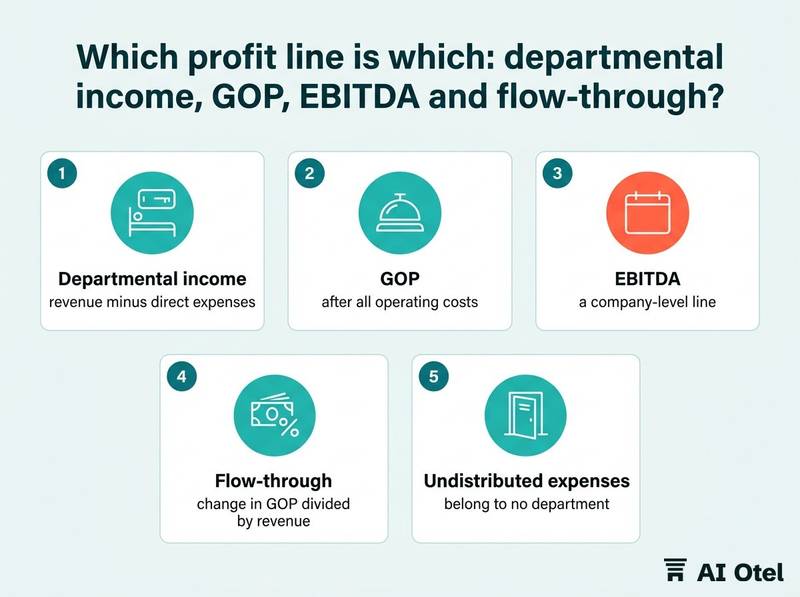
Undistributed expenses (administration, sales, maintenance, utilities) belong to no department. They sit below departmental income, which is why a healthy rooms department and a loss-making hotel can both be true. GOP starts from total revenue and subtracts departmental and undistributed operating expenses. Rent, property tax, insurance and management fees generally sit below it, as do depreciation and interest.
EBITDA is a company line, not a property line. Because definitions vary by contract, the same hotel can report two different EBITDA figures and both can be defensible. Flow-through measures how much of each extra unit of revenue reaches profit: the change in GOP divided by the change in revenue. A negative flow-through means revenue rose and profit fell, which is a cost problem, not a sales problem. For the owner's view of these lines, see GOP, EBITDA and NOI: which profit line belongs to the owner.
Most owner-versus-manager arguments are not about numbers but about which line a target, a bonus or an incentive fee refers to. Ask for the definition page before the discussion, not after.
Which Turkish term does the accountant use, and which does the hotel use?
Turkish hotel practice runs two vocabularies side by side: the accountant's statutory terms and the hotelier's operational words, and the confusion sits in a small set of pairs. Harcama and tahsilat are the pair that causes the most damage. A charge on the guest's bill is a harcama; tahsilat is collecting the payment. Mixing them turns a revenue question into a cash question and the answer stops making sense.
Misafir hesabı (folyo) and fatura are different records. The folio is the working bill during the stay; the invoice is the fiscal document. A folio is not an invoice and an invoice is not a folio. Depozito, avans and ön ödeme are used loosely in daily speech, but in a contract they mean different things, so ask which one the reservation record actually holds before it is posted.
The working pairs an accountant will recognize: tahakkuk (accrual), ertelenmiş gelir (deferred income), dönemsellik (the period principle behind cut-off), ters kayıt (reversal), mizan (trial balance), cari hesap (city ledger), gün sonu (night audit), bölüm kârı (departmental income), FAVÖK (EBITDA). Flow-through has no settled Turkish equivalent in hotel practice; most teams keep the English word and explain it once as the share of extra revenue that reaches profit.
The rule that ends the confusion: one term per concept, written into the property's own glossary, used in every report heading and in the front office manual.
Watch outFalse friends to watch
Ciro is turnover, not profit; use kâr for profit. Tahsilat is collection, not a charge; use harcama for a charge. Fatura is the fiscal document only; use misafir hesabı for the running bill. Depozito in everyday Turkish often means a damage or key deposit; specify booking deposit or avans. Mizan is the trial balance, not a management report; name the report you mean.
What to do next
Write a one-page bilingual term sheet for your own property, one term per concept, and take it to the accountant and the front office manager before the next month close. The order of this article is the order the money travels: the guest's folio, the day close, the period with its accruals and cut-off, the profit lines the owner reads, and finally the Turkish and English words for each step. Agreeing the words is the cheapest correction available, and the only one that prevents the next argument.
Frequently asked questions
Is a deposit the same as an advance at a hotel?
No. A deposit is money held to secure a booking; an advance or prepayment is money paid against the bill before arrival. Both are money the hotel holds rather than revenue, and both become revenue when the stay happens. The contract wording decides which one applies, so check the reservation record before posting.
What is the difference between a void and a reversal?
A void cancels a posting made in error, usually within the same period. A reversal corrects by posting the opposite entry, which works across periods and leaves both entries visible. Neither deletes the original, because the record has to show what happened and what was done about it.
Why does the front desk's revenue figure differ from the accountant's?
They measure different things. The desk reports charges posted during a business day; the accountant reports revenue earned in a period, after deferred deposits, accruals and cut-off. City ledger transfers and cost allocation widen the gap further. Reconcile the two before explaining a variance.
Is the city ledger the same as accounts receivable?
The city ledger is the guest-related part of accounts receivable: agency, corporate and group balances that left the front desk unpaid at checkout. Accounts receivable also includes other trade receivables, so the city ledger sits inside it rather than beside it. These hotel accounting terms are worth fixing precisely because the difference decides who chases which balance.