Working capital of a hotel: how much cash it must carry between paying suppliers and being paid by agencies
Working capital is the cash tied up in your hotel's daily operations. Learn how to measure the gap between paying suppliers and being paid by agencies, and use a one-page monthly check to spot warning signs before they become problems.
AI draft · awaiting editorial review
Contents
Key takeaways
- Working capital is stock plus receivables minus payables; a profit on the income statement says nothing about whether the cash is in the bank on the 15th.
- The number that matters is not the balance but the gap: how many days pass between paying a supplier and being paid by an agency.
- Lengthening agency payment terms by 30 days adds roughly one month of agency-billed revenue to the cash the hotel must hold.
- Pre-season buying turns cash into stock weeks before the season turns stock back into cash, so the buffer peaks before the first guest arrives.
- A written deposit and invoicing rule, applied to every booking, does more for cash than any single negotiation with a supplier.
Hotel working capital is the cash tied up in the business: stock in the storeroom plus money owed by agencies and companies, minus money owed to suppliers. The cash a hotel must carry is that gap multiplied by how long it lasts, plus a buffer for the weeks when payments outrun collections.
The agency's guests checked out in May. The invoice goes out at the start of June, the money lands in July, and the butcher, the laundry and the electricity supplier all want paying in June. Nothing on the income statement looks wrong. This article gives you the definitions, the arithmetic and a one-page monthly check, so you can measure the gap in your own hotel and see which of the three clocks moved.
What is hotel working capital, in plain words?
Working capital is the money a hotel has tied up in running the business day to day: what sits in the storeroom, what customers still owe, minus what the hotel still owes its suppliers. It is a balance at one moment, usually measured on the same date every month.
Keep it separate from profit. Revenue is recognized when the guest stays, but cash arrives when the agency pays, and the two dates are set by contracts, not by the calendar year. A hotel can post a strong month and still be short on the 15th. Also keep it separate from cash flow: cash flow is movement over a period, working capital is a position at a moment. You need both, because they answer different questions.
Hotels are unusual in this respect. The room itself is perishable, but the stock behind the room, food, beverage, linen, amenities, cleaning chemicals and fuel, is real, countable and expensive to hold. One common error makes the number look better than it is: counting unsold rooms as an asset. An unsold room night is lost revenue, not stock, and it cannot be sold later.
Three clocks set the size of the gap: supplier terms, guest and agency terms, and the season. The number has two useful forms, a balance in lira and a duration in days of operating cost. The duration is what tells an owner whether the hotel can survive a slow month.
Key pointThe formula, stated twice
Working capital = stock at cost + receivables − payables. Days of cover = working capital ÷ average daily cash operating cost. The balance tells you what is tied up; the days tell you how long you could run.
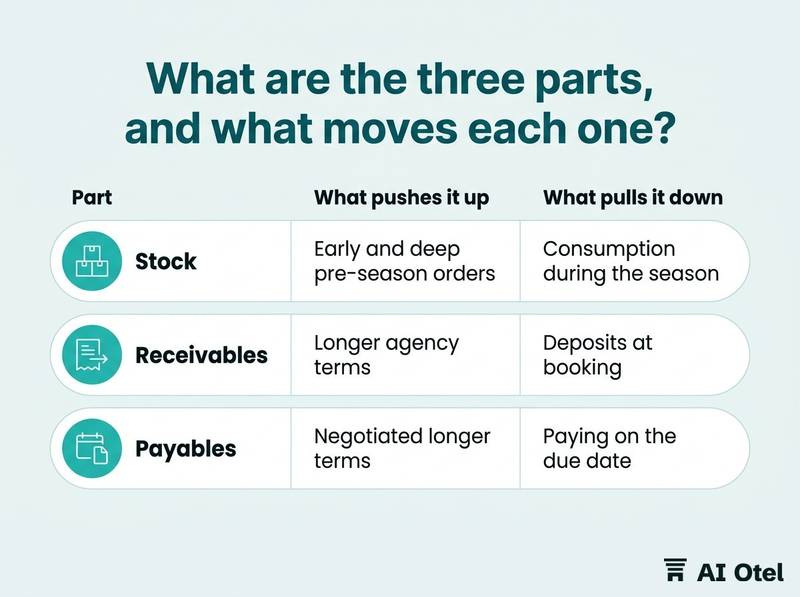
What are the three parts, and what moves each one?
Stock is what sits in storerooms and on shelves, receivables are what agencies, companies and tour operators still owe, and payables are what the hotel still owes its suppliers and service providers. Each part moves for its own reasons, and most of them are inside the hotel's control.
Count stock at cost, never at selling price, and count it on the same date every month: food and beverage, amenities, linen and terry, cleaning chemicals, engineering spares and fuel. Receivables include agency invoices, corporate direct bills, group balances, card settlements still in transit and OTA settlements not yet received. Age them by who owes, not by amount, because the collection conversation is with a debtor, not with a number.
Payables include supplier invoices, utility bills, service contracts and accrued payroll. Note the asymmetry that causes most surprises: payables have a fixed due date and a penalty, while receivables have an agreed term and no penalty. The hotel must actively chase what the contract already promised.
The city ledger explains where the receivable comes from: agency and corporate stays are billed to an account rather than collected at the desk, so the cash arrives after the guest has gone. If you bill agencies and companies, the mechanics are worth understanding in detail, see hotel city ledger explained: invoicing agencies and companies. An OTA settlement date depends on the payment model, so the same booking can produce cash this week or next month; the models are compared in OTA payment terms: hotel collect, OTA collect and virtual cards.
| Part | What it includes | What pushes it up | What pulls it down |
|---|---|---|---|
| Stock | Food, beverage, linen, amenities, spares | Early and deep pre-season orders; par levels set too high | Consumption during the season; tighter ordering |
| Receivables | Agency and corporate invoices; card and OTA settlements in transit | Longer agency terms; late invoicing; invoice errors | Deposits at booking; invoicing on checkout day; disciplined collection |
| Payables | Supplier invoices; utilities; service contracts; accrued payroll | Negotiated longer terms; volume commitments | Paying on the due date; cash-on-delivery discounts; smaller, more frequent orders |
How do you calculate it, month by month?
Add stock at cost to what customers owe, subtract what the hotel owes, then divide the result by average daily cash operating cost to see how many days the hotel could run on what is tied up. Six steps, the same every month.
Step one: a stock count at cost on a fixed date each month, taken by someone who does not order the stock. Step two: an aged receivables list split by debtor type, agency, corporate, group, card in transit, OTA settlement, with the agreed term written next to each line. Step three: payables due in the next 30 days, split into fixed (payroll, utilities, taxes) and movable (trade suppliers), because only the movable part can be negotiated.
Step four: run the arithmetic. For example, an invented 120-room seasonal hotel.
| Line | Base case | Terms move 30 to 60 days | Change |
|---|---|---|---|
| Stock at cost | 3,000,000 TL | 3,000,000 TL | 0 |
| Receivables | 9,000,000 TL | 13,000,000 TL | +4,000,000 TL |
| Payables | 6,000,000 TL | 6,000,000 TL | 0 |
| Working capital | 6,000,000 TL | 10,000,000 TL | +4,000,000 TL |
Illustrative figures only, not a benchmark. The receivables line grows by roughly one month of agency-billed revenue, because every agency invoice now sits on the books twice as long.
Step five: convert the balance into days of cover, and compare this month's days with last month's. The direction of travel matters more than the absolute figure. Step six: keep the same definitions every month. A working capital number that changes definition cannot be compared with anything, including itself.
What lengthens the gap between paying and being paid?
Three things: longer agency and corporate payment terms, buying stock earlier and deeper than the season needs, and invoicing late or wrongly so the payment clock starts after the work is already done.
Agency terms are the biggest lever. Whether the contract says 30, 45 or 60 days, the clock usually starts on the invoice date, not the checkout date, so a late invoice silently adds days nobody negotiated. Corporate and group direct bills add their own delay: the company pays after its own approval cycle, which the hotel does not control and rarely asks about before signing.
OTA settlement models matter too. Hotel collect, OTA collect and virtual card each move the cash date, so a mixed channel mix produces a receivables balance with several different clocks inside it. On the buying side, pre-season buying means stock builds in the weeks before opening, cash leaves immediately, and season revenue arrives later, so the buffer peak comes before the first guest. The pattern is part of the wider problem of cash flow for a seasonal hotel: planning the months between seasons.
Suppliers can shorten terms as well: a supplier who once gave 45 days may move to 15 or to cash on delivery, and the gap widens without any change on the sales side. Disputes and errors do the same. An invoice with the wrong reference, guest name or stay dates is not paid, and the correction restarts the clock from the new invoice date. Seasonality sits on top of all of it: in a seasonal hotel the gap is widest exactly when revenue is lowest, which is why the annual plan and the monthly number must be read together.
Watch outThe gap widens quietly
Nothing on the income statement changes on the day an agency term moves from 30 to 60 days, and nothing changes on the day a supplier shortens terms. Only the cash balance and the days of cover show it.
How do you shorten the gap without damaging the operation?
Move the two dates the hotel actually controls: the day the invoice goes out and the day the deposit comes in. Everything else is slower.
Deposits and prepayment come first. A deposit taken at booking turns a future receivable into cash before the stay, provided the rule is written in the contract and applied to every booking rather than case by case. Next, invoicing rhythm: invoice on checkout day for transient corporate stays, and run agency invoices on a fixed weekly day instead of at month end, so the payment clock starts earlier every time. First-time-right invoicing matters just as much: give the client's system the reference, purchase order, guest name and stay dates it needs, because a corrected invoice costs a full payment cycle.
On the supplier side, ask for a named payment day and a defined term in exchange for reliable payment and clear volume, and put the agreed term in writing so it does not drift back. Know the settlement lag for each card and OTA channel, and treat it as a receivable with a known date, not as cash already earned. For stock, order to a par level set from real consumption rather than habit, and receive against the order so the storeroom does not quietly become the buffer; the full procedure is in hotel purchasing and receiving: a procedure from order to storeroom.
One thing not to do: fund the gap by delaying payroll or tax. That is the most expensive borrowing available and the one that damages the business fastest. If the gap is structural rather than seasonal, financing it properly through a bank is the better route, and the file a bank reads is built from exactly the numbers in this article; see how to get a hotel loan in Türkiye: the file a bank reads and the cash flow it tests. A hotel that wants its operational numbers in one place, rather than spread across the front desk, the storeroom and a spreadsheet, can look at a hotel operating system, built and working, ahead of launch, with reservations, front desk, billing and reports in one record, and at the ecosystem around it.
Which warning signs should you watch, and what belongs on a one-page monthly check?
The warning signs are in the shape of the number rather than its size: receivables aging past the agreed term, payables aging past the due date, and stock growing while the hotel is selling less.
Watch the share of the receivables balance older than its agreed term, and whether the oldest column is growing faster than the total. On payables, paying on the reminder rather than on the due date is the clearest sign that the gap has outgrown the buffer. On stock, stock days rising while covers or occupancy fall means cash is sitting on a shelf instead of in the bank. And watch for mixing months: using next month's deposits to pay this month's suppliers works once, and then becomes the permanent method.
The check is only useful if the same person produces it on the same day each month and the general manager reads it before the supplier run. Decide in advance which movement triggers a conversation with the owner, so the discussion is about the cause and not about the discovery.
ChecklistThe one-page monthly working capital check
- Stock at cost on the count date, with the count sheet attached
- Receivables total and the amount past its agreed term, split by debtor type
- Payables due in the next 30 days, split into fixed and movable
- Working capital in lira, and days of cover, each compared with the previous month
- The three largest movements since last month, each with a one-line cause
- One action, one owner, one date
What to do next
Run the one-page check this month, using the definitions in this article, and let three months of the same number tell you whether the gap is structural or seasonal. The pieces fit together in one order: define the three parts, measure the gap in days, find which of the three clocks moved, and only then negotiate or change a rule.
Frequently asked questions
Can a profitable hotel still run out of cash?
Yes. Profit records the stay when it happens; cash arrives when the contract says it does. A hotel can show a good month and still miss a supplier payment if the receivables sit 60 days out and the stock was bought 30 days early. The two numbers must be read side by side.
Should unsold rooms be counted as stock in the working capital figure?
No. An unsold room night is lost revenue, not an asset. Stock means physical goods counted at cost: food, beverage, linen, amenities, chemicals, spares and fuel. Counting rooms would overstate the balance and hide the real gap.
How many days of operating cost should the cash buffer cover?
There is no universal figure, and a hotel should not borrow one from another property. The hotel's own contract terms, its season length and its fixed payment dates set the number. Write the rule down, state who owns it, and review it every month against the measured days of cover.
Do deposits reduce working capital?
They do, because a deposit converts a future receivable into cash before the stay. They also create an obligation to deliver the stay, so the deposit is not free money. The rule only helps if it is written in the contract and applied to every booking rather than negotiated case by case.
When does the agency payment clock actually start?
Usually on the invoice date stated in the contract, not on the checkout date. That is why invoicing late, or issuing a corrected invoice, adds days nobody negotiated. Read the clause, note the trigger date, and make the invoice run match it.