Petty cash in a hotel: department floats, vouchers and the weekly count
A petty cash float only works if its amount never changes. This guide explains how to size department floats, enforce voucher rules, run weekly counts and handle shortages without losing control.
AI draft · awaiting editorial review
Contents
Key takeaways
- A petty cash float only works if its amount never changes: cash plus vouchers must equal the same total at every count.
- No receipt, no payment: a voucher without its receipt is a payment nobody can prove later.
- The person who counts the float is never the person who holds it, and never the person who approves the spending.
- A shortage covered quietly from another box becomes permanent; record it the same day and find the cause before the refill.
- Petty cash is for what cannot wait; anything that could carry a purchase order belongs in purchasing.
Petty cash in a hotel is a small, fixed float held by one named person in one department for small, immediate expenses. Every payment leaves a voucher with its receipt, someone other than the holder counts cash plus vouchers against the float each week, and the refill equals the vouchers.
The flowers were bought, the taxi was paid, the spare part was collected, and nobody wrote anything down. Three weeks later the box is short, and no one can say by how much or on which day it started. This article gives you the working parts of hotel petty cash: how to size and assign a department float, what every voucher must show, how to run the weekly count, what to do with a difference, and how to hand the float over without losing the trail.
What is a petty cash float in a hotel?
A petty cash float is a small, fixed amount of cash held by one named person in one department to pay small, immediate expenses. It works only when the amount stays fixed and every payment leaves a voucher behind.
The fixed amount is the whole mechanism. Cash in the box plus the vouchers for money already spent must always add up to the same total, and that total is the float. Accountants call this the imprest system: you spend from the float, then refill exactly the value of the vouchers collected, so the float returns to its set amount and the next count is comparable to the last.
Hotels need it because some expenses cannot wait for a purchase order: a taxi for a guest, flowers after a complaint, a replacement part before the supplier opens. It leaks because a cash payment leaves no automatic record of its own. Without a voucher, a payment exists only in someone's memory, and memory is not a control.
Keep petty cash strictly apart from front desk cash. The desk float handles guest payments, drops and foreign currency, and mixing the two hides errors in both counts. The same separation rules apply to front desk cash handling: float, drops and shortages. One float, one holder, one box, one fixed location: every extra hand in the same cash is an extra explanation you will need later.
Key pointThe one-line test
Cash counted plus vouchers listed must equal the float amount, every time, without adjustment.
How much should each department hold, and who should hold it?
Size the float from what the department actually spends in small cash over a few months, then keep it fixed. Give it to one named holder with one named deputy, never to a shared drawer.
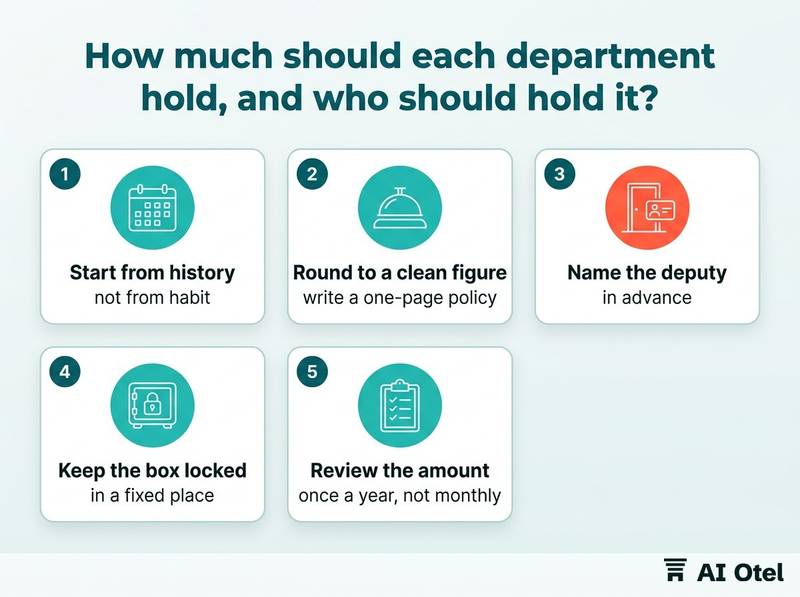
Start from history, not from habit. List the small cash expenses the department paid last quarter, group them by type, and size the float to cover roughly one to two weeks of that pattern. Expect very different answers by department. For example, a housekeeping department that buys nothing locally may need almost nothing, while a maintenance team collecting parts may need considerably more. The number comes from the list, not from what the last holder asked for.
Round to a clean figure and write a one-page policy: the amount, the holder, the deputy, what may be paid, the count day and the per-payment ceiling. The holder signs for the float personally. The department head approves the spending but does not hold the cash, so the person who approves is not the person who pays out.
Name the deputy in advance. Without one, leave creates an unofficial second float that nobody counts. Keep the box locked in a fixed place and record where it is, because a float that moves between offices cannot be counted on a schedule. Review the amount once a year, not monthly: every change to the float breaks the comparison between one count sheet and the next. If you are building the policy alongside other accounting routines, the same vocabulary discipline helps as in hotel accounting terms in Turkish and English, from folio to accrual.
What must every petty cash voucher show?
Every payment needs a voucher a stranger could read: what was bought, for whom, when, how much, who approved it and which receipt backs it.
Use sequential voucher numbers with no gaps and no duplicates. A missing number is a payment that was removed from the record. The voucher carries the date of payment, the amount in figures and in words, and the name of the person or business that received the cash. The purpose is written in plain words: what was bought, for which department, and for which guest or incident if that applies.
The receipt or invoice is attached, and its date and amount match the voucher. If they do not match, the voucher is wrong, not the receipt. The person who received the cash signs, and the approver signs with a date that is on or before the payment date. Approval after the fact is not approval.
No receipt, no payment. No IOUs, no advances to be documented later, and no voucher written from memory at the end of the week. A spoiled voucher is marked void and kept in the book, never thrown away, so the numbering stays intact.
ChecklistVoucher completeness check, run before the cash leaves the box
- Sequential number present
- Payment date
- Amount in figures and words
- Payee name
- Purpose and department
- Receipt attached and matching
- Recipient signature
- Approver signature and date
- Running balance of the float after the payment
How does the weekly count work?
Someone other than the holder counts the cash and the vouchers together, in front of the holder, and signs a sheet showing the float, the cash counted, the vouchers and any difference.
The counter is independent: a controller, an accountant or another department head. Not the holder, and not the person who approves the spending. Count on a fixed day each week so the habit holds, and add an unannounced count now and then. The fixed day trains the routine; the surprise count tests whether the routine is real.
Count the cash first, then list the vouchers by number, then add. Cash plus vouchers must equal the float, and the sheet shows the arithmetic rather than only the result. Check each voucher against its receipt while the box is open: amount, date, purpose, signature. A voucher that fails the check is a finding, not a rounding issue.
Both people sign and date the sheet, and the sheet goes to accounting. It does not go back into the box. Work out the refill at the same moment: the refill equals the total of the vouchers collected since the last refill, which returns the float to its set amount.
| Line | What is checked | Where it comes from | What correct looks like |
|---|---|---|---|
| Float amount | The set total | The policy | Same figure every count |
| Cash counted | Physical cash | Counted with the holder | Counted, not assumed |
| Vouchers | Payments since last refill | The voucher book | Listed by number, no gaps |
| Receipts | Attachments | With each voucher | Amount and date match |
| Total | Cash plus vouchers | The sum | Equals the float |
| Difference | Total minus float | The arithmetic | Zero, or explained in writing |
| Refill due | Total of vouchers | Since last refill | Equals the vouchers exactly |
| Signatures | Holder and counter | Both present | Signed and dated |
What do you do with a shortage or a surplus on the same day?
Record it the same day, in writing, with both signatures, and find the cause before the float is refilled. A difference that is quietly topped up becomes permanent.
On a shortage, recount first, then walk the vouchers against the receipts one by one. The usual cause is a payment made without a voucher, or a voucher whose receipt never arrived. On a surplus, the usual causes are a payout recorded but never made, a receipt counted twice, or change put back without a voucher. A surplus is as much a control failure as a shortage.
Never cover a shortage from another department's float or from the front desk. That hides the loss and corrupts two counts instead of one. Write the difference on the count sheet with the explanation, or with the words "cause not found", and have both the holder and the counter sign it.
Escalate by size and by pattern. One small difference is a mistake; the same difference three weeks running is a control problem that needs a procedure change. Decide in the policy, before anything happens, who bears a loss and at what amount it goes to the general manager. Deciding after the loss invites an argument instead of a fix. Watch the trend across weeks and across departments, and let it reach the monthly variance report rather than staying inside the box, in the same way you read budget vs actual in hotels: reading the monthly variance.
Watch outNever top up a float to hide a difference
Record the shortage or surplus on the count sheet the same day, with both signatures, and refill only against vouchers.
What may and may not be paid from petty cash?
Petty cash is for small, immediate, one-off expenses that cannot wait for the normal purchasing route. Anything with a supplier, a contract or a payroll line belongs somewhere else.
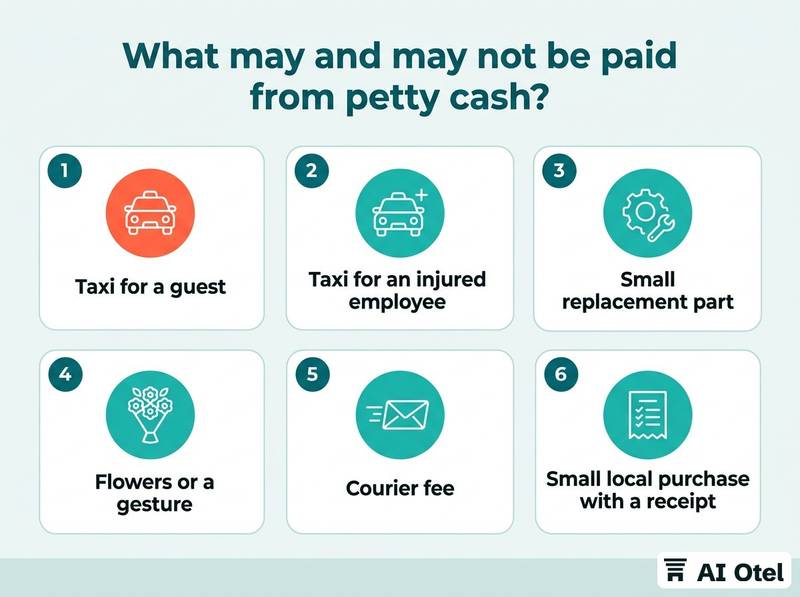
Allowed, when the policy says so: a taxi for a guest or an injured employee, a small replacement part, flowers or a gesture after a complaint, a courier fee, a small local purchase with a receipt. Not allowed: wages, advances on wages, supplier invoices, guest refunds, deposits, personal loans to staff, and cashing a cheque or changing money for anyone.
Supplier purchases go through hotel purchasing and receiving, a procedure from order to storeroom, where the order, the delivery and the invoice meet and can be checked against each other. Guest refunds and bill corrections belong on the guest's bill, where they leave a trail that a cash box cannot produce.
Set a per-payment ceiling in the policy, so a large expense cannot be split into several small ones that each stay under the limit. The test is not the amount alone. Ask whether the expense could wait for a purchase order; if it could, it does not belong in petty cash.
NoteThis article stops at control
Whether a particular receipt is acceptable for tax, and how the expense is recorded in the books, is a question for your accountant.
How do you hand over a float when the holder is on leave?
Count the float before the handover, with the outgoing holder, the incoming holder and a third person, and start the new holder on the same fixed amount.
Count on the last working day, not on the first day back. A float that sat unattended for two weeks cannot be reconstructed afterwards. The new holder signs for the same amount; do not lend a different float or merge two boxes for the duration of the leave.
Hand over the open vouchers, meaning payments already made but not yet refilled, together with their receipts, and list them on the handover sheet. Change the key or the safe code at the handover, so only the current holder can open the box. File the handover sheet with the count sheets, so the history of the float has no gap and the next count has a starting point.
Count again when the holder returns, and sign both directions. Two counts, one on the way out and one on the way back, close the loop.
What to do next
Write the one-page policy this week: the amount per department, the named holder and deputy, the voucher fields, the count day, the per-payment ceiling and who bears a loss. Then run one count exactly as the policy says, and let the first count sheet show you which of those rules is still too vague to follow.
Frequently asked questions
What is the imprest system in hotel petty cash?
A fixed float is set for a department, spending is made only against vouchers, and the refill equals exactly the total of those vouchers, so the float returns to its set amount. The value is comparability: every count starts from the same number, so a difference means something. Without a fixed amount, a count result tells you nothing.
How often should petty cash be counted?
Weekly on a fixed day is the working minimum, by someone other than the holder. Add an occasional unannounced count, and always count at a handover, at a change of holder and at any change to the float amount. The fixed day builds the habit; the surprise count and the handover counts verify it.
Who is responsible for a petty cash shortage?
The holder signs for the float, so the holder explains a difference first. The policy should state in advance who bears a loss and at what amount it escalates, because deciding after the event turns a control question into an argument. A repeated small difference matters more than a single one, because it points to a procedure problem rather than a mistake.
Can petty cash pay for staff expenses like a taxi home?
Yes, if the policy allows it and the payment carries a voucher with its receipt and an approval. Wages and advances on wages do not belong in petty cash, and a per-payment ceiling keeps the box from becoming a second payroll. The voucher should name the employee and the reason in plain words.
Do petty cash receipts need to be kept?
Every receipt stays attached to its voucher and is filed with the count sheets, so the expense can be traced months later. How those receipts are treated for tax, and for how long they must be kept, is a question for your accountant. From a control point of view, the receipt is the strongest proof that a payment was real.