Month-end close in the hotel accounting office: cut-off, accruals and the checks before the reports go out
A hotel month-end close freezes the front office, ties revenue to the bank, and books accruals for stays crossing the month line. This guide provides the five-day calendar and checks needed to send the owner a clear, accurate financial pack.
AI draft · awaiting editorial review
Contents
Key takeaways
- A month-end close is a sequence, not a pile of tasks: front office first, then revenue, then costs, then accruals, then the trial balance, then the pack.
- The check that catches most revenue errors is a three-way tie: the hotel system's day totals, the card settlement report and the city ledger, line by line.
- A stay that crosses the month line belongs to the nights the guest slept, not to the day the card was charged.
- An accrual is a dated promise to yourself: book the cost when the goods arrive, reverse it when the invoice does, and the month stays honest.
- The owner's pack should explain in words what moved and why; a trial balance without a sentence of explanation is a puzzle, not a report.
A hotel month-end close is the five-working-day routine that freezes the front office, ties revenue to the hotel system (PMS) and the bank, cuts off costs, books accruals for stays and invoices that cross the month line, reviews the trial balance, and sends the owner a pack with the numbers explained in words.
The night audit closes the business day at 23:59 on 31 March and the front desk opens 1 April at 00:01. In between, three guests are still in-house, one deposit belongs to April, and the laundry invoice for March arrives on 4 April. This article gives you the close calendar, the checks and the vocabulary to handle exactly those situations, in an order a small accounting office can keep.
Why does a hotel month never end cleanly?
Because a hotel sells nights, not calendar days, and its documents arrive after its events. The close exists to put every amount in the month it belongs to, not the month it turned up.
The night audit closes a business day, not a month. It proves the day's takings and hands a clean starting point to the accounting office, but it does not decide which month an amount belongs to. That decision is the close. For how the day itself is closed in order, see the night audit checklist: closing the hotel business day in order.
Three things cross the line every month. Stays that are still in-house on the first. Deposits and prepayments received for future nights. Supplier invoices for goods delivered in the month just closed. Each one asks a different question, and the close answers them in turn.
Key pointThe three things that cross the month line
An in-house stay: which nights did the guest actually sleep here? A deposit: whose month is this money? An uninvoiced delivery: did the goods arrive before or after midnight on the last day?
The hotel keeps trading while the office closes, so the operational numbers have to be frozen early with a stated hour, or they will change under your hands between day one and day five. In a small office one person does four jobs; the close calendar is what makes the order survive a busy week and a public holiday.
Agree the vocabulary once. Cut-off is the decision about which month a transaction belongs to. An accrual is a cost or revenue booked before its document arrives. A deferral is cash received now for a night later. For more terms in both languages, see hotel accounting terms in Turkish and English: from folio and city ledger to accrual and cut-off.
There is a trade-off between speed and paperwork. A five-day close with named estimates beats a fifteen-day close that waits for every invoice, provided each estimate is reversed and replaced. And nothing in the close decides a tax filing: tax has its own calendar and its own rules, and you should follow your accountant on those.
What does a five-working-day close calendar look like?
Day one freezes the front office and pulls the reports, days two and three reconcile revenue and costs, day four books accruals and reviews the trial balance, day five sends the pack.
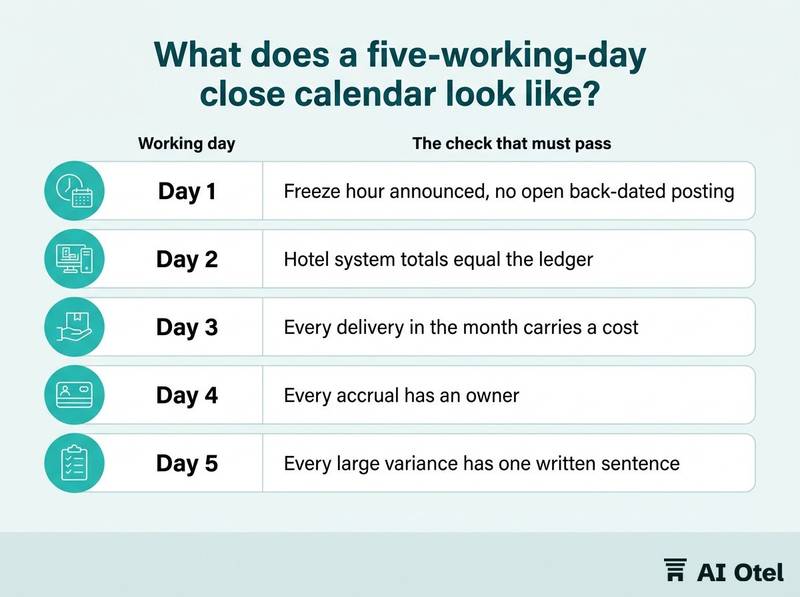
The freeze hour is the heart of the calendar. After it, no back-dated posting enters the system without a written correction that names the person and the reason. Day one belongs to the front office manager and the accountant together, because the reports have to be pulled before the next arrivals change them.
Day two is revenue only. Do not start on costs while the revenue tie is open, or you will be explaining two problems at once. Day three is cost cut-off: delivery notes matched to invoices, the uninvoiced list built, payroll hours confirmed with the payroll provider.
Day four is accruals, deferrals and the trial balance review, with corrections posted as reversals rather than deletions so the trail stays visible. Day five is the pack and the lessons log; the pack goes out on the day even if two lines are estimates, as long as the estimates are named in it.
The calendar is a contract with the rest of the hotel. Purchasing, housekeeping and the front desk need to know the document deadline as clearly as the accounting office does.
| Working day | Who leads | Output by end of day | The check that must pass |
|---|---|---|---|
| Day 1 | Front office manager and accountant | Day totals, city ledger, deposit ledger, card settlement reports | Freeze hour announced, no open back-dated posting |
| Day 2 | Accountant | Revenue tie by center | Hotel system totals equal the ledger and the card settlement, every difference named |
| Day 3 | Purchasing and accountant | Goods received matched to invoices, plus the uninvoiced list | Every delivery in the month carries a cost or an accrual line |
| Day 4 | Accountant, reviewed by finance manager or general manager | Accruals, deferrals, corrected trial balance | Every accrual has an owner and a reversal date |
| Day 5 | Finance manager | Owner's pack and lessons log | Every large variance has one written sentence |
How do you reconcile front office revenue to the ledger?
Tie three sources to each other rather than to memory: the hotel system's day totals, the card acquirer's settlement report and the city ledger, then explain every difference by name.
Build one mapping table between the hotel system's revenue centers and the ledger's revenue accounts, and keep it as the office's most useful single document. Every later tie depends on it. If the mapping is wrong, everything downstream is wrong in the same direction.
Cards: the settlement report net of commission goes against the card clearing account batch by batch, and the commission is a cost in the month it was earned, not a quiet reduction of revenue. City ledger means the accounts billed to companies and agencies instead of paid by the guest; it is a receivable, not cash, and it needs an aging by due date with a named owner for anything past terms.
Deposits received this month for later nights are a liability, and the deposit ledger must agree with that balance sheet line before anything else is signed. Keep an exception list for voids, overrings, house accounts, complimentary and staff stays and walk-outs; each line needs a reason and a person, not just a zero.
Cash: the float, the safe count and the bank deposit slip are three different numbers and all three belong in the tie. When the tie fails, start from the largest single difference, not the smallest. A large gap is usually one posting, and a hundred small ones are usually a mapping error. For what the daily checks cover before the month tie begins, see income audit in hotels: what the day audit checks after night audit.
ChecklistThe revenue tie, in this order
- Revenue by center from the hotel system against the ledger, through the mapping table
- Card settlement report net of commission against the card clearing account, batch by batch
- Cash takings against the safe count and the deposit slip
- City ledger balances aged by due date
- Agency and OTA statements against the reservations they cover, with commission in the month earned
- Deposits received, split into stays this month and stays later
- The exception list, with a reason and a name on every line
- The bank statement against the book balance, with every difference named
Where do you cut off costs that arrive without an invoice?
At the goods received note. If the goods or the work arrived in the month, the cost belongs to the month, whether or not the invoice has.
Match every delivery note to an invoice. Anything delivered and not invoiced goes to an accrual at the last known price and is reversed when the invoice arrives. Payroll rarely follows the calendar month: accrue the days worked but not yet paid, including the employer contributions and provisions the payroll provider confirms in writing.
Utilities: read the meters near the month end where you can, and where you cannot, accrue on the previous month's consumption with a note that the figure is an estimate. Commissions and agency charges are generated by this month's bookings and invoiced later, so they are accrued on this month's production, not on last month's invoice.
Annual contracts such as maintenance, licenses and insurance belong in the month as a monthly share, either as an accrual or as a release from prepayments, never as one lump when the invoice lands. Tax filings follow their own calendar and their own rules; the close records the month, it does not decide a filing, and you should confirm those dates with your accountant. For that calendar, see a hotel's monthly tax calendar: VAT, payroll, accommodation tax and tourism share.
The test of a good cost cut-off is simple: could a reader take the month's profit and loss and match it to what actually happened in the building that month?
Watch outAn accrual without a reversal date becomes a small permanent error
Name the owner of every accrual. Date its reversal on the first working day of the next month. Never net one accrual against a different cost line to make a total look tidy.
How do you handle a stay that crosses the month line?
Split it by nights. Revenue belongs to the nights consumed in each month, and a deposit belongs to the month the guest sleeps, not the month the card was charged.
The night of 31 March is March revenue even if the guest settles the folio on 2 April. The folio stays open and the split is made at the close, not at the front desk. A package or all-inclusive price is one number to the guest but several to the ledger; agree one internal allocation rule with your accountant, write it down once, and apply it every month without renegotiating it.
A deposit for an April stay is a liability in March; when the stay happens the liability becomes revenue, and the two entries should be traceable to each other. A no-show or cancellation charge belongs to the month the room was held, not the month the dispute was settled, and the reason stays next to the entry.
Group business has three dates that are easy to confuse: the contract date, the deposit date and the pickup, meaning the rooms actually taken from the block. Any estimate booked at the close is reversed on the first working day of the next month and replaced by the document, so the estimate never becomes a permanent figure.
TipThe one-line test
If the guest slept in the month, the room revenue is in the month. For example: a guest arrives on 30 March, stays three nights and pays on departure on 2 April; two nights are March revenue, one night is April revenue, and the cash is April.
Which trial balance lines always need a look?
The lines where an error hides quietly, read in the same order every month: receivables, deposits, card clearing, cash, suspense, accruals, prepayments, payroll and revenue by center.
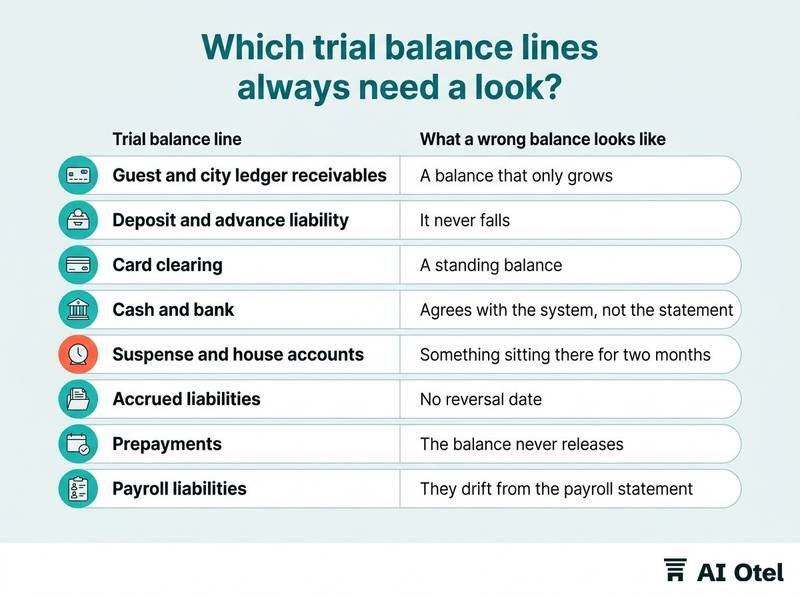
Read the trial balance as a set of questions, not a set of totals. For each line ask what a wrong balance would look like, and then look for exactly that. The deposit liability is the single best early warning in a hotel ledger: a balance that only grows means deposits are being collected but not released when the stay happens, so revenue is recognized too late.
Card clearing should sit near zero after settlement, so a standing balance is either an unsettled batch or a commission posted to the wrong side. Suspense and house accounts should be empty or explained; anything sitting there for two months is a decision nobody has made. For multi-property operators, intercompany balances must mirror each other, and a one-sided balance is usually a posting made in the wrong property's books.
Compare revenue by center with the operational report the general manager reads; if those two disagree, the management meeting will be about the wrong numbers. Write the exceptions down as you find them, because the same three lines tend to fail in the same way every month until a habit changes.
| Trial balance line | What a wrong balance looks like | The check that catches it |
|---|---|---|
| Guest and city ledger receivables | A balance that only grows | Aging by due date, named owner past terms |
| Deposit and advance liability | It never falls | Agree to the deposit ledger; recognize only when the guest sleeps |
| Card clearing | A standing balance | Settlement report net of commission, batch by batch |
| Cash and bank | Agrees with the system, not the statement | Bank reconciliation with unpresented items listed |
| Suspense and house accounts | Something sitting there for two months | Every balance has a reason and a name, or is cleared |
| Accrued liabilities | No reversal date | Each accrual carries an owner and a date |
| Prepayments | The balance never releases | The monthly release is posted, not only calculated |
| Payroll liabilities | They drift from the payroll statement | Agree to the provider's month-end statement |
| Revenue by center | It disagrees with the general manager's report | One mapping table, checked once a month |
What goes into the owner's pack, and what is explained in words?
The pack is short: the numbers the owner can act on, the variance against budget with a reason for each large line, cash and receivables, and a page of plain sentences.
Open with one paragraph in plain language: what happened this month, what changed against budget, and what needs a decision from the owner. Every line that moved beyond the threshold you agreed with the owner gets one sentence: what happened, what it cost, what is being done about it.
Keep the definitions fixed: the same layout, the same cut-off, the same formula for occupancy, average daily rate and revenue per available room, stated once in a footnote, so that month-to-month comparison means something. Do not send the trial balance; it is the working document behind the pack, and a reader without the mapping table will read it wrongly.
Carry last month's open items forward with a status and a date, because an item that disappears from the pack has not been solved, only hidden. Close the pack with the lessons log: one line per error found this month and the habit that prevents the repeat, which is the only page that makes the next close shorter. For how to read the variances themselves, see budget vs actual in hotels: reading the monthly variance.
ChecklistThe owner's pack, page by page
- Page one: one paragraph in plain words on what happened and what needs a decision
- Page two: summary profit and loss against budget and against the same month last year
- Page three: revenue by center with occupancy, average daily rate and revenue per available room, computed the same way every month
- Page four: payroll and the main cost ratios, with the estimates named
- Page five: cash position and receivables aging, with the three largest balances and their owners
- Page six: last month's open items, marked done or still open, with a date
- Back page: the lessons log, one line per error and the habit that prevents it
What to do next
Write your own close calendar this week: name the freeze hour, the five working days, the person who owns each output and the rule that every accrual carries a reversal date. The sequence is the whole idea, because the front office freeze protects the revenue tie, the revenue tie protects the cost cut-off, and the trial balance review protects the pack that goes to the owner.
Frequently asked questions
Who should sign off a hotel month-end close?
The accountant prepares, a second person reviews, the general manager signs the operational numbers and the owner receives the pack. Where the office is one person, the general manager reviews the revenue tie and the bank reconciliation, and the reviewer's name goes on the pack. Separation matters most where money moves: whoever reconciles the cards should not also post the bank.
What is the difference between cut-off and accrual?
Cut-off decides which month a transaction belongs to; an accrual is how the amount is recorded in that month before its document arrives. A deferral is the mirror image, cash received now for a night later. The hotel month-end close uses all three in that order, and the reversal habit keeps the estimates from becoming permanent.
What happens if a supplier invoice arrives after the close?
The cost was already accrued from the goods received note, so when the invoice arrives the accrual is reversed and the invoice is posted. If the amount differs, the difference lands in the month it is found and is explained in the pack rather than buried in a cost line. The point of the accrual is that the month was never left without the cost.
How long should a hotel month-end close take?
Five working days is a workable target for a single property, and the limit is usually late documents rather than the ledger itself. Close the operational numbers first and let the cost accruals follow, instead of holding the whole pack for one invoice. A pack sent on day five with two named estimates is more useful than a perfect pack sent on day twenty.
Should the owner see the trial balance?
No. The trial balance is the working document; the owner gets the summary, the variance with a reason for each large line, cash, receivables and the open items. If the owner asks about a specific line, it is answered in the pack in plain words, not by forwarding the ledger.