Three-way match for hotel purchases: order, delivery note and supplier invoice before payment
A three-way match compares the purchase order, delivery note and supplier invoice before payment. This guide explains how to run the check, set tolerances, and handle differences without software.
AI draft · awaiting editorial review
Contents
Key takeaways
- Each document answers a different question: the order says what the hotel agreed to buy, the delivery note says what arrived, and the invoice says what the supplier wants to be paid.
- A match is a decision, not a comparison: a named person must be allowed to release a payment, hold it, or approve a difference, and that decision must be written down.
- Tolerances belong in a written rule the hotel sets and signs itself, with a separate limit for quantity and for price.
- Services and subscriptions have no delivery note, so the hotel substitutes a signed service confirmation from the department that received the work.
- Exceptions reviewed once a month turn into supplier terms: repeated short deliveries and repeated price differences are a contract conversation, not a paperwork problem.
A three-way match compares three documents before a hotel pays a supplier: the purchase order (what was ordered and at what price), the delivery note (what actually arrived), and the supplier invoice (what is being charged). Payment is released only when all three agree, or when a named person approves the difference in writing.
The invoice arrives, the goods arrived last week, and the payment run is on Friday. Somewhere between the storeroom door and the accountant's desk, the question of whether the hotel actually received what it is being billed for has gone unanswered. This article explains the three-way match for a hotel supplier invoice: what each document proves, what goes on a match slip, how a small hotel runs the check without software, what differences to tolerate, and what to do when the documents disagree.
What is a three-way match, and what does each document prove?
A three-way match is a check that compares the purchase order, the delivery note and the supplier invoice before payment, and releases money only when the three agree. Each document proves something the other two cannot.
The purchase order proves intent and price: what the hotel asked for, in what quantity, at what unit price, from which supplier, and who approved it. Without it there is nothing to compare against. The delivery note proves receipt: what physically arrived, in what quantity, on what date, and who at the hotel accepted it. It is signed at the door, not in the office. The invoice proves the claim: what the supplier says is owed, including unit price, quantity, transport or other charges, and the payment terms.
The three answer three different questions: did we order it, did we get it, and are we being charged what we agreed. A hotel that skips one of them is paying on trust. The order of the check matters too: order first, then delivery, then invoice. Reading the invoice first anchors the reviewer on the supplier's numbers.
The match is not an audit of the supplier. It is a control the hotel runs on itself, so that a missing delivery or a doubled invoice stops at the desk rather than at the bank. It sits downstream of the purchase request form and quote comparison sheet, which is where the order's prices come from in the first place.
| Document | What it proves | Who owns it | What it must carry |
|---|---|---|---|
| Purchase order | Approved intent and price | Purchasing | Supplier, item, quantity, unit price, currency, expected delivery date, approver's name and date |
| Delivery note | Physical receipt | Storeroom or receiving | Date and time, items, quantity delivered against quantity ordered, condition, temperature where relevant, receiver's signature |
| Supplier invoice | The supplier's claim | Accounts payable | Invoice number and date, quantities, unit price, totals, delivery reference, payment terms |
What goes on a match slip?
A match slip is one line per invoice that records the three references, the result of the comparison, and the name of the person who decided. It is the paper that lets a payment be explained a year later without asking anyone.
The header fields identify the set: supplier, invoice number and date, invoice total, currency, purchase order number, delivery note number or numbers, and the date the check was done. The comparison fields carry the substance: quantity ordered, quantity delivered, quantity invoiced, unit price ordered and unit price invoiced, and the difference in each, written as an amount or a count, not as a tick.
The result is one of three words: matched, matched with an approved difference, or held. No blank field, ever. Any difference gets a reason written in the reviewer's own words: short delivery, price change without a revised quote, transport charge not on the order, duplicate line.
Two signatures, not one: the person who compared the documents and the person who releases the payment. In a small hotel they may be the same person only if the owner reads the slips monthly. The slip is filed with the invoice and the delivery note as one set, so the three papers travel together from the storeroom, where storeroom receipts and issues are recorded, to the payment file.
ChecklistMatch slip checklist
- Supplier name
- Invoice number and date
- Invoice total and currency
- Purchase order number
- Delivery note number and date
- Quantity ordered, delivered and invoiced
- Unit price ordered and invoiced
- The difference and its direction
- Result: matched, matched with approved difference, or held
- Reason for any difference
- Name and date of the person who compared
- Name and date of the person who released payment
How does a small hotel run a three-way match without software?
With three trays, a stamp and a fixed half hour each week: the order, the delivery note and the invoice travel as one paper set, and nothing is paid until the set is complete.
Number the purchase order and write that number on the delivery note at the door. That single habit joins the two papers before anyone reaches the office. Keep three trays: awaiting delivery, awaiting invoice, awaiting payment. A set moves forward only when the missing paper arrives.
Stamp every invoice on arrival with the date received and the initials of the person who opened it. The date received is what the hotel's own payment clock runs on, not the invoice date. Run the match on a fixed day each week, not when the supplier calls. Batches keep the reviewer's attention on differences instead of on the calendar.
Give one person the authority to hold a payment and the duty to write the reason the same day. A hold with no reason becomes a dispute nobody can close. Write the procedure on one page and name the period the hotel keeps its own paper sets, so the habit does not depend on one employee's memory. The receiving side of the routine belongs with the hotel purchasing manager's duties, which define what that role owns and what it may not decide.
TipWrite the number at the door
Write the purchase order number on the delivery note at the door, before the driver leaves. It is the cheapest control in the whole process and the one most often skipped.
What differences do you tolerate, and who decides?
The hotel decides in writing, before the first difference appears: a small quantity tolerance, a smaller price tolerance, and one named person who may approve anything above them.
Separate the two tolerances. A few units short on a bulk item is a different problem from a unit price that has moved; one rule for both hides the price problem inside the quantity noise. Set the tolerance as a rule the owner signs and dates, not as a habit of the accountant. Write what happens at the limit as well as below it.
A price difference above tolerance goes back to the supplier for a corrected invoice or a credit, not into the payment run with a note attached. A quantity difference above tolerance goes to the receiving department first: was the delivery short, was the delivery note wrong, or did the storeroom issue the goods before anyone counted them.
Name a second approver for large amounts and write the amount in the procedure. One signature for everything means the control exists on paper only. Apply the rule to every supplier, including the ones the chef likes. Exceptions made by relationship are how the control dies.
Key pointThe tolerance is your own rule
The tolerance is the hotel's own written rule, not a legal or accounting standard. Set it, sign it, date it, and review it once a year.
What do you do with a short delivery or a price difference?
Hold the disputed part, tell the supplier in writing the same day, and release only the lines that match. The exception has a path, and the path ends in a corrected document.
Partial release is the default: pay the matched lines, hold the disputed line, and say so on the remittance. Paying nothing damages the relationship; paying everything damages the control. Ask for a corrected invoice or a credit note rather than editing the supplier's document. The hotel does not alter what the supplier issued.
Log the exception with the date opened, the amount, the reason and the date closed. An exception log with no closing date is a list of unresolved arguments. A short delivery of perishable goods is a receiving question first: if the goods were rejected at the door, the delivery note should say so and the invoice should never include them. The food receiving form for hotels is where temperature, dates and rejected goods are recorded, and it is the evidence the hold stands on.
A price difference that repeats is a contract problem. The agreed price list is out of date, or the supplier is invoicing from a different one; fix the price list rather than the invoice every month. Check the invoice number against the previous month's payments before releasing. A duplicate invoice is the exception a three-way match catches most cheaply.
Watch outNever correct a supplier's invoice by hand
Do not correct a supplier's invoice by hand and pay the corrected figure. Ask for a corrected document, so the paper the hotel holds matches the paper the supplier issued.
What about services and subscriptions with no delivery note?
Replace the delivery note with a service confirmation: a short signed statement from the department that received the work, saying what was done and when.
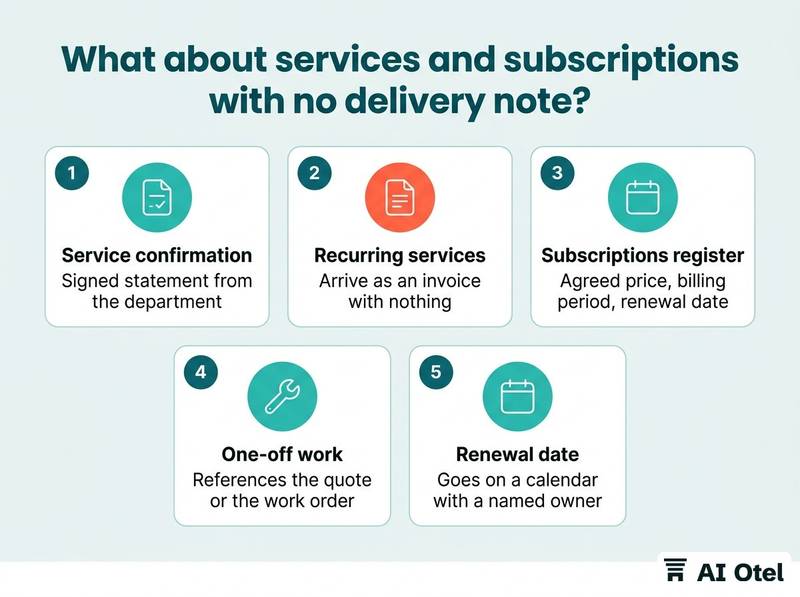
Recurring services such as maintenance contracts, software subscriptions, laundry or pest control arrive as an invoice with nothing at the door. The confirmation stands in for the signature. It names the person in the department who can confirm the work, not the accountant. The accountant cannot know whether the boiler was serviced.
For subscriptions, keep a register: what the service is, the agreed price, the billing period, the renewal date and who owns it. A register stops two departments buying the same thing twice. Check the billing period against the register. An invoice for a period already paid, or for a service that was cancelled, is caught by the register and missed by the invoice alone.
For one-off work, the confirmation references the quote or the work order, so the price comparison has something to stand on. Anything with a renewal date goes on a calendar with a named owner. A silent renewal is the subscription version of a short delivery.
How do you review exceptions every month?
Read the exception log as a whole once a month, rather than one invoice at a time, and turn the patterns into changes to suppliers, price lists or the receiving routine.
Count exceptions by supplier and by reason. One supplier with repeated price differences and one storeroom with repeated quantity differences are two problems with two different fixes. Age the open exceptions: anything open beyond the period the hotel itself set goes to the general manager, not back into the pile.
Compare the number of exceptions against the number of purchase orders raised, so the review shows whether the control is running or whether orders are being written after delivery. Take three questions to the meeting: which supplier caused the most exceptions, which item, and who signed the delivery. The answers point at the fix.
Feed the result back into the written rule. A tolerance that is never reached may be too wide; one reached every week may be too narrow, or the price list is stale. Keep the review to one page. A review that needs a report nobody reads is not a control.
What to do next
Write the tolerance rule and the match slip this week, run them on the next ten invoices, and read the exceptions at the end of the month. The three documents only work as a set: the order sets the promise, the delivery note proves the fact, the invoice is the claim, and payment is the hotel's decision between them.
Frequently asked questions
Who should sign the delivery note in a hotel?
The person who physically receives the goods, at the door, with a name and a time. Not the purchasing manager who placed the order, and not the accountant who never saw the boxes. For food and beverage, the same signature should sit next to the temperature and date checks, because those are part of what was received.
Can the same person order, receive and approve payment?
In a small hotel it often happens, and the honest answer is that it weakens the check. Where staff allow, split the three roles. Where they do not, the compensating control is the owner reading the match slips and the exception log every month, which turns a silent process into a visible one.
What if the supplier refuses to issue a corrected invoice?
Hold the disputed line, keep the written exchange, and escalate to the general manager rather than to the payment run. Treat it as a supplier-terms conversation: the hotel pays what it can evidence and says plainly what it cannot. Nothing is gained by paying a figure the hotel cannot support with its own papers.
Does a three-way match apply to small purchases like a market run?
Use a simplified version. Below a threshold the hotel sets itself, a receipt and a signed petty cash slip replace the order and delivery note, and one person signs. The principle is unchanged: the hotel pays against evidence of what it received, and the paperwork shrinks with the amount.
What is the difference between a two-way and a three-way match?
A two-way match compares the invoice with the order only, so it proves the price but not the receipt. A three-way match adds the delivery note and proves that the goods arrived. Goods suit a three-way match; services with no delivery usually run as a two-way match plus a signed service confirmation.