The agency visit report: one page after each sales call and what the office does with it
A hotel agency sales visit report turns a conversation into a dated promise. Learn the seven blocks to record and the weekly routine that makes those promises actionable work for your office.
AI draft · awaiting editorial review

Contents
Key takeaways
- A visit without a written report is a visit the office cannot act on: the facts stay with the person who went.
- One page is a discipline, not a limitation: it forces the writer to name the promise, the date and the owner.
- Rates and quotas belong in the report as discussed, never as agreed, until a contract or a confirmed booking exists.
- The weekly meeting is where reports become work: promises are read aloud, owners are confirmed and dates are checked against the calendar.
- A visit earns its place when it can be traced to production later, and the report is the first line of that trace.
A hotel agency sales visit report is a one-page record written the same day as a sales call with a travel agency or tour operator: who was met, what they asked, which rates and quotas were discussed, what each side promised, the next date and the person who owns it. The office reads the reports together weekly.
The sales manager comes back from three days on the road with a notebook, a stack of business cards and a clear memory of one conversation. Two weeks later, nobody in the office can say what the agency asked for, what was promised, or who was going to send the contract. This article gives you the form that prevents it: seven blocks on one page, written the same day, and the weekly routine that turns those pages into work with names and dates on it.
Why do sales visits disappear without a report?
Because the only copy of the visit lives in the salesperson's memory, and memory is not something the office can act on.
A visit produces three things that decay at different speeds: the facts, the relationship and the promise. The facts are who was met, when and what was said. The relationship is how warm the account is. The promise is a date someone, on either side, is waiting for. The facts decay fastest, usually within a week, and the facts are what the office needs first.
Without a shared record, the agency's next email waits until the salesperson is back at a desk. A rate question that takes ten minutes to answer takes four days, and the agency spends those four days talking to another hotel. A promise made aloud on a visit becomes a commitment the hotel never priced: a free night, a late release, a rate held for a month. Nobody in the office knows it exists until the agency calls to use it.
The account belongs to the hotel, not to the person who visits it. When the salesperson changes territory or leaves, an unwritten account leaves with them, and the next person starts from zero. The report is not written for the manager. It is written for the next person who speaks to that agency, who may sit in another city or another department.
The test is simple: could a colleague answer the agency's next email from what is on file, without calling the salesperson? If not, the visit has not been recorded, only taken. If the vocabulary of accounts, production and leads is new to your team, start with the words a sales office uses for accounts, production and leads.
What goes on the one-page agency visit report?
Seven blocks in a fixed order: who was met, what they asked for, which rates and quotas were discussed, what we promised, what they promised, the next date, and the owner.
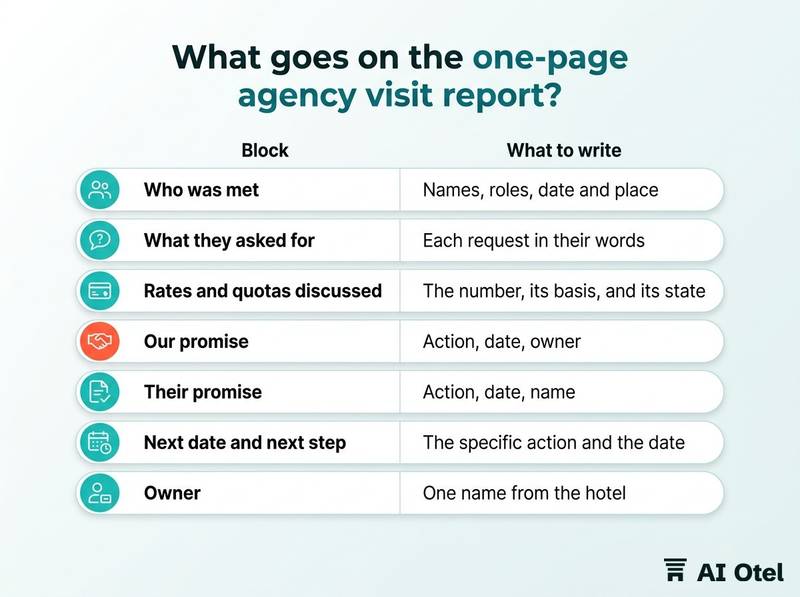
The header comes first: date, place or call, the hotel's attendees and the agency's attendees with their roles. A buyer, a product manager and a reservations supervisor hear the same conversation differently, so a name without a role is half a record. Write requests in the agency's own words, one line each, marked as a request. Your reading of why they asked belongs in the free-text line at the end, not inside the request itself, because later readers need to know what was actually said.
Rates and quotas need their basis: per room per night or per person, which board type, which season and room type, and whether the number is net or commissionable. Promises go in two separate blocks, ours and theirs, each with an action, a date and a name. The next step is a specific action, for example "send the 2027 contract", never "follow up". A short free-text line records what the writer noticed: who decides, what the agency is worried about, what its season looks like.
| Block | What to write | What to leave out |
|---|---|---|
| Who was met | Names, roles, date and place | Job titles without a name, "the team" |
| What they asked for | Each request in their words, marked as a request | Your interpretation of why they asked |
| Rates and quotas discussed | The number, its basis, and its state: discussed, offered or agreed | A number without its basis |
| Our promise | Action, date, owner, and whether it is subject to approval | "Will follow up" |
| Their promise | Action, date, name | "They seemed interested" |
| Next date and next step | The specific action and the date it happens | "Next season" |
| Owner | One name from the hotel | Two names or a department |
One page is a discipline, not a limitation. If the report does not fit on it, the writer is summarizing the meeting instead of recording the commitments, and the commitments are what the office needs. If the visit was a site inspection rather than a desk meeting, the same form carries the extra detail; see showing rooms to agency buyers on a site inspection for what to record around the walk itself.
How do you write a promise so both sides know what they owe?
Write it as an action, a date and a name, in words the other side would recognize, and mark whether the hotel has approved it.
Three parts make a promise usable: what will happen, by when, and who does it. "We will send the 2027 contract by 12 March, [name]" can be checked two weeks later. "Will follow up" cannot be checked by anyone, including the person who wrote it. Write the promise in words the agency would recognize as their agreement, because the report may be the only shared record of what was said in the room.
Separate our promises from theirs. A report with only our side is a wish list; the agency's promises are what the hotel is waiting for, and they need the same three parts. Record the promise as made, not as approved. If a rate or a quota needs the revenue manager's signature, the report says "subject to approval" and gives the date the answer is due.
Anything that binds money or inventory goes to the person who owns that decision the same day, not at the end of the month. When the hotel cannot give what was asked, record the refusal and the alternative offered. The next visit then starts from that line instead of repeating the request from the beginning.
Watch outA promise in writing binds the hotel
A promise written in a report is a promise the hotel will be held to. If the rate, the quota or the free night was not approved before the visit, write "subject to approval" and the date the answer is due.
Never write a promise the hotel has not authorized. The office acts on the report, and the agency will hold the hotel to what it says. The limits of what a salesperson may offer in the first place belong in the yearly plan; see the yearly agency plan that sets what a salesperson may offer.
Where do rates and quotas go when nothing was agreed?
They go in the report as discussed, with the number, its basis and the person who decides, and they are never marked agreed until a contract or a confirmed booking exists.
Keep three states apart. Discussed means a number was said in the room. Offered means the hotel put it in writing. Agreed means a contract is signed or a booking is confirmed. The report records the first, sometimes the second, and never the third without a document behind it. A number without a basis is unusable later: per room per night or per person, which board type, which season, which room type, net or commissionable. A "90" written alone answers none of these questions.
For quotas, record what the agency asked for and what the hotel offered, and name the arrangement in the hotel's own words: whether rooms are held for the agency, booked from live availability, or confirmed by hand one by one. These are industry practices rather than regulated terms, so the hotel's own definition is the one that counts, and the report should use it consistently. Note the release terms discussed and who confirms them, because a held room that is never released is inventory the hotel cannot sell.
Record what the agency said about other hotels' offers as their claim, not as a fact about the market. A buyer saying "we get this for less elsewhere" is information about the negotiation, not a verified price. The report points to the contract and the rate sheet; it does not replace them.
Key pointDiscussed is not agreed
A number in a report records a conversation; a contract or a confirmed booking records a commitment.
How does the office read the reports in a weekly meeting?
It reads them for commitments, not for stories: every promise gets an owner and a date, and the meeting ends with an action list rather than a summary of the week.
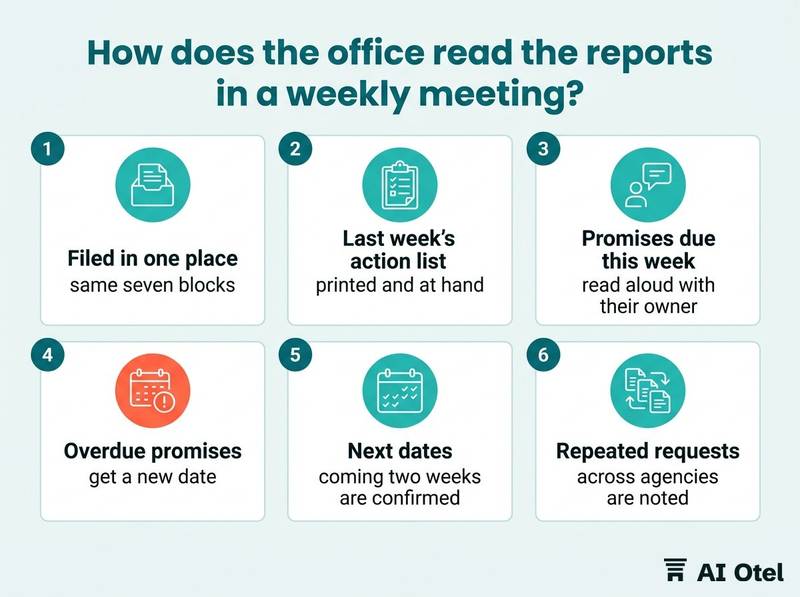
Reports are filed the same day, in one place, in the same seven blocks, so they can be read side by side. The meeting reads them in a fixed order: promises due this week, promises overdue, next dates falling in the next two weeks, then anything new about the account. One person reads the promise and its date aloud; the owner says whether it is done; if it is not, a new date is set in the room, not after it.
Keep the account review separate from the visit review. The weekly meeting checks commitments; it does not re-plan the year, and it does not re-argue strategy. Listen for patterns across reports: the same request from three agencies, a rate question nobody can answer, the same promise made twice with different dates. Patterns are the market speaking, and they are only visible when the reports sit in one format.
Checklist
- Every report from the week is filed in one place, in the same seven blocks
- Last week's action list is printed and at hand
- Promises due this week are read aloud with their owner
- Overdue promises get a new date before the item closes
- Next dates in the coming two weeks are confirmed
- Repeated requests across agencies are noted
One action list survives the meeting, each line with a name and a date. The reports are the source; the list is the work. Reports are not rewritten afterwards: corrections are added as a new line, so the file shows both what was believed and what turned out to be true. If the weekly meeting itself is new to your department, the structure around it is described in the weekly routine of a hotel sales department.
How do you connect a visit to production later?
By filing every report under the account rather than the trip, so the visit, the contract and the first booking can be read as one line.
The account is the unit, not the visit. Reports stack under the agency or tour operator in date order, and the history becomes one file. The first question after a promise date passes is whether the promised action happened. The second is whether a booking followed. Do not read cause from a single booking: read the account across a season and compare what was promised with what arrived. An agency that asked for a large quota and produced two rooms in July is telling you something the report alone cannot.
Close the loop. When the first booking comes, note it against the report that recorded the promise. At the end of the season the file shows which promises were kept and which were not, on both sides, and next year's negotiation starts from evidence instead of impressions.
Fairs, workshops and roadshows
Fairs and workshops use the same form with a different header: event, stand or session, day. Write one report per day, not one per trip. At a workshop or roadshow, record who presented and what the audience asked, because the questions are the market's questions in its own words, and they repeat across events.
TipWrite the fair report at the end of each day
By the third day, the first day's conversations have merged into one. The report written that evening is the only accurate copy.
What to do next
Before the next visit, write the seven blocks once and use that form on the next call, then bring every report to the same weekly meeting. The pieces fit together in one order: the report turns a conversation into a dated promise, the meeting turns promises into work with names, and the account file turns that work into a record of what the agency actually produced.
If you want the reports, the rate sheets and the bookings to live in one system rather than in folders, a hotel operating system keeps reservations, billing and reporting in one place (built and working, ahead of launch), and a B2B distribution hub is the environment where contracted rates and agency relationships are meant to be managed over time (built, with seed data; no agency is connected yet).
Frequently asked questions
How long should an agency visit report be?
One page, seven blocks. If it runs over, cut description first and keep the promises, their dates and their owners. A page of commitments is worth more to the office than three pages of narrative, because the office acts on commitments, not on atmosphere.
Should the salesperson write the report during the visit or after?
Take notes during the visit for names, numbers and dates, and write the full report the same day while the wording is still fresh. A report written a week later records impressions rather than commitments, and the dates in it are guesses. The same-day rule is what keeps the hotel agency sales visit report usable as a record rather than a memoir.
What if the agency asks for something the hotel cannot offer?
Record the request as it was asked, the answer given, the alternative offered and who decides. Do not leave a refusal out because it feels like a failure: the next visit starts from that line, and the office needs to know what the agency wanted even when the answer was no.
Who should read the visit report?
The sales office in the weekly meeting, the person who owns the rate or quota decision, and the manager only where something is exceptional or needs a decision above the salesperson's authority. It is a working document, not a broadcast, and widening the circulation does not make it more useful.