The annual review for the hotel owner: twelve months on four pages
The annual owner review is four pages: results against budget, the year's decisions, the building's condition, and next year's plan. It covers judgment, not only numbers.
AI draft · awaiting editorial review

Contents
Key takeaways
- The annual owner review is four pages: results against budget, the year's decisions and what followed, the state of the building and the repair list, and next year's plan with the questions the owner must answer.
- The monthly report tells the owner what happened; the annual review tells the owner what the hotel learned and what it now needs.
- Every material decision belongs in the review with what was expected before the result was known, including the decisions that failed and the ones that were never taken.
- A renewal reserve that was approved but not funded in cash is not a reserve; the property page shows the cash held, not the intention.
- Fix the template, the definitions and the page order, and restate the prior year when a definition changes: four comparable pages beat one perfect report.
A hotel annual review for the owner is a four-page document written once a year: results against the approved budget in plain words, the year's material decisions and what followed, the building's condition with its repair list and renewal reserve, and next year's plan with the decisions the owner must make. It covers judgment, not only numbers.
The season closes, the accounts are reconciled, and the owner asks the question the monthly reports never answered: what did we decide this year, and what did it cost us? Most hotels reply with a spreadsheet of occupancy and a slide of guest reviews, and the question stays open until the next budget meeting. This article gives you the structure of a hotel annual review owner report that answers it: four pages, a fixed order, and a discipline you can repeat every year.
What goes into a hotel annual review for the owner?
Four pages, in a fixed order: results against budget, the year's decisions and what followed, the building with its repair list and renewal reserve, and next year's plan with the open questions. Each page answers a different owner question, and each is written to be read on its own.
Page 1 is a comparison, page 2 is a record, page 3 is an inventory of needs, page 4 is a set of choices. Mixing them is what turns an annual review into a long monthly report. The document carries a date, the period it covers, the currency and the name of the person who wrote it; an undated review cannot be compared with next year's.
Anything that does not fit the four questions goes to a numbered appendix, referenced from the page that needs it, so the four pages stay readable in one sitting. Four pages is a discipline, not a format: it forces the writer to decide what the owner must know and what the owner can look up.
The review is read before the meeting, not presented in it. The meeting is spent on page 2 and page 4, because those are the pages that need a decision. The owner receives a management document with a signature on it, not a deck assembled by whoever had time in December.
| Page | The question it answers | What must not appear on it |
|---|---|---|
| Results against budget | Did we do what we said, and if not, why? | Daily charts, forecasts, totals with no explanation |
| Decisions and what followed | What did we decide, and what happened? | Only the decisions that worked |
| The building and the repair list | What does the property need, and is the money there? | A repair list without costs, owners or dates |
| Next year's plan and open questions | What are we doing next, and what must the owner decide? | A full budget, or a plan with no owner named for each move |
How do you write results against budget in plain words?
Three columns (approved budget, actual, difference) and one written sentence for each material difference saying what happened, why, and whether it repeats. The page compares like with like and refuses to hide a cause inside a total.
Use the approved budget's own lines, in its own order, so the comparison needs no translation table. If the budget was revised mid-year, show the approved version and the revision side by side. State the basis once at the top: accrual or cash, before or after the management fee, before or after the renewal reserve, and in which currency. A number without its basis cannot be compared with anything.
Show house profit next to revenue. Revenue can rise while the profit the owner keeps falls, and page 1 exists to show which of the two happened. Name external movements separately: an exchange-rate move, a shift in demand from one source market, a new competitor nearby. They are neither the team's success nor its failure, and folding them into one variance hides both.
Classify each material variance as timing (it will appear next year), permanent (the level has changed), or one-off (it will not repeat). This classification is the only part of page 1 that changes next year's budget. Cap the page at about eight lines and put the rest in an appendix with a total, so the page still reconciles to the accounts. For the monthly version of this discipline, see reading the monthly variance between budget and actual.
ChecklistChecklist for page 1
- The lines match the approved budget and its order
- The basis is stated once at the top
- House profit appears next to revenue
- External movements are named on their own line
- Every material variance is marked timing, permanent or one-off
- The page has no more than about eight lines and reconciles to the appendix total
- Each material variance has one written sentence
How do you record the year's decisions and what followed?
One row per material decision: the date, the question, the options considered, what was decided, what was expected, what happened, and what it cost. The page includes the decisions that failed and the ones that were never taken.
Write the expectation before the result is known, or at least date it. A log written at year end rewards hindsight and teaches the reader nothing. Include the decisions that were not taken and the ones that were reversed: a deferred renovation and a rate change withdrawn in week three are decisions with consequences and a cost.
Separate the manager's decisions from the owner's decisions, so next year's conversation starts from the right place and nobody defends a choice they did not make. Carry last year's rows forward and mark each one done, partly done, dropped or still open; the first block of the log is last year's plan, checked. Keep it to roughly six to ten rows. A log of forty decisions is a diary, and nobody reads a diary twice.
The log is the input to next year's budget and one of the first things a serious buyer asks to see, because it shows how the hotel makes choices. Where a decision touched pricing or channel mix, the end-of-season revenue review supplies the evidence, and the end-of-season revenue review of decisions that worked is the companion document; the annual log records what was decided and what it cost.
| Date | Decision | What we expected | What happened | Cost | Status next year |
|---|---|---|---|---|---|
| For example, March | Shortened a group block's release period | Fewer empty rooms after the release date | Fewer empties, two groups rebooked elsewhere | Net gain, small | Done |
| For example, November | Closed the à la carte restaurant on weekdays in low season | Lower food cost, no loss of room revenue | Food cost fell; some guests dined out | Saved, moderate | Partly done |
| For example, May | Held the weekend rate in a shoulder month instead of discounting | Small drop in occupancy, higher room profit | Occupancy fell, room profit held | None | Still open |
What belongs on the property page: the building, the repair list and the renewal reserve?
The condition of the building by area, a repair list sorted by consequence with costs and owners, and the renewal reserve shown as cash held rather than money intended. This is the page that decides whether next year's plan is affordable.
Condition by area, each with a date and a photograph: rooms, bathrooms, public areas, kitchen, plant and machinery, façade and grounds, and the systems the hotel runs on. The repair list is sorted by consequence: life safety first, then guest-facing failures, then cosmetic. Each item carries a cost range, an urgency and the person who owns it.
Deferred maintenance is shown as a total and as a history: what was postponed, in which year, and what postponing it has cost since. Capital projects are shown completed against the amount approved for each, with the overrun or underspend named rather than absorbed. Equipment age and warranty expiry for the large items mean a replacement appears in a plan years before it appears as an emergency. Compliance items carry their dates and the person responsible; confirm your own obligations and calendar with your accountant or legal adviser.
Watch out
A reserve that was approved but not funded in cash is not a reserve. The property page shows the cash held for renewal, the contributions made and the spending, not the intention to set money aside. If the cash was used for something else during the year, the page says so, says how much, and says when it will be restored.
Three numbers for the renewal reserve: what was contributed, what was spent, and what cash is actually held. The third number is the one that matters. For the mechanics behind it, see how a hotel sets aside money for renewal.
When should the annual review be ready, and who writes it?
For a seasonal hotel, after the season closes and after the year-end figures are drafted, and before next year's budget is approved. The general manager writes it, hotel finance reconciles the figures, and the owner reads it before the meeting.
That window is short, so the date goes into the calendar a year ahead, next to the date the budget is due to be approved. Produce two versions with the same page order: a draft on the year-end figures as drafted, and a final once the accounts are settled. The differences between the two are listed, not silently absorbed.
Finance supplies and reconciles the numbers and signs the figures; the general manager signs the narrative. Two signatures, two responsibilities. The owner reads the document in advance and brings questions, not corrections: a review rewritten in the meeting has no comparable version next year. For a year-round hotel, tie the review to the fiscal year and the audit rather than to a season, and keep the same four pages. If the review slips, the budget slips with it, because page 4 is the budget's input and not its summary.
Tip
Book the review date at the same meeting where the budget date is booked. When the two dates are set together, the review cannot quietly arrive after the budget has already been agreed, which is the usual way a good document becomes decoration.
How do you keep the four pages comparable year to year?
Fix the template, the definitions and the page order, and restate the prior year whenever a definition changes. Comparability is what turns four pages into a record an owner, a lender or a buyer can read across years.
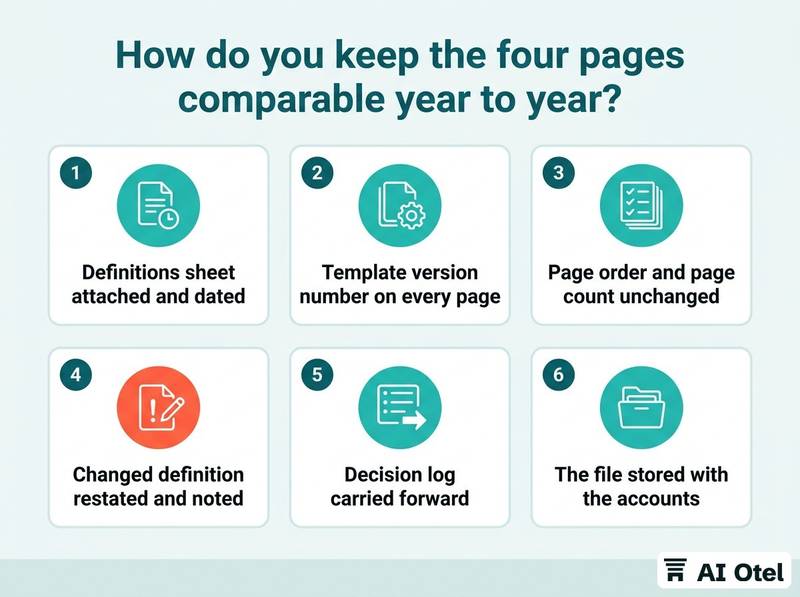
A one-page definitions sheet travels with the template: what house profit means here, which fee line is deducted, how the reserve is treated, which currency, and which exchange rate is used for any conversion. Version and date the template. When a line is added or a definition changes, the prior year is restated on the new basis and the restatement is noted on the page.
Keep the page order and the page count fixed. A new question gets an appendix, not a fifth page, until the next template version. When the management company, the accounting basis or the fiscal calendar changes, split the year at the change and present both periods under the same definitions. Keep each year's file with its decision log, so next year's review can check last year's rows without hunting through mail. A stack of five comparable four-page reviews is worth more than one perfect report, because it is the record a buyer, a lender or an incoming manager will actually read.
ChecklistChecklist for the template file
- Definitions sheet attached and dated
- Template version number on every page
- Period, currency and basis stated on page 1
- Page order and page count unchanged from last year
- Any changed definition restated for the prior year and noted
- The prior year's decision log carried forward with a status on every row
- The file stored with the year's accounts in one place
What should stay out of the annual review?
Anything the owner cannot act on, anything that is not comparable with last year, and anything that is a forecast dressed as a result. The monthly report already carries the operating detail; the annual review should not repeat it.
Daily occupancy charts, pace curves and raw operating data belong to the monthly report, where they can still change a decision. Guest review screenshots without a trend, a cause and an action are decoration: if reviews matter, page 2 carries the decision they led to and page 1 carries its cost. For the operating layer, what to ask your hotel operator for in the monthly owner's report is the companion piece.
Leave out forecasts presented as results, and next year's numbers mixed into this year's page. Leave out staff matters by name, and anything a lawyer would treat as a personnel record. Leave out facts that lead to no decision, no cost and no date; a paragraph the reader will skip costs the writer credibility on the pages that matter. And leave out the everything-is-fine summary. If the year was good, page 1 says so with numbers; the review does not need a page to say it.
What to do next
Before the season closes, open last year's four pages, copy the template, and put the review date in the calendar next to the budget date. The pages work as a set: page 1 says what happened, page 2 says what was learned, page 3 says what the building needs, and page 4 turns all three into the decisions the owner must make before the next budget is approved.
Frequently asked questions
How long should a hotel annual owner review be?
Four pages plus numbered appendices. The length is a discipline rather than a target: if a page grows past what can be read in one sitting before the meeting, the extra moves to an appendix and the page keeps a total that reconciles. A review nobody finishes is not read at all.
Who writes the annual review, the general manager or the owner's finance team?
The general manager writes and signs the narrative, because the decisions described are management's. Hotel finance reconciles the figures, states the basis and signs the numbers. The owner's side may add a short comment page, but does not rewrite the manager's pages, or the document loses its comparable version for next year.
Should the annual review include next year's budget?
No. It includes the shape of next year's plan: three or four moves, each with an owner, a cost, a measure and a date, plus the list of decisions the owner must make. The budget is built after the plan is agreed, and the review is its input rather than its summary.
What if the hotel changed management company during the year?
Split the year at the handover date and present both periods under the same definitions, with the split noted on page 1. Keep one continuous decision log and mark which rows the new team inherited. Page 3 becomes the handover's condition survey and should be agreed by both sides while both are still in the building.
Should the review include decisions that failed?
Yes. A log that contains only successes cannot be used to set next year's budget and cannot answer a buyer's questions. The failed decision is written with what was expected, what happened and what it cost, and that lesson is the asset the review produces.