The first ninety days of selling a new hotel: listings, agencies, direct and what to measure
A new hotel launch sales plan follows a fixed order: direct booking first, then two booking sites and three agencies. Track five weekly numbers to measure channel stability and avoid rate conflicts.
AI draft · awaiting editorial review

Contents
Key takeaways
- Direct booking goes live before any booking site, because it is the only channel where the hotel sets the price, keeps the guest record and can test a rate without asking anyone.
- Two booking sites and three agencies are enough for the first ninety days; each channel needs its own content, its own rate plan and a named person who answers it.
- Every agency agreement should state in writing whether rooms are held for the agency or sold freely, how many days before arrival held rooms return to the hotel, and who confirms a request.
- Five numbers read on the same day each week, room nights by channel, pickup since last week, achieved rate, direct share and inquiry response time, tell a new hotel more than a monthly report.
- A channel is added when the current ones have been stable for two consecutive weeks, not when the hotel is impatient.
A new hotel launch sales plan is a fixed order of work: finish the facts, photographs and rates, open direct booking first, add two booking sites, then three agencies and one corporate account, and read the same five numbers every week. A channel is added only when the previous one is stable.
A new hotel has no history, no reviews and no repeat guests, and every channel asks for the same things at the same time. The temptation is to open all of them in the first week; the cost arrives three weeks later as rates that disagree and requests nobody answers. This article gives you the order of work, the documents to write before the first listing, and the weekly page that turns ninety days into a decision.
What should a new hotel sell in its first ninety days?
Sell in a fixed order: the property's own facts and rates, then its own website, then two booking sites, then three agencies and one corporate account, with a weekly review running from the first week.
Week 0 is content, not selling: room types, capacity, what each board type includes in plain words, cancellation and payment terms, taxes and fees, photographs of every room category, a map pin and a phone number someone answers. Weeks 1 and 2 belong to direct booking: the hotel's own website takes a reservation at the same rate the front desk quotes, and the guest receives a confirmation. Weeks 3 to 6 add two booking sites chosen by the source markets the hotel actually expects, then three travel agencies, two local and one in a source market. In the same weeks, pick one corporate target, for example a company, a hospital, a factory or a tour operator's office, and give it a written rate letter and a site visit. Weeks 7 to 12 are for reviews, corrections and the first decision about adding a channel, not for opening more channels.
The order matters because every channel is a promise about the same physical room. A hotel can only keep promises it can see in one place. Decide before week 1 how many rooms the hotel is willing to sell while it is still finishing its service, and keep that number until the operation is steady; the question of how many rooms to open at all is covered in the soft opening: how many rooms to open and when.
| Weeks | Work | Done when |
|---|---|---|
| Week 0 | Facts, photographs, rates, terms, a named person per channel | A stranger can decide without calling |
| Weeks 1-2 | Direct booking live on the hotel's own site | A test booking reaches the front desk and the guest gets a confirmation |
| Weeks 3-6 | Two booking sites, three agencies, one corporate target | Each has a named contact on both sides and a written rate |
| Weeks 7-12 | Reviews, corrections, first channel decision | Five weekly pages exist and agree with each other |
What has to be ready before the first listing goes live?
Everything a stranger needs in order to decide without calling: what the rooms are, what they cost, what is included, what happens if plans change, and who answers the phone.
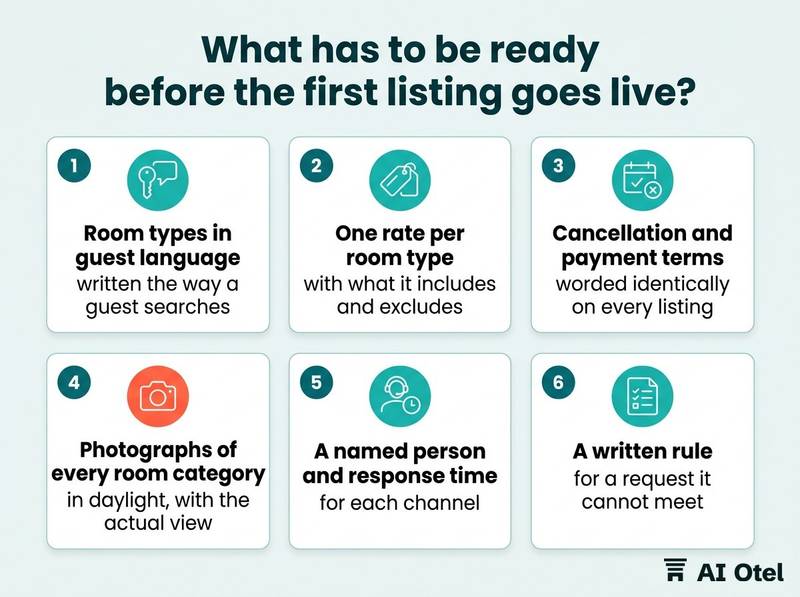
Room types should be written the way a guest searches, not the way the building is numbered. If two rooms differ only by floor, they are one room type online. One rate per room type per date, with what it includes and what it excludes stated in the same line: breakfast, taxes, fees, parking. Cancellation and payment terms belong in one sentence each, worded identically on the hotel's own site and on every listing, because a guest will compare them.
Photographs of every room category in daylight, with the actual view, plus a note about stairs, lifts and accessibility. In Türkiye, every stay involves a payment, a fiscal document (an invoice or e-document), a guest identity notification (KBS) and personal data (KVKK); the front desk must be able to explain each of these at check-in. Finally, a named person and a stated response time for each channel, so a request has an owner before the first request arrives, and the hotel's own written rule for a request it cannot meet, agreed with the owner in advance, so the answer does not depend on who is on shift.
ChecklistBefore the first listing goes live
- Room types in guest language
- One rate per room type per date, with inclusions
- Cancellation and payment terms identical everywhere
- Photographs of every room category, plus the view
- Address, map pin and an answered phone number
- The four things every stay involves, explained at the desk
- A named person and response time per channel
- A written rule for a request the hotel cannot meet
For the booking-site part of this work in more detail, see listing a hotel on booking sites: what to prepare before you go live.
Should the hotel's own website go live before the booking sites?
Yes. Direct booking is the only channel where the hotel sets the price, keeps the guest's contact and can change a rate without asking anyone, so it becomes the reference every other channel is checked against.
Direct booking means a booking engine on the hotel's own domain: the guest chooses dates, sees a rate per room type and pays the hotel, and the hotel keeps the record. It is also the test bench. A rate change made here shows within minutes whether the website, the front desk and the confirmation email agree.
Three things are enough at launch: live availability, a rate per room type, and a confirmation the guest receives by email. A beautiful page that cannot take a booking is worse than a plain one that can. Keep the direct price at least equal to what the booking sites show, so the guest has no reason to leave the site to book; how much lower it should be is a decision for the owner with the accountant. The guest list built from direct bookings is the only list the hotel can write to before next season without asking a channel for permission. Do not wait for the full website: publish the booking page, then improve the rest of the site while it is already taking reservations.
How many booking sites and agencies should a new hotel open at once?
Two booking sites and three agencies are enough for the first ninety days. Each channel needs its own content, its own rate plan and a person who answers it, and a new hotel has none of those spare.
Choose the two booking sites by the source markets the hotel expects, not by size alone; a large site with no demand from your markets is a content project with no return. Choose three agencies, two local and one in a source market, each with a named contact on both sides and a written rate. Write down which channel owns which market, so the sales manager is not quietly competing with the hotel's own agency on the same account.
A hotel with no reviews converts poorly everywhere, so the first ninety days are about collecting the first reviews and the first repeat inquiries, not about reach. Keep one inventory behind all of the channels: what is sold on the website must disappear from the booking sites at the same moment, or the front desk will spend the season fixing overlaps. If the hotel's own system is built so that one room inventory feeds the hotel's website, the booking sites and the agencies at once, that single source is the whole point; the same idea is behind the distribution layer described here.
Watch outOpening every channel in week one
The failure modes are four: rates that disagree between channels, the same room sold twice, requests that wait a day for an answer, and no way to tell which channel produced which booking. A channel is opened only when the previous one has a named owner, complete content and a rate that matches everywhere.
For a longer discussion of channel order, see selling a small hotel online: which channels to open first.
What should an agency agreement say in the first season?
It should say in plain words whether rooms are held for the agency or sold freely, how many days before arrival held rooms come back to the hotel, who confirms a request, and what the price includes.
Allotment means rooms are held for the agency to sell; free sale means the agency sells from the hotel's live availability. Both are industry practice, and the hotel should pick one per agency rather than a mixture nobody can explain. The release period is the number of days before arrival at which unsold held rooms return to the hotel: write it in the contract and enter it in the system as a rule, not as a habit of the reservations clerk. On request means the agency asks and the hotel answers; without a stated answer time the request dies quietly, so put the time in the contract and measure it.
On price, the hotel quotes a net rate and the agency adds its own margin, but the hotel should still know the final price the guest sees, because that is the price it will be compared against. Describe board types in words, what breakfast, dinner and drinks are included, rather than relying on a label that different agencies read differently. Payment terms and who carries the risk of a no-show belong in the contract; settle them with the accountant before the first booking, not after the first dispute. Keep one page per agency where the front desk can find it, with the contact, the rate, the release period and the answer time. How those first-season rates should be set at all is covered in pricing a new hotel with no history.
| Term | Plain meaning | What to write down |
|---|---|---|
| Allotment | Rooms held for the agency to sell | How many rooms, for which dates |
| Free sale | The agency sells from live availability | That no rooms are held |
| Release period | Days before arrival when unsold held rooms return | The exact number, and who checks it |
| On request | The agency asks, the hotel answers | The answer time and who answers |
| Net rate | The price before the agency's margin | Rate, inclusions, validity dates |
| No-show | A guest who never arrives | Who carries the cost, by when it is reported |
What should a new hotel measure every week?
Five numbers, read on the same day each week: room nights sold by channel, rooms picked up since last week, the average rate actually achieved, direct share of room nights, and how long an inquiry waited for an answer.
Room nights by channel is the only way to know which channel earns its place; a channel that produces requests but no room nights is a content problem, not a demand problem. Pickup compares rooms sold for a given date with the same date a week earlier, so the hotel sees demand moving before the month closes. Achieved rate is total room revenue divided by room nights sold, after every discount, not the published rate on the website. Direct share is direct room nights divided by all room nights; it tells the hotel whether its own website is doing any work. Response time runs from the moment an inquiry arrives to the first reply: a request answered the next day is usually a request lost, and it is the one number the hotel fully controls.
| Number | Where it comes from | A reading that needs action |
|---|---|---|
| Room nights by channel | The reservations system, grouped by source | One channel produces requests but no room nights |
| Pickup | This week's rooms sold for a date, minus last week's | Pickup flat or negative inside the usual booking window |
| Achieved rate | Room revenue divided by room nights | Achieved rate falling while occupancy holds |
| Direct share | Direct room nights divided by all room nights | Direct share falling as total room nights rise |
| Response time | Timestamp of the inquiry and of the first reply | Any inquiry answered after the stated time |
Keep one page per week with the date on it. Twelve pages show a trend that a monthly report hides, and they are the evidence for the first channel decision. A reservations and reporting system that groups these numbers by source, such as a hotel operating system with built-in reports, built and working, ahead of launch, saves the front desk from assembling them by hand.
When should a new hotel add the next channel?
Add a channel when the current ones have been stable for two consecutive weeks: content complete, rates agreeing everywhere, and every inquiry answered inside the hotel's own stated time.
Stability is a test with three conditions, all of them observable on the weekly page, not a feeling that the hotel is ready for more. Name the person who will own the new channel before it opens; a channel without a named owner is a channel that will be ignored within a month. Open one channel at a time and give it a full month before judging it, because a channel judged in its first week is judged on noise.
Stability does not mean busy. A quiet week with agreeing rates and answered requests is stable; a busy week with a double sale and three unanswered requests is not. Reviews are part of the channel: a booking-site profile with unanswered reviews is not stable, however many rooms it sold. When the hotel does add a channel, repeat the week-0 checklist for it, content, rate, terms, a named person and a response time.
Key pointThe three-condition test
Content complete on every open channel; rates and availability agreeing across all of them; every inquiry answered inside the hotel's own stated time, for two consecutive weeks. All three, or the next channel waits.
What to do next
Write two documents this week: the week-0 checklist with a name beside every line, and a one-page weekly sheet with the five numbers and a date. Every other decision in this article, which booking sites to open, which agencies to sign, when to add a channel, is made with those two documents in front of you, and nothing else needs to be decided before them.
Frequently asked questions
How long before opening should a new hotel start selling?
Content and rates must be finished before the soft opening, because a listing cannot be built from photographs taken later. Direct booking should be live as soon as the first rooms are sellable, and booking-site content takes time to prepare and review, so start it early. The ninety days in this new hotel launch sales plan begin with the first room sold, not with the grand opening.
Do we need a channel manager from day one?
A channel manager is software that keeps availability and rates the same across the hotel's website and every booking site, so a room sold in one place disappears from the others. With a website and two booking sites, the risk of selling the same room twice is real, so one source of inventory matters from the first day. Whether that is a separate tool or part of the hotel's own system is the hotel's choice; what cannot wait is the single inventory.
Should we discount to get the first bookings?
A discount is a decision with a reason and an end date, written down before it starts. Give the reason, for example a soft opening, a new restaurant or a source market the hotel wants to enter, and the date it stops. A first-season rate should still be defensible when a guest compares it with the hotel next door, because the discount that wins the first booking also sets the price the hotel is remembered for.
How many reviews should a new hotel expect in its first ninety days?
The count depends on how many guests stay, so no target is honest before the hotel knows its own volume. What the hotel controls is the habit: ask every departing guest, in person at check-out, and reply to every review within a stated time. A small number of answered reviews builds more trust than a large number of unanswered ones.
Who inside the hotel should own the channel work?
One named person, with a deputy for days off. The front desk answers requests and records the response time; the sales manager owns rates, content and the agency contacts. The weekly page is read by the same person every week, because a number that changes owner every week stops being compared with anything.