Answering guest questions on booking sites before the booking: speed, tone and what to refuse
Turn pre-booking questions into reservations with a same-day reply rule. Learn what to promise, what to refuse, and how to fix listing gaps that cause repeat questions.
AI draft · awaiting editorial review
Contents
Key takeaways
- A pre-booking question is a decision the traveler cannot finish alone; the reply either removes the doubt or confirms it.
- Write the rule down: every pre-booking question gets a first reply the same business day, with one named owner and a named backup.
- Answer in the first line, state the condition second, and end with one step into the booking; a reply that ends in a question keeps the traveler in the thread instead of in the booking.
- Never put in a message what the system cannot carry: a room number, a price the booking will not show, or a medical, legal or safety judgment.
- A question asked twice is a listing gap: fix the description or the photos, not only the reply.
A pre-booking question is a message a traveler sends through a booking site before reserving. Answer it the same business day, with one named owner: answer in the first line, state the condition, end with one step into the booking. Never promise a specific room, an unlisted price, or a medical or legal judgment.
A traveler is one question away from booking your hotel. The question sits in the extranet, the hotel's own login on the booking site, overnight, and by morning the traveler has decided somewhere else. The reply is a small piece of writing with a large effect, and if your hotel has no written rule for it, this article gives you one. After reading this you will have that rule, in writing, with an owner, a same-day clock, an answer bank for the ten questions that recur, and a weekly review that fixes causes rather than replies.
Why is a pre-booking question a booking in waiting?
Because the traveler has already shortlisted the hotel and is checking one detail before paying; the reply either removes the doubt or confirms it. Answering guest questions on booking sites is therefore not correspondence. It is the last step of the sale, conducted in writing, in front of future readers.
Read the question twice. The factual question, such as whether there is parking, usually carries a fit question underneath: can I arrive by car at midnight and leave it there? Answer the fact, then settle the fit in one clause. Where the platform publishes questions and answers, one reply serves every later reader, so write for the second reader, not only for the person who asked.
A slow reply has three costs. The traveler decides without you. The same question arrives again by phone or email. And the front desk answers it a third time at check-in. One unanswered message can cost three conversations.
Separate three message types before writing a word. A pre-booking question is a decision. A post-booking request is a service task. A complaint is a recovery case. Each has a different owner and a different tone, and mixing them slows all three.
Treat the reply as a written record. Anything you write can be quoted back at the desk months later, so write only what the hotel will still stand behind. And do not answer a pre-booking question with a sales pitch. The traveler is looking for a reason to say no; give them a reason to trust the answer instead.
Key pointThree message types, three owners
Pre-booking question: owned by reservations, answered same business day. Post-booking request: owned by the front desk, answered before arrival. Complaint: owned by the duty manager, acknowledged first and answered once the facts are checked.
The extranet itself is only one part of the wider relationship with booking sites; the same discipline applies across working with online travel agencies.
What is a same-day rule, and who owns it?
A same-day rule is a written commitment that every pre-booking question gets a first reply within the same business day, with one named owner and a named backup. It fits on one page, and it belongs in the same place as your other reservations procedures, next to the rules for a shared reservations mailbox.
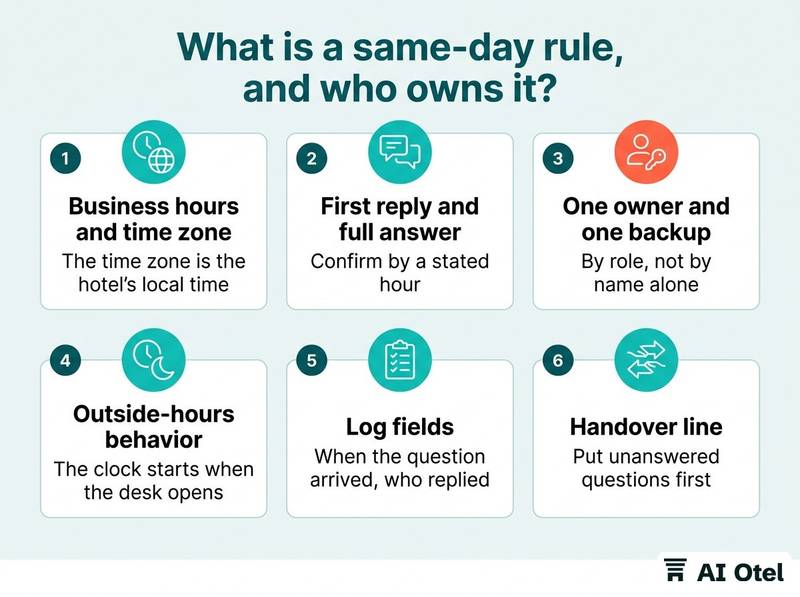
Define the clock in the rule itself. Which hours count, that the time zone is the hotel's local time, and what happens to a message that arrives at 23:40. Without that sentence the rule is a wish.
Separate the first reply from the full answer. The first reply can say that you are checking with housekeeping and will confirm by a stated hour. Silence is the failure, not a short answer. Name one owner and one backup by role, not by name alone, and put both in the rule. A shared inbox with no owner is how messages age.
Decide the outside-hours behavior. If your extranet offers an automatic acknowledgment, use it. If it does not, the clock starts when the desk opens, and the rule should say so plainly. Keep one log: when the question arrived, when the first reply went out, who replied, and what was promised. The log is what makes the weekly review possible.
Put unanswered questions first in the shift handover note, not last. A question that crosses a shift is where most of the delay is created. The rule belongs to the reservations manager, and it applies to the reservations team, not to whoever happens to be free.
ChecklistThe same-day rule, written down
- The business hours and time zone that count.
- The first-reply commitment and the hour by which a full answer follows.
- One owner and one backup, by role.
- The outside-hours behavior.
- The log fields.
- The handover line.
- Who reviews the log and when.
Which questions come up again and again, and what should the answer say?
The recurring questions are almost always about fit, access, price and policy; a short answer bank gives each one a fixed first line, the hotel's own condition and a step into the booking. Build every entry the same way: the direct answer in one sentence, the condition in one clause, the next step in one line. A reader who stops after the first line should still have the answer.
Keep the bank in one document the reservations team edits, not in individual inboxes or in one person's memory. Write for the traveler who has not read the listing, without copying the listing word for word. If the listing already answers the question, the real problem is the listing, not the reply.
Where the honest answer is no, say no in the first line and give the nearest alternative in the second. A clear no that offers an option keeps the booking alive; a vague maybe ends it. Keep the tone plain: short sentences, no exclamation marks, no sales adjectives, no stock greetings. Match the language of the question and the register of the person asking.
Anything that changes by date or room type, such as price and availability, is not a bank entry. It is a lookup in the system, quoted with the date it was checked. Review the bank whenever a policy changes. A stale answer bank is worse than no bank, because it is trusted.
| Question | What the traveler is deciding | The answer must contain | Leave out |
|---|---|---|---|
| Is parking available? | Whether to drive | Yes or no, cost, reservation need, height limit | "Plenty of space" |
| How far is the beach, center, airport? | Daily logistics | Distance, walking time, transport option | A taxi price you cannot guarantee |
| Can I check in early or leave bags? | Arrival plan | Earliest time you can commit to, where bags are stored | A guaranteed room in the morning |
| Is breakfast included, and at what time? | Rate comparison | Yes or no per rate, hours, where it is served | "A rich buffet" |
| Are children charged, is there a crib? | Total cost | Age rule, crib availability, charge | A crib for a room type that has none |
| Can I have a specific room, floor or view? | Certainty | What the category includes; request noted, not guaranteed | A room number |
| Is the pool open in my month? | Season fit | Opening dates, heating policy | A water temperature you do not measure |
| Do you accept pets? | Whether they can come | Yes or no, size limits, fee | "Pets welcome" without the limits |
| Can I cancel or change? | Risk | The rule attached to that rate, and where it is written | A promise more generous than the rate |
| Is the area quiet, suitable for a solo traveler? | Fit | Factual description: location, reception hours, lighting | A safety judgment |
What should never be promised in writing?
Never promise what the system cannot carry or the hotel cannot control: a specific room, a price that is not in the booking engine, or a medical, legal or safety judgment. The message thread is not the system of record. The booking is.
Specific rooms, floors and views: promise the category and the features the category includes, and say in the same sentence whether the request is noted or guaranteed. Those are two different words, and the guest will read them as two different promises.
Prices and discounts: a rate quoted in a message but not loaded in the system becomes either a broken promise or a manual correction at the desk. If the price is real, load it first, then quote it with the date you checked.
Medical, dietary and safety judgments: describe what the hotel provides, such as a first-aid kit at reception or a step-free entrance, and do not assess whether it is safe or suitable for a named condition. Legal and immigration statements, including visa, residence, registration and tax questions, belong to the guest's own adviser and the official source; the hotel states its own procedure, not the law.
Third-party services such as transfers, tours, doctors or babysitters: say who provides them and what the hotel does and does not control. Never write anything about another guest, another booking, or a named employee's shift.
Two final refusals. Availability is held by the system, with an expiry the system enforces, not by a sentence saying you will keep the room. And a confirmation in the thread is not a confirmation: the booking is the confirmation, and a message that reads like one creates a guest who believes they have a reservation.
Watch outThe three refusals, and the lines that replace them
A specific room: "the room type includes a balcony; the floor is noted as a request and confirmed at check-in." An unlisted price: "the rate on the page today is the rate the booking will carry." A medical or legal judgment: "here is what the hotel provides; whether it suits your situation is your decision, with your own adviser."
How do you move the guest from the question into the booking?
End every answer with one concrete next step, and keep the reservation itself in the booking system, never in the message thread. The closing line has three parts: the condition, the fact, and the step. Offer one step, not three. A reply that lists a phone number, an email address and a link splits the traveler's attention and usually produces a fourth message.
When the guest asks you to hold a room, do it in the system with an expiry the system enforces, and tell the guest that expiry time in the reply. When the answer changes price, dates or occupancy, change the system first and quote the result, so the booking and the message agree when the guest clicks.
If the guest wants to book by message or phone, follow the hotel's own routing rule so the request lands in one place with one owner, as covered in turning inquiries into reservations. Attach the question and the answer to the reservation so the front desk does not ask the same thing again at check-in. A guest who has to repeat themselves has already been failed once.
Watch the drop-off. A thread that ends with the guest's last question unanswered is a lost booking, not a finished conversation.
TipThe closing line, as a pattern with blanks
"If [dates] work for you, [room type] is available at [the rate shown on the page]. You can complete the booking here in about two minutes, and I will attach this exchange to your reservation."
How do you review unanswered questions every week?
Hold a short weekly review of three counts: questions received, questions answered the same business day, and questions still open; then fix the cause, not only the reply. Twenty minutes, same day and time each week, with reservations, the front desk and revenue in the room. The front desk hears the consequences; revenue hears the pattern.
Read the open list first. Every open question gets an owner and a deadline before the meeting ends, or it will still be open next week. A question asked twice is a listing gap: fix the description, the photo order or the policy page, as set out in the listing quality score and the photo order on booking sites.
A question answered late is a staffing or handover gap: change the rota or the handover note, not the person's goodwill. A question the team refused to answer is a policy gap: write the policy first, then write the answer, then add it to the bank. Keep the log for a quarter. One week shows incidents; a quarter shows patterns, and patterns are what you can change.
ChecklistThe weekly review, in order
- Count received, answered same day, still open.
- Assign every open question an owner and a deadline.
- Flag any question asked more than once and name the listing fix.
- Flag any late reply and name the handover or rota fix.
- Flag any refusal and name the policy to be written.
- Add new recurring questions to the answer bank.
- Confirm the next review date.
What to do next
Write the rule today, in one page: one owner, one backup, a same-business-day first reply, an answer bank with fixed first lines, and a twenty-minute weekly review. Then read your last twenty pre-booking threads against that page. The gaps will be visible within the hour, and each one is a small, cheap fix.
If you are a traveler reading this rather than a hotelier, the same logic works in reverse: a hotel that answers your question clearly, in the first line, with one next step, is showing you how it runs. You can find a hotel in Türkiye (opens in a new tab) and test that for yourself.
Frequently asked questions
How fast should a hotel answer a question on a booking site?
Same business day for the first reply, measured in the hotel's own local time and defined in writing. The first reply may be short and may promise a fuller answer by a stated hour; what fails is silence, not brevity. Name one owner and one backup so the rule survives a day off.
Can I offer a discount in a message to a guest on a booking site?
Only if the rate exists in the booking system, loaded before you quote it, so the booking carries the same number the guest was told. A discount that lives only in the message thread becomes a manual correction at the desk or a broken promise. What your agreement with the platform allows is a separate question for the hotel's own contract.
What should I do when the guest asks a question I cannot answer?
Say what you will find out, from whom, and by what time, then answer by that time. A holding reply with a deadline is a good reply; a guess is not. If the question needs a person who is not on shift, hand it over as the first item in the shift note.
Should pre-booking questions and complaints be handled by the same person?
No. A pre-booking question is a decision and belongs to reservations; a complaint is a recovery case and belongs to the duty manager. Mixing them slows the decision and puts an argument in front of the next traveler reading the thread. Acknowledge a complaint quickly, then answer once the facts are checked.
Does answering faster improve where my hotel appears on a booking site?
Whether a platform rewards reply speed is set by the platform and by the hotel's agreement with it, so the hotel should read its own contract rather than assume. What the hotel fully controls is the reply itself: the first line, the condition, the next step, and the log that shows what happened.