The internal requisition: how departments ask the storeroom for goods and how it is recorded
This guide explains how departments request goods from the storeroom and how those issues are recorded. It covers signing authority, issue windows, and weekly checks to prevent unexplained stock loss.
AI draft · awaiting editorial review
Contents
Key takeaways
- A requisition is the department's written authority to draw goods; the issue slip is the store's record of what actually left, and the two must carry the same lines and number.
- Whoever signs the requisition carries the cost, which is why the signature matters more than the quantity on the form.
- Fixed issue windows plus one written after-hours route protect the stock record better than an open store door.
- An unsigned take does not save time: stock falls, no department carries the cost, and the month-end count cannot explain the gap.
- Paper and screen both work when there is one record of truth; a screen request and a paper issue that never meet is the worst arrangement.
An internal requisition form in a hotel store is the document a department fills to draw goods from the storeroom: item, quantity, department, date and the signature of someone authorized to spend that department's budget. The storekeeper issues against it and records the same lines on an issue slip, so the cost lands on the department that asked.
It is late, the bar has run out of one bottle, and someone is at the store door asking the storekeeper to open up and settle the paperwork tomorrow. What happens in the next two minutes decides whether that bottle appears in any cost report at all. This article covers the internal requisition end to end: what the form must hold, who signs it, when the store is open for issue, how an issue reaches the department's cost, and what a weekly check catches. After reading, you can write a one-page store rule and post it at the store door.
What is an internal requisition in a hotel store?
It is the department's written instruction to the store: these goods, this quantity, for this department, on this date, signed by someone allowed to ask. The storekeeper issues against it, and the same lines become the record of what left the store.
Three documents do three different jobs, and most store disputes start with them being confused. The purchase request goes out to a supplier; the receiving form records what arrived at the door; the requisition moves goods from the store to a department. If your purchasing chain is unclear further upstream, the article on the purchase request form and quote comparison sheet covers that step.
The requisition is the department's side of the transaction; the issue slip (ambar çıkış fişi) is the store's side. Many hotels print them as one two-part, pre-numbered form so the department copy and the store copy can never disagree. Requisitions are used in number order, and a missing number is a question to answer, not a clerical detail to skip.
The storekeeper is a custodian, not an owner. Goods leave on a signed line, and the storekeeper's own count is checked against the bin card, not against memory. The cost question is settled at the store door: the department that signs is the department that pays. That is the whole reason the form exists.
If the item is not in stock, the requisition does not become a purchase. The storekeeper writes "not in stock" on it, and the department raises a purchase request through the normal route.
| Document | Direction | Who raises it | What it proves |
|---|---|---|---|
| Purchase request | Out to a supplier | Department | A need was approved and quoted |
| Receiving form | In from a supplier | Receiving clerk | What arrived, and in what condition |
| Requisition | Store to department | Department | A department asked for these goods |
| Issue slip | Store to department | Storekeeper | What actually left the store, and when |
| Return to store | Department to store | Department | Unused goods came back; cost reduced |
Who signs the requisition, and what must the form hold?
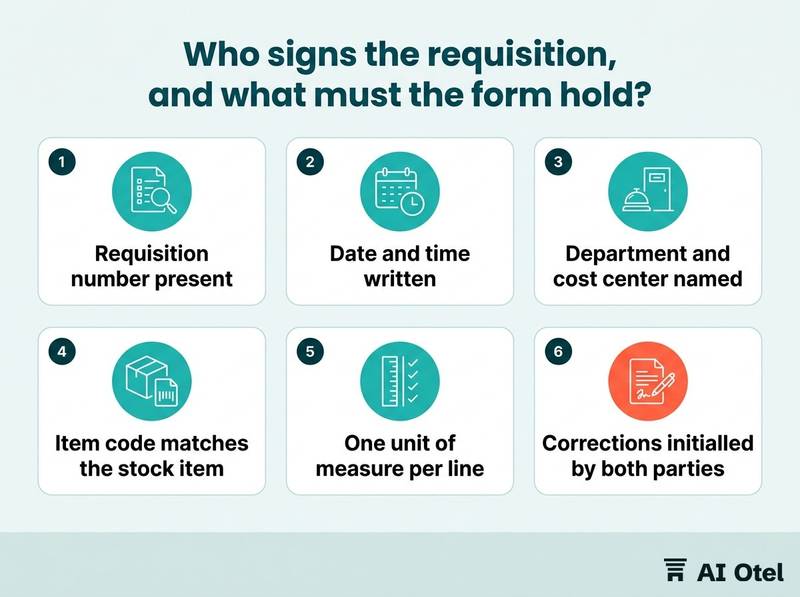
The department head, or a named deputy authorized in writing, signs as requester; the storekeeper signs as issuer; nobody signs for goods they did not personally receive.
Keep a written list of authorized signers per department, with specimen signatures, held by the storekeeper and by cost control, and update it the week someone joins or leaves. An old list is how a former employee keeps drawing stock. The storekeeper never signs as requester on a department's behalf, and never issues to the store's own use without the same form signed by whoever owns the store budget.
The form must carry: requisition number, date and time of issue, department and cost center, item code and name, unit of measure, quantity requested, quantity issued, and the signature of both the requester and the issuer. Where the hotel prices at issue, unit cost and line total sit beside the quantity. Requested and issued quantities differ often, and the difference is written on the form: a form that only shows what was asked cannot explain a shortfall later.
Unit of measure discipline matters more than it looks. The store counts kilos, the kitchen asks in cases. Keep one unit per line, with the conversion written next to it, or the stock record drifts without anyone stealing anything. Corrections are a single line through the entry, initialled by both parties; nothing is overwritten, erased or rewritten on a fresh form that keeps the old number. A form signed with the quantity column empty is an open check. Refuse it and ask for the numbers first.
ChecklistThe store-door checklist, before issuing
- Requisition number present and in sequence
- Date and time written
- Department and cost center named
- Item code matches the stock item
- One unit of measure per line
- Quantity requested and quantity issued both filled
- Unit cost and total, where the hotel prices at issue
- Requester signature on the authorized list
- Issuer signature
- Corrections initialled by both parties
- Stock balance written for high-value items
When is the store open for issue, and what happens after hours?
Set fixed issue windows and one written exception route. An open store with no hours is the most expensive door in the building, because nobody can count what leaves it.
Two windows a day is common practice, for example an early window before service preparation and a second one in the afternoon. The storekeeper needs uninterrupted time outside those windows to receive, count, post and reconcile. Requisitions arrive before the window, not during it: the department writes what it needs, the storekeeper picks and stages it, and the issue takes minutes instead of an argument.
The after-hours rule names a role, not a mood. The duty manager on shift authorizes in writing, on a night issue slip or a numbered line in the duty log, and the item, quantity and department are recorded at the moment of issue. The storekeeper posts the night issue the next morning against the same department, with the duty manager's line as the reference. The paper does not wait for a signature that may never come.
Keys are part of the rule. Decide who holds the store key out of hours and keep a log of every opening; two keyholders and no log is an invitation, not a control. Goods delivered straight to the kitchen still enter the store record when the store is meant to control cost, with the requisition raised at the same time. Otherwise the store's balance is fiction and the department's consumption is invisible.
The "I will bring the form tomorrow" habit is a common source of unexplained stock loss. Goods do not leave without a line, even a handwritten one on the night slip.
TipThe after-hours rule in three lines
1) Outside issue hours, only the duty manager on shift may authorize an issue, in writing, on the night issue slip. 2) The storekeeper or keyholder records item, quantity, department and time before the goods leave. 3) The issue is posted to the department the next working morning and the slip is filed with that day's requisitions.
How does an issue reach the department's cost?
The signed requisition is the document that moves value out of the store and into the department. Without it, stock falls and no department carries the cost, which is why the gap appears at the count and not in the reports.
Two records move together: the store's stock balance falls by the issued quantity, and the department's consumption rises by the same value. If only one of them moves, the store record and the cost report tell different stories. The wider framework for this is covered in the guide to food and beverage cost control in hotels.
Valuation is the hotel's own policy, for example first in first out or a weighted average, agreed with the accountant and applied the same way every month. Changing method mid-year makes month-to-month comparison meaningless. Posting rhythm decides usefulness: daily posting keeps the stock balance worth looking at, while a pile of slips kept for month-end means nobody knows the balance until it is too late to act on it.
The requisition number belongs on the department cost report, so a chef or housekeeping manager can trace a line back to the form, the date and the signature that approved it. Cut-off matters too: a slip dated the second of the month for goods taken on the thirtieth distorts two months at once. Date the issue when it happens.
What the storekeeper must never do: price a requisition to make a department's numbers look better, or hold a slip back to shift cost into the next period. How issues are valued and which documents sit behind the figures is the hotel's own costing policy; agree that detail once, in writing, with the accountant, and keep it stable.
Key pointOne-line rule for the store door
No signed line, no cost owner. Every issue that leaves the store without a requisition number creates stock loss with nobody to charge it to.
What goes wrong at the store door, and what does a weekly check catch?
Store losses are often not theft. They are unsigned takes, estimated quantities and the same need requested twice, and a short weekly check finds them before the month-end count does.
Unsigned takes are the first pattern: goods leave on a promise, the stock record is short, no department carries the cost, and the count cannot say why. Round numbers are the second: ten kilos, twenty bottles, fifty napkins. Round figures usually mean the department estimated instead of counting, and the store absorbs the difference. Double requests are the third: one line to purchasing for an item that is already in the store, and one requisition for the same need raised by two departments for a single job.
Other patterns worth catching early: goods issued for a guest request and never charged to the guest's bill, which turns a cost into a gift without anyone deciding to give it; borrowed items between departments with no paper; and event or banquet issues with no event reference, so the function's cost cannot be closed. If the receiving side of your chain is also weak, the article on the food receiving form and what it must record closes that gap.
The weekly check compares issues per department against that department's activity, such as covers served, rooms occupied or events held. The direction of the movement matters more than a precise ratio. It also reads the paperwork: the same item appearing in small quantities several times a week, issues to a department that has no use for the item, returns to store, gaps in the requisition number sequence, and a spot count of a few high-value items against the bin card.
ChecklistThe weekly store check, one hour at most
- Pull every requisition from the week; confirm two signatures and a number in sequence
- List issues per department and compare with that week's activity
- Flag every round-number line for a question
- Look for the same item requested by more than one department for the same job
- Check returns to store are recorded and the department cost reduced
- Spot count five high-value items against the bin card
- Note any night issue slips and confirm they were posted the next morning
Paper form or screen?
Either works if there is one record of truth. The hybrid, a screen request and a paper issue that never meet, is the worst of both.
Paper does some things well: it survives a power cut, the signature is in ink, and the form is visible on the department wall. Its weakness is that the stock balance is only as fresh as the last posting, and the same lines get keyed twice. A screen does the opposite: the requester sees the balance and the unit of measure at the moment of asking, approval can come from a phone, the issue posts itself to the department, and the system records who did what and when, which is what a signature is for. If you are weighing software, the article on hotel inventory software with storerooms, recipes and purchasing in one record sets out what to look for, and the hotel operating system shows how front desk, billing and reports sit in one place.
Whatever the medium, check the same five things in any system: an item master with units and conversions, issue and approval per department, a reversal that leaves a trace instead of deleting, the requisition number on the cost report, and the ability to issue against an event or a guest. Write the rule down either way: one document, two signatures, one number, one place where the balance lives.
Migration is where hotels lose control. Running paper and screen in parallel for months produces two balances and no trust. Pick a cutover date, close the paper book, and count the store on that day.
| What matters | Paper requisition | Screen requisition |
|---|---|---|
| Stock balance | As fresh as the last posting | Live at the moment of asking |
| Signature | Ink, on the form | Recorded user, time, approval step |
| Posting to department cost | Keyed by hand, often later | Posted by the same action |
| Power or network failure | Still works | Needs a written fallback |
| Audit trail | The filed form | The system log plus the form where used |
| Training needed | Minutes | A session per department |
Write the store rule this week
Write the one-page store rule this week: the issue windows, the named signers per department, the fields on the form, and the single after-hours route. Post it at the store door, then reconcile the first week of requisitions against each department's activity. The requisition is the smallest document in the purchasing chain and the only one that decides who pays.
Frequently asked questions
Can a department take goods from the store without a signed requisition?
Not in a controlled store. If the item is genuinely needed outside hours, the duty manager authorizes in writing on a night issue slip or in the duty log, the goods are recorded before they leave, and the issue is posted to the department the next working morning. The exception exists so the record survives, not so the signature can be skipped.
How should a return of unused goods to the store be recorded?
With a return document that mirrors the requisition: same item, same unit, quantity returned, department, date and two signatures. The store balance rises and the department's cost falls by the same value. A return written on the back of the original requisition is acceptable only if both copies are updated and the number stays the same.
How do you stop departments from requesting more than they need?
Show the stock balance at the moment of asking, compare each department's issues with its own activity every week, and question round numbers. Give the storekeeper the authority to ask what a quantity is for, and make the answer part of the record. Over-requesting usually stops when the department's own cost report is read by the department head.
Does the requisition need to show the price?
It needs to show it wherever the hotel prices stock at the moment of issue, because that is when the department's cost is fixed. Where pricing happens later in the system, the requisition carries quantity and unit only, and the cost report carries the value. Either way, the requisition number must appear on the cost report so the line can be traced back.