Purchasing terms for hotel teams: purchase order, goods received note, par stock, lead time and more
Clarify the difference between requisitions and purchase orders, and define goods received notes, par stock and lead time. This glossary helps hotel teams align documents, control stock and verify invoices.
AI draft · awaiting editorial review
Contents
Key takeaways
- A requisition asks; a purchase order commits. Only the second one binds the hotel to a price and a quantity.
- A delivery note is the supplier's claim about what it sent; a goods received note is the hotel's record of what it actually accepted.
- Par stock is a target, the reorder point is a trigger and safety stock is a buffer; using one word for all three hides the decision.
- Lead time runs from the decision to order to usable stock on the shelf, so the hotel's own approval step counts as much as the supplier's delivery.
- An invoice is paid only when the purchase order and the goods received note agree with it.
A purchase order is the hotel's written commitment to buy a stated quantity at a stated price; a requisition is the internal request that comes before it and commits nothing. A goods received note records what the hotel actually accepted. Par stock, reorder point and lead time decide when the next order goes out.
A department head says the item is ordered. Purchasing says the order went out on Tuesday. The storekeeper says it is in stock. Three people, three meanings, and then an invoice arrives for something nobody can trace. Most of these disputes are not dishonesty; they are vocabulary. This hotel purchasing terms glossary fixes the words, in Turkish and English, so that the paper, the screen and the contract all say the same thing.
What is the difference between a purchase requisition and a purchase order?
A requisition is an internal request that commits nothing. A purchase order is the hotel's written commitment to buy a stated quantity at a stated price, and it is the document that binds the hotel.
The requisition carries the department's need: item, quantity, department or cost center, needed-by date, a short reason and a suggested supplier. It creates no obligation to anyone outside the hotel. The purchase order carries the commitment: order number, item code, quantity and unit, unit price and currency, delivery date and place, payment term, and the name of the person who approved it.
The order number is the thread that holds the paper together. It should appear on the delivery note, on the goods received note and on the invoice, otherwise the three documents cannot be matched later. Approval limits belong in the hotel's own written procedure: who may raise a requisition, who may approve up to what value, who approves above it, and which purchases are exempt. A system can only enforce a rule that has been written down.
The usual failure is a phone call: a department head orders directly, the supplier delivers, and purchasing first hears about it when the invoice arrives. The fix is a rule that no delivery is accepted without an order number, plus one named emergency route that is recorded the same day. If the hotel allows verbal orders, write them up as orders before the goods arrive, with the approver's name and the agreed price. A verbal order that is never written is a price the hotel cannot prove.
Keep the requisition and the order as two separate records, not one form with two headings. When a buyer changes a quantity or a supplier, the difference between what was asked for and what was bought should still be visible. For the forms themselves, see the purchase request form and quote comparison sheet.
| Question | Requisition | Purchase order |
|---|---|---|
| Who raises it | Department head or supervisor | Purchasing office |
| What it holds | Item, quantity, department, needed-by date, reason | Item code, quantity, unit, price, currency, delivery date and place, payment term, approver |
| What it commits | Nothing | A price and a quantity |
| What happens next | Compared with quotes, then approved or rejected | Sent to the supplier, then matched to the goods received note and the invoice |
| Who may change it | The person who raised it, before approval | Purchasing, with a recorded reason and a new version |
What is a goods received note, and what happens to rejected goods?
A goods received note records what the hotel actually accepted at the door: quantity, condition and any difference from the order. The delivery note records only what the supplier says it sent.
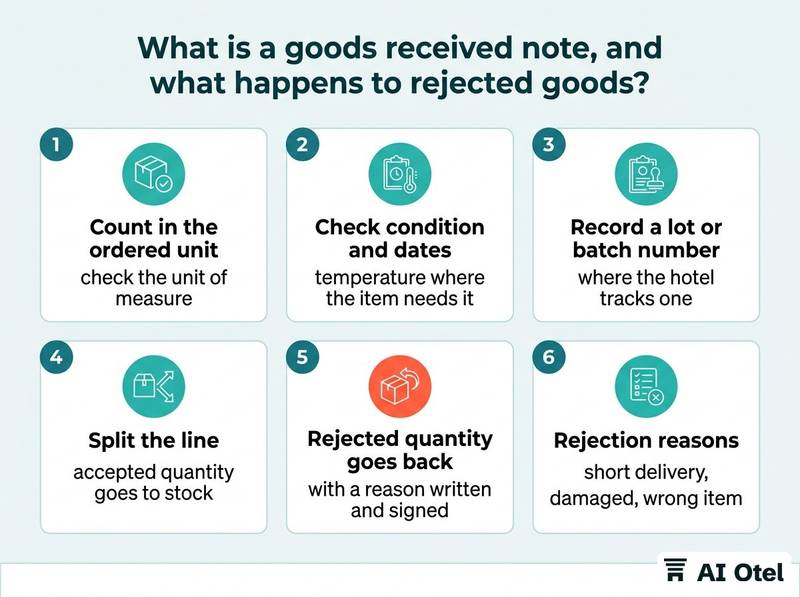
The delivery note (irsaliye) is the supplier's document and the goods received note (mal kabul fişi) is the hotel's. They are not the same paper, and a hotel that files only the delivery note has no record of its own. Receiving checks the order, not the driver's word: count in the ordered unit, check the unit of measure (case against piece), check condition and dates, check temperature where the item needs it, and record a lot or batch number where the hotel tracks one.
Partial acceptance is normal. Split the line: the accepted quantity goes to stock, the rejected quantity goes back with a reason written on the goods received note and signed by the driver. Use a short fixed list of rejection reasons (short delivery, damaged, wrong item, expired or short-dated, temperature out of range). The same words every time make the reasons countable later, which is how a hotel decides whether to keep a supplier.
The goods received note is what updates stock. If it is written on paper and keyed in three days later, the store shows stock it does not have, the kitchen orders again, and the same item arrives twice. Never let the driver leave without a signed copy showing the rejected quantity. That signature is the hotel's evidence when the invoice arrives for the full amount. Receiving is also where the order number is checked: a delivery with no matching order is held, not shelved, until someone in purchasing confirms it.
ChecklistAt the door
- The order number is on the delivery note
- Count or weigh, never estimate
- Count in the ordered unit and check the unit of measure
- Check dates, condition and packaging
- Record temperature where the item requires it
- Write accepted and rejected quantities as separate lines
- Get the driver's signature on the rejected line
- Send the goods received note to stock the same day
For perishables, the food receiving form for hotels extends this with temperature, dates and lot numbers.
What do par stock, reorder point and safety stock mean?
Par stock is the level the hotel wants to hold, the reorder point is the level that triggers an order, and safety stock is the part of the par that covers a late or short delivery. They are three different numbers.
Par is set per item and per outlet from real usage and available storage space, not from habit or from the size of the last delivery. The reorder point is usage during the lead time plus safety stock. Order when stock reaches it and the delivery should land just as stock falls to the safety level. Safety stock covers variability: a delivery that arrives late, a banquet added at short notice, a supplier who short-ships. It is a cost the hotel chooses to carry, so it should be a decision, not a leftover.
The supplier's minimum order quantity can push an order above the reorder point. When that happens, either the par goes up to match the order size or the item is bought less often, and both are deliberate choices. The stock count closes the loop: counted quantity against system quantity, every variance explained, and the par adjusted when usage has genuinely changed rather than when someone was careless.
Separate the roles. The person who counts should not be the only person who approves the adjustment, otherwise a count can always be made to agree with the system. Write the three levels down for each item and keep them where the storekeeper works. A par that exists only in someone's memory disappears when that person leaves. For the wider discipline, see running a hotel storeroom.
TipA worked example
For example, a hotel uses 10 cases of an item a week and the supplier delivers in two weeks, so consumption during the lead time is 20 cases. The hotel keeps one week, 10 cases, as a buffer. The reorder point is therefore 30 cases and the par is 40. The example is illustrative, not a recommendation.
What is lead time, and why does it set your par levels?
Lead time is the whole time from deciding to order to having usable stock on the shelf. It is longer than the supplier's delivery time, and the difference is usually inside the hotel.
Four parts make it up: internal approval and order issue, supplier processing and dispatch, transit, and receiving and inspection before the item can be used. The internal part is the one hotels underestimate. A requisition that waits two days for a signature adds two days that no supplier caused, and the store runs dry while the paperwork moves.
Measure lead time from your own records, order date to goods received date, per supplier and per item. A supplier's promise is a starting point, not a measurement. Some items carry volatile lead times: imported goods, seasonal items, single-source items and anything with a long production step. Those are the items that need the larger buffer or a second supplier.
Lead time also sets the order date for one-off purchases: printed material for an event, a spare part for a machine, a seasonal item that must be on the shelf before a date. When a supplier's lead time slips, the honest answers are more safety stock, a second supplier or a changed specification. Tightening the par only moves the shortage closer.
Key pointOne rule
Par is not a fixed number. It is consumption during the lead time plus a buffer the hotel has decided to pay for, reviewed whenever the lead time or the usage changes.
Which terms decide what the hotel pays?
The invoice claims an amount; the purchase order and the goods received note say whether that amount is owed. Payment needs all three to agree.
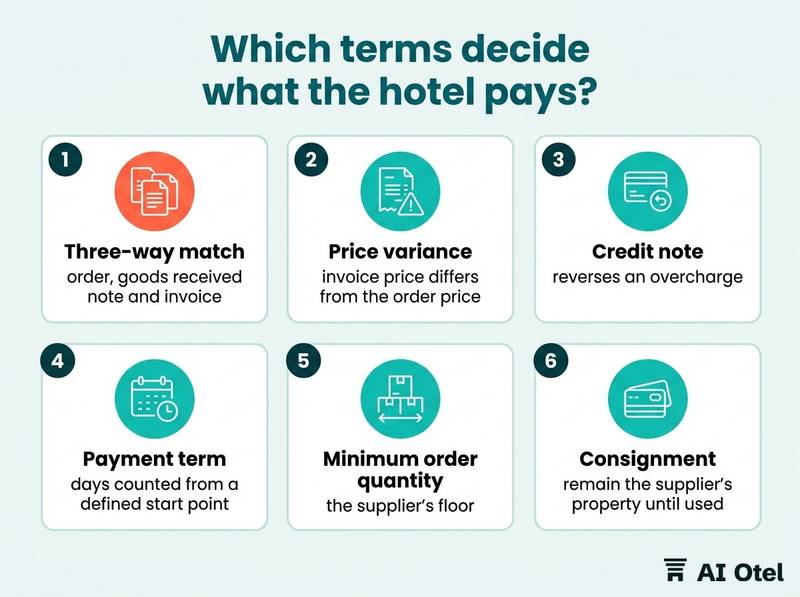
The three-way match compares order, goods received note and invoice on item, quantity and price. A mismatch is a question for the supplier, not a payment to be processed. A price variance means the invoice price differs from the order price: either the order was never updated or the supplier applied a new price, and both need a decision before the payment run.
A credit note (alacak dekontu) reverses an overcharge, a returned item or a rejected delivery, and it should reference the invoice it corrects. How an issued invoice is corrected is a question for your accountant. A payment term is a number of days counted from a defined start point, usually the invoice date or the month end. Write the start point into the contract: it is the most common source of quiet disputes.
Minimum order quantity is the supplier's floor. It changes how often the hotel orders, and therefore how much stock it holds on average, so it belongs in the par calculation, not only in the contract file. Consignment means goods sit at the hotel but remain the supplier's property until they are used; agree in writing when ownership passes, who insures the stock, how it is counted and when it is invoiced. Price validity is how long a quoted price holds. A price list without a validity date is not a price, and a supplier can revise it between the quote and the order.
For who owns these decisions, see what a hotel purchasing manager owns. If the hotel is moving this paper trail into a hotel operating system, the same terms govern the fields on screen; the platform overview shows how the hotel's systems connect.
Watch outPay only what matches
An invoice that does not match the goods received note is a question for the supplier. Paying it first and asking later turns a purchasing error into a collection problem.
The one-page glossary: Turkish and English side by side
Put the terms on one page in both languages, with one line saying what each term decides, and keep it where the purchasing office and the store can both see it.
Use one term for one concept everywhere: the written procedure, the printed forms, the system field names and the supplier contract should all say the same word. Match the glossary to the field names in the hotel's system, so that the paper form and the screen agree and staff do not learn two vocabularies. Give each term a single owner: who raises it, who approves it, who records it, who reconciles it. A term without an owner is a term people interpret.
Review the page once a year and after any system change. Terms drift when a new form or a new supplier arrives. Keep the English column even if the hotel works in Turkish: group reporting, supplier contracts and system interfaces usually use English terms, and the mismatch is where mistakes start.
| English term | Turkish term | What it decides |
|---|---|---|
| Requisition | Satın alma talebi | What the department asks for |
| Approval limit | Onay limiti | Who may commit the hotel |
| Request for quotation | Fiyat teklifi talebi | Which prices are compared |
| Purchase order | Satın alma siparişi | The commitment to buy |
| Order confirmation | Sipariş teyidi | That the supplier accepted |
| Lead time | Tedarik süresi | When the next order must go out |
| Delivery note | İrsaliye | What the supplier says it sent |
| Goods received note | Mal kabul fişi | What the hotel accepted |
| Receiving inspection | Mal kabul kontrolü | Accept or reject |
| Rejection | Kabul etmeme (ret) | What goes back and why |
| Back order | Bekleyen sipariş | What arrives later |
| Par stock | Par stok (hedef stok düzeyi) | The target level to hold |
| Reorder point | Sipariş noktası | When to order |
| Safety stock | Emniyet stoğu | The buffer for a late or short delivery |
| Minimum order quantity | Asgari sipariş miktarı | The supplier's floor |
| Stock count | Stok sayımı | What is really on the shelf |
| Issue | Ambar çıkışı | Which department consumed it |
| Invoice | Fatura | What the supplier claims |
| Credit note | Alacak dekontu | What is corrected |
| Payment term | Ödeme vadesi | When it is paid |
| Consignment | Konsinye | Who owns the goods until use |
| Price validity | Fiyat geçerlilik süresi | How long a price holds |
| Three-way match | Üçlü mutabakat | Whether the invoice is owed |
What to do next
Write the glossary this week, then test it on the next delivery: the order number on the delivery note, the goods received note signed by the driver, the invoice matched against both. The words only help when the same ones appear on the paper, on the screen and in the contract.
Frequently asked questions
Can a department head order directly from a supplier?
It depends on the hotel's own written approval rule, not on the supplier. The commitment is created by the order, so whoever is allowed to place one is spending the hotel's money. Common practice is a requisition from the department and a purchase order from purchasing, with one named emergency route recorded the same day.
What should I do when the invoice is higher than what was delivered?
Hold the invoice and compare it with the purchase order and the goods received note. If the delivery was short or partly rejected, ask the supplier for a corrected invoice or a credit note that references the original. Do not process the payment on the strength of the delivery note alone.
Is par stock the same as minimum stock?
No. Par is the level the hotel wants to hold, the reorder point is the level that triggers an order, and safety stock is the buffer inside the par. Minimum order quantity is a different thing again: it is the supplier's floor, and it can force an order larger than the hotel planned.
Who should count the stock?
The storekeeper counts and a second person checks, with purchasing or finance reviewing the variances. The person who orders should not be the only person who approves an adjustment, otherwise the count can always be made to match the system.
Do we need English terms if the hotel works in Turkish?
Keep both columns. Group reporting, supplier contracts and system field names often use English, and a team that knows only one vocabulary misreads the other. One page with the term in both languages and a line on what it decides prevents most of that.