When an AI reply comes back in the wrong language: setting a language rule for guest messages
A language rule tells an AI assistant which language to use and what to never translate. Learn to write this instruction, test it with real messages, and decide who checks each reply before it goes out.
AI draft · awaiting editorial review
Contents
Key takeaways
- A language rule is not a translation setting: it is a written instruction that names the reply language, the fallback and the phrases that must stay exactly as the hotel wrote them.
- The assistant should reply in the language the guest wrote in, even when that is not the language the hotel would have chosen.
- Names, room types as sold, prices, dates and policy sentences are fixed phrases: they are copied, never reworded, in every language.
- A language nobody on the team can read needs a shorter reply, an approved template or a handover, not more confidence in the draft.
- Every wrong-language or mixed-language reply points to a missing instruction line, so the log is where the fix happens.
A language rule is a written instruction that tells an AI assistant which language to write a guest reply in and what must never be translated. The rule: reply in the language the guest used, fall back to the hotel's working language, keep names and policy phrases fixed, and have a person check any language the team cannot read.
A guest writes in German, the draft comes back half German and half English, and the room type has been translated into something the hotel does not sell. Nothing in the system is broken; the instruction was never written. After reading this guide you will be able to write that instruction, attach a fixed phrase list, test the rule with realistic guest messages, and decide who checks each language before a reply goes out.
What goes wrong when an AI reply comes back in the wrong language?
Four failures repeat: the wrong language outright, two languages in one message, the wrong register, and names or policy phrases reworded into something the hotel never agreed to. If you want to judge whether an AI reply in the wrong language is a translation problem or an instruction problem, read these four shapes first.
The wrong language outright is the clearest case. The guest wrote in Russian and the draft is in English, because the assistant followed the interface language, or the language of the last message in the thread, rather than the guest's own words. The assistant was never told which signal to follow, so it picked one.
Mixed language is subtler and more common. The greeting and the closing arrive in the guest's language, while the middle, the part that actually answers about the room, the transfer or the bill, slips into the hotel's working language. That is where the facts live, and the assistant drifts toward the language it holds the facts in.
Register failures read as rudeness. Turkish has formal "siz" and informal "sen"; German has "Sie" and "du"; French has "vous" and "tu". A draft that mixes them reads as cold or impertinent, and the guest notices before the hotel does. Names get mangled too: a guest called Işık or Şükrü returns as Isik or Sukru, a hotel name gains or loses a letter, and the reply looks like it was written by someone who never opened the booking.
Policy sentences and numbers fail in the most expensive way. The cancellation sentence is paraphrased into a promise the hotel cannot keep, because the assistant was told to reply helpfully and not to copy a fixed sentence. And number formats drift: 1.500 TL becomes 1,500 TL or 1500 TL, 24.09.2026 becomes 09/24/2026, and a price or a deadline is now ambiguous to the reader.
The pattern behind all four: none of these is a model fault the hotel can debug. Each is a missing line in the instruction or a missing fixed phrase, which is why the fix is written, not technical. For the wider question of machine translation quality, see when AI translation is good enough for guest messages.
What is a language rule for guest messages?
A language rule is a short written instruction that fixes three things: which language the reply is written in, what happens when that is not possible, and which phrases are copied rather than translated. It lives in the same document as the assistant's other instructions, and it is short enough to read at a shift handover.
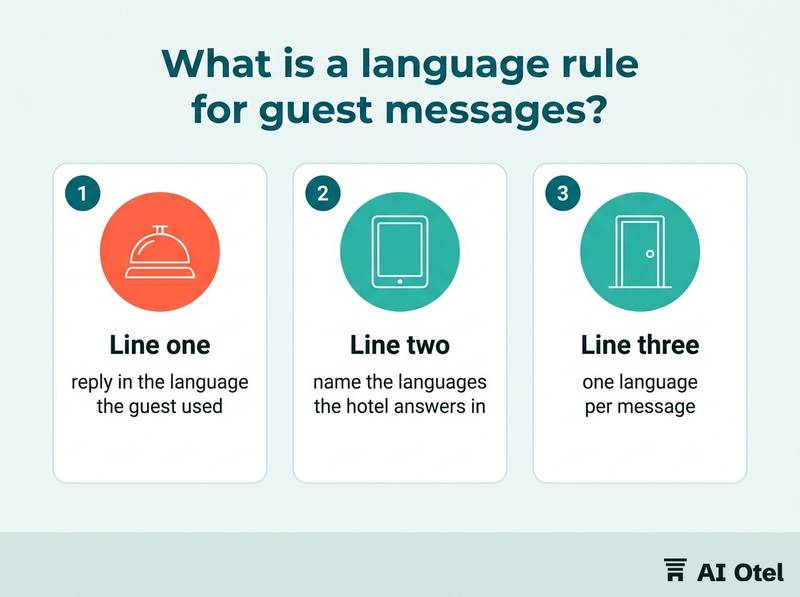
Line one is the primary rule: reply in the language the guest used in their most recent message, not the language of the booking, the channel, the interface or the last reply. Line two is the fallback: name the languages the hotel answers in, and say what happens outside that list. A colleague follows up in the hotel's working language, and the draft says so in one short sentence.
Line three is one language per message: if the guest mixed two languages, answer in the language of the question being answered and do not mirror the mix back. Line four is the fixed list: names, room types as sold, prices, dates, addresses and policy sentences come from the hotel's own list and are copied, never reworded. Line five is the handover: a complaint, a refund, a safety issue or a regulatory step makes the draft a starting point for a person, not a reply.
Key pointThe five lines of a language rule
1. Reply in the language of the guest's last message. 2. Name the languages the hotel answers in; outside that list, a named colleague follows up in the working language, and the draft says so in one sentence. 3. One language per message; never mirror a mixed message back. 4. Fixed phrases (names, room types as sold, prices, dates, addresses, policy sentences) are copied, never reworded. 5. Complaints, refunds, safety issues and regulatory steps go to a person.
The rule has to be written because the same instruction then applies to every draft, every shift and every channel, and it can be tested and corrected. An unwritten preference lives in one person's head and leaves with them. To decide which languages belong on the list in the first place, start from a language plan for your guest mix.
How do you write the rule into the assistant's instructions?
Write it as short, checkable lines in the assistant's own instructions, one decision per line, with the fixed phrase list attached and one worked example of a correct reply. The order matters as much as the content.
Put the language rule above tone and style rules. An assistant told to be warm and brief will be warm and brief in the wrong language if the language line is buried under the style lines. "Reply in the language of the guest's last message" is checkable; "communicate appropriately with international guests" is not, and a reviewer cannot fail a draft against it.
Name the exceptions instead of writing "except when necessary". List the languages the hotel answers in and state exactly what happens outside that list. Attach the copy instruction in concrete words: copy these exactly, the hotel name, room type names, the cancellation sentence, the pet sentence, the child-age sentence, the deposit sentence. Add a short do-not list drawn from failures the hotel has actually seen: do not translate guest names, do not change the format of prices or dates, do not mix two languages in one message.
Include one worked example: a two-line guest message and the correct reply. The assistant gets a shape to follow and the reviewer gets something to compare against. Keep the whole instruction short enough to read at a shift handover; a rule nobody reads is not a rule.
ChecklistYour instruction should include
- The reply language: the language of the guest's last message
- A named list of languages the hotel answers in
- The fallback sentence, and who follows up
- One language per message
- The fixed phrase list, attached to the instruction
- A do-not list drawn from real failures
- One worked example of a correct reply
- The reviewer's name, per language
For the register and proofreading side of the most common working language, a proofreading checklist for AI-drafted Turkish covers the sentence-level checks.
Which phrases should stay fixed in every language?
Anything the hotel is identified by or bound by stays fixed: its names, what it sells, what it promises and what it charges. Everything else may be phrased freely in the guest's language.
Names come first: the hotel's own name, the guest's name with its diacritics, restaurant and outlet names, the beach or spa brand. Copy them; never transliterate a guest's name into plainer letters. Room types stay as sold: the name on the contract and in the booking engine, with a plain-language gloss beside it in the guest's language if the guest needs one, not instead of it.
Policy sentences are the hotel's promises: cancellation, no-show, children's ages, pets, deposits, check-in and check-out times. Keep one approved sentence per policy per language, in one place. Money and dates follow the hotel's own format: the currency written next to the amount, and the same rounding in every draft.
Regulatory wording is fixed as the hotel's accountant and legal adviser have approved it. KBS (guest identity notification), KVKK (personal data protection), e-Fatura and e-Arşiv (electronic invoice) are named, not explained by the assistant in its own words. Confirm the wording of any regulatory sentence for your own case with your accountant or legal adviser. Addresses are not translated; a landmark may carry a gloss.
| Item | What stays fixed | What may change |
|---|---|---|
| Guest name | Spelling and diacritics, copied | Nothing |
| Hotel and outlet names | The registered name, copied | Nothing |
| Room type | The name as sold | A plain-language gloss beside it |
| Policy sentence | The approved sentence | Nothing |
| Price | Amount, currency, format | Nothing |
| Date | The hotel's date format | Nothing |
| Address | The street name as written | A landmark gloss |
| Regulatory term | The approved wording | Nothing |
The working test: if a phrase changes between two drafts in the same language, it is not fixed yet.
How do you test the rule with realistic guest messages?
Test with the messages guests actually send, not with clean sentences: mixed, short, misspelled, dictated and copied out of a translation app. A rule that passes on textbook sentences tells you nothing about Tuesday afternoon.
Build a set of ten to fifteen messages per answered language, taken from real threads with the names changed. Include the awkward shapes: a one-word message, a message with no punctuation from voice-to-text, a message in two languages, a message that is itself machine-translated, a name full of diacritics, and a message that asks two things at once. Include one complaint and one refund question per language, because a wrong draft there costs the most.
Judge each draft on three checks first: right language, one language only, fixed phrases unchanged. Then a fourth: would a person at the desk send this as it stands? Record pass or fail per message rather than a score. One failed policy sentence outweighs nine good greetings.
Re-run the set after every instruction change and every time a language is added, and keep the set in the same place as the instruction so the two move together.
| Test message shape | What it checks | Pass condition |
|---|---|---|
| One-word message | Reply language with minimal signal | Guest's language, one sentence |
| Mixed-language message | One language per message | Reply in a single language |
| Voice-to-text, no punctuation | Comprehension and register | Plain, correct reply |
| Machine-translated guest message | Fixed phrases survive | Names and prices unchanged |
| Name with diacritics | Copying, not transliterating | Name identical |
| Complaint | Handover line | Draft flagged for a person |
| Refund question | Policy sentence | Approved sentence, copied |
Who checks a reply before it is sent, language by language?
Someone who reads the language must see the draft before it goes out, or the hotel must accept that nobody can check it and change what it sends. That second half is a real position for a hotel to be in, and pretending otherwise is the risk.
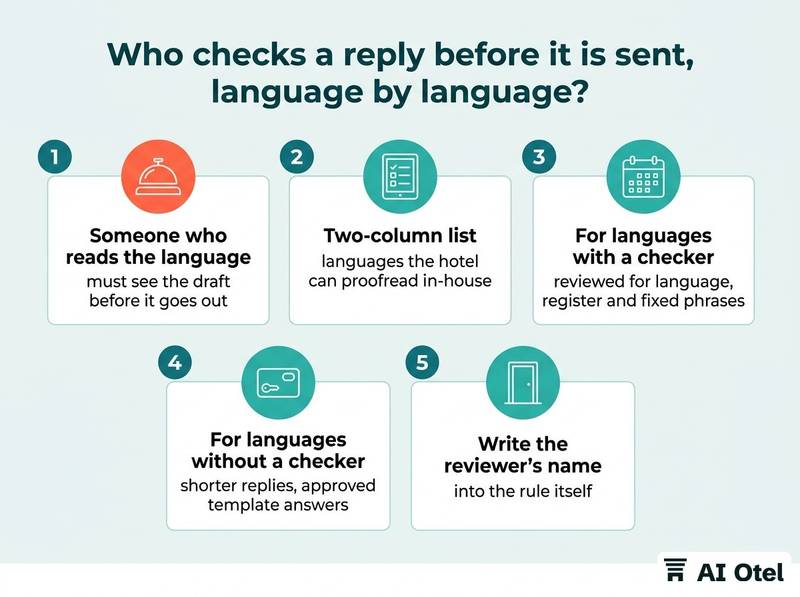
Make a two-column list: languages the hotel can proofread in-house, and languages it cannot. The second column decides the policy, not the first. For languages with a checker, the draft is reviewed for language, register and fixed phrases, the reviewer signs off, and the same person owns the instruction lines for that language. Register belongs in the check: Turkish formal "siz", German "Sie", French "vous". A reviewer who reads the language but not the hotel's register will pass drafts the guest finds rude.
For languages without a checker: shorter replies, approved template answers for the common questions, and a handover for anything that is not routine. A long, fluent-looking draft nobody can read is the risk, not the short one. Decide who is on call outside office hours and what happens when they are not there. A queued draft with a promised reply time beats a fast wrong one. For the boundary between routine and handover, see when to hand over an AI-drafted reply to staff.
Write the reviewer's name into the rule itself, not into a chat message. When that person leaves, the rule must still say who checks.
NoteThe two-column list
The left column, languages the hotel can proofread, keeps full drafted replies. The right column, languages it cannot, gets approved templates, short replies and handover until a reader exists.
How do you log misses, fix the instruction, and know when to stop?
Every wrong-language, mixed or reworded reply is evidence of a missing or unclear instruction line: log it, change one line, re-test, and stop the language where the same error survives the fix. The log is the whole method; without it you are guessing at causes.
Log five fields: date, language, what went wrong (wrong language, mixed, register, name, policy, number format), the instruction line changed, and the re-test date. Change one line at a time; two changes at once and nobody can tell which one fixed the problem. Review the log weekly with the people who send the messages, not only with the person who wrote the instruction.
ChecklistStop criteria for a language
- The same fixed-phrase or policy error appears twice after a correction
- A guest says they did not understand
- A draft touching money cannot be read by anyone on the team
- A draft touching safety cannot be read by anyone on the team
- A draft touching a regulatory step cannot be read by anyone on the team
- No reader exists on the team for that language
Stopping is not permanent. A new reviewer or a set of approved template answers reopens the language, and the log shows what has to pass first. Keep the stopped languages written next to the rule, so a new colleague does not quietly switch them back on.
What to do next
Write the five lines this week, attach the fixed phrase list, and run the test set in the one language your team reads best before adding a second. The rule, the fixed list and the test set are three short documents, and together they turn a wrong-language reply from a habit into a correction.
The PMS assistant from AI Otel, built and working ahead of launch, answers questions about a hotel's own property in plain language, carries out routine actions, and waits for a person to confirm anything sensitive. The hotel operating system it belongs to is built in Turkish, English, Arabic, Russian and German (June 2026); for any other language, the rule and the reviewer are the hotel's own to write. You can read more about the platform's approach, or request a briefing.
Frequently asked questions
Should an AI assistant reply in English when the guest wrote in broken English?
Mirror the language the guest used and simplify inside it: shorter sentences, one question per message, no idioms. Switching language upward makes the guest feel corrected. If the guest asks for another language, switch and note it in the thread so the next draft follows.
What should the assistant do when a guest writes in two languages in one message?
Answer in the language of the question being answered, and keep the reply in one language only. If the guest repeats the question in a single language, that language wins. Log the message as a test case, because mixed messages are the shape that breaks the rule most often.
Do we need a native speaker for every language we answer in?
Not for routine questions covered by approved template answers. Anything beyond routine, and anything about money, safety or a regulatory step, needs a reader before it is sent. Where no reader exists, shorten the reply or hand it over.
Is it better to translate a Turkish reply or to write directly in the guest's language?
The hotel's rule should not depend on which mechanism is used. What matters is that names and policy sentences stay fixed, that the reply is in one language, and that a reader checks it. A translated reply tends to carry Turkish sentence shapes and the formal register across with it, so it needs the same review as a drafted one.
How do we know the language rule is working?
Three signals from the log: fewer wrong-language and mixed-language drafts, fixed phrases identical across two drafts in the same language, and reviewers passing drafts without rewriting them. A rising rewrite count means the instruction, not the reviewer, needs the change.