Window and facade cleaning at a hotel: choosing a contractor, a schedule and a safe work day
Plan facade cleaning by surface, not by building. Learn to choose contractors on method and insurance, build a yearly calendar around season and weather, and manage the work day to protect the guest experience.
AI draft · awaiting editorial review
Contents
Key takeaways
- Clean by surface, not by building: lobby glass, restaurant glazing, guest room windows, balcony glass and cladding each have their own dirt source, frequency and access method.
- The calendar is set by season opening and closing, pollen, salt air, nearby construction dust and wind, not by one fixed date on the wall.
- Choose the contractor on the method statement, the access plan, the insurance documents and a site walk, before any price is compared.
- The work day is a guest-experience problem as much as a cleaning problem: close the drop zone, sell the rooms below last, tell guests in advance and name the person who can stop the job.
- Sign off in daylight against the agreed surface list, with photographs and a closed snag list, before the invoice is approved.
Facade cleaning is the scheduled washing of a hotel's exterior glass, cladding and canopies, usually by an outside contractor using rope access, water-fed poles or scaffolding. Plan it surface by surface, book it around season and weather, choose the contractor on method and insurance rather than price alone, and run the work day around guests.
At ten in the morning the lobby glass is backlit by the sun and every fingerprint shows. By eleven a contractor's ropes are hanging past the third-floor balconies, and the terrace underneath is still set for lunch. Hotel facade and window cleaning fails in that gap between the cleaning plan and the guest day. After reading this you will have a surface list with intervals, a yearly calendar, a contractor checklist, a work-day plan and a sign-off walk you can run this season.
What needs cleaning at a hotel, and how often?
Start with a surface list, not a single frequency. Each glass and facade element has its own dirt source, its own access method and its own acceptable interval.
Lobby and entrance glass is the most visible surface in the building and is touched all day. The inside belongs to the hotel team daily; the outside belongs to a short weekly cycle in season. Restaurant and bar glazing collects a grease film from the kitchen and handprints from the terrace side, so the inside is a daily task and the outside follows the lobby cycle.
Guest room windows are judged from the inside, at eye level, in daylight. The inside is part of the departure clean; the outside belongs to the facade contract. Balcony glass and railings take salt, dust and pollen, and guests lean on them, so a coastal hotel needs a shorter interval than a city hotel for the same surface. Cladding, canopies, entrance soffits and signage are not glass but sit in the same contract: bird droppings, dust streaks and exhaust film build up where nobody looks until a guest photographs it.
Draw the line between what the hotel team can reach safely and what needs a ladder, a pole or a rope. That line decides what goes into the contract and what stays in the housekeeping task list. Coated, tinted and low-emissivity glass reacts to the wrong tool: a scouring pad or a dirty squeegee channel leaves a mark that no second wash removes.
| Surface | Typical dirt source | Who cleans | Starting interval | Method note |
|---|---|---|---|---|
| Lobby and entrance glass | Handprints, dust | Team inside, contractor outside | Inside daily, outside weekly in season | Squeegee, clean channel |
| Restaurant and bar glazing | Kitchen grease, terrace handprints | Team inside, contractor outside | Inside daily, outside weekly | Degreaser on film |
| Guest room window, inside | Fingerprints, condensation marks | Housekeeping | Every departure clean | Microfiber, plain water |
| Guest room window, outside | Dust, rain streaks, pollen | Contractor | Pre-season and post-season | Rope or pole |
| Balcony glass and railings | Salt, pollen, sunscreen | Contractor outside, team inside | Shorter on the coast | Check coating type |
| Cladding, canopies, soffits | Bird droppings, exhaust film | Contractor | Twice a year | Low-pressure wash |
| Signage and lighting boxes | Dust, insects | Contractor | With facade pass | Power off first |
The interval column is a starting point you adjust, not a standard. Your own weather, elevation and guest traffic set the real numbers.
How do you build a yearly window and facade cleaning calendar?
Build it backwards from the season. The two fixed points are the week before the season opens and the week after it closes; everything else is fitted around pollen, salt, dust and weather.
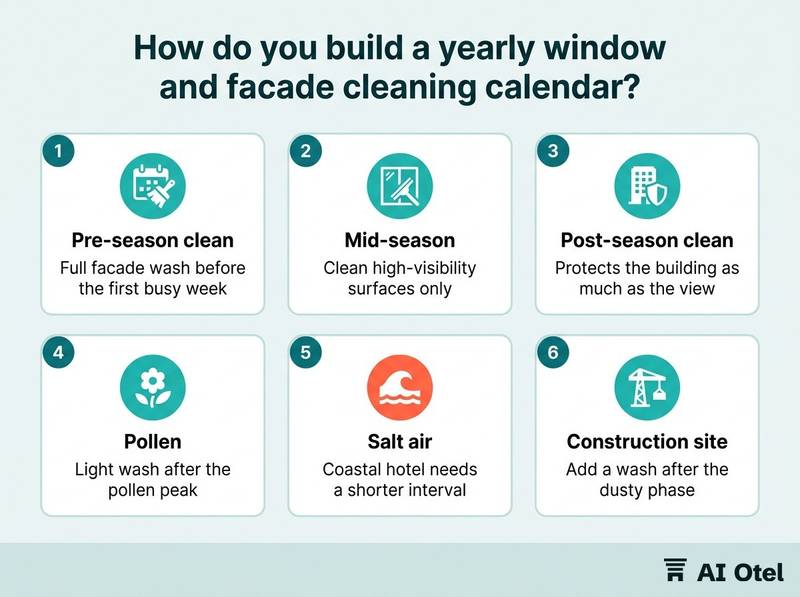
The pre-season clean is the one that matters: a full facade wash before the first busy week, because anything missed appears in every guest photograph of the view. Mid-season, clean high-visibility surfaces only, on a shorter cycle: lobby, restaurant, pool-facing glass and the elevation guests see from the terrace. The post-season clean protects the building as much as the view, since dirt holds moisture against frames and sealant through the wet months.
Pollen arrives as a film that returns within days, so plan a light wash after the pollen peak, not during it, or the money is spent twice. Salt air leaves a sticky film that traps dust, which is why a coastal hotel needs a shorter interval than an inland one on the same elevation; the same logic drives the corrosion plan described in salt air and sun: a corrosion and repaint plan for balconies and units. If there is a construction site next door, ask the site or the municipality for the dusty phase of the works and add a wash after it, not before.
Write the calendar as dates plus a decision rule: if wind exceeds the contractor's own limit, the day moves to a named reserve day, not to the next free slot in three weeks. Keep the calendar and the actual dates in one file. Next year's tender is only realistic if it knows how many days the weather actually cost.
TipThree anchors and four triggers
Anchor the calendar on the week before season opening, one mid-season high-visibility pass and the week after season closing. Add a wash when one of four triggers fires: the pollen peak has passed, a nearby construction phase has ended, a special event or photo shoot is coming, or a visible film has formed on the lobby glass.
How do you choose a facade cleaning contractor?
Choose on method and evidence, not on the lowest number. Ask for the access plan, the method statement, the insurance documents and a site walk before any price is discussed.
Ask which access method they propose for each elevation and why: rope access, a water-fed pole from the ground, scaffolding or a lift. Each leaves a different footprint on guest areas and a different amount of ground to close. Ask for their written method statement and safety plan for this job and read it: who works on the rope, who stands on the ground, what the exclusion zone is, and at what wind speed they stop.
Ask for their insurance documents, check that they cover the work being done, and have your own insurer confirm the cover is adequate before the first day on site. Ask for references on buildings of similar height and access, and visit one if you can. A reference you can walk past is worth more than a folder.
Ask how they protect what sits below: planting, awnings, parked cars, terrace furniture, the pool edge and the entrance marble. Ask who supplies the water and where the run-off goes, because a full facade wash puts a large volume of water onto terraces, planting and walkways. Ask about the crew's conduct and language, because they will be visible to guests for a whole day, and about who supervises them on site. A contractor who cannot produce a method statement before the first day will not produce one after the first complaint. How the technical service department manages outside firms generally is covered in how a hotel technical service department is organized around outside firms.
ChecklistAsk the contractor to show, before the first day
- Method statement per elevation
- Access plan and anchor points
- Insurance documents
- Crew list and named site supervisor
- Exclusion zone plan
- Weather stop rule in writing
- Protection plan for terraces, planting and vehicles
- Water source and run-off plan
- Two comparable references
- A signed work order listing dates and surfaces
How do you run the work day so guests are not affected?
Treat the work day as a guest-experience operation. Decide which areas close, which rooms stay empty below the work, what guests are told and when, and who has the authority to stop the job.
Map the drop zone first: every rope line has a footprint on the ground. Close the terrace, the pool edge or the walkway beneath it and mark the boundary so a guest cannot wander in. Rooms directly below or beside the work should be sold last or the guests moved. A stranger passing the window at eight in the morning is a complaint, not a cleaning detail.
Tell guests twice: a short note at check-in and a card in the room, naming the elevation, the hours and a contact who can answer questions. Time the visible elevations after the breakfast peak and finish before the evening terrace service, so the ropes are never part of the dinner setting. Watch water: drips onto guests in the pool, wet marble at the entrance and run-off into planting are the three most common damage routes of a wash day.
Name one person on the hotel side who can stop the work for wind, heat or a guest situation, and make sure the contractor's supervisor knows that name. Set a service route and a service lift for the crew, with equipment carried covered through back-of-house and never through the lobby. A work day that runs late is usually a work day that started without a drop-zone plan. The same planning logic applies to any noisy or visible work, as described in renovating while the hotel stays open: noisy-work windows and guest messages.
Watch outThree complaint causes on a facade day
A guest at a window with no warning, water on a guest area, and a rope outside a room that nobody explained. Each has one prevention: the room list, the drop-zone plan, the guest message.
What should the hotel check before signing off the work?
Inspect in daylight, elevation by elevation, against the surface list you agreed, and sign off only after the snag list is closed.
Inspect from the guest's viewpoint, not the contractor's: from inside a room, from the terrace, from the entrance steps, at the hour the sun hits that elevation. Look for the specific failure modes: streaks and drips on frames and sills, water marks trapped inside double glazing, disturbed sealant, scratched coating, flattened planting, furniture moved or damaged.
Photograph each elevation before and after. The photographs settle the argument about what was already there before the wash. Write the snag list with a return date and inspect again before the invoice is approved. A verbal promise to come back is not a snag list.
Record what actually happened: the dates worked, the days lost to weather, the elevations reached and the ones postponed. That record is the input to next year's calendar. File the inspection with the contractor's method statement and insurance documents, so the next tender compares like with like instead of starting from memory.
ChecklistSign-off walk
- Every agreed surface checked in daylight
- Frames, sills and sealant checked
- Interior side of each room window checked
- Planting and terrace furniture checked
- Drop zone cleaned and reopened
- Photographs filed
- Snag list written with a return date
- Invoice approved only after the second walk
How do you compare facade cleaning quotes?
Compare per surface and per square meter, with access, water, protection and frequency included, never on the headline total.
Fix the unit before you ask for prices: per square meter of glass or cladding, per pane, per elevation or per visit. Then require every bidder to price the same list in the same unit. Ask what is excluded: access setup and mobilization, water, protection of terraces and planting, out-of-hours or weekend work, and a return visit for a missed elevation.
Price two products from each bidder: the full facade and the high-visibility surfaces only. The difference is the real cost of the mid-season pass. Ask what moves the price: the number of drops, the height, the days lost to wind, and any change of access method mid-job. Tie payment to completed elevations or completed visits, with the final part released after sign-off, so a missed elevation is a commercial item and not an argument. A one-off deep clean and a seasonal contract are different products; comparing them on one number hides the frequency, which is the part that decides how the building looks in August.
| What to compare | Why it changes the total | What to ask each bidder to state in writing |
|---|---|---|
| Unit of measure | Different units hide the scope | Price per square meter or per pane, same list |
| Access method and setup | Scaffolding costs more days on site | Method per elevation, setup days |
| Water supply and run-off | Hotel water or contractor tank | Source, outlet, run-off route |
| Protection of guest areas | Terrace closure has a cost | What is covered and how |
| Out-of-hours work | Weekend or night rates differ | Rate and availability |
| Visits and frequency | Frequency decides the look | Number of visits included |
| Exclusions | Missed elevations return later | Full exclusion list |
| Payment terms | Sign-off protects the hotel | Payment per completed elevation |
For the paperwork around this, a purchase request form and quote comparison sheet for hotels gives you the structure to hold these answers side by side.
What can the hotel team clean between contractor visits?
The hotel team keeps the reachable, high-visibility glass clean daily. Everything that needs a ladder, a pole above head height or a rope belongs in the contract.
Reachable interior glass is housekeeping work: lobby doors, reception screens, restaurant partitions, corridor glass and room windows from the inside. Use tools that do not damage: microfiber cloths, a squeegee with a clean channel, plain water or the cleaner the glass supplier recommends. No abrasive powder, no scouring pad, no high-pressure jet near seals.
For coated, tinted or low-emissivity glass, read the glass supplier's cleaning note before the team touches the exterior face, and keep that note with the task list. Balcony glass from the inside is guest handprints and sunscreen, and it belongs to the departure clean, not to the facade contract.
Write down what the team must never do: lean out of a window, stand on a balcony rail, put a ladder on a windy terrace, or work above a guest area. Give the daily glass round a named owner and a short checklist, or the lobby glass quietly becomes a contractor job at contractor prices. The daily side of this work fits into the wider public area cleaning plan for the lobby, corridors, lifts and stairs.
NoteOne boundary rule for the task lists
"Reachable" and "needs access" are two different jobs with two different owners. Put the boundary in writing in both the housekeeping list and the technical service list, so nobody assumes the other team has it.
What to do next
Write one page, not a project: a surface list with an interval for each item, a contractor file holding the method statement and insurance documents, and a work-day plan naming the drop zone and the person who can stop the job. Review it at season opening, and the same page becomes next year's tender and the standard your sign-off walk is measured against. If you want the calendar, the contractor file and the snag records to live in one place your team can actually use, a hotel operating system, built and working ahead of launch, keeps reservations, front desk, housekeeping, billing, reports and compliance in one place, and the wider platform covers how the pieces connect.
Frequently asked questions
Can balcony glass be cleaned while guests are in the room?
Schedule the balcony elevation for the hours the room is normally empty, and sell those rooms last on the work day. If the guest is in, ask them to step inside and close the curtain. Never let a contractor work on the outside of a balcony panel while a guest is standing on the balcony.
Is rope access cheaper than scaffolding for a hotel facade?
There is no general answer, because the comparison depends on height, the number of drops, how long the setup stays on site and how much ground area you are willing to close. Ask both prices against the same surface list in the same unit, and add the cost of the closed terrace or car park to each.
What happens if the wind picks up during facade cleaning?
The stop rule is agreed in writing before the first day: the contractor states the limit at which the crew comes down, and the hotel names the person who can call a stop. Lost days move to a reserve day written into the calendar, so the schedule does not silently slip into the high season.
Do guests need to be told before the facade is cleaned?
Treat it as guest practice rather than a formal duty: a note at check-in, a card in the affected rooms, a sign at the closed area and a contact name. Guests forgive the work; they do not forgive finding a stranger outside the window with no explanation.
Who should supply the water for a facade wash?
Agree it in the contract, because it decides both the price and the mess. Ask whether the contractor brings a tank or draws from a hotel outlet, which outlet, and where the run-off lands: terrace drains, planting beds or a guest walkway. Walk the route with the supervisor before the first day.