Renovating while the hotel stays open: noisy-work windows, guest messages and room moves
Keep selling rooms during renovation by phasing work and setting strict quiet hours. Learn how to block inventory, script guest messages, and move disturbed guests efficiently.
AI draft · awaiting editorial review

Contents
Key takeaways
- Decide close, phase or stay fully open before you sign a contractor's program: that one decision sets the room block, the working hours and the notice you owe guests.
- Quiet hours, dust barriers, lift use and site access belong in the signed agreement with a clock time for each, not in a conversation on the first morning.
- A room leaves the inventory the same day it leaves the key rack, and it returns only after a snagging check, not when the contractor says it is finished.
- Tell guests three times, at booking, before arrival and at check-in, and name the hours and the areas rather than the word renovation.
- A disturbed guest is moved first and told why second, from a live list of clean rooms the desk keeps at every shift.
A phased renovation keeps part of the hotel selling while work continues: you take a defined block of rooms and areas out of sale, write quiet hours and dust rules into the contractor's agreement, tell guests and agencies before arrival, and give the desk a script and a room-move rule for the day the work reaches a guest.
The drill starts at 08:30 in the room above a guest who landed at 02:00. Nothing about the work is wrong; the plan around it was never written down, so the desk is improvising at the counter with a guest holding a key card. Renovating a hotel while open is an operations problem more than a construction problem. After reading this article you will be able to choose your renovation model, block the right rooms, write the contractor's rules into the program, script the guest messages and run a daily check that catches failures before guests do.
Should you close, phase the work or stay fully open?
Decide the model before the contractor's program is signed, because closing, phasing and staying fully open each demand a different room block, a different set of hours and a different message to guests.
There are three models. Full closure means no guest is in the building. Phased work closes one wing or floor at a time while the rest sells. Fully open means the work happens around guests, usually in public areas and back of house. The test that decides it: can a guest walk from the entrance to the room without crossing the site? If not, it is not a phased job, it is a closure that still sells rooms.
Phase by vertical stack, not by scattered rooms. One floor, one riser and one corridor at a time keeps the barrier in one place and the noise in one column of the building. Then count the exposure per phase: how many rooms leave the inventory, and what that does to the room types you can still sell. A hotel left with only standard rooms cannot upgrade anyone out of the noise.
Name one person who owns both the contractor and the room block. Without that, the first sunny morning wins and the block quietly shrinks. Write the decision on one page: model, phases, dates, room counts, hours, and the person who may change any of it. Check the decision against the revenue sum before you start a room renovation, so the room block and the expected return are argued together rather than separately.
| Model | What the guest sees | What you must control | When it fits |
|---|---|---|---|
| Full closure | Nothing; no guest in the building | Security, insurance, reopening plan | Heavy structural work, low season |
| Phased, one wing or floor at a time | A sealed barrier and a quieter wing | Room block, phase order, release rule | Room renovations in a sellable building |
| Fully open, works around guests | Work in public areas at set hours | Hours, routes, dust barriers | Lobby, restaurant, back of house |
Which rooms come out of sale, and when do the channels hear about it?
Block the rooms in one stack, take them out of sale the same day they leave the key rack, and tell the channels and agencies when the block is fixed rather than when the work starts.
Block by stack: a floor or a wing, plus the rooms directly above and below the loudest tasks if the structure carries sound. A room can be marked out of order (not sellable, kept out of availability) or out of service (temporarily blocked); agree internally which label you use and what each one does to availability and to your reports.
Keep a buffer of clean, sellable rooms free every night for moves, and treat them as unavailable to the reservations team until the evening. The order of telling matters: the block goes into the system first, then your own website, then the agencies and corporate clients. A blocked room still on sale on a channel is a guest standing at the desk with a confirmation you cannot honor.
Check existing group and allotment pick-up before choosing the phase order. For example, a group that has already taken forty rooms on the third floor decides which floor you cannot touch this month. Release rooms back one at a time, after the snagging check and housekeeping, never on the contractor's word.
ChecklistThe room-block decision
- The stack is drawn on a floor plan
- The rooms above and below the loud work are included
- The out-of-order and out-of-service labels are agreed
- The move buffer is fixed for each night
- The block is loaded before any channel is told
- Group and allotment pick-up is checked
- The release rule is written down
What belongs in the contractor's agreement about noise, dust and access?
Quiet hours, dust barriers, lift use, delivery times and site access belong in the signed program with a clock time for each, because the first morning is too late to negotiate them.
Define quiet hours by clock and by area: for example no drilling, wall chasing or core drilling in guest areas before 09:00 or after 19:00, with the exact windows written into the program. Separate the loud tasks from the dirty ones. Demolition, chasing and core drilling are loud; sanding, plastering and painting are quiet but dusty. Give them different windows so a quiet afternoon is not also a dusty one.
Dust control means sealed barriers on frames, taped joints, a zipped doorway and a waste route that never crosses a guest corridor. Where extraction is used, describe it to staff as a fan that keeps air moving into the site rather than out of it. For lifts and corridors: one lift designated for the contractor, protection boards on the walls, and a rule that materials move outside breakfast and check-out peaks.
Access needs a named worker list, a sign-in book, passes, keys issued and returned daily, and one hotel name with the authority to stop the work. Agree who switches off water and power, and who signs a permit before any cutting or welding. Agree in the contract what happens when a window is broken, so the remedy is a clause rather than an argument.
Watch outThe clock decides, not the supervisor
The same drill is a different event depending on the guest: at 11:00 it is background, at 08:30 above a guest who arrived at 02:00 it is the reason for a complaint. Put the clock time in the program, not in the site supervisor's judgment. For why noise at the wrong hour disturbs sleep so much, see why guests sleep badly: noise, light and temperature in the room.
How do you tell guests about the works?
Tell them three times, at booking, before arrival and at check-in, and name the hours and the areas instead of the word renovation.
At booking, put one plain line on your own website and in the descriptions you send to agencies, with the dates, the areas affected and the working hours. Before arrival, send a short pre-arrival message of two or three sentences giving the hours, what is not affected, and a direct way to ask for a different room. On arrival, the desk says it out loud at check-in, and a card in the room repeats the hours and the number to call if the noise becomes a problem.
Name the hours, not the word. Work on the third floor between 10:00 and 17:00 on weekdays is information; renovation in progress is a warning with no content. Do not promise a completion date you have not been given in writing, and do not promise that a guest will hear nothing.
Give agencies and corporate clients the same text. They will be asked by their own customers, and a version they can forward saves the desk the call. Guests who booked before the works were scheduled need the message too, and they need it first.
| Moment | Who sends it | What it must say | What it must not say |
|---|---|---|---|
| At booking | Website and channel copy | Dates, areas, working hours | Nothing, or vague warnings |
| Before arrival | Reservations or the desk | Hours, what is unaffected, how to ask for a move | A completion date |
| On arrival at the desk | Receptionist | The hours, out loud | "You will not notice it" |
| In the room | A card in the room | Hours and the number to call | An apology in advance |
What does the front desk say, and when is a guest moved?
The desk apologizes once, offers a specific room and moves the guest before discussing anything else; the decision to move is a rule, not a negotiation at the counter.
Give the desk a script in three sentences with no adjectives: what the work is, when it stops today, and what you can do right now. Move first, explain second. A disturbed guest is moved to a room away from the site, and the explanation comes after the new key is in their hand.
Decide in advance who may move a guest, who may upgrade, and who may offer anything beyond that. Keep the offer out of the printed script so it stays a decision rather than a reflex. The desk needs a live list of rooms available for moves on every shift, refreshed at handover.
Record every disturbance call with the room, the time and what was done. The pattern shows which phase is failing and which barrier is leaking sound. Escalate on the second call, or on any complaint from a room that was supposed to sit outside the noise zone, to the duty manager in the same shift. A guest who does not answer the door is handled under your welfare policy, not left until morning; see do-not-disturb rooms and the welfare check at the desk.
Key pointMove first, explain second
The guest gets a new key before they get a reason. A correct explanation in a noisy room is still a noisy room.
How do you manage contractor staff inside a working hotel?
Treat contractor staff as people moving through a guest building: named, signed in, badged, routed away from guest areas, and out of the guest lifts at peak times.
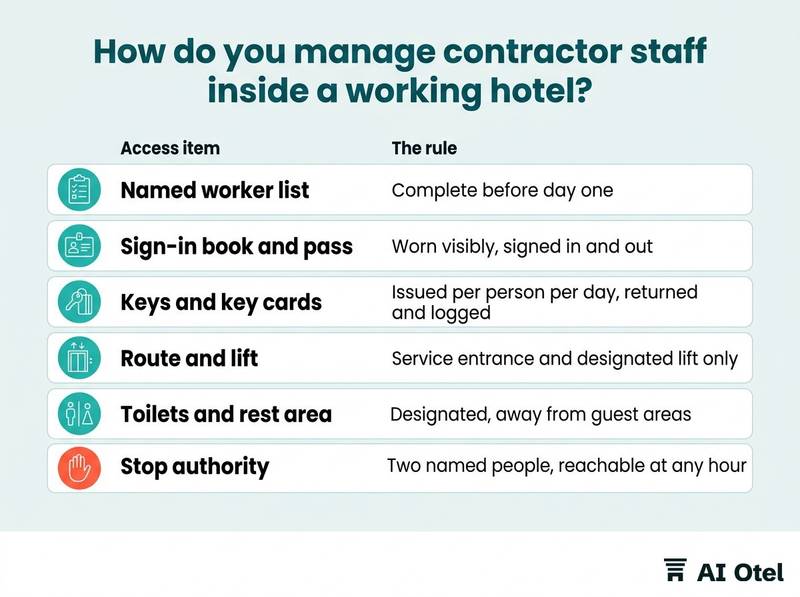
Before the first working day, get a named list: names, company, trade and the supervisor who answers for them. Run one sign-in and sign-out point, with a pass worn visibly; the same book doubles as your evacuation list. Issue keys and key cards per person per day and have them returned at the end of the shift, logged against the name.
Set the routes: in through the service entrance, materials by the service lift or a protected lift, never across the lobby at check-in time. Give contractor staff a designated toilet and rest area away from guest toilets, plus rules on smoking, phones, radios and speaking to guests. Name the stop authority: one hotel name and one contractor name, both reachable at any hour, who can halt the work immediately.
| Access item | The rule | Who checks it |
|---|---|---|
| Named worker list | Complete before day one | Front office manager |
| Sign-in book and pass | Worn visibly, signed in and out | Duty manager |
| Keys and key cards | Issued per person per day, returned and logged | Duty manager |
| Route and lift | Service entrance and designated lift only | Security |
| Toilets and rest area | Designated, away from guest areas | Duty manager |
| Stop authority | Two named people, reachable at any hour | General manager |
What does the daily check look like, and how do you close the job?
One walk at a fixed hour, one line at every shift handover, and a room that returns to sale only after a snagging check rather than on the contractor's word.
The walk follows the same route, at the same hour, by the same person, along the guest path from the entrance to the furthest affected room. The handover line at every shift change covers noise complaints, rooms blocked, rooms released, and the loud task planned for tomorrow. Tomorrow's loud task is today's message: the desk should know by mid-afternoon what will be drilled at 10:00 the next day, so the pre-arrival message and the room allocation match it.
Release to sale in order: snagging check, then housekeeping, then the inventory. Skipping the middle step puts a guest into a room with a missing towel rail. In the last week, schedule the noisiest remaining tasks, the barrier removal and the corridor cleaning before the first sold night on that floor. Close with a written list of what remains, who returns for it, and how the desk handles a guest who finds a fault after the contractor has left. For the room side of that handover, see snagging a renovated room block before the first guest sleeps there.
ChecklistThe daily check
- The guest path walked at the fixed hour
- The barrier intact and the door zipped
- The loud task for tomorrow confirmed and passed to the desk
- Rooms blocked and released today reconciled against the inventory
- Every disturbance call logged
- The handover line read out at the shift change
Write the one-page decision this week
Start with the one-page decision: close, phase or stay fully open, with the phases, the room block, the working hours and the single person who may change them. Everything else in this article follows from that page, because the room block, the contractor's windows, the guest message and the desk's room-move rule are all consequences of the same choice. Write the page this week, before the program is signed, and give a copy to the contractor, the front office manager and the reservations team.
Frequently asked questions
Can you keep selling rooms on a floor where work is going on?
Yes, if the site is sealed off from the guest path and the loud tasks are scheduled outside the hours guests are likely to be in their rooms. The decision is per room and per day: a room beside the barrier is a different product from a room two floors up, and it should be priced and described as such.
Do you have to tell guests that the hotel is being renovated?
This article does not set out a legal duty to disclose the works; it sets out the practice that keeps complaints and room moves low. Whether you must disclose, and in what form, depends on your own contracts and your own case, so confirm it with your legal adviser.
What hours should noisy work be allowed in a hotel that is open?
There is no single rule. Set the windows around the guest day: avoid guest areas before 09:00 and after 19:00, keep the loudest tasks inside a defined midday and afternoon window, and give dusty quiet work a separate slot. Put the clock times in the contractor's program and repeat them in the guest message.
What should the desk do when a guest complains about construction noise?
Apologize once, offer a specific room from the live clean-room list, and move the guest before explaining. Log the room, the time and the action. If the same room complains twice, or a room outside the noise zone complains at all, the duty manager takes it in the same shift.
Should contractor staff use the guest lifts and toilets?
No. Designate a service entrance, one lift or a protected route for materials and people, and a separate toilet and rest area. Issue passes and keys per person per day, keep a sign-in book that also serves as your evacuation list, and name the person who can stop the work.